Pages

Showing posts with label Brazil2014. Show all posts

Saturday, 13 August 2016

Editing the Gymnastics & Archery at the Rio 2016 Olympic Games August 12, 2016


Very much a change of pace today as the Trampoline took centre stage at the Rio Olympic Arena. The pictures take on a rather erie sense of calm as the athletes seem to fall gracefully from the skies only to be propelled up again twisting and turning. Switzerland based photographer Ruben joined Mike to help cover the competition in the gym.


Rana Nakano of Japan competes in the Trampoline Gymnastics Women's Qualification Round of the Rio 2016 Olympic Games in Rio de Janeiro, Brazil.   REUTERS/Mike Blake  

I am very drawn to this almost abstract image and it took me a while to work out why. I think I like its graceful confusion as the eye jumps around the picture with no time to pause while the athlete is timelessly suspended at the peak of their performance. The eye moves from the highlight of the feet against the black background and red of the leotard, then simultaneously out right and up and left and down to the hands that both seem to float in space, severed from the body.  The position of the hands then beckon you back into the image towards the Olympics Rings, soft in tone and focus, in contrast to the black, white and red.  The image then comes together to make sense just before the athletes twists and falls.

Ruben's picture is wonderful in its timing and design. Athlete Nicole perfectly horizontal as she falls past the Rio 2016 logo.  The judge to the far right has his head tilted slightly left to mirror the judge on the left forming a visual bracket bringing your eye into the centre of this letter box shaped picture.


Nicole Ahsinger of the USA competes in the Trampoline Gymnastics Women's Qualification Round of the Rio 2016 Olympic Games in Rio De Janeiro, Brazil.  REUTERS/Ruben Sprich

Later in the day I also edited Lucy's pictures who was shooting the heats of the 1500m, 400m and 100m at the Track and Field. No finals tonight, so relaxed and fun, the detail of the Olympic Rings earring catching my eye in the mass of flowing hair.


Rosangela Santos of Brazil wears Olympic ring earrings as she competes in the Rio 2016 Olympic Games Women's Preliminary 100m Round 1 at the Olympic Stadium, Rio de Janeiro, Brazil.      REUTERS/Lucy Nicholson 

To see more pictures from the day's action at the Rio 2016 Olympics click here

Monday, 7 July 2014

On the Sidelines of the Brazil 2014 World Cup

As national soccer teams and the photographers who have been covering them start to trickle home from the Brazil World Cup, it’s time to revisit the “On the Sidelines” project.
This Reuters Pictures project was billed as a chance for photographers to share “their own quirky and creative view of the World Cup”. I thought that I’d examine what has been achieved


As a way of introducing the project, let me use a comparison. I’m intrigued by the notion that an animal that has been caged, but is well fed and well treated, will not exchange freedom from its pen for the uncertainty that this freedom might bring.

Likewise, working as a photographer at the World Cup comes with a kind of cage of security. You know what you are going to do, what time you are going to do it, and what is expected of you. You need to capture pictures of great sporting action, goals, celebrations, red cards and, of course, every important incident, be it Suarez’s teeth marks or the collision that led to Neymar’s broken vertebra.


For editors too, life can fall into a regular pattern. First, arrive at the office two hours before the start of the game and make sure all the technology works, and that tests have been received from the photographers.

Then, with three other colleagues, look at between 12,000 and 20,000 frames per game, select the right pictures and make sure the captions and image quality are good (all while trying to block out the sound of drilling from builders in the next room… See video below).


As the game finishes and the last end-of-match celebration and dejection pictures are being picked through, the photographers from the next game are already starting to send in tests for their match.

Eleven hours after arriving in the office, the World Cup editing team here in Miami leaves and tries to find something (healthy, of course…) to eat. And hopefully there is no polite but disgruntled call from a photographer claiming you missed their best picture…

Here is my screen after the Netherlands v. Costa Rica quarterfinal match.


It’s not at all easy to cover the World Cup. Photographers face all sorts of struggles: travelling for hours to get to the ground, avoiding being robbed, dealing with technical issues, setting up and shooting in the rain, not to mention getting the best picture. All of this can make you feel like you are trapped in a cage when it comes to being creative with your photography.

The “On the Sidelines” project was intended as an outlet from this hard work – an opportunity to enjoy the freedom to shoot additional creative and unexpected photographs, just for fun’s sake.


The guidelines for the project were simple. You could photograph anything that you liked, with any camera or even phone that you liked, and use any caption you wanted as long as it had the correct date and location and didn’t offend.

The photographers were not to use filters (who needs amateur filters when you can compose and expose professionally anyway?) and, of course, they had to follow all of our professional ethical guidelines.

We added the following sentence to the caption of each picture so that some of the stranger shots would be put into context: “In a project called “On The Sidelines” Reuters photographers share pictures showing their own quirky and creative view of the 2014 World Cup in Brazil”.


And which photographers took part? Every one of them.

What amazed me most was the energy and sense of fun that came through in the hundreds of pictures produced by photographers who were tired, hungry, and sometimes wet and grumpy, but never bored.

After a hard day in the cage, it was time for some freedom.

Having edited thousands of pictures from the matches, I also enjoyed looking at and processing “On the Sidelines” images when they were filed. They can all been seen here.

As we prepare for the final four matches of the World Cup, we are sending our mainstream clients an edited picture package, showing a selection of some of the hundreds of images produced as part of “On the Sidelines”.

We hope that our media clients and their readers will enjoy this second package of new material as much as they enjoyed a previous set of Sidelines pictures that we sent out.

So, what has been achieved by the “On the Sidelines” project?  Our professional photographers have had a lot of fun producing yet another set of amazing pictures, all of which are in the archive to show “their own quirky and creative view of the 2014 World Cup in Brazil.”

It’s a great record for them to look back on, in addition to the thrills and spills of the soccer action.

Now, bring on the final.


Suarez - Did he bite?

The shout went up “He’s bitten him! Suarez has just bitten him!” 

It was the World Cup match between Uruguay and Italy, and both teams were playing for a place in the last 16. 

The game was tense, with pictures streaming in from the match in Brazil to the remote picture-editing centre we have set up in Miami. 

A television replay and it looked pretty certain that Uruguay’s Luis Suarez had bitten Italy’s Giorgio Chiellini on the shoulder in an off-the-ball incident. But you can never tell 100 percent when looking at TV. 

Chiellini was in no doubt though. He tried to show the referee tooth marks on his shoulder by pulling down his shirt.

We waited for the pictures to drop. Photographers Tony Gentile and Toru Hanai were sitting at the right end of the pitch. Tony was on the right side to get the picture

The pictures dropped in quickly, in sequence. Suarez on the ground holding his mouth. Chiellini holding his shoulder. 

Finally, we get the pictures of Chiellini pulling down his shirt to reveal marks on his shoulder. There are only 6 pictures, with one key frame below. 


At this stage we are unable to confirm what happened. We move the picture cropped wide to demonstrate what we do know - Chiellini is trying to show his shoulder to the referee.


We then look closely at the picture – you can clearly see marks, but are they teeth marks? We cannot confirm it. All we can do is show Chiellini’s shoulder and let the story take its own course. 

A tighter crop shows Chiellini’s face and his shoulder. Mindful of clients’ needs we crop the same picture into an upright shape. 


Lastly, we take some time and look at just how far we can crop the image to show the marks. Too close and the image quality breaks up. Too loose and we add nothing more to the images we have already sent. 

A final decision is made. We crop the picture, keeping in the fingers pulling down the shirt to draw the eye up and reveal the marks on Chiellini. His face is cropped out entirely, so no extra details detract from the picture. 


TV pundits and voices on social media were already calling for Suarez to be banned and punished. 

We had moved the pictures out. Uruguay score a goal and more pictures came streaming in. The game had moved on, but we all knew what the talking point was going to be and what picture was going to be used. 

Was it a bite? We have to wait for the FIFA ruling, but Tony Gentile’s photography offers a pretty clear picture.


Tuesday, 10 June 2014

Imagine the world viewed through the single constant of a goalpost

Sometimes the best ideas are also the simplest ones, especially when you have the support of the world’s biggest news agency behind you. 


Children play soccer on a playing field in Kirtipur, Kathmandu May 31, 2014. The 2014 Brazil World Cup opens on June 12 and fans around the globe are gearing up for the big tournament. REUTERS/Navesh Chitrakar

Inspired by the energy generated by a Wider Image workshop with our photographers in South America, I wanted to work on a global story about the Brazil 2014 World Cup. So many superlatives are used to describe it: the world’s greatest show, the most watched tournament, the biggest sporting event.


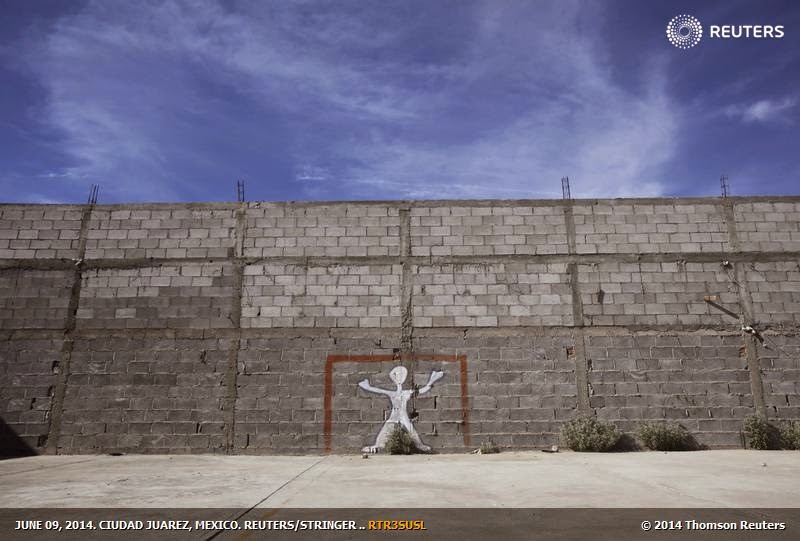
A goalpost is painted on a wall at a house used as a creche in Ciudad Juarez June 3, 2014. The 2014 Brazil World Cup opens on June 12 and fans around the globe are gearing up for the big tournament. But soccer lovers are not only preparing to watch the world's best professional players battle it out on the pitch; they are also out there kicking a ball about themselves. REUTERS/Jose Luis Gonzalez

I needed a big idea that could demonstrate the worldwide reach of football (or soccer, for our U.S readers) and I wanted to include our global team of busy photographers. For them to find the time to get involved, the idea had to be simple. 

I once heard that the rules of football are among the most universally recognised codes in the world.  They transcend divides of creed, culture, education, geography and wealth. Off-side is off-side no matter who you are, or what your nationality. And what is football actually about? It’s about goals.
And what is a goal? That moment of ecstatic joy, crushing defeat, a game won, lost or drawn (unless it’s a dull 0-0). Lucky, unlucky, frequently contentious, always an event. Maybe it should have been a goal and was disallowed, maybe it shouldn’t have been but was counted anyway. Goals can signify millions of dollars won or lost or invested in the business of football. They can mean winning or losing a bet. 


A makeshift soccer goalpost stands near Molweni, west of Durban June 5, 2014. The 2014 Brazil World Cup opens on June 12 and fans around the globe are gearing up for the big tournament. But soccer lovers are not only preparing to watch the world's best professional players battle it out on the pitch; they are also out there kicking a ball about themselves. Reuters photographers on every continent, in countries from China to the Czech Republic, went out to capture images of soccer goalposts used by players to practise the 'beautiful game'. REUTERS/Rogan Ward

And what is an actual physical goal? FIFA’s rules are strict, but simple: “The distance between the posts is 7.32 m (8 yds) and the distance from the lower edge of the crossbar to the ground is 2.44 m (8 ft)… Both goalposts and the crossbar have the same width and depth, which do not exceed 12 cm (5 ins).”

I read this, and an idea came to me. Imagine the world viewed through the single constant of a goalpost: the green grass and cloudy skies of Manchester, the dusk in Karachi, a cityscape in Boston, Kathmandu and Tokyo. I checked with a colleague to see  that this was not a daft idea. He loved it.

I knew that to get what I was looking for I needed to apply some structure. Experience has told me that photographers, on the whole rightly so, tend to follow their own ideas better than they follow those of others (no disrespect team, but it is as it is). 


I set some guidelines: a 24mm lens should be used, the pictures should be shot from the distance of the penalty spot (FIFA rules) and the camera should be at a height of 2 ft, from behind or in front, whatever looked better. My “goal” was to ensure that the position of the goalposts in the picture frame was a constant. I even shot a picture myself to explain what I wanted. What guide could be simpler to stick to?


Some followed the instructions to the letter, a few ignored some of them, and an elite handful completely made up their own rules. I love the result! I hope you do too. Click here to see the pictures