Pages

Showing posts with label Yemen. Show all posts

Friday, 31 July 2020

A Week in Pictures, Middle East and Africa, July 31, 2020

If someone has 160 suits, 200 pairs of shoes and 300 hats more is more. Thomas Mukoya asked his subject to dress up in different suits and photographed him with the same backdrop, these then presented as a combination picture. The more we can see the better – enjoy the story here.

A combination picture shows Kenyan fashionista James Maina Mwangi posing as he displays his attire comprising at least 160 suits with matching accessories including a mask to prevent the coronavirus disease (COVID-19) infection at his residence in Nairobi, Kenya July 30, 2020. REUTERS/Thomas Mukoya

What you mainly get a sense from in Mohamed al-Sayaghi’s picture is the weight of the sheep being carried away. It’s probably wriggling about quite a bit, making it even harder to carry. The image has been shot quite wide so you get a real feeling of the bustle of the ancient business of goat-selling, with straw, and mud all mingled in with the modern trappings of cars, a modern building with reflective glass and advertising hoardings as people prepare for the festival. 

A man carries a sheep at a livestock market ahead of the Eid al-Adha festival amid the coronavirus disease (COVID-19) pandemic in Sanaa, Yemen July 28, 2020. REUTERS/Mohamed al-Sayaghi

In Ronen Zvulun’s picture your attention is immediately grabbed by the graphic shape of the hand contrasting with the the red and the Israeli flag. It takes more than a little while before you can visually get around this bold and loud shape to see the water cannon spray thundering into the crouching protesters, who protect themselves with small shields. Read on here.
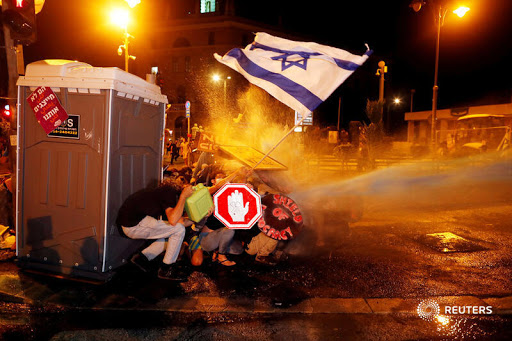

Police use water cannon during a protest against Israeli Prime Minister Benjamin Netanyahu's alleged corruption and his government's handling of the coronavirus disease (COVID-19) crisis, near his residence in Jerusalem July 26, 2020. REUTERS/Ronen Zvulun

Makeshift roofing, rubbish in the street and drying clothing hanging over rough brick walls crisscross through Khaled Abdullah’s picture and dwarf the two figures. This feeling of enormity echoes the seemingly insurmountable problem of poverty and poor housing. Everything crushes down heavily in the heat and squalor: the old tyres, the large bricks, the makeshift weights to keep the flimsy roofs from blowing away.

Boys play at a slum area for the Muhamasheen (marginalized) community in Sanaa, Yemen July 26, 2020. REUTERS/Khaled Abdullah

Although this is a straightforward before and after image using Ahmed Jadallah’s file picture dated 2016,  the power of comparison to demonstrate the impact of  COVID-19 and social distancing is striking. Read on here.

A combination picture shows Muslim pilgrims circling the Kaaba at the Grand mosque during the annual Haj pilgrimage September 8, 2016, and after the coronavirus disease (COVID-19) outbreak July 29, 2020, in Mecca, Saudi Arabia. Pictures taken September 8, 2016 and July 29, 2020. REUTERS/Ahmed Jadallah (top)/ Saudi Ministry of Media/Handout via REUTERS

What a wonderful feature picture by Zohra Bensemra who teases us with “photography pure” elements of the moment caught, tones, shape and colour. Take the time to get past the almost abstract shapes and tones of solid blacks that fill the foreground. We are given just enough highlight detail of the boy’s face in the centre, but nothing is given away in the figure on the left or the dark space on the ground, we just have to figure it out ourselves. To counter these shadows we are treated to the full orange colour in bright sunlight of the boy playing, legs at full stride, head held high, a moment caught. I even like the roof of the building that just kisses the edge of the frame against the blue sky.  

Children are seen at the fishermen port ahead of the Muslim festival of sacrifice Eid al-Adha, amid the coronavirus disease (COVID-19) outbreak, in Dakar, Senegal July 30,2020. REUTERS/Zohra Bensemra

The dawn light bursts over a herd of goats being sold off for slaughter in Thomas Mukoya’s picture. The image is well composed so the animals’ bodies fan out from the centre highlight of the sun, like rays of warmth reaching out to the chill in the foreground. Dotted amongst them are herders and customers alike drawing us deeper into the picture as the goods are inspected and haggled over.    

Muslim faithful buy goats at a livestock market during celebrations marking the Muslim holiday of Eid al-Adha amid the spread of the coronavirus disease (COVID-19) in Nairobi, Kenya July 31, 2020. REUTERS/Thomas Mukoya

I can’t hide my pleasure over a great detail picture that focuses on a small element of a scene that tells a bigger story, and this enjoyment is doubled when it’s an element from a hard to illustrate economic story. Afolabi Sotunde has captured a money dealer flicking through naira notes that are as tired and worn as the trader’s fingers. The story is that the economy is struggling as businesses struggle to find U.S. dollars to buy the materials they need to continue trading. The oil price, Nigeria’s main export to secure dollars, is depressed by the impact of COVID-19.  Read on here.

A man carries Nigerian naira banknotes at a livestock market in Abuja, Nigeria July 29, 2020. REUTERS/Afolabi Sotunde


Friday, 3 July 2020

A Week in Pictures, Middle East and Africa, July 3, 2020

Mohamed Torokman’s picture is just crammed full of action and so perfectly timed that I don’t think it can be any better. The background is solid with black smoke, the soldiers rifle barrel glints against it as flames roar with reds, oranges and yellows. We are given enough highlight detail of the soldier at the height of his jump, so he stands out from the heavy smoke. The dust trailing from his back foot gives us a clue to the speed at which he is running. Read on here. 

An Israeli border police member jumps during a Palestinian protest against Israel's plan to annex parts of the Israeli-occupied West Bank, in Kafr Qaddum near Nablus July 3, 2020. REUTERS/Mohamad Torokman 

The light of the motorcycle beams through what at first appears as to be heavy rain being displaced by the speeding bike in Baz Ratner’s terrific picture. But what we see against the shadows and dark tones of the bush are in fact thousands of locusts being scattered from the road. The hills in the background give us a sense of the size of the locust swarms that are devastating the pastoral lands of Turkana.  Video explaining the issue here.

A motorcycle rider tries to protect his eyes as he drives through a swarm of desert locusts at the village of Lorengippi near the town of Lodwar, Turkana county, Kenya, July 2, 2020. REUTERS/Baz Ratner

I can’t help feeling a little sad as I look at Alaa Al-Marjani’s picture although I know maybe I am possibly misinterpreting the body language. Even though the man at the window wants to get in closer to his relative, the only thing stopping him is the glass but the patient is keeping away, he is sitting on the edge of the bed, his body turned away. Alaa has used the space between these men and the red blanket to drive home a real sense of uneasy distance. 

An Iraqi man infected with the coronavirus disease (COVID-19) talks with his relative through a quarantine window at Al-Hakim Hospital in the holy city of Najaf, Iraq June 16, 2020. Picture taken June 16, 2020. REUTERS/Alaa Al-Marjani 

There is such a feel-good factor in Mohamed Abd El Ghany picture it makes you want to go straight away to Egypt and pay over the odds to ride on this camel. A big smile, bright colours, blue sky and mirrored glasses to welcome tourists as the guide struggles to keep control of the camel. Its almost reptilian in appearance head and neck breaks the skyline filling the space in the sky left by the pyramid, the restraining chain continuing the line of the compositional triangle. 

A man with a camel is seen in front of the Great Pyramids of Giza after reopening for tourist visits, following the outbreak of the coronavirus disease (COVID-19), in Cairo, Egypt July 1, 2020. REUTERS/Mohamed Abd El Ghany

Dust, heat, tension and potential chaos all crammed into one frame by Mohamed Nureldin Abdallah. The picture seems to go from icy blue of the soldiers to the dusty yellow/orange heat of the protesters in the background. I love the small details of the outstretched fingers  reaching into the murk. 

Riot police officers hold position against protesters near the Parliament buildings, as members of Sudanese pro-democracy protest on the anniversary of a major anti-military protest, while groups loyal to toppled leader Omar al-Bashir plan rival demonstrations, in Omdurman, Khartoum, Sudan June 30, 2020. REUTERS/Mohamed Nureldin Abdallah 

What a beautifully composed picture by Njeri Mwangi as the red gloved action takes places against a backdrop of lines, shapes and shadows that cut across the frame like giant brushstrokes as a cubist painter sets out their canvass. What I especially like is how the edge of the shadow cuts down dra you eye to the highlight of the boxer’s face. 

A child hits a punching bag as she attends a boxing training session at the Mathare North Boxing Club, after the government ordered closure of all schools due to the coronavirus disease (COVID-19) outbreak, in Nairobi Kenya June 17, 2020. Picture taken June 17, 2020. REUTERS/Njeri Mwangi

The lifted arms of the solitary figure in Khaled Abdullah picture says it all ‘Oh no what now?’ We are left in no doubt that his livelihood is destroyed as he walks on the smoldering rubble. The bright orange shirt, really the only colour in the frame, and his position at the bottom of the wide compositional V of the twisted metal snaps our attention straight to his despair.      

A worker reacts as he stands on the wreckage of a vehicle oil and tires store hit by Saudi-led air strikes in Sanaa, Yemen July 2, 2020. REUTERS/Khaled Abdullah 

To make a cleaner image one might be tempted to crop out the car in the rear of Mussa Qawasma’s picture to highlight even more the joy of the boy’s face as he plays in the smoke; but try it with your thumb. Suddenly something is lost. I think what makes this such fun is the fact that this strange opportunist game is taking place in the street and it’s the context of the ordinary that highlights the joy. 

A Palestinian boy plays as disinfectants are sprayed by workers to sanitize cars and shops amid the coronavirus disease (COVID-19) outbreak in Hebron in the Israeli-occupied West Bank June 28, 2020. REUTERS/Mussa Qawasma


Sunday, 29 September 2019

A Week in Pictures, Middle East and Africa, September 27, 2019

It’s rare that a set piece, pool position picture makes an image that will catch my eye.  Normally these staged and heavily controlled events make for cold and functional images that are “for the record”. Not so Toby Melville’s image from South Africa. What attracts me most is the obvious warmth in this picture and as I try to figure out why I get this feeling, my conclusion is the eye contact. Both figures are leaning into each other, intent on listening. Baby Archie is focused on Tutu’s eyes too. The curve of the shoulder line, Meghan’s arms and Tutu’s pocket handkerchief complete a compositional oval that keeps our attention in the centre of the image, with that warm eye contact. You can see more from the tour here.  

Britain’s Meghan, Duchess of Sussex, holding her son Archie, meets Archbishop Desmond Tutu at the Desmond and Leah Tutu Legacy Foundation in Cape Town, in South Africa, September 25, 2019.   REUTERS/Toby Melville

Mohamed Torokman’s picture is black, almost completely abstract and full of menace. Your eyes skip around looking to make sense of what is going on and, after being drawn into the far distance by the light, you are brought sharply back to the hard, curved line of the tyre. It’s then you see the masked face of the protester, your initial sense of tension confirmed. But as you begin to work out what the protester is doing, moving tyres to be burned, you also get a growing feeling of determined calm from him.  

A demonstrator carries tyres to be set on fire during a protest to show solidarity with Palestinian prisoners held in Israeli jails, near the Jewish settlement of Beit El in the Israeli occupied West bank September 23, 2019.   REUTERS/Mohamad Torokman

Tonally and visually, Mohammed Salem’s picture is very similar to the image above, but the main difference is that your eyes jump immediately to the focal point, the face. And the moment you look at the face, you can’t look elsewhere. The lines of the shadows are intriguing as they cross the man’s face, you focus into the tiny juncture of the corner of his eye as he looks out of the frame and the line of shadow. It looks all very mysterious until you read the caption: he’s doing his laundry!

A Palestinian man sits in his home as laundry hangs to dry in Dier al-balah refugee camp in central Gaza strip September 22, 2019.   RUTERS/Mohammed Salem

A news feature picture by Khaled Abdullah improved, I think, by the little crop to remove the figure on the right who is wearing a high visibility jacket. I hope you agree the crop improves this image by letting your eye be drawn to the dancers’ faces and away from the yellow jacket. Have a look at both the cropped and uncropped versions and see what you think. 

Houthi supporters perform the traditional Baraa dance during a ceremony held to collect supplies for Houthi fighters in Sanaa, Yemen, September 22, 2019.    REUTERS/Khaled Abdullah

Houthi supporters perform the traditional Baraa dance during a ceremony held to collect supplies for Houthi fighters in Sanaa, Yemen, September 22, 2019.    REUTERS/Khaled Abdullah

Philimon Bulawayo’s picture is powerful with its simple circular composition shot from above. The ring of the white bucket top echoes the circle of the black well. I like it too that the circle of the grass has been cropped off at the bottom of the picture, the rings giving feeling of ripples on a pond reaching the edge of the water. The woman looks exhausted as she struggles to collect water. 
  
A woman fetches water from a well in Warren Park suburb, Harare, Zimbabwe, September 24, 2019.   REUTERS/Philimon Bulawayo

Mohamed Nureldin’s image is busy and deep, it’s full of action and colour and you are kept busy picking up all the details. The cool of the glass and metal buildings contrasts with the warmth of the colours of the crowd. The harsh light ensures you can never quite make out what is going on, who is holding what flag, which hand belongs to whom and what the people in the background are standing on, but you come away with an overall feeling of peaceful protest.

Protesters attend a rally calling for a stop to killing in Darfur and stability for peace, next to a building in front of the ministry of Justice in Khartoum, Sudan, September 23, 2019.   REUTERS/Mohamed Nureldin  

Giant hands envelop a tiny creature, but this image really works for one reason only, the mouth of the turtle is open. If you didn’t get the visual clue of an animal’s head it would be hard to see what is going on, and it would not make any sense. Amir Cohen’s sophisticated use of a very small depth of field ensures that we don’t miss that all important detail. If the mouth was shut and everything was in focus it would look like a grey/black blob being held. You can read on here.

A child holds a newly-hatched baby sea turtle born at a protective nesting site set-up as part of the Israeli Seat Turtle Rescue Centre conservation programme, at a beach near Mikhmoret north of Tel Aviv, Israel September 9, 2019.   REUTERS/Amir Cohen

Eissa Alragehi’s picture is a pleasant, well composed and well-lit portrait of a fresh-faced boy sitting in temporary camp for the displaced. How long does it take you to notice that the boy is missing a leg? When you do notice it comes as shock, and what was a moment ago pleasant is now distressing. Read on here.

Ismail Abdullah, 12, who lost his leg in an air strike two years ago, poses for a picture in his hut in a camp for the internally displaced people in Khamis of Hodeidah province, Yemen August 31, 2019.   REUTERS/Eissa Alragehi


Friday, 6 September 2019

A Week in Pictures, Middle East and Africa, September 6, 2019.


A lucky accident for Siphiwe Sibeko, as I can’t imagine for a minute that this hand creeping into the frame was planned. The playful game with scale and perspective grabs you, giving the impression that a giant hand is reaching out to grab unsuspecting locals on their way home from a hard day at work.

A hand of a local is seen as people returning from work walk along the beach, with the city skyline in the background ahead of pope Francis’ visit to Maputo, Mozambique, September 2, 2019.    REUTERS/Siphiwe Sibeko


Leading you from the foreground to the destroyed building in the rear of Mohamed al-Sayaghi’s picture is a medic, walking with his head bowed along a line of covered bodies. The shape of the clouds seems to burst back over the building like an echo of the blast that destroyed it. Mohamed has many other far more brutal images of dead bodies half covered and crushed in the rubble but none as poignant as this one.

A Red Crescent medic walks next to bags containing the bodies of victims of Saudi-led airstrikes on a Houthi detention centre in Dhamar, Yemen, September 1, 2019.    REUTERS/Mohamed as-Sayaghi

Two things strike me as I look at Ali Owidha’s picture of the funeral in Yemen. The first is the symmetrical shape to it, the coffin bearers centered between the two lines of soldiers forming the guard of honour, only the lack of synchronization of the marching soldiers breaking the momentary mirror illusion. And the second, the position Ali must be in to take this picture. Take a moment to think what it takes to get yourself at this low angle, to take the picture and then leave without getting in the way (remember this is a military funeral) or being trampled on.     

Honour guards carry the coffin of a Yemeni army officer killed in the southern province of Abyan in clashes with UAE-backed southern separatist forces, in Marib, Yemen, August 31, 2019.   REUTERS/Ali Owidha

Visually the World Economic Forum in Africa would not be on the top of your list for potential good news photography but Sumaya Hisham has worked hard to get herself into a position to shoot an intriguing image of a politician sitting in a chair. No matter how hard I look at it I can’t quite work out what is going on in the chaos of the right side of the image, or how the refection works. Normally too, showing eyes closed would kill an image as it gives the unfair impression that the politician is asleep, which they are not. In this case the closed eyes create a sense of considered calm around a swirl of visual chaos. 

Zimbabwean President Emmerson Mnangagwa speaks during a session of the World Economic Forum on Africa in Cape Town, South Africa, September 4, 2019.   REUTERS/Sumaya Hisham


At first glance Aziz Taher’s picture looks two dimensional, almost abstract and quite painterly. Then the vehicle in the foreground snaps into focus and wow! you get the sense of scale.    

A view of burnt areas from Israeli shelling is seen in Maroun Al-Raz village, near the border with Israel, in southern Lebanon, September 2, 2019.    REUTERS/Aziz Taher

A stark line cuts through the landscape in Baz Ratner’s drone picture of deforestation in Madagascar. The curve of the road seems to sweep around to envelop the living trees, as though it’s leading the slow and unstoppable march of dead and burned tress to consume all that is living. Very sad. You can see the full story here.

Burnt trees are seen in Menabe Antimena protected area near the city of Morondava, Madagascar, September 1, 2019.   REUTERS/Baz Ratner 


The xenophobic attacks in both South Africa and Nigeria are quite disturbing but I am really drawn to Siphiwe Sibeko’s well observed image of people making the most of a bad situation. The burned-out vehicle is being taken for scrap, like hunters taking home their kill. Bad for the vehicle owner but good for the surprise windfall of scrap metal for these dealers. A detail I really like is the backward glance of the man pulling the truck, his blue cap matching the colour of the roof and sign in the background.  

Scrap metal collectors transport a shell of a burnt-out car after Xenophobic attacks that took place earlier this week in Johannesburg, South Africa, September 5, 2019.   REUTERS/Siphiwe Sibeko

Mike Hutchings picture may have been taken in 2008 but it’s a fitting obit picture to mark the death of former Zimbabwe president Robert Mugabe. Love him or hate him, Mugabe was a powerful leader with global impact and Mike’s picture exudes that strength through the use of deep shadows and exposing for the highlights. It never ceases to amaze me what image defines a person’s life be they world famous or just known to family and friends. Everyone has an image of a person who has died in their mind’s eye. You can see the full obituary package here.   

Zimbabwean President Robert Mugabe watches a video presentation during the summit of the Southern African Development Community (SADC) in Johannesburg, August 2017, 2008.   REUTERS/Mike Hutchings

One does not associate Mozambique with cold damp weather but travelling photographer Yara Nadi has captured Pope Francis hunched up against the inclement conditions. What she has also captured is the warmth and energy of the people crowded in the background trying to get a glimpse of the pontiff. Look at each face - although they are bundled up against the weather - there is no mistaking that everyone is smiling. I would so love the blue W on the bottom right of the image to not be there - a distraction that you need to wrestle with – but the world is not perfect so I will have to live with it.  You can see more from the Pope’s visit to Mozambique here

Pope Francis arrives for holy Mass on a rainy day at Zimpeto stadium in Maputo, Mozambique, September 6, 2019.   REUTERS/Yara Nardi