Pages

Showing posts with label Zimbabwe. Show all posts

Friday, 10 July 2020

A Week in Pictures, Middle East and Africa, July 10, 2020

A brutal and sad picture by Thalefang Charles. The elephant appears to reach out to the viewer with its trunk at the moment of its death in a barren landscape. There is no escaping the black hollow of the animal’s eye or the gaping hole where a tusk would have once been as we are led along the line of the trunk and the animal’s back to the tiny figure of a vet in the background.  Read on here 

Dr Wave Kashweeka, Principal Veterinary Officer stands over the carcass of an elephant found near Seronga, in the Okavango Delta, Botswana, July 9, 2020. REUTERS/Thalefang Charles

At first glance we are not sure if the screen on the left is a TV or a mirror. Ari Jalal has used the mirror hanging in the temporary accommodation to enable us to both look in and out of this room at the same time.  We get a sense of people being busy, the hurried tension of a small space, change happening. I love the body language of the young man in the doorway, as though he is saying “come on, get a move on”, but can’t out of respect to the others he shouldn’t really rush.  Read on here.

Yazidi displaced family of Nayef al-Hamo is reflected in the mirror as they prepare to leave their home in Sharya town and head back to Sinjar following the outbreak of the coronavirus disease (COVID-19) and economic crisis, near Dohuk, Iraq July 3, 2020. REUTERS/Ari Jalal

A wide and slightly compositionally chaotic picture from Philimon Bulawayo as the eye chases around looking for a focal point. It’s rather visually uncomfortable with figures running out of the frame left and right and the line of trees and sky cutting mercilessly across the frame into the head of the central figure, who seems to be coming up for air. But it’s what written on the sign that comes as bit of a shock and is uncomfortable reading.  
Health workers carry placards as they protest against economic hardship and poor working conditions during the coronavirus disease (COVID-19) outbreak in Harare, Zimbabwe, July 6, 2020. REUTERS/Philimon Bulawayo 

Two terrific pictures by two photographers working on one story about the convergence of the Nile. In the first by Zohra Bensemra we are immediately intrigued by the brown swirling mass “penned” in by trees left and right, a centrally placed figure making us wonder what is going on. I love the detail of his shoes on the right-hand side of the frame and the dappled light coming through the rough and ready roofing as we slowly begin to understand he is squashing mud with his feet. Read on here.

David Plantino, 35, a pottery maker from South Sudan, kneads mud with his feet, that will be used to make pottery at a workshop in an area known as the 'Potters Village' in Alqamayir, Omdurman, Sudan February 16, 2020. "I have been a pottery maker for 7 years, I relied on the Nile river like most people around me here for water and the mud", Plantino said. "Both are the foundation for people who rely on pottery to make a living." REUTERS/Zohra Bensemra

Mohamed Nureldin Abdallah entertains us with a beautiful abstract curve through his picture leaving us unsure of a sense of scale. We are initially confused by the flat grey shape that has a mirror-like quality and then the abandoned chairs snap into focus. We are looking at the waters edge of the Nile.       

Chairs are left facing the banks of the Blue Nile river in Khartoum, Sudan, February 15, 2020. REUTERS/Mohamed Nureldin Abdallah 

Just how much do you want to swim in that pool? Ahmed Jadallah’s picture is pleasing on so many levels: the colours, the shapes, the teasing shadows of the trees and the tantalising ripples on the water and that small figure, arms stretched out luxuriating in the warm water.  Dive in and have some fun, I wish. 

People swim at a swimming pool in the Atlantis The Palm hotel, as the Emirates reopen to tourism amid coronavirus disease (COVID-19), in Dubai, United Arab Emirates July 7, 2020. REUTERS/Ahmed Jadallah

Anees Mahyoub’s picture is striking as the graves are so deep, dark and so close together. What is to stop the walls of sand and mud falling in the diggers? But it’s the small details next to the sad and ugly gaping holes that gives this image its strength: like the pickaxe between the graves and the feet of the bystander. Read on here.

People dig graves at a cemetery where victims of the coronavirus disease (COVID-19) are buried in Taiz, Yemen June 23, 2020. Picture taken June 23, 2020. REUTERS/Anees Mahyoub 

A very busy but at the same time simple half-length environmental portrait by Muhammad Hamed works so well that you just want to meet this doctor. The direct eye contact draws you straight into his gentle, concerned but reassuring face past all the visual noise, his clean white jacket helping you make that journey. Once you have looked him in the eye then you can enjoy the rest of the room. I love the echo of his fingers in the brochure dispenser on the left of the image 

Jordanian doctor Nizar al Halaby poses at his clinic in Amman, Jordan, July 5, 2020. Picture taken July 5, 2020. REUTERS/Muhammad Hamed

I think Yamam al-Shaar has captured a moment of work that seems like it will never end. A single figure, masked against coronavirus set against a wall of boxes.  Not an inch of respite for her amid the boxes that completely fill the frame and bear down on her. 
A worker wearing a face mask holds an ice cream box inside an ice cream factory in Damascus, Syria July 2, 2020. Picture taken July 2, 2020. REUTERS/Yamam Al Shaar 

Is this bride dancing in Amir Cohen’s picture dancing? Why is she letting her beautiful wedding dress get dirty? Why on earth would she want to be photographed in an area that looks like an industrial estate? All these questions raised by a beautifully composed and side lit picture enables the viewer to make up their own story for this strong and affectionate standalone image of happiness.  
A bride walks on the shore of the Mediterranean Sea as she is photographed before her wedding amid the spread of the coronavirus disease (COVID-19), in Ashdod, Israel July 6, 2020. REUTERS/Amir Cohen

I feel in Thomas Mukoya’s picture as if this train is bearing down on me. I am the proverbial rabbit in the headlights as others scatter left and right away from its path. An effect created by careful exposure to allow the highlight of the train’s light to burn out. A quick look at the track and you see the kink in the line so we know it’s not travelling all that fast, time enough for me to scuttle away too.  

A commuter train arrives at a makeshift station, amid the spread of the coronavirus disease (COVID-19), at the Kibera slums, in Nairobi, Kenya July 6, 2020. REUTERS/Thomas Mukoya

In Mohamed Azakir’s wonderfully lit picture a yellow cushion seems to come to life with a facial expression that sums up the whole situation. It’s only then we notice the central figure in the gloom, and the candle light is neither kind or romantic but a necessity as powers cuts mean no electricity. Read on here.

Badiaa, 75, lights a candle and a portable light to light up the room due to a power cut in Beirut, Lebanon July 6, 2020. Picture taken July 6, 2020. REUTERS/Mohamed Azakir 


Friday, 7 February 2020

A Week in Pictures, Middle East and Africa, February 7, 2020

Alaa al-Marjani has shot a picture that intrigues, with contradictions that unsettle what you’d naturally feel. Leaning back and looking relaxed as you are surrounded by flames is not the natural order, especially at a demonstration. The picture has been cleverly shot to give a realistic perspective of what is going on, the flaming tyres are either side of the protester. Had it been cropped to remove his legs and the background the image would have a completely different feel.  

An Iraqi demonstrator sits amid burning tires blocking a road during ongoing anti-government protests in Najaf, Iraq February 2, 2020.   REUTERS/Alaa al-Marjani

Prior to the game, videos of a fan threatening violence with weapons including, knives, blades, a hammer and a chisel circulated on social media, so it was no surprise when trouble erupted. Mohamed Nureldin Abdallah’s picture wonderfully depicts the scene of chaos as police surround players and the referee to protect them from attacks. I like the contrast between the players body language, which is quite relaxed while the tension in the faces of the police is obvious.

Sudanese riot police control soccer fans during a match between Sudanese team Al Hilal against Egypt’s Al Ahly in Group C of the African Champions League at the Al-Jawhara Stadium in Khartoum, Sudan February 1, 2020.   REUTERS/Mohamed Nureldin Abdallah 

With people crushed, squeezed and cramped from foreground to horizon, you feel the claustrophobia in Shorky Hussien’s picture illustrating the fact that Egypt’s population will hit 100 million in the next few days. What takes a little while to notice is that you can’t see a single man anywhere in the frame, and that is because it’s a women-only carriage. Read on here

Passengers board a train at the underground Al Shohadaa ‘Martyrs’ metro station in Cairo Egypt, January 29, 2020.   REUTERS/Shorky Hussien 

You can almost hear the echo of the steps of a mother and child in Philimon Bulawayo’s picture from inside a hospital. Although it looks quite a dark and gloomy place, the happy swing of the child’s bag gives it a warm feel. I can’t help but imagine hearing the chitter chatter of the child’s voice over the cold footsteps. 

A mother and child arrive for treatment at a local government hospital in Harare, Zimbabwe, February 4, 2020.   REUTERS/Philimon Bulawayo

Siphiwe Sibeko’s picture puts me in two minds. It’s about load-shedding (power cuts) in South Africa, and instinctively I really want to the crop out the cold blue light of the phone bottom left to leave us with the warm glow of the single light source of the candle. But the story is about the lack of power and this single electric light adds weight to illustrating the story. What do you think?  

Nokuthula Thwala looks on next to a candle during load shedding in Soweto, South Africa, February 2, 2020.    REUTERS/Siphiwe Sibeko

It’s the touch of the man on the body that gives this image the empathy I was looking for in what otherwise could be unfairly interpreted as a utilitarian burial process. Everyone is precariously close to the grave, the digger still in it. The man on the right is holding the body’s head with his feet, seemingly to stop the body rolling into the grave. What really strikes me in Alaa al-Marjani’s image is the strong circular compositional line of the mourners that draws us anti-clockwise into the picture and down into the grave past the obvious and slightly disturbing shape of the body of the dead protester.   

Mourners gather around the body of a demonstrator who was killed at an anti-government protest overnight, during the funeral in Najaf, Iraq, February 6, 2020.   REUTERS/Alaa al-Marjani 

In Luc Gnago’s picture your eye is immediately drawn to the banner that is front and centre in the picture, because the eye loves to make sense of words in pictures. Cutting down the middle of the image is a post that should cut the image in two, but it doesn’t. The slight tilt and the words cutting across it prevents the post from dividing the picture in two. Once you have read it you are drawn into an image of ecstatic celebration, open-mouthed joy, big smiles and waving arms 

Supporters of former Ivory Coast President Laurent Gbagbo watch his trial on screen in Abidjan Ivory Coast February 6, 2020. The banner reads ‘Gbagbo is coming, the reconciliation and peace too’.   REUTERS/Luc Gnago 

Temilade Adelaja’s picture just oozes warmth and affection even though it’s slightly messy shape, causing your eye to wander around. Smiling faces and a Tupperware presentation of food, the sagging sign ‘Veggie Victory’, and the roof supports all zoom you to the back of the frame, to the man tucking into his vegan food, yum. I like the daring crop of the woman on the right, right down the middle of her face, her one eye looking across seems to say to me ‘hurry up I want to get some food’. Read on here.

A woman serves herself to a plate of vegan food at a gathering for vegans in a restaurant in Lagos, Nigeria January 18, 2020.     REUTERS/Temilade Adelaja

I can’t decide if Satish Kumar’s picture reminds me more of the monster creation of Sid Philips, the boy next door in Toy Story or the sensuous character in Alex Garland’s sci-fi film Ex Machina.The robot is graceful in shape, its limbs extending out to conduct the orchestra. But the body then loses its grace as you look down towards the mechanics. Would it feel different and less graceful if the face was less feminine? Either way it’s a terrific picture of technology. See more here

A robot maestro leads an orchestra at the Sharjah Performing Arts Academy in Sharjah, UAE, January 31, 2020.   REUTERS/Satish Kumar

Mohamad Torokman’s picture at the protests is perfectly timed and perfectly shaped. The thrown rock is just far enough away from the arm to see it in flight yet close enough for it to be seen. The line of the wall and the smoke guide your eye to the action of the figure and his upturned masked face. The composition shapes and lines divide the image into the classic thirds. The richness and range of colour and tones also build the image giving it added depth; from the warm tones of the flames, the cool greys of the wall and skies to the dark shadows of the smoke.    

A Palestinian demonstrator hurls stones at Israeli forces as tires burn near the Israeli barrier during a protest against U.S President Donald Trump’s Middle East peace plan in the village of Bilin, in the Israeli-occupied west bank February 7, 2020.   REUTERS/Mohamed Torokman


Friday, 6 December 2019

A Week in Pictures, Middle East and Africa, December 6, 2019


I wanted to update this week’s selection with three images from Baz Ratner in Kenya. They each represent a mix of emotion at the same time; despair, hope, fear, relief and joy as the story of the collapsed building unfolds. Looking at the sandwiched layers of floors of the building how can anyone be expected to survive, yet the rescue services dig in hope. People watch, some I imagine with loved one missing others just intrigued by the spectacle, drawn to the horror. And finally relief and joy as a woman is pulled from the rubble. No doubt next there will be anger, why did this building collapse? Read the rescue story here.

People watch as rescue teams search the scene where a building collapsed in Nairobi, Kenya December 6, 2019.   REUTERS/Baz Ratner


People watch as rescue teams search the scene where a building collapsed in Nairobi, Kenya, December 6, 2019.   REUTERS/Baz Ratner

An injured woman, rescued from the rubble, is carried by from the scene where a building collapsed in Nairobi December 6, 2019.  REUTERS/Baz Ratner
2019
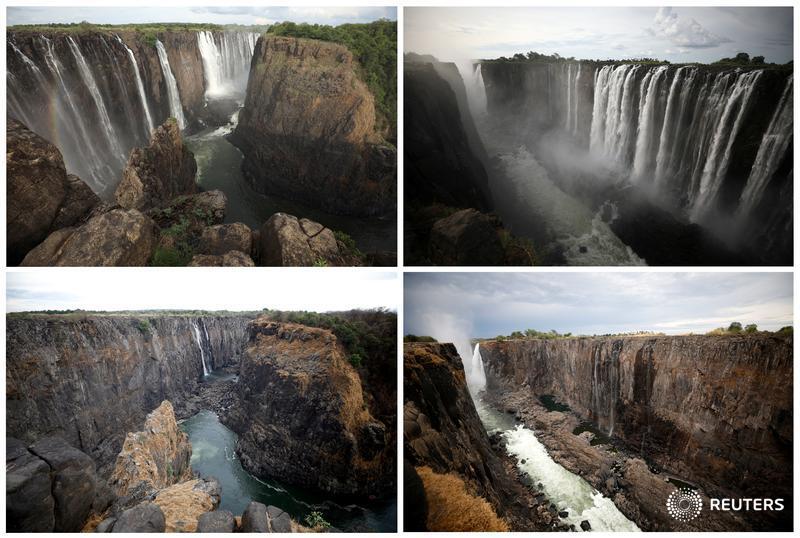
A debate is raging. Are the nearly dry Victoria Falls in Zimbabwe a consequence of
climate change or just seasonal and quite ordinary? Either way this is a striking image
that makes you stop and think about the debate.

Low water levels are seen after a prolonged drought at Victoria Falls, Zimbabwe, December 4, 2019. 

Better still if you can see what the waterfall looks like when it’s at full flow. The use of a
combination ‘before and after’ provides a visual solution. At the same time the format of
two images on top of each other creates its own problem. It won’t fit into the
conventional horizonal shape that is seen on most digital platforms. The solution is to use
two combination pictures next to each other. Read on here  

A combination picture that shows water flowing (top) and low water levels after a prolonged drought at Victoria Falls, Zimbabwe, taken January 17, 2019 and December 4, 2019. 

No matter how much you prepare, knowing that you are going to be surprised by love,
you are still surprised. Just look at Nevine’s face and gesture as she meets her son after
20 years. Even though Mohamed Abd El Ghany has shot this quite wide to give it a little
space, your eye just zooms into her face. It’s the complex arrangement of compositional
zigzag lines and shapes made up by the stairwell, the doorframe and their arms that keep
you centered on her joy. Read on here.

Palestinian Amjad Yaghi and his mother Nevine Zouhier, reunite after 20 years of separation in Banha, Egypt December 2, 2019.   REUTERS/Mohamed Abd El Ghany

A slightly different pick for the week, but I just can’t resist the echo of the shape of the
flag being carried by Abdelkarim Hassan and the image of the flag on the hoarding in the
background in Ibraheem Al Omari’s picture. I also like the illusion of the giant ball
bouncing off the player’s knee too. Good luck or good judgement? A photographer’s eye
or a careful pick by an editor? I think a combination of all that.

Qatar’s Abdelkarim Hassan celebrates with a flag after their Gulf Cup qualifying match against UAE in Doha, Qatar December 2, 2019. REUTERS/ Ibraheem Al Omari

In a similar sense to the football picture above, Khalid al-Mousily uses the backdrop
graffiti to build his image. The success of this picture is the perfect timing that places the
woman, at full stride, in the centre of the tableau, poised between gunman and injured
protester. The matching scale of the figures helps the illusion.

An Iraqi woman demonstrator walks past a mural during anti-government protests in Baghdad, November 22, 2019.   REUTERS/Khalid al-Mousily  

From the foreground, the cracked and dried-up earth of a reservoir stretches out to the
distant horizon like an alien landscape. Mike Hutchings has captured two tiny figures in
the bleak landscape who break the horizontal line where the cloud-heavy skies meet the
dried-out earth, giving the image a focal point as your eye races to the distance at
breakneck speed. Read on here

Clouds gather but produce no rain as cracks are seen in the dried up municipal dam in drought stricken Graaff-Reinet, South Africa, November 14, 2019.   REUTERS/Mike Hutchings 

I love pictures that have chaos and calm in them and Afolabi Sotunde delivers both with
this terrific image shot with a wide-angle lens. You feel that you are in the middle of the
fight as people grapple in the courtroom. You are not a bystander as the scene opens up
momentarily, giving you a view from the very core of the affray to the rear of the court,
where you can see the lawyers in the background, one of whom is causally shooting the
whole scene with his phone while the others glance around the wood-paneled room.

Fighting breaks out as security personnel re-arrest Nigerian activist Omoyele Sowore at the Federal high Court in Abuja, Nigeria, December 6, 2019.   REUTERS/Afolabi Sotunde 


 image that makes you stop and think about the over-all debate.

Sunday, 29 September 2019

A Week in Pictures, Middle East and Africa, September 27, 2019

It’s rare that a set piece, pool position picture makes an image that will catch my eye.  Normally these staged and heavily controlled events make for cold and functional images that are “for the record”. Not so Toby Melville’s image from South Africa. What attracts me most is the obvious warmth in this picture and as I try to figure out why I get this feeling, my conclusion is the eye contact. Both figures are leaning into each other, intent on listening. Baby Archie is focused on Tutu’s eyes too. The curve of the shoulder line, Meghan’s arms and Tutu’s pocket handkerchief complete a compositional oval that keeps our attention in the centre of the image, with that warm eye contact. You can see more from the tour here.  

Britain’s Meghan, Duchess of Sussex, holding her son Archie, meets Archbishop Desmond Tutu at the Desmond and Leah Tutu Legacy Foundation in Cape Town, in South Africa, September 25, 2019.   REUTERS/Toby Melville

Mohamed Torokman’s picture is black, almost completely abstract and full of menace. Your eyes skip around looking to make sense of what is going on and, after being drawn into the far distance by the light, you are brought sharply back to the hard, curved line of the tyre. It’s then you see the masked face of the protester, your initial sense of tension confirmed. But as you begin to work out what the protester is doing, moving tyres to be burned, you also get a growing feeling of determined calm from him.  

A demonstrator carries tyres to be set on fire during a protest to show solidarity with Palestinian prisoners held in Israeli jails, near the Jewish settlement of Beit El in the Israeli occupied West bank September 23, 2019.   REUTERS/Mohamad Torokman

Tonally and visually, Mohammed Salem’s picture is very similar to the image above, but the main difference is that your eyes jump immediately to the focal point, the face. And the moment you look at the face, you can’t look elsewhere. The lines of the shadows are intriguing as they cross the man’s face, you focus into the tiny juncture of the corner of his eye as he looks out of the frame and the line of shadow. It looks all very mysterious until you read the caption: he’s doing his laundry!

A Palestinian man sits in his home as laundry hangs to dry in Dier al-balah refugee camp in central Gaza strip September 22, 2019.   RUTERS/Mohammed Salem

A news feature picture by Khaled Abdullah improved, I think, by the little crop to remove the figure on the right who is wearing a high visibility jacket. I hope you agree the crop improves this image by letting your eye be drawn to the dancers’ faces and away from the yellow jacket. Have a look at both the cropped and uncropped versions and see what you think. 

Houthi supporters perform the traditional Baraa dance during a ceremony held to collect supplies for Houthi fighters in Sanaa, Yemen, September 22, 2019.    REUTERS/Khaled Abdullah

Houthi supporters perform the traditional Baraa dance during a ceremony held to collect supplies for Houthi fighters in Sanaa, Yemen, September 22, 2019.    REUTERS/Khaled Abdullah

Philimon Bulawayo’s picture is powerful with its simple circular composition shot from above. The ring of the white bucket top echoes the circle of the black well. I like it too that the circle of the grass has been cropped off at the bottom of the picture, the rings giving feeling of ripples on a pond reaching the edge of the water. The woman looks exhausted as she struggles to collect water. 
  
A woman fetches water from a well in Warren Park suburb, Harare, Zimbabwe, September 24, 2019.   REUTERS/Philimon Bulawayo

Mohamed Nureldin’s image is busy and deep, it’s full of action and colour and you are kept busy picking up all the details. The cool of the glass and metal buildings contrasts with the warmth of the colours of the crowd. The harsh light ensures you can never quite make out what is going on, who is holding what flag, which hand belongs to whom and what the people in the background are standing on, but you come away with an overall feeling of peaceful protest.

Protesters attend a rally calling for a stop to killing in Darfur and stability for peace, next to a building in front of the ministry of Justice in Khartoum, Sudan, September 23, 2019.   REUTERS/Mohamed Nureldin  

Giant hands envelop a tiny creature, but this image really works for one reason only, the mouth of the turtle is open. If you didn’t get the visual clue of an animal’s head it would be hard to see what is going on, and it would not make any sense. Amir Cohen’s sophisticated use of a very small depth of field ensures that we don’t miss that all important detail. If the mouth was shut and everything was in focus it would look like a grey/black blob being held. You can read on here.

A child holds a newly-hatched baby sea turtle born at a protective nesting site set-up as part of the Israeli Seat Turtle Rescue Centre conservation programme, at a beach near Mikhmoret north of Tel Aviv, Israel September 9, 2019.   REUTERS/Amir Cohen

Eissa Alragehi’s picture is a pleasant, well composed and well-lit portrait of a fresh-faced boy sitting in temporary camp for the displaced. How long does it take you to notice that the boy is missing a leg? When you do notice it comes as shock, and what was a moment ago pleasant is now distressing. Read on here.

Ismail Abdullah, 12, who lost his leg in an air strike two years ago, poses for a picture in his hut in a camp for the internally displaced people in Khamis of Hodeidah province, Yemen August 31, 2019.   REUTERS/Eissa Alragehi