Pages

Monday, 8 August 2016

Editing the Gymnastics & Archery at the Rio 2016 Olympic Games

I am lucky enough to be part of the Reuters team covering the Rio 2016 Olympic Games. My role is to lead the edit team and edit the Gymnastics and the Archery. It's hard work but the pictures are amazing. I thought that occasionally I'd share some thoughts, pictures and inside information during the tournament.


Here is the team, eight editors who chose the images from the photographers and nine processors who add the caption details and publish to clients. I am well hidden at the back.

In short the photographers stream their picture directly from their cameras at the venues to our edit system, the editor chooses the best frame and then sends it the processor. He or she checks it for quality, captions it and then sends it to Reuters global networks.

For the opening ceremony we had a sweep to guess the number of pictures we moved to the wire. The sweep was $170 won with a bet of 2555 pictures that was nearest to the total.

I will try to update this daily. Here is a catch-up from day one and two.


Spent the day looking at thousands of great pictures from the team of Dylan, Mike, Damir and Athit. The obvious picture to share is Samir's broken leg after his fall at the vault (yuk) or the bent double Swiss athlete Hegi, but I have gone for the smoking hands of japan's Kohei Uchimura as he falls from the Horizontal bar by Dylan Martinez. It reminded me of my processors Darrelle and Gary's hands as they rush the pictures out.

It was great, the next day to see it being well used.


August 9, 2016

Here is my view today waiting for the start of the men's finals.


It would be hard not to include Dylan's picture of the Japanese team celebrating their gold win as my favorite tonight. Love the upward motion of the shape of the picture and the sheer joy on their faces. Add the Japanese flag coming in from the left and the small detail of the Olympic rings on the bottom right we have a great image. Would be nice if the cameraman on the right was not there but life is just not perfect.


Second placed Russian's is always hard one one to illustrate. Needless to say the team are happy they have won silver, who wouldn't be, but it must have the slight bitter taste of not winning the gold. How do you illustrate that? My view is that Mike's picture of the team with the logo on the right in the pace sums it all up, team spirit.


August 10, 2016 - See the latest pictures from Rio 2016 Olympic Games

We have just been talking about the viral picture of the North and south Korean girls posing for a selfie. Dylan's wonderful image of two girls enjoying the global event has taken on its own dynamic in the face of the global politics of the North and South Korea divide. Publications headlines range from Rio Olympics breaking down borders, heart warming unity and The Independent even running an editorial on Dylan's picture. I wonder what impact this image will have on the girls once they are at home?


Lee Eun-Ju of South Korea takes a selfie picture with Hong Un Jon of North Korea

If it's archery it's a sport that South Korea dominate. A visual challenge for Leonhard trying to get a different picture when archery is about the Art of Repetition.


Xhang Hye-Jin of South Korea in the Women's Individual eliminations.

A quick lunch just before we start testing lines from gym, hot dog with BBQ sauce, tomatoes and lettuce.


One of the greatest rewards of editing is when a photographer goes out of their way to say thanks for cropping an image of theirs to make it special. Mike's pictures of the USA women's gymnastic team celebrating winning gold are great especially when you know just how many photographers are fighting to get it. The first picture is full frame, the second is another frame from the sequence with the middle cropped tight. This only works with the right moment and it has to be pin sharp. I love it!!  


Simone Biles of the USA celebrates with her team mates following her floor routine during the Women's team final.

Had it not been for Mike's word of thanks I would have led with Damir's beautifully seen picture of Simone waiting for her turn. The red, white and blue leading your eye from hers to the gold in the top left corner.


....and a quick dinner before bed


And more pictures from all the sports at the Rio 2016 Olympics  here

August 10

Dylan is off to the dentist for root canal work today (yikes) so he is replaced by Alessandro. Kai is also joining the team for tonight's action. No prizes for guessing who this is.... yep Kai.


A quandary for me tonight at the Men's Individual All-round Final. Two pictures of winner Japan's Kohei Uchimura with his gold medal shot from above by Kai. The first picture the medal is sharp, the second the face is sharp. Which one to chose? A new angle on a medal picture so I moved both. Not an easy decision to make risking messing it all up to try to do something very different like this during a medal ceremony. Potentially you could miss everything, but Kai got two cracking pictures.


Last offering from the gymnastics tonight is a picture by Alessandro of an athlete who is very happy. Placed 17th in the final but did Arthur Mariano of Brazil have a great time! The simple shape of the X with the clean background makes this picture an obvious edit. The slightly pigeon toed stance also gives it a sense of real affection too; maybe that only exists in my mind'e eye. I think in every frame I looked of him he was smiling. And why not, he was playing to a home crowd.


Arthur Mariano of Brazil waves after competing on the floor exercise of the Men's Individual All-round Final.

What you can almost be certain of as an editor is that you wont be working in the rain. That cannot be said of photographers at many Olympic events, especially those who are covering the archery.  I really like the effect the water on the lens adds to Leonhard's picture and how this changes the visual structure of what is actually quite a detailed, complex and confusing image. The rain circles draw the eye back from the storm clouds and the central flood lights to the soaked archers on the left. The reds and the white of their clothing holding the eye long enough to enable you to understand what is happening. The dark clouds top right keeping your eye to the left. I also have a sneaking suspicion that the water on the lens might also be a plea for sympathy from Leonhard - "it's raining and I am all wet". No sympathy here, done it, been there.


Robin Rameakers of Belgium and Juan Ignacio Rodriguez of Spain compete in the Men's Individual 1/16 Eliminations 

See the latest pictures from Rio 2016 Olympic Games here


Sunday, 22 March 2015

A Decisive Journey Across The Thames (and back again)

Over the last few weeks I have had a lot of fun. First getting out with the cameras and doing what we demand of our photographers, taking a different look at what is seen every day. Secondly, I enjoyed re-reading 'The Decisive Moment' by Henri Cartier-Bresson; again inspired by his words, “the picture-story involves a joint operation of the brain, the eye and the heart”. And lastly I contributed to a kick starter project for the first time. Congratulations to Peter Densch, his hardback book “The British Abroad” will now be published with a little help from me and a lot more from others.


Captain Dave Watkins in the Wheel House of the James Newton ferry before dawn in Woolwich, London February 5, 2015. 

In short, I have managed to get back to the roots of what drives me to work in the news picture business. A love of picture stories about people.

For quite some time a nagging thought had been growing in my mind. Could I actually achieve myself what we demand of Reuters photographer’s and look differently at something we see all the time? I decided to shoot a local story that had fascinated me, London's Woolwich Free Ferry. The full story can be seen here on the Wider Image.


Gaining permission for access took time. “So you want to spend time with the crews of a public service to take pictures completely unsupervised – why?” I had to explain what I was doing, who for and why. It was good to have these thoughts cleared in my own head. The toughest question ‘who actually cares?’ Eventually I was handed a green high-visibility ‘VISITOR’ jacket, a pair of steel capped shoes and signed a form after completing a health and safety training session. Job done I thought.

But I thought wrong. I quickly discovered that I had lost my confidence taking pictures of people and technically I had lost it completely. Poor exposure, bad timing and poor focus. Years of driving a desk had taken its toll. What I had not lost was sense of shape and my honed skills as an editor. I did a harsh edit of my work to discover I actually had nothing. I resisted the temptation to switch my cameras from manual to automatic, got up at 04.45 and did it all again and then again. 

Recently I asked a photographer to reshoot part of a story and wondered if it was possible. He said it was but failed to mention it involved a half-day walk and chest deep wade across a flooded river.  Respect to him and a great re-shoot. What is important here is to be honest with yourself when editing your picture stories, if it doesn’t work you have just got to do it again. If you can’t do it again, then sadly it still doesn’t work.


Chargehand for the Woolwich Ferry workshop Terry Hanlan clears the bench in the ferry workshop in London February 5, 2015.  

But there is so much more now to getting the “job done”. Full captions and additional information to give the story context and relevance, we are after all photojournalists. Historical documents and archive pictures, full copyright secured. And then there is presentation and publication in all formats, print, online and hand held devices. Also there is the question of the inclusion or not of video, ambient sound, sound bites and graphics in the final piece.


So during my short journeys back and forth across the River Thames what did I learn? I would hardly describe my picture story as groundbreaking, but I am happy with result; I’ve never seen the working life of the Woolwich Free Ferry photographed this way before and it opened in 1889. Viewed in 50 years I hope it will be a sound historical document.  I learned that the opportunity for visual story telling is as great, if not greater, than it has ever been. All you need to do is look, think and see.

The last word to Cartier-Bresson. “Though it is difficult to foresee exactly how colour photography is going to grow in photo-reporting, it seems certain that it requires a new attitude of mind, an approach different than that which is appropriate for black and white”.


Saturday, 22 November 2014

The first photographer to travel on a royal tour - 1862

Everyone involved is long dead but the inquisitive feel, sense of exploration and beauty of the pictures live on. These are the thoughts that stuck me as I looked at the pictures by Francis Bedford of The Prince of Wales Middle East tour. This was the first time ever a photographer was invited to travel on a royal tour. It was 1862. Having been on several royal tours as a photographer I was intrigued.


Rarely, on first look when visiting exhibitions, do I use the recorded narration or read the small labels as I want to come to my own conclusions about the pictures. As the exhibition "Cairo to Constantinople" in the Queen's Gallery, is small I decided to look at it twice, the second time using the narration.

On first look the pictures are beautiful in composition, light, and technical execution. The prints are quite small so you have to peer closely at them. As I looked closer the details that really came to life and fascinated me were the local people. Exposures at that time were long, so to capture people without movement they would have to stand still for quite a while - completely still. I can't imagine for a minute that Francis would ask his Royal host to pose for pictures, under strict instructions not to move an inch for 12 seconds. The locals, on the other hand, would be a completely different matter. This for me, 152 years later, is the strength of these pictures.


The Mosque of Muhammad Ali, Cairo. Francis Bedford, 1862.

Listening to the narration I came across two wonderful gems of information that made me take a closer look at two specific pictures. The first is that the party travelled wearing tweed. Just imagine how hot it would have been riding horseback under the Middle East sun wearing tweed. This picture by French photographer Gustave Le Gray shows the party in their full splendour (the Prince 5th from right).  Le Gary, an important French photographer at the time, was in the Middle East on commission to cover the conflict in Syria but was injured in a horse accident, so joined the royal party up the Nile.


But to discover that Francis Bedford had managed to capture his own portable darkroom in the corner of his picture of the Great Court in Edfu, is truly wonderful. It so reminds me of the desperate and sometimes failed attempts by photographers to clear the background on modern royal tours.


The exhibition is on at the Queen's Gallery, Buckingham Palace until 22nd February 2105 and I highly recommend it if you have a spare 90 minutes and a tenner to spend. I even bought the book! If you are interested to learn more on Wednesday 26th November there is a lecture about the work. Sadly I can't make it. 

Monday, 7 July 2014

On the Sidelines of the Brazil 2014 World Cup

As national soccer teams and the photographers who have been covering them start to trickle home from the Brazil World Cup, it’s time to revisit the “On the Sidelines” project.
This Reuters Pictures project was billed as a chance for photographers to share “their own quirky and creative view of the World Cup”. I thought that I’d examine what has been achieved


As a way of introducing the project, let me use a comparison. I’m intrigued by the notion that an animal that has been caged, but is well fed and well treated, will not exchange freedom from its pen for the uncertainty that this freedom might bring.

Likewise, working as a photographer at the World Cup comes with a kind of cage of security. You know what you are going to do, what time you are going to do it, and what is expected of you. You need to capture pictures of great sporting action, goals, celebrations, red cards and, of course, every important incident, be it Suarez’s teeth marks or the collision that led to Neymar’s broken vertebra.


For editors too, life can fall into a regular pattern. First, arrive at the office two hours before the start of the game and make sure all the technology works, and that tests have been received from the photographers.

Then, with three other colleagues, look at between 12,000 and 20,000 frames per game, select the right pictures and make sure the captions and image quality are good (all while trying to block out the sound of drilling from builders in the next room… See video below).


As the game finishes and the last end-of-match celebration and dejection pictures are being picked through, the photographers from the next game are already starting to send in tests for their match.

Eleven hours after arriving in the office, the World Cup editing team here in Miami leaves and tries to find something (healthy, of course…) to eat. And hopefully there is no polite but disgruntled call from a photographer claiming you missed their best picture…

Here is my screen after the Netherlands v. Costa Rica quarterfinal match.


It’s not at all easy to cover the World Cup. Photographers face all sorts of struggles: travelling for hours to get to the ground, avoiding being robbed, dealing with technical issues, setting up and shooting in the rain, not to mention getting the best picture. All of this can make you feel like you are trapped in a cage when it comes to being creative with your photography.

The “On the Sidelines” project was intended as an outlet from this hard work – an opportunity to enjoy the freedom to shoot additional creative and unexpected photographs, just for fun’s sake.


The guidelines for the project were simple. You could photograph anything that you liked, with any camera or even phone that you liked, and use any caption you wanted as long as it had the correct date and location and didn’t offend.

The photographers were not to use filters (who needs amateur filters when you can compose and expose professionally anyway?) and, of course, they had to follow all of our professional ethical guidelines.

We added the following sentence to the caption of each picture so that some of the stranger shots would be put into context: “In a project called “On The Sidelines” Reuters photographers share pictures showing their own quirky and creative view of the 2014 World Cup in Brazil”.


And which photographers took part? Every one of them.

What amazed me most was the energy and sense of fun that came through in the hundreds of pictures produced by photographers who were tired, hungry, and sometimes wet and grumpy, but never bored.

After a hard day in the cage, it was time for some freedom.

Having edited thousands of pictures from the matches, I also enjoyed looking at and processing “On the Sidelines” images when they were filed. They can all been seen here.

As we prepare for the final four matches of the World Cup, we are sending our mainstream clients an edited picture package, showing a selection of some of the hundreds of images produced as part of “On the Sidelines”.

We hope that our media clients and their readers will enjoy this second package of new material as much as they enjoyed a previous set of Sidelines pictures that we sent out.

So, what has been achieved by the “On the Sidelines” project?  Our professional photographers have had a lot of fun producing yet another set of amazing pictures, all of which are in the archive to show “their own quirky and creative view of the 2014 World Cup in Brazil.”

It’s a great record for them to look back on, in addition to the thrills and spills of the soccer action.

Now, bring on the final.


Suarez - Did he bite?

The shout went up “He’s bitten him! Suarez has just bitten him!” 

It was the World Cup match between Uruguay and Italy, and both teams were playing for a place in the last 16. 

The game was tense, with pictures streaming in from the match in Brazil to the remote picture-editing centre we have set up in Miami. 

A television replay and it looked pretty certain that Uruguay’s Luis Suarez had bitten Italy’s Giorgio Chiellini on the shoulder in an off-the-ball incident. But you can never tell 100 percent when looking at TV. 

Chiellini was in no doubt though. He tried to show the referee tooth marks on his shoulder by pulling down his shirt.

We waited for the pictures to drop. Photographers Tony Gentile and Toru Hanai were sitting at the right end of the pitch. Tony was on the right side to get the picture

The pictures dropped in quickly, in sequence. Suarez on the ground holding his mouth. Chiellini holding his shoulder. 

Finally, we get the pictures of Chiellini pulling down his shirt to reveal marks on his shoulder. There are only 6 pictures, with one key frame below. 


At this stage we are unable to confirm what happened. We move the picture cropped wide to demonstrate what we do know - Chiellini is trying to show his shoulder to the referee.


We then look closely at the picture – you can clearly see marks, but are they teeth marks? We cannot confirm it. All we can do is show Chiellini’s shoulder and let the story take its own course. 

A tighter crop shows Chiellini’s face and his shoulder. Mindful of clients’ needs we crop the same picture into an upright shape. 


Lastly, we take some time and look at just how far we can crop the image to show the marks. Too close and the image quality breaks up. Too loose and we add nothing more to the images we have already sent. 

A final decision is made. We crop the picture, keeping in the fingers pulling down the shirt to draw the eye up and reveal the marks on Chiellini. His face is cropped out entirely, so no extra details detract from the picture. 


TV pundits and voices on social media were already calling for Suarez to be banned and punished. 

We had moved the pictures out. Uruguay score a goal and more pictures came streaming in. The game had moved on, but we all knew what the talking point was going to be and what picture was going to be used. 

Was it a bite? We have to wait for the FIFA ruling, but Tony Gentile’s photography offers a pretty clear picture.


Tuesday, 10 June 2014

Imagine the world viewed through the single constant of a goalpost

Sometimes the best ideas are also the simplest ones, especially when you have the support of the world’s biggest news agency behind you. 


Children play soccer on a playing field in Kirtipur, Kathmandu May 31, 2014. The 2014 Brazil World Cup opens on June 12 and fans around the globe are gearing up for the big tournament. REUTERS/Navesh Chitrakar

Inspired by the energy generated by a Wider Image workshop with our photographers in South America, I wanted to work on a global story about the Brazil 2014 World Cup. So many superlatives are used to describe it: the world’s greatest show, the most watched tournament, the biggest sporting event.


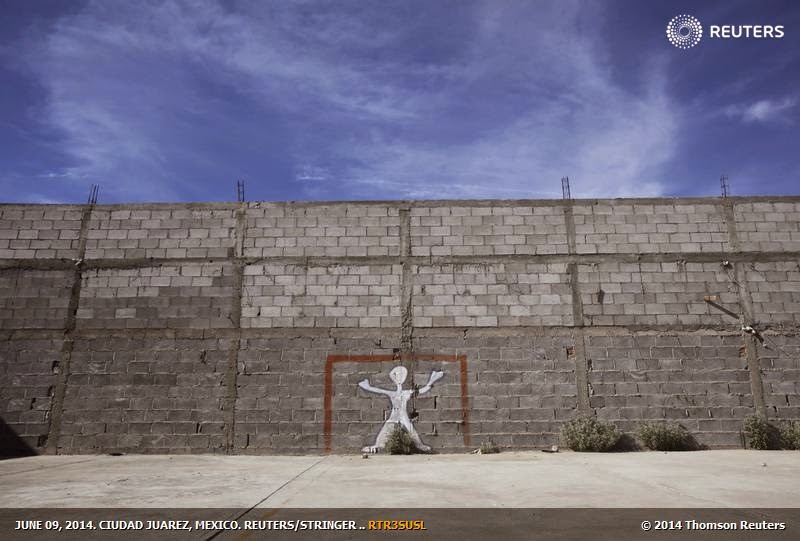
A goalpost is painted on a wall at a house used as a creche in Ciudad Juarez June 3, 2014. The 2014 Brazil World Cup opens on June 12 and fans around the globe are gearing up for the big tournament. But soccer lovers are not only preparing to watch the world's best professional players battle it out on the pitch; they are also out there kicking a ball about themselves. REUTERS/Jose Luis Gonzalez

I needed a big idea that could demonstrate the worldwide reach of football (or soccer, for our U.S readers) and I wanted to include our global team of busy photographers. For them to find the time to get involved, the idea had to be simple. 

I once heard that the rules of football are among the most universally recognised codes in the world.  They transcend divides of creed, culture, education, geography and wealth. Off-side is off-side no matter who you are, or what your nationality. And what is football actually about? It’s about goals.
And what is a goal? That moment of ecstatic joy, crushing defeat, a game won, lost or drawn (unless it’s a dull 0-0). Lucky, unlucky, frequently contentious, always an event. Maybe it should have been a goal and was disallowed, maybe it shouldn’t have been but was counted anyway. Goals can signify millions of dollars won or lost or invested in the business of football. They can mean winning or losing a bet. 


A makeshift soccer goalpost stands near Molweni, west of Durban June 5, 2014. The 2014 Brazil World Cup opens on June 12 and fans around the globe are gearing up for the big tournament. But soccer lovers are not only preparing to watch the world's best professional players battle it out on the pitch; they are also out there kicking a ball about themselves. Reuters photographers on every continent, in countries from China to the Czech Republic, went out to capture images of soccer goalposts used by players to practise the 'beautiful game'. REUTERS/Rogan Ward

And what is an actual physical goal? FIFA’s rules are strict, but simple: “The distance between the posts is 7.32 m (8 yds) and the distance from the lower edge of the crossbar to the ground is 2.44 m (8 ft)… Both goalposts and the crossbar have the same width and depth, which do not exceed 12 cm (5 ins).”

I read this, and an idea came to me. Imagine the world viewed through the single constant of a goalpost: the green grass and cloudy skies of Manchester, the dusk in Karachi, a cityscape in Boston, Kathmandu and Tokyo. I checked with a colleague to see  that this was not a daft idea. He loved it.

I knew that to get what I was looking for I needed to apply some structure. Experience has told me that photographers, on the whole rightly so, tend to follow their own ideas better than they follow those of others (no disrespect team, but it is as it is). 


I set some guidelines: a 24mm lens should be used, the pictures should be shot from the distance of the penalty spot (FIFA rules) and the camera should be at a height of 2 ft, from behind or in front, whatever looked better. My “goal” was to ensure that the position of the goalposts in the picture frame was a constant. I even shot a picture myself to explain what I wanted. What guide could be simpler to stick to?


Some followed the instructions to the letter, a few ignored some of them, and an elite handful completely made up their own rules. I love the result! I hope you do too. Click here to see the pictures 

Saturday, 3 May 2014

Instagram - A Platform For Professionals?

Two amazing pictures showed up on my screen over the past few days. The first was from Myanmar, where a Rohingya Muslim woman was pictured holding her malnourished twins. The second captured a deadly explosion in Iraq. 

Both were sent out to our clients on our newswire, and I decided to share them on social media. First I posted them to Twitter, with links to Reuters.com slideshows and our Wider Image website. The people who follow us on Twitter know what to expect – breaking news pictures from around the globe including some images that are quite brutal. 

Then I went to Instagram. I paused. Over the last few months, Reuters Instagram account has increased its following to almost 50,000. Each picture gets an average of over 1,000 likes and the numbers are growing. 

We don’t force crop our pictures into squares and we never use the filters – what you see is an image just as it was moved to the wire, un-manipulated. 


Displaced Rohingya woman Norbagoun carries her severely malnourished 25-day-old twins in her lap in their house at the Dar Paing camp for internally displaced people in Sittwe, Rakhine state, April 24, 2014. Restrictions on international aid have exacerbated a growing health crisis among stateless Muslim Rohingya in west Myanmar. In February, Myanmar's government expelled the main aid group providing health to more than half a million Rohingya, Medecins Sans Frontieres-Holland (MSF-H), after the organisation said it had treated people believed to have been victims of violence in southern Maungdaw township in January. The United Nations says at least 40 Rohingya were killed there by Buddhist Rakhine villagers. The government denies any killings occurred. An attack in March on NGO and U.N. offices by a Rakhine mob led to the withdrawal of other groups providing healthcare and other essential aid to another 140,000 Rohingya living in camps.  REUTERS/Minzayar

We are continually told that Instagram is the platform of the future for picture-sharing and news photography. It’s a space Reuters need to be in.  

So why my hesitancy? Who would want to “like” a picture of malnourished children? No one, I assume. Yet purely in terms of beauty of photography, emotion and content it’s a very powerful news picture. 

But is Instagram a platform for this? The second picture is an exclusive image of a deadly blast, captured with full force. It shows the very moment that several people were killed and many injured. Again, what to “like”? 


An explosion is seen during a car bomb attack at a Shi'ite political organisation's rally in Baghdad, April 25, 2014. A series of explosions killed 18 people at a Shi'ite political organisation's rally in Iraq on Friday, police and medical sources said. The militant group, Asaib Ahl Haq (League of the Righteous), introduced its candidates for elections on April 30 at the rally in eastern Baghdad. Three bombs exploded in succession as people were leaving, Reuters reporters at the scene said. REUTERS/Thaier al-Sudani 

Followers can comment right under the picture. Would there be an outcry and accusations of insensitivity at posting a picture of suffering children? Or would groups, who blame the Myanmar authorities for the health crisis among Rohingya Muslims – which the state denies – say the image was meant to advocate their cause? 

Would supporters of militants who exploded the bombs at the Shi’ite political rally write comments applauding the image and enraging those who suffered from the attack, who would be appalled that the image had even been posted? 

Every good news picture evokes debate and opinion. The more followers an Instagram account gets, the more diverse the commentary normally becomes. Nothing goes unchallenged or fails to raise the hackles of one group or another. 


One might think a picture from Ireland of a sheep that had been dyed pink to support a cycle race would be fun and harmless enough (it got 1046 “likes”). The comments ranged from clapping hands, smilies and “Mood for a pink outfit anyone?” to “People who do this to animals should be SHOT. Most dyes are not safe for them”.


The only pictures that don’t seem to upset people are silhouettes. So maybe we should just ignore everyone and post whatever represents the best of the file? But the point is to gain followers not lose them. Would someone interested in world news like to see cute pandas; or would our “panda followers” be horrified by pictures of children with malnutrition or bomb blasts in Iraq? 

I have to admit I enjoy posting Reuters pictures to Instagram; I get the buzz of instant gratification from “likes” and positive comments. Also, I tip my hat the very small group of photographers who have carved out a niche for themselves using Instagram to promote their work (I believe these photographers are so good that they could make great pix using a pin-hole camera). The platform has given joy to millions of amateurs using their phones to post pictures.   

But we are paid professionals and I am beginning to struggle with the question: “what is the actual value of Instagram for professional news photographers?” Likes cannot not, as yet, be converted into dollars so how will they fund the business now or in the future? 

So another question: is the platform best left to the amateurs, to enjoy filter-enhanced sunsets, rainbows, street scenes, lovers, pets and families or is this really the new, professional platform of the future? 

Last question “Would you ‘like’ a picture of malnourished babies in Myanmar?” 


If don’t give a damn about “likes” and just want to read the story and see the pictures, click here