Pages

Showing posts with label week in pictures. Show all posts

Saturday, 11 August 2018

A Week in Pictures Middle East and Africa August 10, 2018

Some time on vacation but I am drawn as ever to look at the pictures. Here are the images that struck me most during this week from the region.


Iron Dome anti-missile system fires an interceptor missile as rockets are launched from Gaza towards Israel near the southern city of Sderot, Israel August 9, 2018. REUTERS/Amir Cohen 


A missile lands as an Israeli aircraft bombs a building in Gaza City August 9, 2018. REUTERS/Mohammed Salem

More picture from the Israeli-Palestinian clashes here.


A vendor carries a sold sheep to the customer's car, ahead of the Muslim festival of sacrifice Eid al-Adha in Giza, on the outskirts of Cairo, Egypt August 9, 2018. REUTERS/Mohamed Abd El Ghany


Ivory Coast's former first lady Simone Gbagbo smiles as she is welcomed by supporters after being released from detention in Abidjan, Ivory Coast August 8, 2018. REUTERS/Thierry Gouegnon


Ruqqayah Abubakar lies on a bed after being treated at an obstetric fistula repair centre in Maiduguri, Nigeria August 1, 2018. Picture taken August 1, 2018. REUTERS/Afolabi Sotunde


A Palestinian boy looks out of his family's house that was damaged in an Israeli air strike, in Al-Mughraqa on the outskirts of Gaza City August 9, 2018. REUTERS/Mohammed Salem


A boy stands on woven mats in Idlib province, Syria July 29, 2018. REUTERS/ Khalil Ashawi


Women from Berber Kabylie region walk up to visit the Azrou N'Thor (Zenith Rock) mausoleum on the top of the Djurdjura Mountain in Tizi Ouzou province, Algeria August 3, 2018. REUTERS/Zohra Bensemra
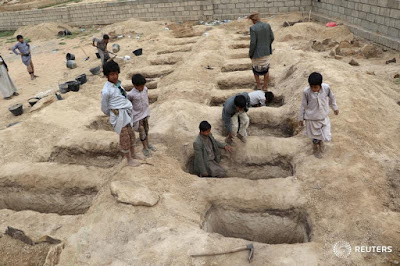

Boys inspect graves prepared for victims of Thursday's air strike in Saada province, Yemen August 10, 2018. REUTERS/Naif Rahma


A former child soldier holds a gun as they participate in a child soldiers' release ceremony, outside Yambio, South Sudan, August 7, 2018. REUTERS/Andreea Campeanu. More picture here


Flowers are laid under a wall displaying the names of people killed in the 1998 U.S. Embassy bombing at the August 7th memorial park in Nairobi, Kenya, August 5, 2018. Picture taken August 5, 2018. REUTERS/Baz Ratner


Ethiopian Federal Police officers detain a woman suspected to be carrying explosives during the welcoming ceremony of Jawar Mohammed, U.S.-based Oromo activist and leader of the Oromo Protests, in Addis Ababa, Ethiopia August 5, 2018. REUTERS/Tiksa Negeri


South Sudanese civilians celebrate the signing of a cease fire and power sharing agreement between President Salva Kiir and rebel leader Riek Machar, in Khartoum; along the streets of Juba, South Sudan August 5, 2018. REUTERS/Samir Bol

Although it's from the week when i was travelling before I just had to include this from Siphiwe Sibeko. You can see images from Zimbabwe here.


A supporter of the opposition Movement for Democratic Change party (MDC) of Nelson Chamisa wears a cone as they block a street in Harare, Zimbabwe, August 1, 2018. REUTERS/Siphiwe Sibeko

Friday, 13 July 2018

A Week in Pictures Middle East and Africa July 13, 2018

There is no escaping the feeling that Ronen Zvulun’s picture is more than a little bizarre. Five people dressed the same, sitting on what looks like a precipice, legs daggling into the abyss looking into Syria. Once you get past looking at the raised arms and wondering why they are doing that, your gaze is propelled to the far horizon through blue skies to a haze that might be created by the clashes near the border or could just be banks of cloud. 


Israeli Druzes sit together watching the Syrian side of the Israel-Syrian border on the Israeli-occupied Golan Heights, Israel, July 7 2018.   REUTERS/Ronen Zvulun 

Feisal Omar’s picture is a powerful news picture in a classic sense: it’s full of action and drama. Armed men rush through bomb-damaged streets; your eye races around the frame in confusion. Your attention darts from the coloured screen and reds and blacks of the tuk tuk, to the shadows and harsh vertical lines of the grey concrete building behind, back to the gunman on the left, and finally to the three men on the right, with their weapons held at the ready.  You can see the full sequence of pictures here


Somali security agents take position as they secure the scene of a suicide car bombing near Somalia’s Presidential Palace in Mogadishu, Somalia, July 7, 2018.   REUTERS/Feisal Omar


Alaa Al-Fakir’s picture is all about perseverance and determination. The small girl labors in the heat of the overhead sun at what seems her impossible task of pushing a wheelchair-bound elderly person over rough and barren terrain. The glimmer of hope I try to take from this picture of difficult struggle is the determination in the girl’s efforts. Using the full force of her body, she is not giving up: her legs are braced, head down and arms straight. She will succeed in helping this person less able than her. 


An internally displaced girl pushes a woman in a wheelchair near the Israeli-occupied Golan heights in Quneitra, Syria July 11, 2018.   REUTERS/Alaa Al-Fakir

When I look at the light and compositional structure of Ronen Zvulun’s picture I think of the American painter Edward Hopper . Warm and cold colours, strong lines and bold flat shapes fighting for equal amounts of space. The figure always perfectly positioned in the composition, but leaving us with the sense that they are slightly distant, divorced or uncomfortable, that they’d rather be elsewhere. 


A Syrian woman holds a baby as she walks into a checking room just after they crossed the armistice line to the Israeli-occupied Golan heights to get medical treatment in Israel July 11, 2018.   REUTERS/Ronen Zvulun 

I was impressed with Ibraheem Abu Mustafa’s picture from Gaza for complex reasons that I will explain. Often, he covers clashes and funerals but we also need to illustrate less visually rich news stories such as financial and complex political stories about longer-term trends. On this occasion the story was China’s growing economic influence in the Middle East. Not an easy one, not one to make immediate impact but certainly one to demonstrate sophisticated visual thinking. What would you take a picture of? When a customer searches ‘China Gaza’ to illustrate the political and economic of China’s role in Gaza this image will be found. It’s a ‘slow burn’ clever picture told by the words MADE IN CHINA on the box. 


A Palestinian vendor carries a cardboard box containing toys made in China, in Khan Younis in the southern Gaza Strip, July 10, 2018.  REUTERS/Ibraheem Abu Mustafa  

Two striking and thoughtful pictures from Sumaya Hisham to illustrate the ongoing turmoil at the energy company Eskom. I love the march of the pylons appearing over the hill like an alien army. With the washed out sky, the cold steel shapes seem to be wading  through what looks like a cold sea, an effect created by the horizonal lines in the grass. Read on here about the Eskom pay deal.


Electricity pylons carrying power from Koeberg nuclear power station are near Cape Town, South Africa, July 11, 2018.   REUTERS/Sumaya Hisham

And in Sumaya’s picture below I love the patches of cold blue of the cross painted in the door and the equally cold blue light in the two windows on the left countered by the warmth of the sky and the hot spots of the lights overhead. And both these pictures were used to match a financial story about pay negotiations between workers and a company. To produce such imaginative pictures from what is a relatively dry story is a mark of a great photographer.   


Overhead power lines are seen at Khayelitsha informal housing settlement near cape Town, South Africa, July10, 2018.  REUTERS/Sumaya Hisham

To describe Andreea Campeanu’s picture as ‘busy’ would probably be the understatement of the week. Your eye jumps from the red shirt of the barber, to the window highlight reflected in the mirror, back down the whites and blues of the customer’s shirt, up to the pattern on the ceiling, then down along the pictures of potential styles on the back wall, to the barber’s brush held and silhouetted against the mirror on the back wall. Finally, you come to rest on the gentle eyes and broad smile of the customer. It’s then you notice the next customer, seated, waiting in line, also reflected in the mirror. What an epic journey and all in such a small barber shop.   


An Internally displaced man receives care inside a barber shop in the United Nations Mission in South Sudan (UNMISS) protection of Civilian 3 site (PoC), outside Juba South Sudan, July 12, 2018.    REUTERS/Andreea Campeanu

Friday, 29 June 2018

A Week in Pictures Middle East & Africa, June 29, 2018

When I got my first full-time job as a photographer with a small news agency, I was told by my boss: “If you shoot a ‘thumbs-up’ picture or a ‘points at something picture’ I will fire you on the spot. We are better than that.” Sound advice but rules are for breaking, so with these words of wisdom ringing in my ears I select Hamad I Mohammed’s wonderfully happy picture of a beaming woman giving a thumbs-up as she drives her car off the forecourt just after midnight on the first day that women were allowed to drive in Saudi Arabia. You can see more picture here


A Saudi woman celebrates as she drives her car in her neighborhood in Al Khobar, Saudi Arabia, June 24, 2018.    REUTERS/Hamad I Mohammed 

A simple gesture from the woman who sits behind a sleeping child has an overwhelming sense of futility. The child sleeps on, resting on what we assume is all that remains of her possessions. Khaled Abdullah created this sense of hopelessness by leaving an over-exposed and empty space that fills over half the frame. It says: “What future for these people? Who knows?” The answer is in the picture itself. Follow the story here


A woman displaced by the fighting in the Red Sea port city of Hodeidah reacts as she waits to be registered at an IDP registration centre in Sanaa, Yemen June 27, 2018.  REUTERS/Khaled Abdullah

A simple gesture from the woman who sits behind a sleeping child has an overwhelming sense of futility. The child sleeps on, resting on what we assume is all that remains of her possessions. Khaled Abdullah created this sense of hopelessness by leaving an over-exposed and empty space that fills over half the frame. It says: “What future for these people? Who knows?” The answer is in the picture itself.  


Cranes are seen at the Red Sea port of Hodeidah, Yemen June 24, 2018. REUTERS/Abduljabbar Zeyad

Again creeping off my turf and onto Russian soil, I could not help but include Jason Caimduff’s emotional picture of dejected soccer star Mohamed Saleh. It never ceases to amaze me how much passion and energy these sportsmen display right up until the final whistle, believing until that moment they can still win no matter what the score. When the whistle blows the losers are are crushed. To judge from Mohamed’s disappointed face, highlighted against the clean green background, he just can’t believe it, he doesn’t know what to do. So he grabs his shorts and pulls them up as far as they will go. Now, like all great athletes, he will no doubt get back to training, get his head (and his shorts) straight, focusing on the next match, ready to enrich millions of  (Egyptian) fans’ lives with his skills. See the highlight pictures from the game here.


Egypt’s Mohamed Saleh looks dejected after their Group A World Cup match against Saudi Arabia in the Volgograd stadium, Volgograd, Russia June 25, 2018.  REUTERS/Jason Caimduff

There is something gentle and calm in the visual frenzy of Zohra Bensemra’s picture of the Old Town of Jeddah. Maybe it’s the way your eye is slowly drawn from the chaos of the red bunting, the yellow road barriers, the ramshackle balconies and the whirring aircon units to the beautifully crisp white robes of the man on the phone. Whatever it is that gives this image its calm, I love this eye-of-the-storm composition.


A Saudi man walks through the old town of Jeddah Saudi Arabia June 22, 2018. REUTERS/Zohra Bensemra

National leaders dancing and smiling during peace talks provide a warm image shot by Mohamed Nureldin Abdallah. I suspect that Mohamed was happy to capture all three main parties in one image, especially managing to keep the pointing fingers and hands in the top of the frame What I also like about this are the dashes of red and purple in the leaders ties and the flag set against white with a bright yellow background. All very cheerful. 


Sudan’s President Omar Al-Bashir joins South Sudan’s President Salva kiir and South Sudan rebel leader Riek Machar in a dance during a peace meeting as part of talks to negotiate an end to a civil war that broke out in 2013, in Khartoum, Sudan June 25, 2018.   REUTERS/Mohamed Nureldin Abdallah


Virtually all colour is drained from Thomas Mukoya’s back-lit picture that looks like a scene from the apocalypse, the four horsemen dismounted. We are sucked into the centre of the breathless picture by a clever series of compositional U’s that lead us from the top of the frame into the centre just above the police helmets. The centre is marked with a small red part of the policeman’s weapon to finally catch the eye.


Riot police stand at the smoldering scene of the fire that gutted a timber dealership in Gikomba market and nearly homes in central Nairobi, Kenya.   REUTERS/Thomas Mukoya

One can only begin to imagine what is going through the mind of the girl in Omar Sanadiki’s picture. Her blank stare seems to pass right through the viewer as she maybe thinks of an uncertain and distant future. What I really like about this picture is how Omar has not only exposed for the shadow detail of the girl, leaving the soldiers in the background to bleach out, but used a shallow depth of field, adding to the feeling that maybe this journey is fading into the past in the girls mind. 


A Syrian refugee girl who left Lebanon looks through a window as she arrives in Qalamoun, Syria June 28, 2018.   REUTERS/Omar Sanadiki 

On the other side of the Lebanese Syrian border, Mohamed Azakir photographed the chaos of families try to leave. People crammed into overloaded vehicles with all they own, children and grandparents squeezed onto the truck almost as an afterthought. At first, I thought it was a shame that the top of the mattresses were cropped off but then I decided that this crop, which might have been unintentional, actually adds to the cramped feeling of the picture. Maybe it needs an even tighter crop? You can read the developing story  here 


Syrian refugees prepare to return to Syria from the Lebanese border town of Arsal, Lebanon, June 28, 2018.    REUTERS/Mohamed Azakir

I can’t hide my disappointment that Senegal are out of the World Cup and I can’t explain to myself why I really hoped they'd do well. Maybe it was the effort the fans would put into getting a glimpse of the game, a passion highlighted by Mikal McAlister’s picture. All they had to do was draw but sadly, for me, they lost 1-0. See highlight pictures from the match here


People climb into a tree in Dakar Senegal to watch the Senegal v Colombia Group H World Cup match June 28, 2018.   REUTERS/Mikal McAllister


Friday, 15 December 2017

A Week in Pictures Middle East & Africa December 15 2017

Okay okay it’s from last week, but it’s good enough for a mention this week as I bend the rules to include Ronen Zvulun’s picture. Wham! You are drawn in to the white shirt and face on the pavement make up a tiny fraction of the picture. As your eye draws out from the centre, the more intrigued and maybe confused you are. Shadows of people push you back in, where you are met with a surreal combination of hooves, boots, shoes and stirrups that I think Salvador Dali would have admired.  


A Palestinian man lays on the ground beneath police horses as he is detained by Israeli police during scuffles at Damascus Gate after Friday prayers in Jerusalem’s Old City, as Palestinians call for a ‘Day of Rage’ in response to U.S President Donald Trump’s decision to recognize Jerusalem as the capital of Israel December 8, 2017.   REUTERS/Ronen Zvulun

A crisscross composition of blacks, reds, whites and the silhouette of an outstretched hand that demands you look at the weeping woman makes for a powerful picture of grief. Everything leads to the open mouth and closed eyes of the woman who sobs for her dead relative. The sadness of this picture is burned into my mind forever.   


A relative of a Palestinian man, who was shot dead during clashes with Israeli troops on Friday, mourns during his funeral in Khan Younis in the southern Gaza strip December 9, 2017.   REUTERS/Suhaib Salem

To say that Thaier Al-Sudani’s picture is a little messy is an understatement - a blue gash right to left across the centre of the picture, ugly lines in the buildings in the background, a power cable top right, not to mention two balloons, one red, one pink, in the bottom left. So why did this catch my eye? The answer is in the detail: this is a moment of sheer joy. A man is dancing and waving a flag, and in fact he is so happy he has thrown his crutches aside and is dancing on the roof of a kiosk on his one good leg.  


A man holds an Iraqi flag as he celebrates the final victory over Islamic State at Tahrir Square in Baghdad, Iraq, December 10, 2017.  REUTERS/Thaier Al-Sudani 

Sometimes a picture raises many questions. Satish Kumar’s picture of a camel hanging upside down is one such image – what is going on? At first glance I thought of food, game hanging from the ceiling or even a giant turkey, maybe because it was near lunchtime and I was hungry. Who are the people on the right? They are actually vets and this is the Dubai Camel Hospital, a warm picture that will certainly bring a smile to most – click here to know more. 


A camel is seen hanging upside down as he is brought in for foot surgery at the Dubai Camel hospital in Dubai, UAE December 11, 2017.  REUTERS/Satish Kumar

I bet Baz Ratner could not believe his luck when a tiny figure dressed all in black stopped at the exact point on a wall where the sunlight ended and the shadows began, climbed onto a railing and leaned over to try to catch a glimpse of the burial of Rabbi Shteinman. This gives a focal point to what would otherwise have been a very busy picture with a strong diagonal composition and no focus. 


An Ultra-Orthodox Jewish man tries to see the burial of prominent spiritual leader Rabbi Aharon Yehuda Leib Shteinman, who died at the age of 104, during his funeral ceremony in Bnei Brak near Tel Aviv, Israel, December 12, 2017.   REUTERS/Baz Ratner

On Wednesday I was interviewed by Monocle about Reuters’ pictures of the year and was asked what makes a picture of the year. The answer is easy: a powerful, beautifully composed image that captures a key moment in a top news story. Mohamad Torokman’s picture of an undercover policeman making an arrest is made extraordinary when the policeman points his pistol at Torokman, delivering a very clear message – keep back. Torokman’s presence of mind has to be admired. In one minute everyone around him is shouting anti-Israel slogans, and in the next, as the undercover security reveal their identity, protesters are grabbed and detained. To continue to take pictures when a gun is being pointed at you at close range in a riot situation is for me truly remarkable. Could you remain calm enough to grasp what had happened, react, keep safe and get the picture sharp? The full back-story can be read here


Undercover Israeli security personnel detain a Palestinian demonstrator during clashes at a protest against U.S President Donald Trump’s decision to recognize Jerusalem as the capital of Israel, near the Jewish settlement of Beit El, near the West Bank city of Ramallah December 13, 2107.   REUTERS/Mohamad Torokman

I think it’s worth showing a few more pictures shot by Mohamad Torokman this week to demonstrate that his fantastic picture of the undercover policeman was not a one-off but part of a very strong body of work. It’s also worth mentioning that he works as part of a team, but this week the luck was with him.


A Palestinian lawyer hurls stones towards Israeli troops during clashes toprotest against U.S President Donald Trump’s decision to recognize Jerusalem as the capital of Israel, near the Jewish settlement of Beit El, near the West Bank city of Ramallah December 13, 2017.   REUTERS/Mohamad Torokman


An Israeli border policeman reacts as he fires towards Palestinian protesters during clashes as Palestinians call for a ‘Day of Rage’ in response to U.S President Donald Trump’s decision to recognize Jerusalem as the capital of Israel, near the Jewish settlement of Beit El, near the West Bank city of Ramallah December 8, 2017.   REUTERS/Mohamad Torokman


A Palestinian demonstrator hurls stones towards Israeli troops during clashes to protest against U.S President Donald Trump’s decision to recognize Jerusalem as the capital of Israel, near the Jewish settlement of Beit El, near the West Bank city of Ramallah December 11, 2017.   REUTERS/Mohamad Torokman


A Palestinian kicks a burning tire during clashes with Israeli troops at a protest against U.S President Donald Trump’s decision to recognize Jerusalem as the capital of Israel, near the Jewish settlement of Beit El, near the West Bank city of Ramallah December 12, 2017.   REUTERS/Mohamad Torokman

The slowly turning wheels of the political story in Zimbabwe have overtaken the frenzied elation in the streets in Harare of last month. It’s much harder to photograph politics than street demonstrations, but it’s equally important and when it’s done well, it’s very rewarding. I think that Philimon Bulawayo’s quiet photograph of a picture being hung, half out of the spotlight, prior to a political meeting speaks volumes. To me this picture asks the question will President Mnangagwa bring  Zimbabwe out of the shadows and back into the international community? Only time will tell, but either way, it’s a great picture.


An official puts up a portrait of Zimbabwe’s President Emmerson Mnangagwa ahead of a meeting of the ZANU-PF central committee in downtown Harare, Zimbabwe, December 14, 2017.   REUTERS/Philimon Bulawayo

Sometimes when events unfold and there is a great single picture there is also the sequence around that single image. A question often asked is can video be replacement for a series of stills? Personally, and especially in this case, I don't think so as each picture can be carefully studied frame by brutal frame as the event unfolds. Video would have been more about the motion but you just would not be able to see the detail a high resolution picture provides. Have a look at Goran Tomaesvic's picture and then the combo we produced and decide for yourself. You can read the full story here too.


Israel border police stand away after shooting a Palestinian man with a knife and what looks like an explosive belt near the Jewish settlement of Beit El, near the West Bank city of Ramallah, December 15, 2107.   REUTERS/Goran Tomasevic