Pages

Friday, 10 January 2020

A Week in Pictures, Middle East and Africa, January 10, 2020

I was stopped in my tracks by this sad image by Nazanin Tabatabaee from the Ukraine International Airlines crash scene in Iran. What was once a treasured personal effect, a family picture album, is seen among items strewn over the ground. The pictures are faded and drained of colour with age and mixed with other rubble like a lost object. Rescue workers trying to salvage the possession of those who lost their lives. Once happy memories now loaded with much sadness if they are returned to families of those who died in this crash. Read on here for the latest 


Passengers belongings are seen after a Ukraine International Airlines crashed after take off from Iran’s Imam Khomeni airport, on the outskirts of Tehran, Iran January 8, 2020.   REUTERS/WANA/Nazanin Tabatabaee


We can’t see the eyes of the border policeman although his mirror sunglasses and the helmet shield leaves us with the impression, right or wrong, of a calm and cold stare in Raneen Sawafta’s picture from the anti-Israel protests.  We are drawn to the centre highlight of the image to see enough detail of the protest in the mirror lenses to understand what he is watching.

An Israeli border policeman looks on during an anti-Israel protest by Palestinians, near Qalqilya in the Israeli-occupied West Bank, January 6, 2020.    REUTERS/Raneen Sawafta 


So many funeral procession images have moved after the killing of Iranian military commander Qassem Soleimani and Iraqi militia leader Abu Mahdl al-Muhandis that it was hard to select one. But the claustrophobic and chaotic scene in Abdullah Dhiaa al-Deen’s picture is a very powerful image. It is so close to the coffin that you feel crushed, hot and breathless as hundreds of people struggle for a final touch of the coffin. Your eye is drawn through the teeming crowds to the distance by the brightly lit minarets of a mosque.

Mourners attend the funeral procession of the Iranian Major-General Qassem Soleimani, head of the elite Quds Force of the Revolutionary Guards and the Iraqi militia commander Abu Mahdl al-Muhandis, who were killed in an airstrike at Baghdad airport, in Kerbala, Iraq January 4, 2020.   REUTERS/Abdullah Dhiaa al-Deen 


Equally busy and chaotic is Khalid al-Mousily’s picture from the funeral procession of Soleimani and al-Muhandis. It’s so busy your eye just doesn’t rest; it darts from the soldier in the black helmet in the foreground, then to the flags and the poster in the background, back to the man in the white short touching the vehicles, over to the soldier in the red beret looking backwards and then the to edges of the frame, sunglasses on the left and military vehicles on the right. You feel as breathless as if you were there.  

A coffin is seen inside a car during the funeral of the Iranian major-General Qassam Soleimani, commander of the elite Quds Force of the Revolutionary Guards, and Iraqi militia commander Abu Mahdl al-Muhandis, who were killed in an airstrike at Baghdad airport, in Baghdad, Iraq, January 4, 2020.   REUTERS/Khalid al-Mousily


The Dakar rally is taking place in Saudi Arabia and Hamad Mohammed has the opportunity to shoot John Ford style landscapes and capture the sporting action too. Easier said than done, shutter speed too fast and the vehicles are frozen and look static, all drama lost. Shutter speed too slow and you get to much movement and you end up with a blurry picture, which looks great (some of the time) if intentional and it works well. The picture below perfect, just enough movement in the wheel but the action frozen. 

Monster Energy Honda Team 2020’s Kevin Benavides in action in Stage 4 of the Dakar rally in Neom Saudi Arabia January 8, 2020.   REUTERS/Hamad I Mohammed


Shooting a sports landscape too wide and you lose the detail of the action, too tight and you lose the landscape. The light has to be right and the shapes through contours of the landscape have to keep the eye interested. Hamad’s picture below is a perfect balance of all elements: John Ford would be proud. 

Red Bull KTM Factory Team’s Sam Sunderland in action in Stage 2 of the Dakar Rally in Neom Saudi Arabia January 6, 2020.   REUTERS/Hamad I Mohammed


One would imagine that at a very simple scenario, a person talking at a podium, one image would be enough. But if its news value is so important and the world is waiting to see the pictures a single definitive image probably wont exist, and a wide selection is needed to convoy the whole story. Competition is tight as the first pictures will probably be the most published. But what is also key is how the images are presented because a person talking at a podium is not visually rich. Photographer Mohamed Azakir was under pressure to deliver not only the first pictures, and seconds count, but the editors have to think how best to present them so they will be used again and again. A clever combination of Mohamed’s very fast pictures by picture editor Maria Semerdjian do the job required in this special case. If you had to chose a single image which one would it be? 

A combination of pictures show former Nissan chairman Carlos Ghosn addressing a news conference at the Lebanese Press syndicate in Beirut, Lebanon January 8, 2020. REUTERS/Mohamed Azakir

A combination of pictures show former Nissan chairman Carlos Ghosn addressing a news conference at the Lebanese Press syndicate in Beirut, Lebanon January 8, 2020. REUTERS/Mohamed Azakir


Friday, 6 December 2019

A Week in Pictures, Middle East and Africa, December 6, 2019


I wanted to update this week’s selection with three images from Baz Ratner in Kenya. They each represent a mix of emotion at the same time; despair, hope, fear, relief and joy as the story of the collapsed building unfolds. Looking at the sandwiched layers of floors of the building how can anyone be expected to survive, yet the rescue services dig in hope. People watch, some I imagine with loved one missing others just intrigued by the spectacle, drawn to the horror. And finally relief and joy as a woman is pulled from the rubble. No doubt next there will be anger, why did this building collapse? Read the rescue story here.

People watch as rescue teams search the scene where a building collapsed in Nairobi, Kenya December 6, 2019.   REUTERS/Baz Ratner


People watch as rescue teams search the scene where a building collapsed in Nairobi, Kenya, December 6, 2019.   REUTERS/Baz Ratner

An injured woman, rescued from the rubble, is carried by from the scene where a building collapsed in Nairobi December 6, 2019.  REUTERS/Baz Ratner
2019
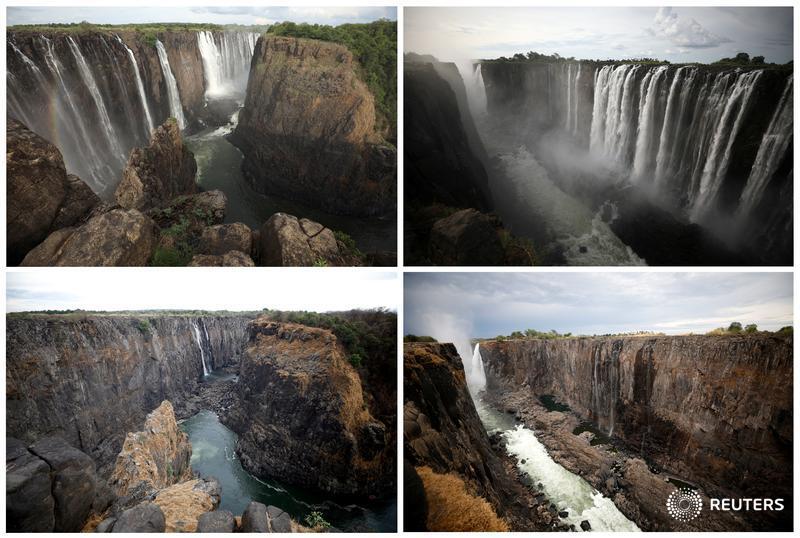
A debate is raging. Are the nearly dry Victoria Falls in Zimbabwe a consequence of
climate change or just seasonal and quite ordinary? Either way this is a striking image
that makes you stop and think about the debate.

Low water levels are seen after a prolonged drought at Victoria Falls, Zimbabwe, December 4, 2019. 

Better still if you can see what the waterfall looks like when it’s at full flow. The use of a
combination ‘before and after’ provides a visual solution. At the same time the format of
two images on top of each other creates its own problem. It won’t fit into the
conventional horizonal shape that is seen on most digital platforms. The solution is to use
two combination pictures next to each other. Read on here  

A combination picture that shows water flowing (top) and low water levels after a prolonged drought at Victoria Falls, Zimbabwe, taken January 17, 2019 and December 4, 2019. 

No matter how much you prepare, knowing that you are going to be surprised by love,
you are still surprised. Just look at Nevine’s face and gesture as she meets her son after
20 years. Even though Mohamed Abd El Ghany has shot this quite wide to give it a little
space, your eye just zooms into her face. It’s the complex arrangement of compositional
zigzag lines and shapes made up by the stairwell, the doorframe and their arms that keep
you centered on her joy. Read on here.

Palestinian Amjad Yaghi and his mother Nevine Zouhier, reunite after 20 years of separation in Banha, Egypt December 2, 2019.   REUTERS/Mohamed Abd El Ghany

A slightly different pick for the week, but I just can’t resist the echo of the shape of the
flag being carried by Abdelkarim Hassan and the image of the flag on the hoarding in the
background in Ibraheem Al Omari’s picture. I also like the illusion of the giant ball
bouncing off the player’s knee too. Good luck or good judgement? A photographer’s eye
or a careful pick by an editor? I think a combination of all that.

Qatar’s Abdelkarim Hassan celebrates with a flag after their Gulf Cup qualifying match against UAE in Doha, Qatar December 2, 2019. REUTERS/ Ibraheem Al Omari

In a similar sense to the football picture above, Khalid al-Mousily uses the backdrop
graffiti to build his image. The success of this picture is the perfect timing that places the
woman, at full stride, in the centre of the tableau, poised between gunman and injured
protester. The matching scale of the figures helps the illusion.

An Iraqi woman demonstrator walks past a mural during anti-government protests in Baghdad, November 22, 2019.   REUTERS/Khalid al-Mousily  

From the foreground, the cracked and dried-up earth of a reservoir stretches out to the
distant horizon like an alien landscape. Mike Hutchings has captured two tiny figures in
the bleak landscape who break the horizontal line where the cloud-heavy skies meet the
dried-out earth, giving the image a focal point as your eye races to the distance at
breakneck speed. Read on here

Clouds gather but produce no rain as cracks are seen in the dried up municipal dam in drought stricken Graaff-Reinet, South Africa, November 14, 2019.   REUTERS/Mike Hutchings 

I love pictures that have chaos and calm in them and Afolabi Sotunde delivers both with
this terrific image shot with a wide-angle lens. You feel that you are in the middle of the
fight as people grapple in the courtroom. You are not a bystander as the scene opens up
momentarily, giving you a view from the very core of the affray to the rear of the court,
where you can see the lawyers in the background, one of whom is causally shooting the
whole scene with his phone while the others glance around the wood-paneled room.

Fighting breaks out as security personnel re-arrest Nigerian activist Omoyele Sowore at the Federal high Court in Abuja, Nigeria, December 6, 2019.   REUTERS/Afolabi Sotunde 


 image that makes you stop and think about the over-all debate.

A Week in Pictures, Middle East and Africa, December 13, 2019


As the year-end approaches I thought that I would compile some of the images that I have highlighted over the last 12 months and put it in a slideshow with music. It’s frenetic to say the least, but I hope you enjoy being visually bombarded. Click on the image below, expand to full screen, click play and hold on to your hat. Respect to the whole Reuters pictures team in the Middle East and Africa for producing such a striking set of images.


A long-term project finally published after months of hard work that involved several photographers in different counties with pictures that date from the 40s, 50s and 60s and today. A terrific set of images that bring to life quite an abstract concept: a ‘before and after’ where the ‘before’ was decades ago and the ‘after’ only exists in sense and feeling through human stories and not physical reality. This visual concept was used to illustrate the complex and pollical issue of funding UNRWA. See the whole story here

A combination picture shows young women playing basketball at the Women’s Activity Centre in Qalandia in the Israeli-occupied West Bank in this undated handout photo provided by UNRWA and Palestinian school girls playing basketball at the Women’s Activity Centre in Qalandia in the Israeli-occupied West Bank September 17, 2019.  REUTERS/Mohamad Torokman

A combination picture shows Palestinian school girls waiting in line to collect UNRWA prepared food parcels during the first Intifada in the Gaza Strip in this handout picture believed to be taken in 1988 by UNRWA photographer Zaven Mazakian and Palestinian school girls waiting in line to collect snacks in a UNRWA-run school in the Gaza Strip September 2, 2019. REUTERS/Ibraheem Abu Mustafa 


A simple but effective detail picture from Ramzi Boudina catches the eye this week. Five candidates and five empty chairs seems a counter-intuitive way to illustrate the angry and bitterly contested Algerian election. The calm and cool effect of this image is created by the almost monochromatic colours and the regular spacing of the dark-toned shapes of the chair backs.

Ballot papers of the five presidential candidates are displayed at a polling station in Algiers, Algeria December 12, 2019.    REUTERS/Ramzi Boudina 


In complete contrast to the calm of the detail image above, a second picture by Ramzi of vote casting is as frenetic as it is perfectly timed. Your eye is drawn to the centre of the swirling, chaotic melee, to the crisp white voting slip and to Tebbourne’s face. If the paper was held an inch higher, the dark gap between the head and paper would dislocate face and ballot, an inch lower and the regular shape of the ballot paper would be broken, the focal point being lost. Despite the bright TV light in the background, your eye is drawn down to its reflection in the ballot box and then to the slit in the box.   

Algeria’s presidential candidate Abdelmaiid Tebbourne cast his ballot during the presidential election in Algiers, Algeria December 12, 2019.   REUTERS/Ramzi Boudina 


This is a wonderfully composed and side lit picture by Njeri Mwangi, with the subject of the image seeming to be crushed into the bottom of the frame. The visual weight of the microphone stand, police and security bear down on Nairobi Governor Mike Sonko, but the highlights picking out the details of his upturned face push back just as hard. Finally, the highlight on the policeman’s blue shirt allows your eye to escape to the top of the frame, and without it you would be trapped in this visual pressure cooker.
Prison and police officers keep watch over Nairobi’s Governor Mike Sonko as he appears for a hearing on his bond application after he was arrested on corruption related charges, at the Milimani Law Courts in Nairobi, Kenya December 11, 2019,   REUTERS/Njeri Mwangi  


Many of the protests in Iraq have been bloody with more than 400 killed in recent weeks. The expectation is that you’d see images of death, injury, fires, armed security and violent clashes – all of which we have on the file. So this protest image by Essam al-Sudani comes as quite a surprise. Balloon-holding students are set against a beautiful blue sky in muted but determined protest. I really like it that you have to explore very hard to get additional detail from the picture whose shadows are dark amid the light bright. This sense is highlighted by the fact that most of the faces are covered or obscured, except one. To me this puts a human face on the crowd and I am rewarded with the detail after looking so hard.

University of Basra students carry balloons as they take part in an anti-government protest in Basra, Iraq December 8, 2019.    REUTERS/Essam al-Sudani

One of the oldest tricks in the book to grab visual attention is to set a small detail against an expanse of nondescript visual noise and they eye will be drawn immediately to it. If that detail is a bright colour set against a muted background you will draw the eye; if you set a small area of high contrast against flat tones the same will be achieved. Christopher Pike has done all three. What is also interesting is that this image is somewhat counter- intuitive to the whole story, which is about caving. It took a while to shoot and was released this week – read on here 

A member of the Middle East Caving and Expeditionary Team looks that the landscape after exploring the Birdwing cave, the deepest in gulf, on Jebel Kawr near Ibri, Oman December 1, 2019.    REUTERS/Christopher Pike 


A very gentle picture that is beautifully composed and timed from Corinna Kern. The horizon line divides the image up into classic thirds. The curve of the woman’s wind-swept clothing and the position of her arms complete the sweep of compositional line of the kite and its tail. To top it all I love the position of the boy in the background that acts a as a counterweight to the slightly right-of-centre position of the woman and the solid black shape her clothing makes. 

A woman flies a kite at Katara beach, Doha, Qatar December 13, 2019.   REUTERS/Corinna Kern 


Friday, 15 November 2019

A Week in Pictures, Middle East and Africa, November 15, 2019


Very hard to choose a single image from the hundreds of powerful news pictures that have moved on the wire in the last few weeks from Iraq, Syria, Lebanon, Algeria, the Palestinian Territories and Israel, but here goes. First thing I need to do is thank the whole team in the Middle East and Africa for their hard work and dedication to deliver fast, unbiased and powerful news image via the Reuters network.

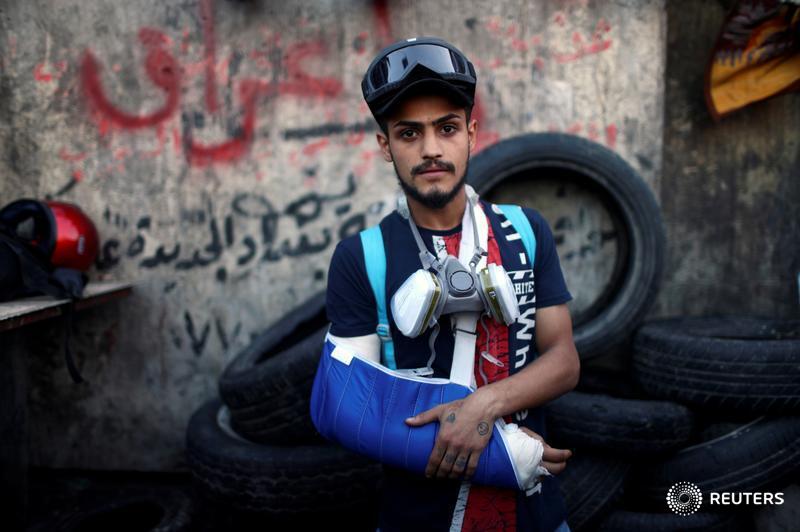
The temptation would be to lead with an image of clashes from Iraq, but I wanted to start with the less obvious, but no less powerful, picture by Ahmed Jadallah. As well as shooting the violence, Ahmed wanted to explain, through the words and portraits of the demonstrators, why the violence is happening. The half-length portrait is shot in cool, soft light, giving the image a feeling of pensive, uneasy and temporary calm. The long stare, straight into the camera, by the subject, tells us he wants to say something. The chaos of the situation around him, his broken arm and the ad hoc safety gear he is wearing tell us that what he has to say is worth listening to. The extended caption (something I am never really a fan of) works well here as it adds the details we want to know. You can see the whole series of picture here.  

Mohammad Said Yasseen, an Iraqi demonstrator poses for a picture during the ongoing anti-government protesters in Baghdad, Iraq, November 5, 2019. He said “we are only carrying flags, we don’t have anything else in our hands, but they keep hitting us and we’ve had at least seven martyrs here. I want my rights, we are being oppressed, we have nothing, no schools, no decent hospitals, no riches for the people. They only know how to steal, and they steal from us, leaving is with nothing. We are only asking for education and health. We must get rid of the corrupt ones and without that there is no solution. We want a civil state, we don’t want corrupt parties and corrupt politicians. I want these youths to govern us.” REUTERS/Ahmed Jadallah

Stretched to the last inch, Alaa al-Marjani’s picture has the same feeling of apprehensive tension we all get when we watch a pin slowly being pushed into a balloon. We know there is going to be a bang and we brace ourselves for it. Heads bowed, arms tensed, protesters hold the industrial-sized catapult as a man pulls back the loaded elastic. Everyone else is standing in the detritus of street conflict, watching and waiting for the explosive moment of release. As we look we hold our breath. Latest from Iraq here

Iraqi demonstrators use a catapult during ongoing anti-government protests in Baghdad, Iraq, November 14, 2019. REUTERS/Alaa al-Marjani

The demonstrations in Lebanon at times have a party feel and are less violent than the protest in Iraq, but there is an undercurrent of a sense of fear of a wider conflict. In a sense the potential conflict in Lebanon has much greater regional and global implication given the powerful forces which operate in the background of local power politics. With this in mind, I am very drawn to Andres Martinez Casares’ image. It has a very complex composition: a slight tilt gives you a sense of unease, the strong reds and harsh light in the foreground fight for your attention, with the back focus that wants to draw you past the policeman in the foreground to the sharp background through a gap in the fence. As your eye jumps between the two, you notice the demonstrators banging rocks on the metal fence. Finally, you settle of the three solders standing on the rubble. You get a sense that they are waiting, and something else is going to happen. Latest from Lebanon here

Police officers stand guard as protesters hit the fencing as they demonstrate outside Lebanon’s Central Bank during ongoing anti-government protests in Beirut, Lebanon, November 11, 2019.   REUTERS/Andres Martinez Casares

Another picture by Andres also caught my eye, as it too has a strong sense of the mood of the demonstrations. But I could not quite understand why I had a feeling that something visually was amiss. I spent quite a long time looking, then it struck me. The highlight on the wall on the far right distracts your eye from the sleeping protester in the car and lead you to the flames and smoke the background.  
A man sleeps in a car next to burning tyres barricading the highway during ongoing anti-government protests at Nahr El Kalb, Lebanon, November 13, 2019.   REUTERS/Andres Martinez Casares

Crop out that highlight and suddenly you see him and you eye is drawn to the shadows in the foreground. And now you can see the man sleeping you get a better sense of the mood of the protests. Not often you can sleep when it’s your chosen role to guard the burning barricades. Make sense? 

A man sleeps in a car nxt to burning tyres barricading the highway during ongoing anti-government protests at Nahr El Kalb, Lebanon, November 13, 2019.   REUTERS/Andres Martinez Casares

I am more than a little uncomfortable highlighting Ibraheem Abu Mustafa’s air strike image, especially after I read that people suffocated in the sands under the building. But I am drawn to the shapes created by the destroyed building. With the exception of the holes in the plastics on the left of the image, there is no sign of damage beyond the circle of the wrecked building. The high position from which Ibraheem has taken his image demonstrates in no uncertain terms that one building was targeted.
Palestinians gather around the remains of a house destroyed in an Israeli air strike in the southern Gaza strip November 13, 2019.   REUTERS/Ibraheem Abu Mustafa

A birds-eye view by Sumaya Hisham makes for a very graphic shape in her picture. At first glance it looks like an ancient representation of the bone structure of a mythical creature, or, if your mind works another way, rows of freshly dug graves. It is in fact artisanal mining for diamonds. The story, that was released this week can be seen here

Batho Pele Artisanal mining Cooperative miners are seen form the air as they mine for diamonds in Kimberley, South Africa, October 22, 219.   REUTERS/Sumaya Hisham

Full of joy is the best way to describe Mike Hutchings’ picture. Warm sunshine, blue skies, smiling faces that fill the space from the horizon to the foreground, a cheeky hint of a tilt and bright colours all combine for a feel-good factor. Take one of these many elements out and it would not be selected. Take the time to look at all the faces and enjoy.   
  
South Africa fans waves flags as they watch the South Africa Rugby World Cup trophy tour in Pretoria, South Africa November 7, 2019.   REUTERS/Mike Hutchings

A bold and simple illustration picture by Philimon Bulawayo might appear a strange pick this week. One would expect, when a new currency is launched, to see crisp new notes being printed or thumbed through in shiny banks. But Philimon’s thoughtful idea to isolate a single two-dollar coin held in a hand is probably the best way to try to illustrate the complexities of Zimbabwe’s struggling economy.

A man poses for a picture with Zimbabwe’s new two-dollar coin as customers queue outside a bank in Harare, Zimbabwe, November 12, 2019.   REUTERS/Philimon Bulawayo