Pages

Showing posts with label AFCON. Show all posts

Friday, 19 July 2019

A Week in Pictures, Middle East and Africa, July 19, 2019

It’s too hard to choose a single image from a series of pictures the team shot at the Africa Cup of Nations to show the emotions around a goal being scored, so I’ve picked two – from  anguish to jubilation. Francis Kokoroko’s picture of the stunned faces for me says it all, open-mouthed utter disbelief. The curve of the shadow folding in closer and closer to the fan in centre of the image. I imagine this stunned look went on for quite a few seconds, giving Francis time to maybe even reposition himself to get a better angle to work the light.  


Football fans react after Tunisia’s Rami Bedoui scored an own goal during their Africa Cup of nations (Afcon) match against Ghana, as they watch the match on a screen in Elmina, Ghana July 8, 2019.   REUTERS/Francis Kokoroko 

On the other hand Zohra Bensemra would have had no time at all to capture the rapturous  excitement in the boys’ faces as they celebrate a goal. The direct eye contact means you are right there in this moment of manic joy. To see the rest of the images click here 


Senegal fans celebrate after Sadio mane scores a goal during the Africa Cup of Nations (Afcon) Round of 16 match against Uganda in Dakar, Senegal July 5, 2019.    REUTERS/Zohra Bensemra 

Corinna Kern’s picture is a “what on earth is going on here?” picture which makes you want to know more. Corinna, who has been working on this project for several weeks, has avoided the temptation of shooting this too tight on the masks of the performers. Instead she lets the black frame of the doorway draw you in. The benefit of this is that we get to see the stark “stage”, which is actually a bus station. It’s at this point we realise this image is almost monochromatic. Read on here for more quirky images.      


Lior Avshalem, 42 and Rotem Cohen, 41 actors from the Mystorin Theatre Ensemble, perform is the group’s show ‘Seven’ a site specific act that uses all seven floors of the Central Bus Station in Tel Aviv, Israel may 25, 2019.    REUTERS/Corinna Kern 


An almost intrusive picture taken by Olivia Acland using a wide-angle lens forces the viewer into the space and mind of the woman who is being tested for signs of fever, a symptom of Ebola. She avoids our stare, but we get a such a powerful sense of fear and apprehension that we hardly notice the visual noise in the background.


A health worker checks the temperature of a woman as part of the Ebola screening when entering the General Hospital in Goma, Democratic Republic of Congo July 15, 2019.    REUTERS/Olivia Acland

The colours, line of design and shape in Cooper Inveen’s picture are just irresistible. The line of the hedge sends your eye racing to the focal point of the girls sheltering under a red umbrella. If the diagonal line of the hedge was not enough we have the run of glistening water on the muddy track to also draw us to the huddle of girls. The complimentary colours of red and green shimmer against each other while the warm  tones in the road and clothing counter the damp weather. Ideally, the post behind the trees wouldn’t be there, but the world is far from perfect. Read about Mariatu Sesay here. 


Mariatu Sesay, 15, walks home with her school mates in a countryside village in Sierra Leone. REUTERS/Cooper Inveen


Cold and stark is probably the best way to describe Ahmed Jadallah’s image of the aircraft carrier USS Boxer. The tones are grey and cold, all colour has been bleached out of the image by the strong overhead and slightly hazy light. Our eye moves away from the menacing black shape of the vessel, looking for warmth in the empty space, but all we see is a tanker in the distant haze. 


USS Boxer (LHD-4) ship sails near a tanker in the Arabian Sea off Oman July 17, 2019.   REUTERS/Ahmed Jadallah 


Tiksa Negri’s image is a potent display of political defiance: a youth leader, draped in a flag, stands in front of a sea of faces that stretches back to the far horizon. For me the power of the scene is in the fact everyone is seated on the ground, you sense that the crowd is silent, listening. The clean colours and vertical lines of the flag cape cut through the sea of faces, the top line of the flag matches the horizon, the youth’s head is almost lost in the background of the trees.   


A Sidama youth leader carrying a flag addresses people as they gather for a meeting to declare their own region in Hawassa, Ethiopia July 17, 2019.   REUTERS/Tiksa Negeri

I kept coming back to Mohamed Abd El Ghany’s image and I wasn’t sure why. It doesn’t have people in it, but the eye on the sarcophagus seems to follow you around the room, like something out of a B horror movie. I took the time to look harder, then it struck me: the face looks like that of a child who has just woken up too soon and is in that mysterious transition period between sleep and wakefulness. What do you think? 

A sarcophagus that was discovered during archaeological excavations near the King Amenemhat II pyramid is displayed during a presentation of the find, south of Cairo, Egypt July 13, 2019.   REUTERS/Mohamed Abd El Ghany


Shafiek Tassiem’s picture has an air of tension about it. Perhaps obvious since it shows   two soldiers in full gear on the paved streets, but I think it’s more than the obvious that creates this feeling. Maybe it’s the clever symmetrical composition using the barred windows, the soldiers placed equally apart. Maybe it’s the line that cuts the image horizontally in half that is not comfortable for the eye?  Then there’s the slow shutter speed blurring the figure in the foreground, so the person seems to be hurrying past. I’m still not sure but looking at this image I feel apprehensive.   

Soldiers patrol as they are deployed to quell gang violence in Manenberg township Cape Town South Africa July 18, 2019.   REUTERS/ Shafiek Tassiem

Friday, 12 July 2019

A Week in Pictures, Middle East and Africa, July 12, 2019


A stark and simple portrait by Umit Bektas with the subject staring you right in the eye. She is isolated in the foreground by strong highlights with the background falling into shadow. Her unfaltering stare is strong and determined, but her body language defensive, which leaves us wanting to know more. She is one of many women who were beaten and abused in Sudan during their fight for freedom. Read on here

Shems Osman, 32, employee at an international company, poses for a photograph in Khartoum, Sudan, June 29, 2019.    REUTERS/Umit Bektas


When you look at Clarel Faniry Rasoanaivo’s picture it’s hard not to hold your breath. Every element is frozen in time, waiting for the next explosive second. The keeper is poised for the shot, the goal mouth gaping open except for his tiny figure. The striker’s toes are curled up in sandals, their shadow falling on the ball. His right leg is bent back ready to release the shot, and his hand reaches down into the frame for balance, just filling the blue space of the sky created by striking leg. We all know what’s going to happen next, but the anticipation is wonderfully captured in this warm picture.      

Malagasy children play soccer on a pitch in Ankazobe town in the Analamanga Region Madagascar, July 10, 2019.  REUTERS/ Clarel Faniry Rasoanaivo

What better way to mark the first anniversary of the peace agreement between Ethiopia and Eritrea than a quick game of football, with junked buses and trucks marking the edge of the pitch. A wonderfully hopeful and well seen picture by Tiksa Negeri that gives me the feeling that what was bad is in the past and now is the time to look forward to better things, even if you are playing football barefoot in the dust.  

Eritreans play soccer as they celebrate the first anniversary of the reconciliation of Eritrea and Ethiopia in Mekele. Tigray Region, Ethiopia July 7, 2019.   REUTERS/Tiksa Negeri

A strong composition of diagonal lines making up an extended triangle gives Ako Rasheed’s picture a very solid and powerful feel. And that’s even before you take on board the subject matter. In step, these women soldiers march forward, weapons trained on an imaginary enemy, a solid and powerful force.  

A group of Iranian Kurdish women, who have joined Kurdish Peshmerga fighters, take part in a training session in a military camp in Erbil, Iraq, July 9, 2019.    REUTERS/Ako Rasheed


I have no idea just how long Sumaya Hisham had to wait, or how many frames it took, to get this perfectly framed moment. Whatever it took it was worth it. Like someone coming up for air in a sea of blue, this fan wearing giant yellow glasses is momentarily glimpsed, mouth open, singing at full volume. Catch up with the latest from AFCON here 

A Mali fan sings prior to their Round of 16 Africa Cup of Nations match against Ivory Coast in Suez, Egypt, July 8, 2019.    REUTERS/Sumaya Hisham

If I said zig zag zig zag you’d know exactly what I was going on about with Amir Cohen’s picture. Now take the time to look carefully. He shot this using a low shutter speed so the sea has blurred to appear like a deep purple carpet, allowing us to see details that would otherwise fall into deep shadow during this half-light time. Some of the figures have blurred too, but not the central focal point of the seated figure, who sits there, static and immovable, like King Canute.

A power station is seen in the background as beach goers are seen along the shore of the Mediterranean Sean in the evening at a beach in Ashkelon, Israel July 7, 2019.   REUTERS/Amir Cohen

A simple crowd-pleasing optical illusion from Mohamed Abd El Ghany is an easy pick for the week, hard to choose as there have been so many great images from AFCON. What makes this work so well as an illusion is that player Adrien Melvin seems to be watching the line of the giant ball and not the actual ball, and his leg position just could not be better. 

Madagascar’s Adrien Melvin in action durng their Round of 16 Africa Cup of nations against DR Congo in Alexandria, Egypt, July 7, 2019.   REUTERS/Mohamed Abd El Ghany

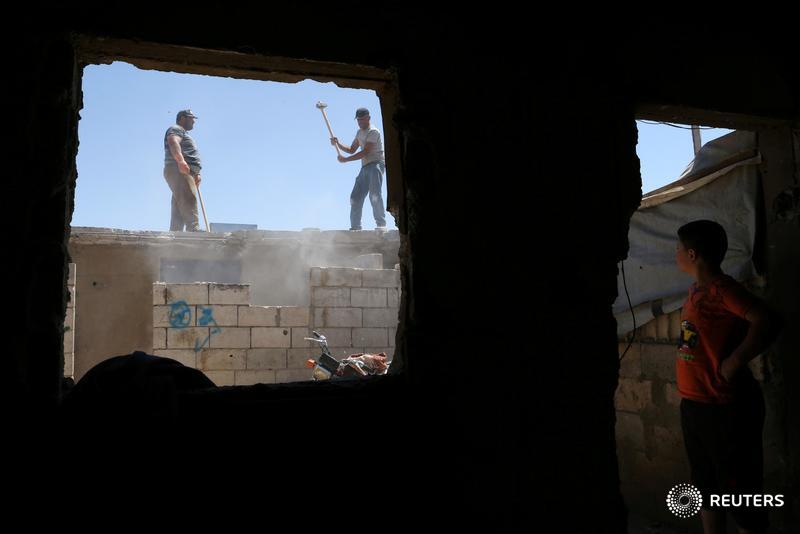
It would have been good enough for Mohamed Azakir to photograph the workers framed through the broken windows as they demolish huts, the hammer poised in mid-air and clear to see. But to have the boy in the shadows watching gives the image added strength and mood. It changes it from a ‘men at work’ image to ‘a home being destroyed’ image.


Workers use hammers to dismantle concrete huts at a makeshift Syrian refugee camp on the Lebanese border town of Arsal, Lebanon July 4, 2019.   REUTERS/Mohamed Azakir

I am not a great fan of ‘people walking past a picture’ to make a picture, but there is no getting away from the graphic immediacy of Nazanin Tabatabaee’s image. You are in no doubt about where this is, nor are you in any doubt about the political message in the mural, so given the tensions between Iran and the United States, it’s a very good illustrative image. 

A woman walks in front of a mural depicting the Statue of Liberty in Tehran, Iran, July 7, 2019.  Nazanin Tabatabaee/WANA (West Asia News Agency) via REUTERS    


Friday, 28 June 2019

A Week in Pictures Middle East and Africa, June 28, 2019

Anger flares in Mussa Qawasma’s picture that has a feeling of being bad tempered, hot and sweaty. A strong oval and diagonal composition created by the helmets and position of the arms draws us into the centre of the image. The strong sunlight catches the sweat on the face of the man who is held back by his friends as he confronts the Israeli forces. 

A Palestinian demonstrator scuffles with Israeli forces during a protest against Bahrain’s workshop for U.S peace plan, in Bethlehem, in the Israeli occupied West Bank June 25, 2019.   REUTERS/Mussa Qawasma 

I’ve selected Mohamed Abd Al-Ghany’s football celebration for no better reason that it’s just fun and a lovely shape. The players look like a well-rehearsed dance troupe coming on stage for the opening of a show. Do they practice these moves?  Who knows? But whatever they do it works, it’s fun and makes a great lighthearted picture. 

Madagascar’s Romain Metanire, Ima Andriatsima and team mates celebrate thei goal against Guinea during the Africa Cup of nations in Alexandria, Egypt June 22, 2019.   REUTERS/Mohamed Abd El Ghany

Deeper and deeper and deeper you are drawn into Umit Bektas’ picture of the boy posing for a picture, through the U-shaped curve of the camel’s neck, past the armed soldiers to the people on camels in the distance. The clean skyline ensures we are not distracted by any visual noise.   

A supporter of Lieutenant General Mohamed Hamdan Dagalo, deputy head of the military council and head of parliamentary rapid Support Forces (RSF), holds his portrait as he rides his camel before a meeting in Aprag village, near Khartoum, Sudan June 22, 2019.    REUTERS/Umit Bektas

Okay nit-pick time, how much on a scale of 1-10 do you think Baz Ratner would like the foot of the soldier in the centre of the picture not be to be covered by the soldier in the foreground? I am prepared to bet about 9. It’s almost as if the soldier is looking down at the offending appendage in this otherwise perfectly balanced image.     

Honour guards march after the memorial ceremony for the Ethiopian Army Chief of Staff Seare Mekonnen, in Addis Ababa, Ethiopia, June 25, 2019.   REUTERS/Baz Ratner

Often the most eye-catching subject is an object out of context, a boat on a roof or a car in a swimming pool. An upside-down tank in a stream also fits this category, especially when it is photographed with a slow exposure so the water blurs to give it a rather mystical and dreamlike feel.  Ronen Zvulun’s picture is part of a series of pictures titled “Land Scars”, that documents sites, buildings and objects that all form part of the long history of conflict and failed peace processes in the Israeli-Palestinian conflict. The series has taken weeks to shoot and was published to mark the start of the Bahrain Workshop, the latest attempt to break the deadlock.You can read on here.  

A Syrian tank lies over turned in the Hermon steam in Banias Nature Reserve on the western edge of the Israeli-occupied Golan heights February 27, 2019.   REUTERS/Ronen Zvulun 

There is no escaping the strong symmetrical shape to Tiksa Negri’s funeral picture. The rope holding the coffin and the compositional lines created by the people lowering the coffin form almost perfect diagonals that lead your eye from the corners of the frame to the grave. It gives the image a strangely serene feeling, but take a moment to look at the struggle, pushing and shoving that is taking place on the outer reaches of the image, nothing serene there. Now consider the effort it must have taken Tiksa to get into the position to shoot this perfectly shaped image.  

Pallbearers bury the flag-draped coffin carrying the body of Ethiopian Army Chief of Staff, Seare Mekonnen during his funeral in Mekele, Ethiopia June 26, 2019.   REUTERS/Tiksa Negeri

A cold, lonely and painful image by Ismail Zitouny from Libya created by the blues of the wall, the cold white light and a complex, busy composition. Your eye wanders around the messy image trying to make sense of the tubes, cables, a confusing vertical shape and a slight tilt to the horizontal lines all of which add to your sense of unease. It’s then that you spot the injured solder, laid out flat, alone and bloodied on what looks like a very uncomfortable bed. A second soldier, goes almost unnoticed on the bed on wheels but at least he has a slightly thicker mattress to lay on.   

Injured soldiers of the eastern forces led by Khalifa Haftar. Lay on beds at the Gharyan hospital, south of Tripoli, Libya June 27, 2019. REUTERS/Ismail Zitouny