Pages

Showing posts with label Eritrea. Show all posts

Friday, 12 July 2019

A Week in Pictures, Middle East and Africa, July 12, 2019


A stark and simple portrait by Umit Bektas with the subject staring you right in the eye. She is isolated in the foreground by strong highlights with the background falling into shadow. Her unfaltering stare is strong and determined, but her body language defensive, which leaves us wanting to know more. She is one of many women who were beaten and abused in Sudan during their fight for freedom. Read on here

Shems Osman, 32, employee at an international company, poses for a photograph in Khartoum, Sudan, June 29, 2019.    REUTERS/Umit Bektas


When you look at Clarel Faniry Rasoanaivo’s picture it’s hard not to hold your breath. Every element is frozen in time, waiting for the next explosive second. The keeper is poised for the shot, the goal mouth gaping open except for his tiny figure. The striker’s toes are curled up in sandals, their shadow falling on the ball. His right leg is bent back ready to release the shot, and his hand reaches down into the frame for balance, just filling the blue space of the sky created by striking leg. We all know what’s going to happen next, but the anticipation is wonderfully captured in this warm picture.      

Malagasy children play soccer on a pitch in Ankazobe town in the Analamanga Region Madagascar, July 10, 2019.  REUTERS/ Clarel Faniry Rasoanaivo

What better way to mark the first anniversary of the peace agreement between Ethiopia and Eritrea than a quick game of football, with junked buses and trucks marking the edge of the pitch. A wonderfully hopeful and well seen picture by Tiksa Negeri that gives me the feeling that what was bad is in the past and now is the time to look forward to better things, even if you are playing football barefoot in the dust.  

Eritreans play soccer as they celebrate the first anniversary of the reconciliation of Eritrea and Ethiopia in Mekele. Tigray Region, Ethiopia July 7, 2019.   REUTERS/Tiksa Negeri

A strong composition of diagonal lines making up an extended triangle gives Ako Rasheed’s picture a very solid and powerful feel. And that’s even before you take on board the subject matter. In step, these women soldiers march forward, weapons trained on an imaginary enemy, a solid and powerful force.  

A group of Iranian Kurdish women, who have joined Kurdish Peshmerga fighters, take part in a training session in a military camp in Erbil, Iraq, July 9, 2019.    REUTERS/Ako Rasheed


I have no idea just how long Sumaya Hisham had to wait, or how many frames it took, to get this perfectly framed moment. Whatever it took it was worth it. Like someone coming up for air in a sea of blue, this fan wearing giant yellow glasses is momentarily glimpsed, mouth open, singing at full volume. Catch up with the latest from AFCON here 

A Mali fan sings prior to their Round of 16 Africa Cup of Nations match against Ivory Coast in Suez, Egypt, July 8, 2019.    REUTERS/Sumaya Hisham

If I said zig zag zig zag you’d know exactly what I was going on about with Amir Cohen’s picture. Now take the time to look carefully. He shot this using a low shutter speed so the sea has blurred to appear like a deep purple carpet, allowing us to see details that would otherwise fall into deep shadow during this half-light time. Some of the figures have blurred too, but not the central focal point of the seated figure, who sits there, static and immovable, like King Canute.

A power station is seen in the background as beach goers are seen along the shore of the Mediterranean Sean in the evening at a beach in Ashkelon, Israel July 7, 2019.   REUTERS/Amir Cohen

A simple crowd-pleasing optical illusion from Mohamed Abd El Ghany is an easy pick for the week, hard to choose as there have been so many great images from AFCON. What makes this work so well as an illusion is that player Adrien Melvin seems to be watching the line of the giant ball and not the actual ball, and his leg position just could not be better. 

Madagascar’s Adrien Melvin in action durng their Round of 16 Africa Cup of nations against DR Congo in Alexandria, Egypt, July 7, 2019.   REUTERS/Mohamed Abd El Ghany

It would have been good enough for Mohamed Azakir to photograph the workers framed through the broken windows as they demolish huts, the hammer poised in mid-air and clear to see. But to have the boy in the shadows watching gives the image added strength and mood. It changes it from a ‘men at work’ image to ‘a home being destroyed’ image.
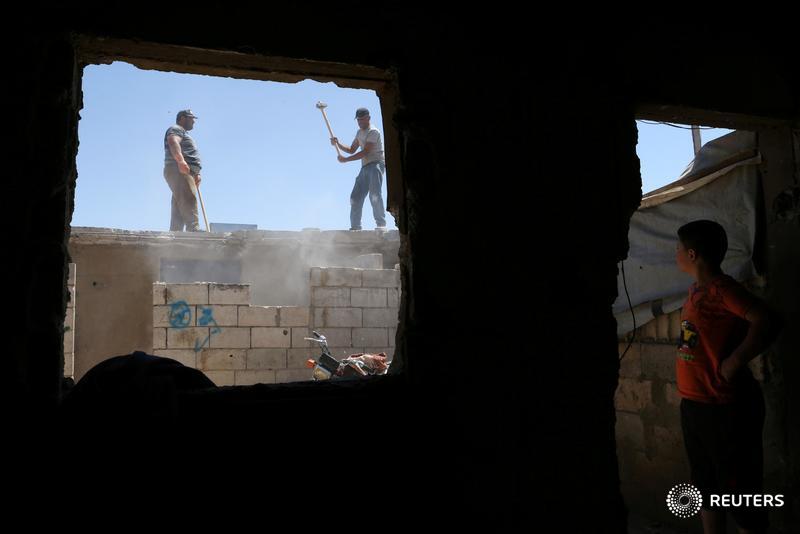

Workers use hammers to dismantle concrete huts at a makeshift Syrian refugee camp on the Lebanese border town of Arsal, Lebanon July 4, 2019.   REUTERS/Mohamed Azakir

I am not a great fan of ‘people walking past a picture’ to make a picture, but there is no getting away from the graphic immediacy of Nazanin Tabatabaee’s image. You are in no doubt about where this is, nor are you in any doubt about the political message in the mural, so given the tensions between Iran and the United States, it’s a very good illustrative image. 

A woman walks in front of a mural depicting the Statue of Liberty in Tehran, Iran, July 7, 2019.  Nazanin Tabatabaee/WANA (West Asia News Agency) via REUTERS    


Friday, 27 July 2018

A Week in Pictures Middle East and Africa July 27, 2018

I just needed to add Mohamed Abd El Ghany’s star spangled picture of the 'Blood Moon'. What I like so much about this is that Mohamed has approached this differently know that there would be many images of the moon in its red state through out the region. By using a long exposure and tripod he has put the lunar eclipse in the context of the cosmos and man. I feel this drives home just how small we look with our little electric light and digital technology. See more lunar eclipse pictures here


A Man takes pictures during the ‘Blood Moon’ lunar eclipse in the desert of Al Fayoum Governorate, south west of Cairo, Egypt July 27, 2018.   REUTERS/Mohamed Abd El Ghany

Baz Ratner’s picture of people watching as slum homes are destroyed to make way for a road has a slightly uncomfortable yet familiar feel to it. How often have you peered through fencing to watch construction work, or those of you who have toddlers would have more than likely entertained them with a trip to look at the ‘diggers’ and ‘workmen’. Although a very busy and complex image we are drawn into it from the strong dark tones in the foreground, through to the centrally placed figures wearing red in the middle ground up to the hazy distance of a mechanical digger tearing at the makeshift buildings in the dust. What is slightly uncomfortable is that this is the destruction of the homes of some of the poorest in the city. Read on here.


Onlookers watch as bulldozers demolish houses to make way for a new road in the Kibera slum in Nairobi, July 23, 2018.   REUTERS/Baz Ratner

The only way to describe Luc Gnago’s picture from the bus station in Mali is an explosion of light and colour. I am excited and exhausted as my eye races around this busy scene. Any colour you like is there. I so want to be there in the hustle and bustle, and I am not even worried by his shadow cast on the back of the green minibus or is that the shadow of the woman with the sack on her head? 


People hurry as they move to and from mini buses at the bus station in the evening light in Bamako, Mali, July 24, 2018.    REUTERS/Luc Gnago

I can’t help but think of the sun-dried bones of a prehistoric dinosaur when looking at the building in Tiksa Negri’s picture from Eritrea. I like the beauty and magnificence of the building destroyed by conflict and baked for years by the sun. It’s the same heat that the person carrying a table is sheltering from.  


A man carries a table as he walks past the ruins of a building in the port city of Massawa, Eritrea July 22. 2018.   REUTERS/Tiksa Negri

What is exciting is that we are now getting pictures out of Eritrea after years of no access. I love the pool of light which draws the viewer straight to the figures crossing the road silhouetted by the single car heading towards us. I sense that Tiksa Negri’s night street scene picture is really quite illustrative of the issues confronting the country and the capital, Asmara. The fact that the streets are hardly lit demonstrates the extent of the poverty the country is facing. 


An Eritrean couple walk along a street at night in Asmara, Eritrea July 21, 2018.   REUTERS/Tiksa Negri

In very much the same vein as the picture above, a small detail in a wide, even-toned space will catch your eye and you will look closely into it. With Ammar Awad’s powerful picture of a warplane in an attack dive you need to study it even more closely. Only then will you spot the two bombs released from the aircraft - destruction and possible death only seconds away.  


A warplane carries out a bombing run above Syria near the Israeli-Syrian border as seen from the Israeli-occupied Golan heights Israel, July 24, 2018. REUTERS/Ammar Awad


The strong light and the shallow depth of field in Suhaib Salem’s picture create an almost abstract swirl of body shapes, faces and hands that finally draws you to the face of the grieving woman. Once your eye settles on her, you look deeper into the grief. Her arms are tightly wrapped around the man, squeezing hard. It’s then you notice the hand from the almost invisible woman standing passively on the left, fingers digging into her brow, we assume, trying to rub her grief away.   


Relatives of Palestinian militant Abu Dakah, 31, who was killed in an Israeli strike, mourn during his funeral in Khan Younis in the Southern Gaza strip July 21, 2018.   REUTERS/Suhaib Salem

One normally associates the rainbow colours with LGBT and gay rights demonstrations, but not so in Corinna Kern’s haunting picture. Most colour has been taken out of the image as Corinna shoots through a transparent banner that has Netanyahu’s face printed on it. The image has the look of video frozen in transition as you fade from one sequence to the next. 


Israeli national flags can be seen through a banner with a picture of Israeli Prime Minister Benjamin Netanyahu, during a LGBT community members protest against the discriminatory surrogate bill in Tel Aviv, Israel July 22, 2018.   REUTERS/Corinna Kern

Strong colours, strong lines of design and a flow and counter flow all balance in Siphiwe Sibeko’s picture to make you feel like you are on a powerful tide of people moving from left to right and back again. Everyone is looking from right to left in this picture, their arms all leading in the same direction, a seething mass of people. But the main figure looks in the opposite direction, her face held motionless in the strong light. She seems to be beckoning to the army of people from Zimbabwe: Onwards, onwards!    


Supporters of Zimbabwe’s opposition party attend a rally in Chitungwiza, outside the capital Harare, Zimbabwe, July 26, 2018.   REUTERS/Siphiwe Sibeko

The inclusion of a second picture from the same story by the same photographer is rare in my weekly round-up, but I cannot resist the grace and beauty of the hands, fingers, eyes and colours in Luc Gnago’s wonderful picture of supporters at a political rally. You are immediately smitten with the beauty of the woman in profile with the red head scarf. You then feel as if you are in a complex and delicate dance that involves half glances of eyes through veils that finger and hand movements momentarily reveal. Count the number of eyes you can see but where you can’t see the full face; include in that count the posters too and you will maybe understand how I got this impression. Read on here.


Supporters of candidate Aliou Diallo, leader of the Democratic Alliance for Peace (Alliance Democratique pour la paix, or ADP-MALIBA) Party, attend an election rally in Bamako, Mali, July 26, 2018.   REUTERS/Luc Gnago

Amr Abdullah Dalsh uses the simple technique of back focusing that draws you immediately to the point of the picture, a portrait of a son. The ugly top stark lighting in the room not only highlights the picture in the black frame against a white wall but also darkens the eyes of the parents as they recount their story of their arrested son. The mood is very somber. Shawkan, their son, faces the death penalty. Read on here.


A photograph of jailed Egyptian photojournalist Mahmoud Abu Zeid, also known as ‘Shawkan’ is seen behind his parents at their home in Cairo, Egypt July 19, 2018.   REUTERS/Amr Abdallah Dalsh


Friday, 20 July 2018

A Week in Pictures Middle East & Africa July 20, 2018


I can’t decide if Amir Cohen is lucky or unlucky to be close enough to an Iron Dome missile system to capture its launch during a mortar attack, but either way it’s a striking picture. What adds to the strength of this image is that the photographer was quick enough to not only capture the missile’s launch but keep in the frame an equally lucky/unlucky person to give it scale and drama.  


An Israeli man looks on as Iron Dome launcher fires an interceptor rocket in the southern Israeli city of Ashkelon July 14, 2018.   REUTERS/Amir Cohen

No less striking a moment is captured by Ibraheem Abu Mustafa’s picture of an airstrike in Gaza on the same day as the Iron Dome launch. The ball of fire and great plumes of smoke are see in the terrifying context of city buildings all around. Stepping away from the actual news story that this was the worse exchange of fire between Israel and Gaza since 2014, and looking at this in pure visual terms, like the dark shapes in the foreground, it gives it scale and places it in a city. I did have a look at a tighter crop of the ball of fire as a focal point of the picture but think at the end of the day the wider image tells the story better. What do you think?   


An explosion is seen following an Israeli airstrike on a building in Gaza City July 14, 2018.   REUTERS/Ibraheem Abu Mustafa

An editor’s crop has transformed Philimon Bulawayo’s picture from vertical to  horizontal but also removed wasted white space at the top, drawing your eye to Chamisa’s face and the outstretched hands. What you do lose is the sense of the enormous crowds and the people who have climbed the pylon in the background. For my money I like the tighter crop. You may differ. 


Zimbabwe’s opposition party leader Nelson Chamisa is greeted by supporters at a rally at Sakubva stadium in Mutare, Zimbabwe, July 14, 2018.   REUTERS/Philimon Bulawayo

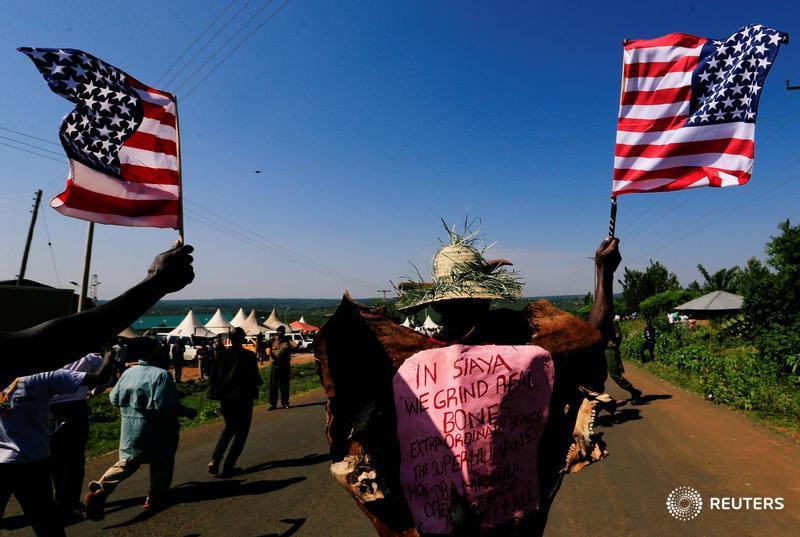
Sometimes you look and look at a picture and think something is a little out of place but can’t quite put your finger on what. Thomas Mukoya’s picture is one such image. The harsh light creates a complex set of shapes and colours, the hat, silhouetted figures, the pink shirt with writing on it you can’t make out and the tents, all make it hard for the eye to settle. Then slowly it dawns: the US flags have been attached to their poles back to front.  


Residents wave the U.S. national flag as the chant slogans as they walk along the road prior to the visit by former U.S. president Barack Obama to his ancestral home, Nyangoma Kogelo village, in Siaya county, western Kenya, July 16, 2018.   REUTERS/Thomas Mukoya

Siphiwe Sibeko’s picture breaks all the rules. You have a flat line that cuts the image in half, top to bottom; large empty black spaces; faces looking out of the frame so close to the edge of the picture you sense they are going to bump their heads. And yet it works wonderfully. 


Former U.S. President Barack Obama delivers the 16th Nelson Mandela annual lecture, marking the centenary of the anti-apartheid leader’s birth in Johannesburg, South Africa, July 17, 2018.   REUTERS/Siphiwe Sibeko

 We encourage photographers when they are shooting a story to make sure to include a detail picture. In my mind a detail picture is an image of something small that might easily go unseen but is quite revealing. It doesn’t have to be a closeup but often it is. Ari Jalal’s picture is quite abstract when you look at it in its entirety and turns the notion of detail on its head. You see a wide picture, horizonal line cutting the image in half with two slabs of toned colour, a ‘button’ casting a shadow in the top centre and small patches of colour. You have to look closely to see the patches of colour are hand prints and signatures of patients. Now you take the time to look at each of the hand prints and try to read the writing of each individual’s story.  


A mural of painted hands and messages from wounded people, who have recovered and have been discharged from the Medecins Sans Frontieres hospital in Mosul, Iraq, July 10, 2018.   REUTERS/Ari Jalal

One can only imagine the feelings you must have as a father hugging your daughters after being separated for 18 years, but Tiksa Negeri captures this moment forever. A very quiet image that needs a caption to explain it but you immediately get a sense of the powerful and tight embrace, as his daughters are held close and tight, their faces pressed to his chest. When you look into the shadows of the image, its real beauty comes alive, the sisters looking into each other’s tear-stained eyes, one with her hand on her father’s chest, just inside his jacket, where she can feel his heart beat. The lines on his face speak to me of years of worry and separation. You can see more heart-warming pictures from Asmara here


Adisalem Abu, reacts as he embraces his daughters, after meeting them for the first time in eighteen years at the Asmara International Airport after Ethiopian Airlines flight ET314 arrived in Asmara, Eritrea July 18, 2018.   REUTERS/Tiksa Negeri

The woman in the blue head scarf in Khalil Ashawi’s picture looks like she is frozen in time. Her mind and eyes are a thousand miles away, her sleeping baby is held close. Even though the picture is busy with the swirl of activity around her, your eye is drawn to the central point of her face. You are not distracted by the boy in the blue shirt, the white highlight to the left or the purple head scarf, you just keep coming back to that face.   


People are evacuated from the villages of al-Foua and Kefraya, Syria, July 19, 2018.   REUTERS/Khail Ashawi