Pages

Showing posts with label Golan Heights. Show all posts

Friday, 28 June 2019

A Week in Pictures Middle East and Africa, June 28, 2019

Anger flares in Mussa Qawasma’s picture that has a feeling of being bad tempered, hot and sweaty. A strong oval and diagonal composition created by the helmets and position of the arms draws us into the centre of the image. The strong sunlight catches the sweat on the face of the man who is held back by his friends as he confronts the Israeli forces. 

A Palestinian demonstrator scuffles with Israeli forces during a protest against Bahrain’s workshop for U.S peace plan, in Bethlehem, in the Israeli occupied West Bank June 25, 2019.   REUTERS/Mussa Qawasma 

I’ve selected Mohamed Abd Al-Ghany’s football celebration for no better reason that it’s just fun and a lovely shape. The players look like a well-rehearsed dance troupe coming on stage for the opening of a show. Do they practice these moves?  Who knows? But whatever they do it works, it’s fun and makes a great lighthearted picture. 

Madagascar’s Romain Metanire, Ima Andriatsima and team mates celebrate thei goal against Guinea during the Africa Cup of nations in Alexandria, Egypt June 22, 2019.   REUTERS/Mohamed Abd El Ghany

Deeper and deeper and deeper you are drawn into Umit Bektas’ picture of the boy posing for a picture, through the U-shaped curve of the camel’s neck, past the armed soldiers to the people on camels in the distance. The clean skyline ensures we are not distracted by any visual noise.   

A supporter of Lieutenant General Mohamed Hamdan Dagalo, deputy head of the military council and head of parliamentary rapid Support Forces (RSF), holds his portrait as he rides his camel before a meeting in Aprag village, near Khartoum, Sudan June 22, 2019.    REUTERS/Umit Bektas

Okay nit-pick time, how much on a scale of 1-10 do you think Baz Ratner would like the foot of the soldier in the centre of the picture not be to be covered by the soldier in the foreground? I am prepared to bet about 9. It’s almost as if the soldier is looking down at the offending appendage in this otherwise perfectly balanced image.     

Honour guards march after the memorial ceremony for the Ethiopian Army Chief of Staff Seare Mekonnen, in Addis Ababa, Ethiopia, June 25, 2019.   REUTERS/Baz Ratner

Often the most eye-catching subject is an object out of context, a boat on a roof or a car in a swimming pool. An upside-down tank in a stream also fits this category, especially when it is photographed with a slow exposure so the water blurs to give it a rather mystical and dreamlike feel.  Ronen Zvulun’s picture is part of a series of pictures titled “Land Scars”, that documents sites, buildings and objects that all form part of the long history of conflict and failed peace processes in the Israeli-Palestinian conflict. The series has taken weeks to shoot and was published to mark the start of the Bahrain Workshop, the latest attempt to break the deadlock.You can read on here.  

A Syrian tank lies over turned in the Hermon steam in Banias Nature Reserve on the western edge of the Israeli-occupied Golan heights February 27, 2019.   REUTERS/Ronen Zvulun 

There is no escaping the strong symmetrical shape to Tiksa Negri’s funeral picture. The rope holding the coffin and the compositional lines created by the people lowering the coffin form almost perfect diagonals that lead your eye from the corners of the frame to the grave. It gives the image a strangely serene feeling, but take a moment to look at the struggle, pushing and shoving that is taking place on the outer reaches of the image, nothing serene there. Now consider the effort it must have taken Tiksa to get into the position to shoot this perfectly shaped image.  

Pallbearers bury the flag-draped coffin carrying the body of Ethiopian Army Chief of Staff, Seare Mekonnen during his funeral in Mekele, Ethiopia June 26, 2019.   REUTERS/Tiksa Negeri

A cold, lonely and painful image by Ismail Zitouny from Libya created by the blues of the wall, the cold white light and a complex, busy composition. Your eye wanders around the messy image trying to make sense of the tubes, cables, a confusing vertical shape and a slight tilt to the horizontal lines all of which add to your sense of unease. It’s then that you spot the injured solder, laid out flat, alone and bloodied on what looks like a very uncomfortable bed. A second soldier, goes almost unnoticed on the bed on wheels but at least he has a slightly thicker mattress to lay on.   

Injured soldiers of the eastern forces led by Khalifa Haftar. Lay on beds at the Gharyan hospital, south of Tripoli, Libya June 27, 2019. REUTERS/Ismail Zitouny


Friday, 27 July 2018

A Week in Pictures Middle East and Africa July 27, 2018

I just needed to add Mohamed Abd El Ghany’s star spangled picture of the 'Blood Moon'. What I like so much about this is that Mohamed has approached this differently know that there would be many images of the moon in its red state through out the region. By using a long exposure and tripod he has put the lunar eclipse in the context of the cosmos and man. I feel this drives home just how small we look with our little electric light and digital technology. See more lunar eclipse pictures here


A Man takes pictures during the ‘Blood Moon’ lunar eclipse in the desert of Al Fayoum Governorate, south west of Cairo, Egypt July 27, 2018.   REUTERS/Mohamed Abd El Ghany

Baz Ratner’s picture of people watching as slum homes are destroyed to make way for a road has a slightly uncomfortable yet familiar feel to it. How often have you peered through fencing to watch construction work, or those of you who have toddlers would have more than likely entertained them with a trip to look at the ‘diggers’ and ‘workmen’. Although a very busy and complex image we are drawn into it from the strong dark tones in the foreground, through to the centrally placed figures wearing red in the middle ground up to the hazy distance of a mechanical digger tearing at the makeshift buildings in the dust. What is slightly uncomfortable is that this is the destruction of the homes of some of the poorest in the city. Read on here.


Onlookers watch as bulldozers demolish houses to make way for a new road in the Kibera slum in Nairobi, July 23, 2018.   REUTERS/Baz Ratner

The only way to describe Luc Gnago’s picture from the bus station in Mali is an explosion of light and colour. I am excited and exhausted as my eye races around this busy scene. Any colour you like is there. I so want to be there in the hustle and bustle, and I am not even worried by his shadow cast on the back of the green minibus or is that the shadow of the woman with the sack on her head? 


People hurry as they move to and from mini buses at the bus station in the evening light in Bamako, Mali, July 24, 2018.    REUTERS/Luc Gnago

I can’t help but think of the sun-dried bones of a prehistoric dinosaur when looking at the building in Tiksa Negri’s picture from Eritrea. I like the beauty and magnificence of the building destroyed by conflict and baked for years by the sun. It’s the same heat that the person carrying a table is sheltering from.  


A man carries a table as he walks past the ruins of a building in the port city of Massawa, Eritrea July 22. 2018.   REUTERS/Tiksa Negri

What is exciting is that we are now getting pictures out of Eritrea after years of no access. I love the pool of light which draws the viewer straight to the figures crossing the road silhouetted by the single car heading towards us. I sense that Tiksa Negri’s night street scene picture is really quite illustrative of the issues confronting the country and the capital, Asmara. The fact that the streets are hardly lit demonstrates the extent of the poverty the country is facing. 


An Eritrean couple walk along a street at night in Asmara, Eritrea July 21, 2018.   REUTERS/Tiksa Negri

In very much the same vein as the picture above, a small detail in a wide, even-toned space will catch your eye and you will look closely into it. With Ammar Awad’s powerful picture of a warplane in an attack dive you need to study it even more closely. Only then will you spot the two bombs released from the aircraft - destruction and possible death only seconds away.  


A warplane carries out a bombing run above Syria near the Israeli-Syrian border as seen from the Israeli-occupied Golan heights Israel, July 24, 2018. REUTERS/Ammar Awad


The strong light and the shallow depth of field in Suhaib Salem’s picture create an almost abstract swirl of body shapes, faces and hands that finally draws you to the face of the grieving woman. Once your eye settles on her, you look deeper into the grief. Her arms are tightly wrapped around the man, squeezing hard. It’s then you notice the hand from the almost invisible woman standing passively on the left, fingers digging into her brow, we assume, trying to rub her grief away.   


Relatives of Palestinian militant Abu Dakah, 31, who was killed in an Israeli strike, mourn during his funeral in Khan Younis in the Southern Gaza strip July 21, 2018.   REUTERS/Suhaib Salem

One normally associates the rainbow colours with LGBT and gay rights demonstrations, but not so in Corinna Kern’s haunting picture. Most colour has been taken out of the image as Corinna shoots through a transparent banner that has Netanyahu’s face printed on it. The image has the look of video frozen in transition as you fade from one sequence to the next. 


Israeli national flags can be seen through a banner with a picture of Israeli Prime Minister Benjamin Netanyahu, during a LGBT community members protest against the discriminatory surrogate bill in Tel Aviv, Israel July 22, 2018.   REUTERS/Corinna Kern

Strong colours, strong lines of design and a flow and counter flow all balance in Siphiwe Sibeko’s picture to make you feel like you are on a powerful tide of people moving from left to right and back again. Everyone is looking from right to left in this picture, their arms all leading in the same direction, a seething mass of people. But the main figure looks in the opposite direction, her face held motionless in the strong light. She seems to be beckoning to the army of people from Zimbabwe: Onwards, onwards!    


Supporters of Zimbabwe’s opposition party attend a rally in Chitungwiza, outside the capital Harare, Zimbabwe, July 26, 2018.   REUTERS/Siphiwe Sibeko

The inclusion of a second picture from the same story by the same photographer is rare in my weekly round-up, but I cannot resist the grace and beauty of the hands, fingers, eyes and colours in Luc Gnago’s wonderful picture of supporters at a political rally. You are immediately smitten with the beauty of the woman in profile with the red head scarf. You then feel as if you are in a complex and delicate dance that involves half glances of eyes through veils that finger and hand movements momentarily reveal. Count the number of eyes you can see but where you can’t see the full face; include in that count the posters too and you will maybe understand how I got this impression. Read on here.


Supporters of candidate Aliou Diallo, leader of the Democratic Alliance for Peace (Alliance Democratique pour la paix, or ADP-MALIBA) Party, attend an election rally in Bamako, Mali, July 26, 2018.   REUTERS/Luc Gnago

Amr Abdullah Dalsh uses the simple technique of back focusing that draws you immediately to the point of the picture, a portrait of a son. The ugly top stark lighting in the room not only highlights the picture in the black frame against a white wall but also darkens the eyes of the parents as they recount their story of their arrested son. The mood is very somber. Shawkan, their son, faces the death penalty. Read on here.


A photograph of jailed Egyptian photojournalist Mahmoud Abu Zeid, also known as ‘Shawkan’ is seen behind his parents at their home in Cairo, Egypt July 19, 2018.   REUTERS/Amr Abdallah Dalsh


Friday, 13 July 2018

A Week in Pictures Middle East and Africa July 13, 2018

There is no escaping the feeling that Ronen Zvulun’s picture is more than a little bizarre. Five people dressed the same, sitting on what looks like a precipice, legs daggling into the abyss looking into Syria. Once you get past looking at the raised arms and wondering why they are doing that, your gaze is propelled to the far horizon through blue skies to a haze that might be created by the clashes near the border or could just be banks of cloud. 


Israeli Druzes sit together watching the Syrian side of the Israel-Syrian border on the Israeli-occupied Golan Heights, Israel, July 7 2018.   REUTERS/Ronen Zvulun 

Feisal Omar’s picture is a powerful news picture in a classic sense: it’s full of action and drama. Armed men rush through bomb-damaged streets; your eye races around the frame in confusion. Your attention darts from the coloured screen and reds and blacks of the tuk tuk, to the shadows and harsh vertical lines of the grey concrete building behind, back to the gunman on the left, and finally to the three men on the right, with their weapons held at the ready.  You can see the full sequence of pictures here. 


Somali security agents take position as they secure the scene of a suicide car bombing near Somalia’s Presidential Palace in Mogadishu, Somalia, July 7, 2018.   REUTERS/Feisal Omar


Alaa Al-Fakir’s picture is all about perseverance and determination. The small girl labors in the heat of the overhead sun at what seems her impossible task of pushing a wheelchair-bound elderly person over rough and barren terrain. The glimmer of hope I try to take from this picture of difficult struggle is the determination in the girl’s efforts. Using the full force of her body, she is not giving up: her legs are braced, head down and arms straight. She will succeed in helping this person less able than her. 


An internally displaced girl pushes a woman in a wheelchair near the Israeli-occupied Golan heights in Quneitra, Syria July 11, 2018.   REUTERS/Alaa Al-Fakir

When I look at the light and compositional structure of Ronen Zvulun’s picture I think of the American painter Edward Hopper . Warm and cold colours, strong lines and bold flat shapes fighting for equal amounts of space. The figure always perfectly positioned in the composition, but leaving us with the sense that they are slightly distant, divorced or uncomfortable, that they’d rather be elsewhere. 


A Syrian woman holds a baby as she walks into a checking room just after they crossed the armistice line to the Israeli-occupied Golan heights to get medical treatment in Israel July 11, 2018.   REUTERS/Ronen Zvulun 

I was impressed with Ibraheem Abu Mustafa’s picture from Gaza for complex reasons that I will explain. Often, he covers clashes and funerals but we also need to illustrate less visually rich news stories such as financial and complex political stories about longer-term trends. On this occasion the story was China’s growing economic influence in the Middle East. Not an easy one, not one to make immediate impact but certainly one to demonstrate sophisticated visual thinking. What would you take a picture of? When a customer searches ‘China Gaza’ to illustrate the political and economic of China’s role in Gaza this image will be found. It’s a ‘slow burn’ clever picture told by the words MADE IN CHINA on the box. 


A Palestinian vendor carries a cardboard box containing toys made in China, in Khan Younis in the southern Gaza Strip, July 10, 2018.  REUTERS/Ibraheem Abu Mustafa  

Two striking and thoughtful pictures from Sumaya Hisham to illustrate the ongoing turmoil at the energy company Eskom. I love the march of the pylons appearing over the hill like an alien army. With the washed out sky, the cold steel shapes seem to be wading  through what looks like a cold sea, an effect created by the horizonal lines in the grass. Read on here about the Eskom pay deal.


Electricity pylons carrying power from Koeberg nuclear power station are near Cape Town, South Africa, July 11, 2018.   REUTERS/Sumaya Hisham

And in Sumaya’s picture below I love the patches of cold blue of the cross painted in the door and the equally cold blue light in the two windows on the left countered by the warmth of the sky and the hot spots of the lights overhead. And both these pictures were used to match a financial story about pay negotiations between workers and a company. To produce such imaginative pictures from what is a relatively dry story is a mark of a great photographer.   


Overhead power lines are seen at Khayelitsha informal housing settlement near cape Town, South Africa, July10, 2018.  REUTERS/Sumaya Hisham

To describe Andreea Campeanu’s picture as ‘busy’ would probably be the understatement of the week. Your eye jumps from the red shirt of the barber, to the window highlight reflected in the mirror, back down the whites and blues of the customer’s shirt, up to the pattern on the ceiling, then down along the pictures of potential styles on the back wall, to the barber’s brush held and silhouetted against the mirror on the back wall. Finally, you come to rest on the gentle eyes and broad smile of the customer. It’s then you notice the next customer, seated, waiting in line, also reflected in the mirror. What an epic journey and all in such a small barber shop.   


An Internally displaced man receives care inside a barber shop in the United Nations Mission in South Sudan (UNMISS) protection of Civilian 3 site (PoC), outside Juba South Sudan, July 12, 2018.    REUTERS/Andreea Campeanu

Friday, 6 July 2018

A Week in Pictures Middle East and Africa July 6, 2018

I have an ongoing love of pictures that are based around commodities and the infrastructure associated with this industry; oil, coal, wheat and mining all top of my list. Akintunde Akinleye's picture of oil workers, wearing matching orange boiler suits and yellow helmets, dwarfed by a rusting tank, the lines of the rust dicing the frame in a regular patten, the metal steps crashing diagonally across the warm toned picture is just wonderful. I like it too that all the workers seem to have taken a break from the work at hand to have their picture taken.  


Construction workers are seen at an oil storage tank at the Dangote Oil Refinery under construction in Ibeiu Lekki district, on the outskirts of Lagos Nigeria, July 5, 2018.   REUTERS/Akintunde Akinleye

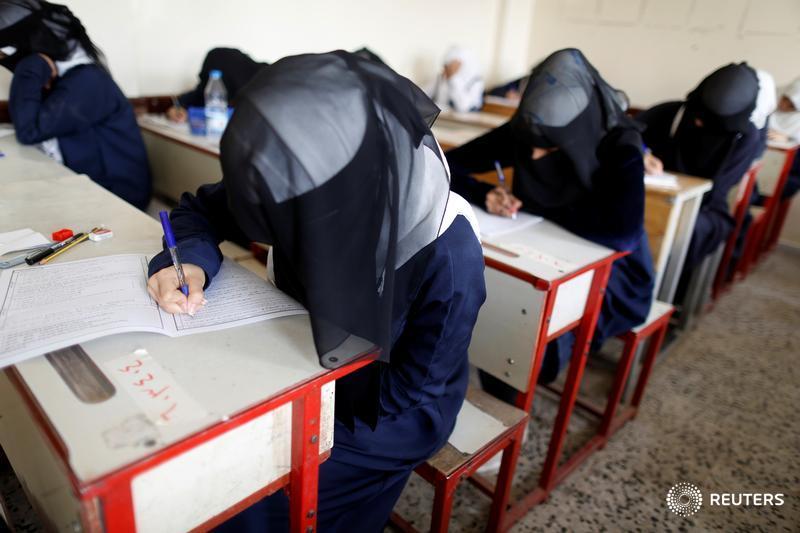
A clever use of shape, line and pattern by Khaled Abdullah gives this image a ‘robotic machine’ feel as the students, heads down and working hard, try to achieve their best. It took me a while to work out why I got this impression, but I think it’s a combination of the reds, whites and blues all regularly spaced, the pens all tilting at the same angle, and the students all with their left hands under their desks. 


Students take their final High School exams in Sanaa, Yemen June 30, 2018.  REUTERS/Khaled Abdullah 

At first glance this picture is almost abstract and it takes a while to figure it out as you struggle past the bright reds and opaque blacks. Yasser Abu Al-Naia is cocooned in red and white and smothered in harsh black shadows, and hands reach up from the bottom of the picture to draw your eye to the 14-year-old’s face in Suhaib Salem’s powerful picture. Once you see that young face it’s hard to look away. I didn’t for a very long time.  


Mourners carry the body of 14-year-old Palestinian boy Yasser Abu Al-Naia who was killed by Israel forces during a protest at the Israeli-Gaza border, during his funeral in Khan Younis, the southern Gaza Strip June 30, 2018.    REUTERS/Suhaib Salem

One of the best things about being a news photographer is seeing events unfold in front of you, so you can take great pictures for the world to see. To do that you need to be in places that many cannot go to and that too is very attractive. Feisal Omar takes advantage of this opportunity to stand on a red carpet in front of a full parade of police on Independence Day to take a carefully composed picture balancing the red stripe of the carpet with the white lines on the ground. Shame the officer was just a few inches too far to the left of the carpet. 


Somali police forces attend a parade during celebrations to mark Somali’s 58th Independence Day in Mogadishu, Somalia, July 1, 2018.    REUTERS/Feisal Omar

Beyond the immediate tragedy of Alaa Al-Faqir’s picture of a woman made homeless through conflict, I am struck that she is carrying a carpet that is almost twice as large as she is across a muddy field. Obviously, a prized possession to be carried to safety when she was forced to leave home, but strangely this image gives me a glimmer of hope. I sense that even though she was forced to flee she expects to build her home again with more than just essentials. But that said, it’s still a sad picture that raises many questions.      


A woman carries a carpet on her shoulders near the Israeli-occupied Golan heights in Quneitra, Syria July 2, 2018.  REUTERS/Alaa Al-Faqir

The small demonstration of displaced Syrians in Ammar Awad’s picture is dwarfed by the zig zagging fence, security lines and slight shimmer of heat haze that surround them. The scene is compressed as it has been shot on a very long lens, and your eye is drawn to the white placards held by the protesters. Once there, you are trapped with them, your eye held fast by posts of the barbed wire fencing pointing at them, making it hard to look away. Read on here. 


Internally displaced people in the Golan Heights protest near the border between Israel and Syria in an appeal to the UN and the international community to stop Russia from carrying out an offensive, as seen from the Israeli-occupied Golan heights, Israel July 4, 2018.   REUTERS/Ammar Awad

Mohamad Torokman produced a powerful set of pictures when police clashed with Palestinians, throwing up dust clouds around the struggling figures. This is a complex picture of twisting bodies and swirling limbs as people try to pull a woman away from the police. You have to fight equally hard visually to get to the focal point, through the almost monochromatic framing until you reach the centre of the picture. Hands and clothing stretched to tearing point, grimacing faces and the bright complimentary colour of green and reds. You can see more here


Israeli policemen try to detain Palestinians in the Bedouin village of Al-Khan al-Ahmar near Jericho in the occupied West Bank July 4, 2018.   REUTERS/Mohamad Torokman

Siphiwe Sibeko’s picture of demonstrators blocking roads with burning tyres is wonderful. You are immediately grabbed by the graphic shape of the circle of the black tyre surrounded by orange flames. What I like too is the position of the feet, the protester in full purposeful stride, and the picture brimming with energy.  


A man blocks a road with a burning tyre while protesting against electricity cuts in Klipspruit Soweto, Johannesburg, South Africa July 4, 2018.   REUTERS/Siphiwe Sibeko

A simple and affectionate picture of dancing men by Zoubeir Souissi caught my eye this week. The mood of the picture created by the slight tilt to the framing and the regular shape of the arches in the background that seem to bounce from left to right over the heads of the swaying, barefoot men. A final nice touch is the ‘halo’ around the head of the man in black in the centre of the image.  


A Tunisian Sufi group perform in Tunis, Tunisia July 5, 2018.   REUTERS/Zoubeir Souissi


Friday, 16 February 2018

A Week in Pictures - Middle East & Africa, February 16, 2018

A last minute update to the week's selection from Middle East and Africa of Luc Gnago's wonderfully composed picture using classic thirds and complementary colours of orange and blue. The picture of the tree against the blue sky on the orange earth would have been nice enough but three girls walking from left to right, all equally spaced in line, one, two, three or A, B C to fill the space perfectly make this image just a little bit special.


Girls carry water on their bicycles at a dispensary in Nedago village near Ouagadougou, Burkina faso, February 16, 2018.   REUTERS/Luc Gnago

A series of air raids by the Israeli Air force and anti-aircraft counter attacks by Syrian forces prompted a quick response by Ammar Awad, who headed to the Golan Heights. The main questions at this time were: ‘Whose move and what happens next?’Ammar’s picture of the signpost, the waiting woman and the cut-out figure of a gunman sum up the moment of watching and waiting. 


A woman sits near a sign at Mount Bental, an observation post in the Israeli-occupied Golan Heights that overlooks the Syrian side of the Quneitra crossing, Israel February 10, 2018. REUTERS/ Ammar Awad

If the cut-out of the gunman in Ammar's picture above is classic in its shape, I think Baz Ratner's running boy is another classic. The boy's legs are almost at full stretch, his arms are clearly defined, and water is splashing up behind. It is an irresistible pick for the week.  


A boy runs across the Turkwel River running through Lodwar, in Turkana County, Kenya February 6, 2018.  REUTERS/Baz Ratner

Satish Kumar’s picture is a wonderful combination of busy line and shape through shadow and structure. There are too many triangles to count as your eye races to the world’s tallest building, the Burj Khalifa, in the middle distance to the tiny shape formed between the hands of the woman taking a picture of her friend.


A visitor takes photos at the 71st floor of the Gevora Hotel, the world's tallest hotel, in Dubai, UAE February 12, 2018. REUTERS/Satish Kumar

The eerie cold blue light from a mobile device highlights the face of the fighter in a room bathed in the warm glow of firelight, creating an almost theatrical scene in Khalil Ashawi’s terrific picture. Shadows flickering in the light on the wall soften the unmistakable shape of his weapon in the background. At the same time the fighter’s covered features are frozen like ice in the harsh blue light.  


Turkey-backed Free Syrian Army fighter holds a cell phone in the town of Tadef in Aleppo Governorate, Syria February 12, 2018. Picture taken February 12, 2018. REUTERS/Khalil Ashawi

Faded glory has got to be the understatement of the week to describe Amr Abdullah Dalsh’s picture. The colours are muted, every poster is torn or faded and the piles of rubbish look as if they have been there for years and will be there for years to come. I can’t imagine for a minute what these men are talking about, but I sense they are in no hurry to finish their conversation. I think this is a wonderful and timeless picture.


An Egyptian man waits in front of Pepsi products shop for customers at the shanty area Zabaleen or "Garbage City", the poorest part of Cairo, where thousands of Copts make a living by recycling everything from plastic bottles, food remains, carton and metal on the Mokattam Hills in eastern Cairo, Egypt February 12, 2018. REUTERS/Amr Abdallah Dalsh

On the day police recommended that Netanyahu should be indicted for bribery, Nir Elias had a lucky break with the light as the prime minister walked into the spotlight. An inch lower and his eyes would be in shadow and the essence of the picture would have been lost. What also makes this picture for me is the fact that the sliver of light ends in black shadow on both sides of the frame, suggesting a momentary glimpse of something going on. 


Israeli Prime Minister Benjamin Netanyahu (R) arrives ahead of a planned address at the Muni World 2018 conference in Tel Aviv, Israel February 14, 2018. REUTERS/Nir Elias

In Bassam Khabieh’s picture, the boy’s arm and his cheek echo the shape of the Red Crescent logo. The circles of the emblem are also echoed in the wheels of the bike and the truck, all combining to make a very complicated composition. There is there is no telling if this boy is holding his head in relief because supplies have reached Douma, or in concern that it’s not enough. But either way, I think the tension in his locked fingers tells a story of concern. 


A boy gestures near a Syrian Arab Red Crescent truck in the besieged town of Douma, eastern Ghouta, in Damascus, Syria February 14, 2018. REUTERS/Bassam Khabieh 

A sea of faces stretching to the furthest horizon, with people’s arms crossed in unison, makes Tiksa Negri’s picture quite striking. The only break in the flow to the rear of the picture is a single flag being waved. I can almost taste the dust being thrown up by these thousands of people.


Supporters of Bekele Gerba, secretary general of the Oromo Federalist Congress (OFC), chant slogans to celebrate Gerba's release from prison, in Adama, Oromia Region, Ethiopia February 14, 2018. REUTERS/Tiksa Negeri

A surprise press conference late in the evening by South African President Zuma gave Siphiwe Sibeko access to a historical moment. On the face of it, a simple assignment -- man speaks at podium to announce his resignation – but it’s much harder to make it something special. Throw in strong light and a long shadow and you have a special moment well captured by Siphiwe. I have added a second picture that was well used and which demonstrates that ‘bread and butter’ pictures are as important as thoughtful, creative images. Think too about the caption as we edit this live. Zuma arrives as president, all smiles, and we don’t know what he is going to say. At the end of his address he announces his resignation and leaves press conference as a former president. 


South Africa's President Jacob Zuma arrives to speak at the Union Buildings in Pretoria, South Africa, February 14, 2018. REUTERS/Siphiwe Sibeko


South Africa's President Jacob Zuma looks down as he speaks at the Union Buildings in Pretoria, South Africa, February 14, 2018. REUTERS/Siphiwe Sibeko