Pages

Showing posts with label Turkana. Show all posts

Friday, 17 July 2020

A Week in Pictures, Middle East and Africa, July 17, 2020

There is something childishly wonderful about watching people get soaked but not as wonderful as intentionally getting soaked yourself. I dare you not to smile at Mike Hutchings’ pictures. The sea foam looks almost like drifting snow but Mike has left a sliver of background at the top of the frame so we get a sense of the power and scale of the wave crashing in.  


People are drenched by sea spray thrown up by huge swells as a cold front moves in over Cape Town, South Africa, July 13, 2020. REUTERS/Mike Hutchings 

I could not resist adding a second frame from the same scene as I love the way the wave is backlit so it looks like an alien reaching out to consume a hapless human. Move over Ridley Scott and James Cameron, there’s a new boy in town. 

People watch spray thrown up by huge swells as a cold front moves in over Cape Town, South Africa, July 13, 2020. REUTERS/Mike Hutchings 

A captured moment by Mohamed Abd El Ghany as a young woman adjusts her veil in a mirror, or is she looking at herself? It’s a shy look with a catch light in her eye that draws us to that glance as her hands gently adjust the garment. Once you ease away from that look you are enveloped in the richness and depth of the gold, blue, red and green colours all warmed up under artificial lighting.    
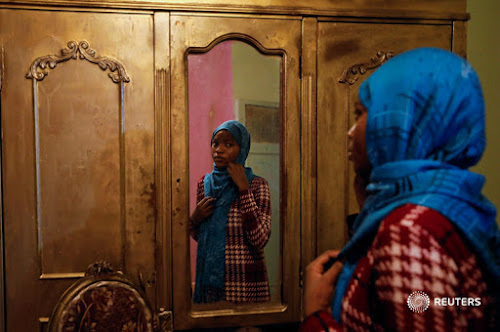
Sudanese refugee, Hamida Abdallah, fixes her veil in front of a mirror at her apartment in Ain Shams district, amid concerns about the spread of the coronavirus disease (COVID-19, in Cairo, Egypt, July 7, 2020. Picture taken July 7, 2020. REUTERS/Mohamed Abd El Ghany 

Ammar Awad’s picture is crammed full of faces, hands and reds and is more than a little claustrophobic to look at. Pirates, clowns, gloves and masks all fill the space, vying for attention, and the longer you look the hotter the temperature seems to get in this busy, crowded picture.  

Israelis protest against the government's response to the financial fallout of the coronavirus disease (COVID- 19) crisis at Rabin square in Tel Aviv, Israel July 11, 2020. REUTERS/Ammar Awad 

With an initial glance, Baz Ratner has produced a semi-formal environmental portrait of proud, traditionally dressed people looking directly at us through the lens, set against a clean background. But look again, peering around a corner is the smiling face of another, watching the scene unfold, breaking the formality of the moment with an almost cheeky glance. And look even deeper, a backward glance of a strikingly dressed passerby also catches our eye. Read on here.  

A family from the Turkana tribe pose for a picture in the village of Lorengippi near the town of Lodwar, Turkana county, Kenya July 2, 2020. REUTERS/Baz Ratner 

 A very nicely seen picture by Temilade Adelaja as we get an insight into the records department through the open doorway. Soft light and warm colours leave us with the feeling that this is a pleasant place to work. Maybe it’s not the light and colours that leave us with that impression but a sense of a bygone age, no computer on the desk, calm worker with pen on paper, neatly stacked files on the bookshelf at the rear and the sign above the door that states very clearly that this is the RECORD DEPARTMENT. Read on here. 

A woman wearing a protective mask works at the record department of the Primary Healthcare Centre, amid the spread of the coronavirus disease (COVID-19) in Lagos, Nigeria May 7, 2020. REUTERS/Temilade Adelaja 

 Hang on, something’s missing in Mike Hutchings’ picture. The shoulders look right and the hands are well placed to support the weight of the head. The pattern of the stonework replaces the eyes and the curve of the arch replaces the imaginary top line of the head as the mind’s eye struggles to recreate what is missing: the head of the statue. Read on here. 

A damaged bust of Cecil John Rhodes, a controversial figure in the history of South Africa, is seen after the statue had been vandalised and had the head removed in Cape Town, South Africa, July 14, 2020. REUTERS/Mike Hutchings 

 Essam Al-Sudani has produced one of the most moving and sad set of images I have seen for quite some time: a child cancer ward impacted by coronavirus disease COVID-19. Many of the images appear without hope at all as parents sit with gravely ill children. This single image really jumped out at me as there is no escaping the faraway look in this mother’s eye as she looks out of the window. We can only imagine what she is thinking, her thoughts uninterrupted by her child, who is bound tightly in swaddling and silent. Read on here. 

An Iraqi woman wearing a protective mask carries her baby, who is suffering from cancer, at the Children's Hospital for Cancer Diseases, amid the spread of the coronavirus disease (COVID-19), in Basra, Iraq July 9, 2020.  REUTERS/Essam Al-Sudani  

Raneen Sawafta shoots wide and exposes for the highlights so all the shadows fall into darkness, leaving us with the masked face and hand of the dancer surrounded by solid black, with just the tiniest hint of torso. Even the mask doesn’t detract too much from the intensity seen in her face, a feeling created by the downcast eyes.  

A Palestinian girl wearing a mask rehearses for a performance at the Freedom Theatre amid the coronavirus disease (COVID-19) crisis in Jenin in the Israeli-occupied West Bank July 16, 2020. REUTERS/Raneen Sawafta  


Friday, 16 February 2018

A Week in Pictures - Middle East & Africa, February 16, 2018

A last minute update to the week's selection from Middle East and Africa of Luc Gnago's wonderfully composed picture using classic thirds and complementary colours of orange and blue. The picture of the tree against the blue sky on the orange earth would have been nice enough but three girls walking from left to right, all equally spaced in line, one, two, three or A, B C to fill the space perfectly make this image just a little bit special.


Girls carry water on their bicycles at a dispensary in Nedago village near Ouagadougou, Burkina faso, February 16, 2018.   REUTERS/Luc Gnago

A series of air raids by the Israeli Air force and anti-aircraft counter attacks by Syrian forces prompted a quick response by Ammar Awad, who headed to the Golan Heights. The main questions at this time were: ‘Whose move and what happens next?’Ammar’s picture of the signpost, the waiting woman and the cut-out figure of a gunman sum up the moment of watching and waiting. 


A woman sits near a sign at Mount Bental, an observation post in the Israeli-occupied Golan Heights that overlooks the Syrian side of the Quneitra crossing, Israel February 10, 2018. REUTERS/ Ammar Awad

If the cut-out of the gunman in Ammar's picture above is classic in its shape, I think Baz Ratner's running boy is another classic. The boy's legs are almost at full stretch, his arms are clearly defined, and water is splashing up behind. It is an irresistible pick for the week.  


A boy runs across the Turkwel River running through Lodwar, in Turkana County, Kenya February 6, 2018.  REUTERS/Baz Ratner

Satish Kumar’s picture is a wonderful combination of busy line and shape through shadow and structure. There are too many triangles to count as your eye races to the world’s tallest building, the Burj Khalifa, in the middle distance to the tiny shape formed between the hands of the woman taking a picture of her friend.


A visitor takes photos at the 71st floor of the Gevora Hotel, the world's tallest hotel, in Dubai, UAE February 12, 2018. REUTERS/Satish Kumar

The eerie cold blue light from a mobile device highlights the face of the fighter in a room bathed in the warm glow of firelight, creating an almost theatrical scene in Khalil Ashawi’s terrific picture. Shadows flickering in the light on the wall soften the unmistakable shape of his weapon in the background. At the same time the fighter’s covered features are frozen like ice in the harsh blue light.  


Turkey-backed Free Syrian Army fighter holds a cell phone in the town of Tadef in Aleppo Governorate, Syria February 12, 2018. Picture taken February 12, 2018. REUTERS/Khalil Ashawi

Faded glory has got to be the understatement of the week to describe Amr Abdullah Dalsh’s picture. The colours are muted, every poster is torn or faded and the piles of rubbish look as if they have been there for years and will be there for years to come. I can’t imagine for a minute what these men are talking about, but I sense they are in no hurry to finish their conversation. I think this is a wonderful and timeless picture.


An Egyptian man waits in front of Pepsi products shop for customers at the shanty area Zabaleen or "Garbage City", the poorest part of Cairo, where thousands of Copts make a living by recycling everything from plastic bottles, food remains, carton and metal on the Mokattam Hills in eastern Cairo, Egypt February 12, 2018. REUTERS/Amr Abdallah Dalsh

On the day police recommended that Netanyahu should be indicted for bribery, Nir Elias had a lucky break with the light as the prime minister walked into the spotlight. An inch lower and his eyes would be in shadow and the essence of the picture would have been lost. What also makes this picture for me is the fact that the sliver of light ends in black shadow on both sides of the frame, suggesting a momentary glimpse of something going on. 


Israeli Prime Minister Benjamin Netanyahu (R) arrives ahead of a planned address at the Muni World 2018 conference in Tel Aviv, Israel February 14, 2018. REUTERS/Nir Elias

In Bassam Khabieh’s picture, the boy’s arm and his cheek echo the shape of the Red Crescent logo. The circles of the emblem are also echoed in the wheels of the bike and the truck, all combining to make a very complicated composition. There is there is no telling if this boy is holding his head in relief because supplies have reached Douma, or in concern that it’s not enough. But either way, I think the tension in his locked fingers tells a story of concern. 


A boy gestures near a Syrian Arab Red Crescent truck in the besieged town of Douma, eastern Ghouta, in Damascus, Syria February 14, 2018. REUTERS/Bassam Khabieh 

A sea of faces stretching to the furthest horizon, with people’s arms crossed in unison, makes Tiksa Negri’s picture quite striking. The only break in the flow to the rear of the picture is a single flag being waved. I can almost taste the dust being thrown up by these thousands of people.


Supporters of Bekele Gerba, secretary general of the Oromo Federalist Congress (OFC), chant slogans to celebrate Gerba's release from prison, in Adama, Oromia Region, Ethiopia February 14, 2018. REUTERS/Tiksa Negeri

A surprise press conference late in the evening by South African President Zuma gave Siphiwe Sibeko access to a historical moment. On the face of it, a simple assignment -- man speaks at podium to announce his resignation – but it’s much harder to make it something special. Throw in strong light and a long shadow and you have a special moment well captured by Siphiwe. I have added a second picture that was well used and which demonstrates that ‘bread and butter’ pictures are as important as thoughtful, creative images. Think too about the caption as we edit this live. Zuma arrives as president, all smiles, and we don’t know what he is going to say. At the end of his address he announces his resignation and leaves press conference as a former president. 


South Africa's President Jacob Zuma arrives to speak at the Union Buildings in Pretoria, South Africa, February 14, 2018. REUTERS/Siphiwe Sibeko


South Africa's President Jacob Zuma looks down as he speaks at the Union Buildings in Pretoria, South Africa, February 14, 2018. REUTERS/Siphiwe Sibeko