Pages

Showing posts with label black and white photography. Show all posts

Tuesday, 2 April 2024

...And now for my next trick?

Last week a line was drawn under my work in Hull. Stories I had begun in the 1980s and completed over the last three years - ‘Rag Bone!’, ‘Ladies and Gentlemen, Kandy de Barry!’ and ‘Star & Garter’ - all converged in one place. Drag artist Ray Millington, originally known as Kandy de Barry, was performing as Bobby Mandrell in the Star & Garter pub, now called Rayners. Rag and Bone man and long-term friend George Norris was there, not to collect scrap, but to photograph Ray. I was in Hull to show some friends our exhibition ‘You and Me in HU3’ at the Humber Street Gallery, which featured these three stories as well as pictures by George. An opportunity for a ‘happy snap’ too good to miss.

George Norris, Ray Millington and myself in Rayners, on Hessle Road, Hull March 23, 2024. 

Below George Norris with horse Sally and cart, The Star & Garter pub and Kandy de Barry performing in the St Georges pub, all taken in 1983

In two weeks’ time, our exhibition in Hull will be closing. All the books of the show have sold out, feedback in the comments book was heart-warming, media coverage and gallery footfall were terrific, and we’ve just finished a series of talks about it all. 


A couple of the hundreds of comments left by people who visited our exhibition at the Humber Street Gallery 'Wonderful, eye opening, Incredible, important photos'


Exhibiting this work has been as exciting for me as when I was a child blowing up an enormous balloon to bursting point, then letting it go, releasing the pent-up energy, wonderful to watch as it darts around the room. 


But now the hunt is on for the spent balloon. It’s never easy to find. And after going through the story-telling process, I am feeling like that spent balloon. I have to start again, but I need time for a rethink.


The big question – why bother?  


On and off for about the last 18 months and interrupted by the ‘You and Me in HU3’ exhibition, I have been shooting a new story, walking up and down the Lea Bridge Road in northeast London. it’s typically London and ordinarily happy, with business, leisure, faith, food, migration, gentrification, cycle and bus lanes, and 20 mph speed cameras. I want to capture the ordinariness of the changing face of London and I think the Lea Bridge Road community sums up this change perfectly. 


I knew I was going to hit the buffers once the Hull exhibition closed so I decided to take some pre-emptive action. As I was revisiting the stories I’d shot in Hull in the 1980s, I decided to ask my original tutor, respected documentarist Daniel Meadows, if I could show him my recent work and ask for feedback. Despite the passage of over 40 years Daniel hadn’t lost his edge. He asked me all the questions that had been nagging in the back of my mind. In short, why am I doing this? Is the story interesting enough? Are the pictures good enough? Why am I using an old Rolleiflex and shooting black and white film?


I have printed out Daniel’s key point and put them on my notice board. They are as good as they are brutal. Pulling out a few in bold to mull them over, I’ve added images to illustrate them. 


1 - ‘Sharpen the focus of your intent’ tells me I am not fully communicating what I am trying to say. This is true. I am still circling the story and need to find a way in to capture the essence of this community without misrepresenting it. This will take time. 


A woman waits for a bus on the Lea Bridge Road, London September 23, 2023.  


4 – ‘No point photographing familiar things unless you show them in a way which hasn’t been seen before.’ In short, the pictures are boring in terms of content, composition and light. I agree and have still not shot a picture that makes me think, mmm I’m happy with that, but I am getting closer. I have restricted myself to a square format film camera as an entrĂ©e to people I photograph on the street and as a visual challenge to my own picture-taking. I am very much struggling with technology, or the lack if it, with the Rolleiflex but I don’t want to do what I did when I was a student aged 23 shooting 35mm format black and white film, nor do I want to do what I did as a news photographer, using the latest 35mm digital technology. I want to struggle with something that is new to me and will, I hope, eventually produce different results from what I have done in the past. 


Boys chat on the top deck of a bus just off the Lea Bridge Road, London September 26, 2023.  


5 – ‘You seem to be avoiding getting too close and I wonder why?’ I know exactly why. I am trying to rebuild my confidence in photographing people and at the same time struggling with the notion of a ‘negotiated space’ in which to take these pictures. As a news photographer there was no negotiation, I just took. Today, I want my pictures to have a feel of ‘candid permission’, so the images will have a look of being candid while being permissioned but without being set up. This is a very small space that I am trying to occupy, which I sometimes fear might not really exist given it’s now 2024.


Girls chat as they wait at traffic lights to cross Argall Way that crosses Lea Bridge Road, London September 4, 2023.  


10 – ‘Justify working in black and white’. I have considered this and decided to shoot black and white for two reasons. The first was to take out the noise of colour that we are bombarded with on the street when composing pictures. Secondly, I wanted to give people actual prints and slow the ‘act of photography’. This I hope will produce an image for them that feels more considered and as a consequence is more treasured. 


A woman cycles down Lea Bridge Road, London, past graffiti on a wall, September 27, 2023.  


12 – ‘Keep going’. And this is what I intend to do. 


A woman vapes and blows smoke as she walks past dumped furniture on Bickley Road just off Lea Bridge Road, London, September 1, 2023.


This post originated as a few notes to clarify my own thinking. But after chatting to a few colleagues I realised that many are going through the same thought processes, so I decided to share some of my thinking. Rejecting the obvious attractions of a comfy sofa and afternoon TV I have loaded up the camera with film and headed out. 


Plucking up all my courage I asked Kelly Bear if I could photograph her and her dog, Dr Nommy, as they headed off to the vets just off the Lea bridge Road. At the end of the day, it’s just a picture of a woman in the street with a dog on a lead but to me it represents the next step as I leave the past in the past and try to use what I have learned in Hull with future work.


Kelly Bear with her dog Dr Nommy who were off to the vets along the Lea Bridge Road March 21, 2024. Kelly, who lives on the Lea Bridge Road, said the biggest change she had noticed is that there are so many better coffee shops since she moved to the area. 


Russell Boyce  


Edited by Giles Elgood  


Friday, 17 June 2022

The Danger of Looking Back and Getting trapped in All Our Yesterdays

A respected friend and colleague once said to me: ‘At our age it’s dangerous looking back at the past’. That struck a chord as I was considering revisiting a picture story I had shot almost 40 years ago and I really didn’t want it to turn into ‘all our yesterdays’. I decided the real danger was that once you start looking back you might never stop, and looking forward would be a thing of the past. 


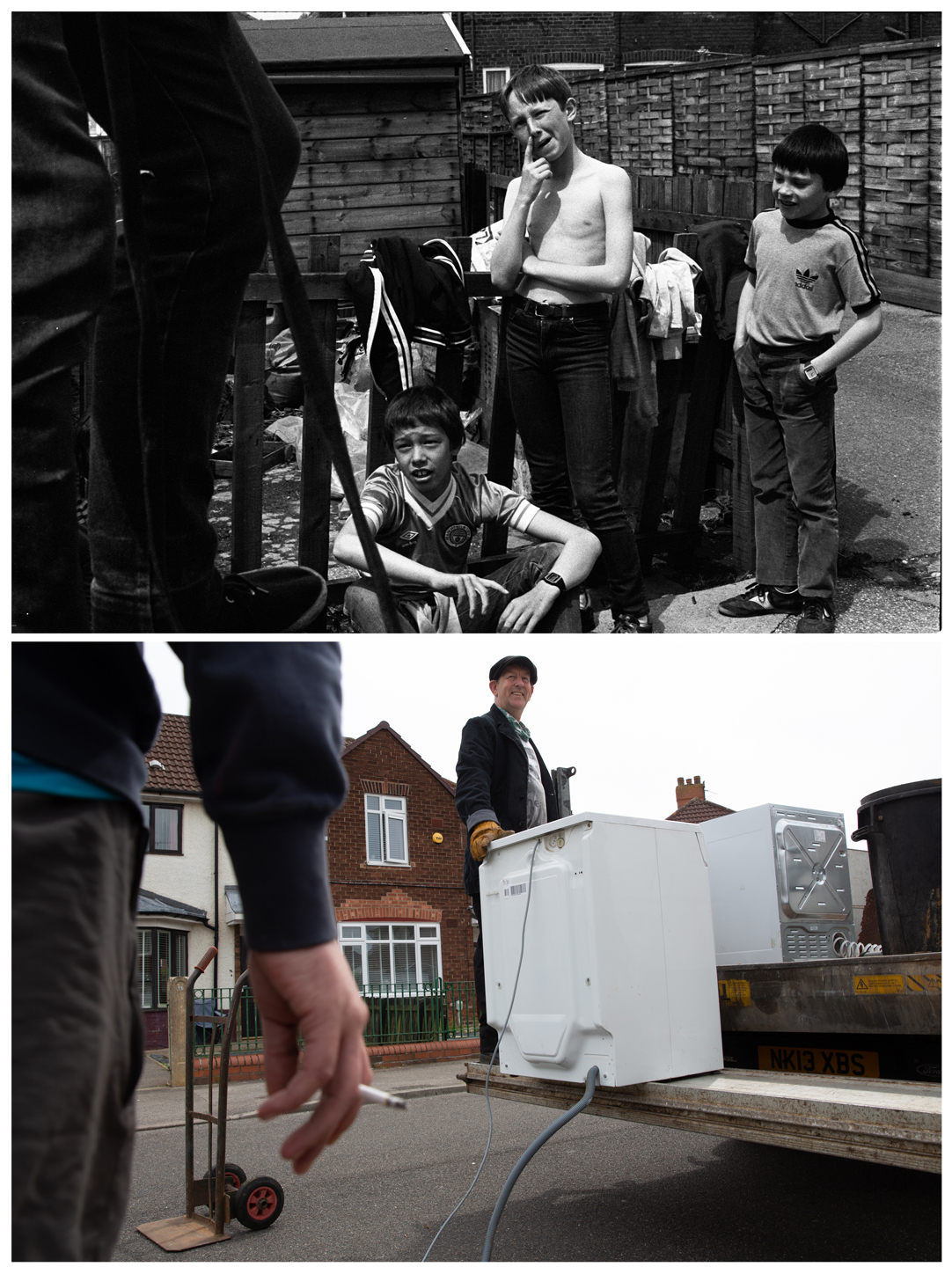
My dilemma was this: in 1983 I documented George Norris, a 19-year-old Rag and Bone man in Hull. We’ve been in touch ever since and he called me to say he was back on the carts, but this time with his 81-year-old father, George Snr, who had been collecting scrap since he was 13. 

Rag and Bone man George Norris Snr attends to his horse and cart in the 1960s in Hull.           Picture Keith Wade

On the one hand this was a terrific opportunity to photograph him again, looking at what had changed in Hull over the past 40 years, and what had not. On the other hand, I feared I was retracing old steps and reliving my past. In the end, I decided it’d be fun spending time with George and I’d get my step numbers up too. George agreed immediately but I suggested he thought it over, asked his dad, thought about it again, and then replied in the cold light of day. Yes again. 

I now had to decide how to shoot this and, more importantly, why. In 1983, as an art student, I shot the whole story with a Minolta 100b camera, mainly using a 35mm lens and all on black and white film. In our 2022 post-digital revolution I could go all-out analogue by dusting off my old Nikon FE and slapping on a 35mm lens. I rejected that idea. I was not interested in trying to recreate the style of what I had achieved in 1983 as this would be stepping on to the slippery slope towards all our yesterdays. Two reasons for this: I might discover that I hadn’t improved as a photographer, and I had already recreated a picture for fun… 

About five years ago when I was visiting George, we decided to recreate one of my pictures. George had to tap up a mate to borrow a horse, we had to find the right junction on Woodcock Street where the housing had long been demolished, and avoid the traffic. It was chaos. George was bitten by the horse, which reared up and tried to kick him, much to the amusement of its owners, the traffic backed up and we were shouted at by motorists. But we got a nice picture that features on the Cafe Royal Books publication ‘George Norris Rag and Bone Hull 1980s’.  


Apart from avoiding slippery slopes, I was unclear what story I wanted to tell. Was it George then and now? Was it George and his father’s Rag and Bone legacy? Was it the demise of the traditional Rag and Bone trade? Or were these Rag and Bone men appearing as bit players in Hull’s changing cityscape? 


But I ditched any preconceived ideas and decided to go out with my cameras and see what happened. I also threw in a wild card:  as well as shooting on 35mm digital I carried a Rolleiflex and shot black and white film. The attraction here being the square format and the slower pace of composition and shooting. Conscious that I’d be doing a Q&A on video, I also needed some B roll and would shoot that on my iPhone.


What I learned on day one (12,000 steps) was that the story needed the actual voices of George and his father, not just quotes in text, so the planned video Q&A session gained importance. What also became apparent was that the ‘then and now’ pictures were happening in front of me whether I liked it or not. Not only in the repetitive nature of their work but in terms of line, shape and composition within the cityscape.


My content had mushroomed. In 1983 it was black and white film in 3:2 format. In 2022, it was 3:2 format colour digital, Q&A video shot at 16x9 on the DSLR and mic’d for sound, iPhone video B roll and square format 120 black and white roll film. Well, I suppose ‘Content is King’.  I was editing the file down and captioning the pictures after each day’s work to try to keep the mushroom contained. 

This was the pattern of the day’s work. At 8.30 sharpish George Norris Snr would sound his horn outside George’s house and the three of us would squeeze into the cab. He would then get ‘a vibe’ as to where they’d call the streets, and ‘if aught were comin’ out’ a new area would be tried. By 1 p.m. (day 2, 18,000 steps) we’d head off to Neise’s Diner for lunch. A dice with death to cross the road as George Snr refused to use the crossing. Steaming hot steak and kidney pie with mash, veg, a cuppa and a pudding, with custard of course, countered the good work the steps were doing on my midriff and all for £6. Then to the Griffiths Group, Metal and Waste Recycling (we don’t call them scrapyards anymore, recycling is the buzzword) to offload the morning’s collection.

George Snr would drop us back at George’s house. A power nap for George while I got down to editing and captioning.


By day three (20,500 steps, we went out that night too) I had come to realise that the pictures I shot in 1983 should be the story’s visual base element and that would rein in the visual chaos I was creating. By looking back at my original pictures I was able to build on that foundation and begin to structure the story visually. None of the pictures, either in 1983 or 2022, were posed or set up. 

When I saw the opportunity, I worked hard to position myself so a detail like the roof line was at the same angle as the picture shot in 1983 while George pounded the streets. Parked cars and wheelie bins in pictures taken in 2022 destroyed many of the compositional lines the pictures had in 1983. Their bright colours were a distraction. 


I experimented with removing the colour from the 2022 images to create black and white combination pictures. Although initially it seemed like a solution to the problem of mixing black and white and colour, it quickly looked like a pastiche and I felt I was staring down that slippery slope again. 


Apart from the obvious differences - no horse and cart, no flattened Victorian housing, no second-hand shops and no obvious signs of unemployment and poverty - there was a noticeable shortage of people on the streets, which was a concern for me. Also missing was the modern equivalent of one of my favourite pictures from 1983, June outside her second-hand shop, a type of business that just doesn’t exist anymore.


I began to think beyond the more obvious visual aspects of combination pictures - repetition of action, line and shape - to examine the notion of using sentiment to combine images. I thought at first that visually this would be like adding tomato ketchup to custard in Neise’s Diner. I tested my idea on a friend who’s a terrifically creative editor (not the custard and ketchup idea, the picture idea) and it began to make sense to us both. The example below uses the eye line as the common factor to make the link.


To help me sort out the chaos (day five, 10,000 steps) I got all the newly edited pictures printed and spread them out of the floor. The distraction of a drugs bust at a cannabis farm opposite colour printers Foto Worx helped me while away the time as the prints were made.


I was trying to work out how the edit would work in terms of sequence: what order should the pictures be seen in and was a natural flow developing? Nagging in the back of my mind were the different format requirements of video, web page design and, if possible, print. Two landscape pictures made into a combination create a vertical and two vertical pictures make a landscape. Verticals seen on both video and web pages do not sit comfortably but verticals viewed on mobile devices do sit well. Both shapes would create black bands either on the top and bottom or the sides on the 16x9 video format and a transition between the two could make a visual ‘jump’, especially shifting from black and white to colour. 


So, I concluded that different edits were needed for the different formats, which sounds obvious now. But to create different edits to tell the same story I needed lots of content, which luckily I had.

For my website I transcribed all the video and wrote the text story (not without help from my colleague Giles, thanks again). I realised that I needed some additional pictures from 1983 to provide social and economic context for the flow of the narrative. This presented me with the opportunity of using the picture of June in the second-hand shop. The use of text was heavier at the start of the piece than further down, where I just relied on captions. I decided to bold the text to accentuate this. I think the combination pictures work very well, especially when viewed on a phone.


I structured the story as ‘a day in the life’ timeline starting in the morning, through to the collection of scrap, weighing at Griffiths and then the day’s end. You can see the result by clicking here.

The video edit was more complex. I wanted to use the video platform to tell the story through still images. The danger was that I would be seduced into using too much video, and the stills from 2022 would take second place. At the same time, I had to consider the potentially uncomfortable viewer experience as the content format jumped from 16x9 video to vertical combination still pictures. My solution was to not shy away from these concerns but use them to my advantage. 

In my first edit I led the story with the head shot combo of George in 1983 and 2022 to introduce him to the viewer and to say this was a story told in stills and not video. But I was a little uncomfortable with how the almost square shape appeared on the screen as an introduction. My solution was somewhat counterintuitive. I led the edit with B roll video which says ‘hey this a video piece about George’ but then crashed in a single vertical 3:2 still black and white portrait picture of George with my narration as audio. I think the black around the image enhances it too. This to me says ‘hey this is a story about George told in still pictures using a video format as a platform. Enjoy!’  You can see the full video by clicking here.


What the video does allow is a transition between the 1983 and 2022 still pictures. This removes need to use the combination pictures and when you freeze the transition it produces rather pleasing results.  


I was also acutely aware that the video is 10 minutes long. I’m told the attention span of viewers of most online content is 30 seconds. As a challenge to myself I produced a 59 second video too that you can see here. Maybe the audience I am looking for has more than 30 seconds. I certainly hope so. The analytics on the video so far bear this out, so I am more than happy.   

I think I have managed to avoid the problem associated with looking back at the past and getting stuck there. I have done a full 360 degrees and am looking forward to the next idea. I think I have moved the story on by how I shot and presented it in 2022. But you can be the judge of that.

As for the 120 black and white Rolleiflex pictures, I felt they would not add anything more to the telling of George’s story in these formats. But I could not resist a sneaky footnote on the video with a combination of nine pictures. I will turn my mind to them soon.


Russell Boyce 2022


Tuesday, 8 March 2022

What's on a film that sat in a camera on a shelf for 40 years?

Recently a friend handed me a boxed Zeiss Ikon camera, first made in 1932. The box was a little tattered, the instructions a bit creased but the camera looked in excellent condition. 


Now my heart usually sinks when asked about cameras. For me they are simply a means to an end, capturing ‘the picture’.  


He said it was his Godmother’s camera and had sat on his shelf for at least thirty years, and wanted me to shoot a roll of film with it. 


At home I read the instructions and popped open the back. To my amazement there was a roll of film that had been wound through the camera. There could be an unseen picture of relatives in younger days. Or it could be a case of a full year high days captured to the shout of ‘get the camera dear, time to do a picture’, Christmas, Easter, a summer holiday, a birthday celebration and a new-born all on one roll. Or just a blank strip of fogged film.


So now I had two jobs; first, get the film processed and secondly, see if the camera still works. 


The film needed to be processed C22. I quickly discovered that the C22 process was superseded by C41 in 1972. I decided to explore the rabbit hole of technical photo forums on how to best get this film processed, it made my head spin. So, I made a quick post on Facebook for some help and emailed a few photo labs to see what they advised. 


Capturing the present…


In the meantime, I decided to pop a roll of HP5 film into the camera to see if it was still light tight and the shutter worked. The shutter speed range is 25th to 125th with a ‘not so handy’ B setting too. Aperture ranging from F6.3 to F22. 


Before going out I again referred to the instructions. Just as well as I discovered if you want a horizontal picture hold the camera upright and if you want vertical picture hold the camera horizontal. See fig 1.


Fig 1.


A diagram to explain what is where on pages 2 and 3 and an attractive assistant to help with my exposure.


Focussing was (as ever) going to be a challenge. The focus ring was marked in feet, 4.6, 6, 9, 12, 18, 30 and infinity. I decided to keep it constant so paced out four steps and set the camera at 12ft at F8. I kept that distance in my mind’s eye, moving back or forth or letting people walk into range. It was all very hit and miss and needed a lot of practice. If people were moving too quickly, I decided to leave well alone as at 125th it would not freeze the ‘action’.


I fought myself with the notion that I had to try to make half decent pictures. Why put all that effort in if the camera was leaking light, but then again if it wasn’t leaking light I would end up with a boring set of pictures. Also, I couldn’t remember how much I had to wind the film to make sure that it didn’t double expose part of the frame. 


Upside down numbers appearing in dark red windows on the back of the camera as I wound the film. The black squares on the contact sheet are where I over wound the film. Lesson learned.


I spotted two ladies who were walking slow enough that I figured 125th would freeze their movement. As they came into the 12 ft line, I took their picture and immediately the woman on the left said, ‘you can take my picture wearing a bikini if you like.’ 


Quick as a flash I replied, ‘It’s too cold for me to wear a bikini and as I’ve put on a bit a weight it causes too much chafing when I run about.’ 


Lucky for me they hadn’t heard the second oldest joke in the photographer’s repertoire and off they went chuckling to each other.  


The picture itself, although dull except for the laugh with these two old dears, demonstrates that the lens is sharp enough and with a little tweaking in photoshop the tones are quite pleasing too. I shot the picture below to eliminate the movement element. Sharp enough to methinks. 


It started to rain so not wanting to get the old camera wet I headed home, second task complete. I have returned the camera to Chris, its owner, loaded with a roll of film so he can master it.


Processing the past…


As for developing the colour film I was given a few options. Process it in modern C41 chemicals but at room temperature for 50 minutes. This method may retain some colour but risks losing all images. Another forum said forget any notion of retaining colour and develop in ID11 for 13 minutes so at least you’ll be assured of an image if there is anything on the film. And a third suggestion was to process in ID11, agitate for one minute and then leave undisturbed for an hour. I went for option four and sent to AG Photographic+Photolab who assured me they give it love and care and hand process as black and white. 


And that’s exactly what they did. Here is the processed film on my light box. At first glance nothing to see. 


But the team at AG Photographic+Photolab must have worked some magic as there are two images.


The black lines are where the film has been fogged over the years. But what is most exciting for Chris is that woman in the first frame on the left is his Godmother, Carys Houston. But as yet, he is unable to identify the other woman in the picture or where this picture was taken. It also transpires the camera was actually owned by Carys’ husband, Canadian Roy Houston, who was a cardiologist and died in 1958. 


I have cropped the image here so you can see them more clearly. Is that a figure between them who has moved their head quickly and blurred? Remember the camera shutter speed is 125th at best. The hair dos look similar or maybe it’s just a plant? I’ll let you think on that. 


No-one is sure where or what the battleships are so even though at the time it was important enough for someone to take a picture of them, that importance has faded with time. No doubt there is someone out there in the Metaverse who can identify it. 


For sure this journey was not a Vivien Maier discovery in terms of photography. But in simplest terms Chris has another image of his Godmother Clarys and a Zeiss Ikon camera that works. 


Oh, and if you are wondering what the oldest joke in a photographer’s repertoire is, I think it is; ‘let’s go into the darkroom and see what develops.’


Thursday, 18 November 2021

A year on - what's next?

Saturday November 13, 2021 was a rather special day. Almost exactly a year to the day of being told that I was to be made redundant from a job I loved, I was out taking pictures on a story I had thought about for years but never got around to do. And just as importantly I knew why I was doing it. I have discovered, the passion I have for pictures and story-telling is no less diminished. 

I shot twelve frames on a Rolleiflex 75mm F3.5 using HP5. The film I processed myself, my love hate relationship with the smell of ID11 and fixative revisited. The negatives scanned on an Epson V600.  Here is the contact sheet, frame one, bottom left, frame 12 top right.


I will be the first to admit that none of the images are earth shatteringly wonderful, but the exposure is even, the composition and timing not bad. But actually, what is more important is how I arrived at this point – shooting black and white on a vintage medium format camera. I will wind my year back to explain. 


But first, my favourite image is frame two. The man wearing headphones reflected in two mirrors, I like the busy lines criss-crossing through the picture, one of which, the reflection of the padlock, points to the figure, giving the image a focal point despite the words ‘Bargain’ and ‘Sale’ fighting for attention.


After attending a Zoom call in February 2021 titled ‘Out of the Archives. Collecting Stories of Everyday Life’ hosted by Four Corners I spent weeks scanning 35mm black and white negatives I shot in 1985 that had been gathering dust in my attic. I was encouraged by Lisa der Weduwe from the Museum of Youth Culture (MOYC), who addressed the call, to scan them. We were all in lockdown so why not? I am very happy with the result, about 150 pictures of Newtown Youth culture published and archived by the MOYC. If you click here or on the picture below you can see them all. I’m also in talks to have an exhibition of these pictures in Peterborough, but that’s another story, and quite exciting.


Cleaning, scanning and removing 36 years of dust from negatives is a rather time consuming and solitary task. Although it was quite exciting to see what a wonderful archive I had, I was, in essence, looking backwards. All my yesterdays, I asked myself was I hiding? 


Britain was in full lockdown so shooting pictures of people wasn’t easy. Maybe everybody was hiding? I would go for a daily walk around local parkland to get some exercise and clear my head. The lockdown rules permitted you to walk with one other person but at a 2m distance. I noticed, as I walked past others, I’d catch a snippet of their conversation. To start to regain my confidence photographing people I decided that I’d shoot a series of portraits of fellow walkers and include what I’d overheard in the caption, I called it 'Overheard in Lockdown'. I was amazed that only one person refused to be photographed and be included in the project. The pictures are simple environmental portraits, the background determined by where my path crossed with other walkers. It was fun and I had great conversations with total strangers. I think it’s a timely document, prior to the UK’s four-step roadmap out of lockdown, that’s hopefully never to be repeated. Click here or on the picture below to see the full set.    


‘I keep cycling the same old loop again and again’. Davide Terrasi and Naiem Dakry


While sorting out the Newtown Youth negatives, I came across another small project I shot in 1985. In short, I photographed everyone who knocked on my door.  Spurred on by the success of the ‘Overheard in Lockdown’ project I decided that I’d try to track down these people 36 years later and re-photograph them on their doorstep. With the help of the local paper and the easing of lockdown I managed to find a few. The local response was heart-warming and when I did meet up with my subjects, reshooting them and giving them prints was a major confidence boost. You can see the whole series here.


I have always been fascinated by change, but change that is imperceivable until you look at it retrospectively. The corner shop that is always open until it’s no longer there, the aged owner passed on or moved away. The three old men sitting on the same seats in the pub sipping at their pints every night that for years were part of the furniture who are now no longer there; or that old factory building or row of terraced houses that is now a new mini store or block of flats. The slow decline or the gentrification of an area as the populous slowly changes, to me, is a rich area for social documentary. London is a constantly changing, hundreds of years of migration, growth and change. I want to capture London now, not the usual landmarks, high life, low life and razzamatazz that gets the attention but the imperceivable changes in ‘ordinary’ London, like a river slowly changing its banks and course over the years.


To me the Lea Bridge Road (A104) is such a place. It runs between Hackney and Waltham Forest, through Leyton. It was named after a bridge that was built over the River Lea in 1745. Over the years I have spent hours stuck in slowly chugging traffic looking out of my window watching life go by. I have decided to photograph people and places along the length of this road. To me it encapsulates the unseen changes that London is going through, people, commerce, leisure, faith and architecture. My ambition is to capture the everyday ordinariness today that in the future will be so special as it will no longer exist.


Long gone are the halcyon days when you can go into a pub, factory or institution, ask the boss if you can take pictures and they’d decide yes or no within minutes. For example, for me to photograph the Woolwich Ferry it took over a year to get all the permission I needed. But to me it was well worth the time spent.


The Woolwich ferry story is a good example of what I am trying to achieve. The three boats that I photographed in 2015 and had been crossing the Thames since the 1960’s are now no longer in service, forever gone. Most of the staff, retired. 


Also, a question that troubled me was technically how to photograph the Lea Bridge Road? I could dust off my Nikon FM2, click in my trusty 35mm, wind on a roll of HP5 and push it two stops and wear a keffiyeh as a neck scarf. But wasn’t that what I did in 1985, all my yesterdays? I could use my Canon 5D that will produce technically wonderful images in low light. As a news photographer, editor and manager I have always advocated the use of colour, pure commercial sense once the business had changed to full colour, especially with online digital. But, the perception of most is that people who produce 35mm cameras with no apparent good reason, such as a wedding, are predators and up to no good. It would be hard to integrate into the community of the Lea Bridge Road with continual cries of ‘What you taking pictures of?” Or ‘Oi paparazzi’ or even as I was once told when shooting a simple feature ‘If you took my picture, I will ram that camera up your arse!’  As a side note I assured this gentleman that I did not take his picture and was able to safely return my camera into a bag. 


These days people tend to be suspicious of photographers.


A chance conversation with a friend provided the answer. He told me casually that he was being given a Rolleiflex and would need to learn how to use it. This was the solution I was looking for. 


First, the new visual challenge of composing in a square format, with the added complexity of everything being back to front was very appealing. Secondly, focussing manually, no motor drives and only having twelves frames per roll of film all restrictions that, I believe, leads to more creative thinking. Another friend wisely said to me recently when I asked him why use black and white film when digital colour is so perfect, ‘the perfection and beauty of using black and white film are the small imperfections it throws up’. I was sold.


So after two bad online shopping experiences trying to get the right camera I bought a wonderful camera from Robert at the Vintage & Classic Camera Company. Not cheap, but excellent condition and fully working. The last thing I wanted to do was struggle with the mechanics of a camera when I was struggling with everything else involved in taking pictures. 


Once purchased I then had to learn how to use it. I quickly discovered that I needed more time than I imagined. After a few rolls of the long-suffering family and a few frames of the neighbours I decided to put the Lea Bridge Road project on hold and embark on something a little easier. Today, I shot the final picture of this sidebar project that I started in June 2021. Although I see this project very much as a learning curve, that I will share once complete, it has been amazingly rewarding shooting it. 


What I have gained by taking my time is the confidence to actually start my Lea Bridge Road project, which brings me back to the beginning of my post. Using the Rolleiflex has intrigued people enough to ask me what I am doing when they see me on the street. On the first day of shooting, two people who had cycled past, stopped and returned to talk to me about the camera and what I was doing. I am not a threat.


I am also learning a new way to look as I take pictures. People allowed me stand for ages waiting for shapes and lines to change as they carried on with what-ever they were doing. I think it’s about eye contact, I can look down at the camera to compose and focus, then look up to engage with what or who I am photographing, something that had never occurred to me. Luke below for example described himself being in another world as he took a break from work and ignored me as I waited for him to mentally drift back to this other world. 


Once the dialogue is started, I feel that people come to believe that photographers, are people who can be trusted. Especially when they return with a nice print.  


I will continue shooting pictures on the Lea Bridge Road and update this post when I have more to offer.


Russell Boyce