Pages

Showing posts with label photography. Show all posts

Wednesday, 9 November 2022

Redundancy, two years ago and now

It’s been two years to the day, November 9, 2020, that I received my redundancy notice. ‘Hi Russell, You are required to attend a mandatory meeting to discuss...’ The clue being that it was mandatory and senior HR staff were cc’d. 


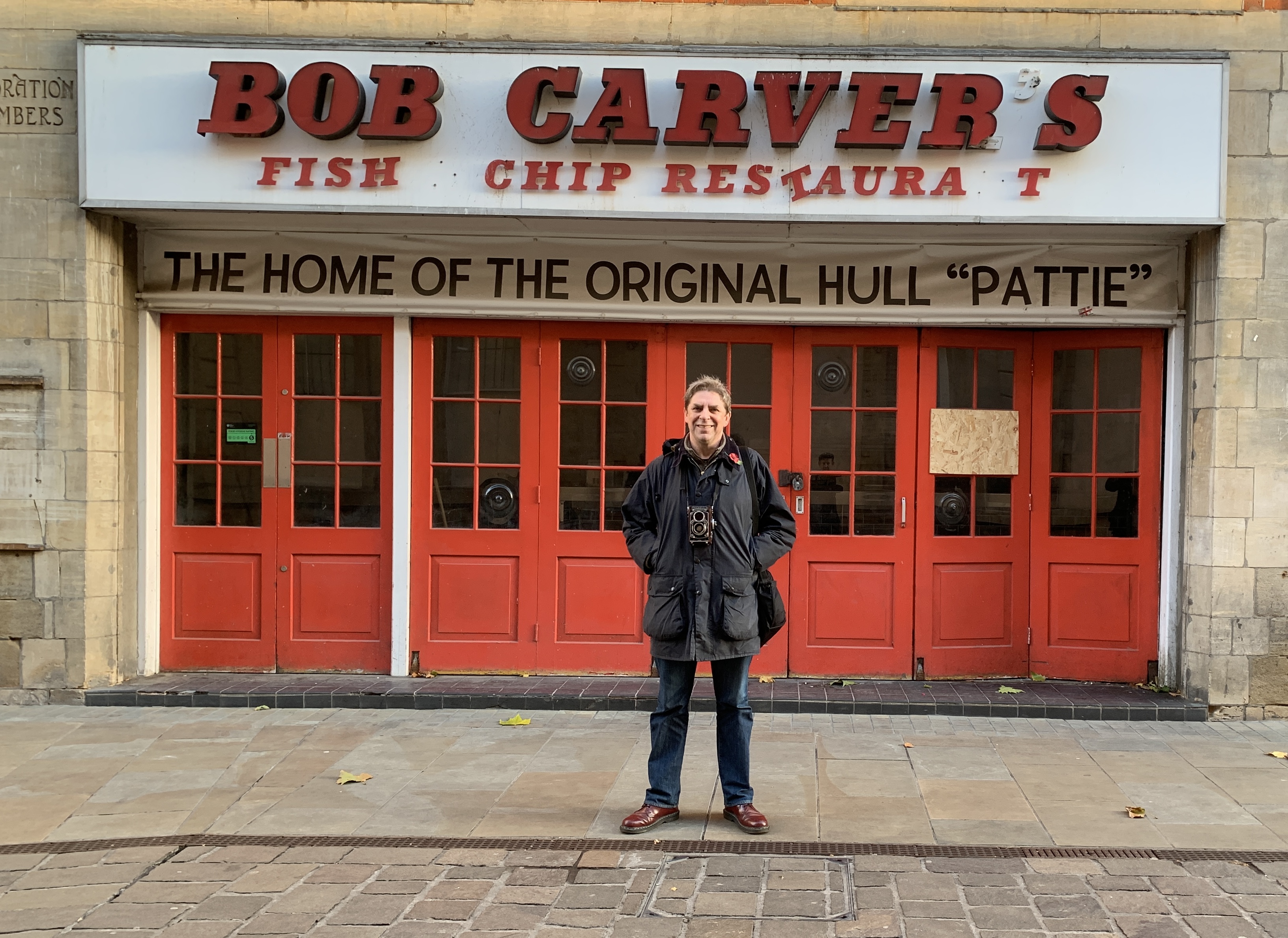
What set me thinking about my progress over the last two years is this: last week I walked past the location of my first ever picture story, ‘Bob Carver’s Fish and Chip Restaurant’, when I was an inexperienced photographic student in Hull. 


I have been in ‘transition’. A journey that everyone will make, regardless of their job, a transition from working to not working. I believe everyone will transition in one of three ways:  one death, two life-changing illness or three fulfilling the next stage of life. Sadly many people, men in particular, fearing that they will not know who to be without the status of career, push on far too long in their workplace. I now believe I would have been one of those people.


My colleague Victor, the same age as me and looking forward to spending fulfilling days fishing and being with his family, shockingly died of a heart attack one month after being given all my responsibilities.


Three weeks after being told that I was being made redundant I collapsed watching TV at home, and I came round to see two paramedics standing in my front room. I’d had a stress-related blackout. I took a picture in the hospital, it’s a significant part of my transition, a sort of ground zero from which to build upon. 


I knew I had to move on. The job I loved was taken away, no status, money uncertainty, ill health and sometimes I worried what I would do to fill the hours I spent working. I am no gardener and struggle to see the point of golf. But instead, I quickly discovered that I would not have enough hours to feed my passion for pictures and story-telling.  


Back to November 9, 2020. On the same day I got my redundancy notice I also received a mail from Craig at Café Royal Books. It was the proof of my first ever book, my documentary pictures ‘George Norris, Rag and Bone, Hull 1980s’. A bitter-sweet day. The book was published on December 19, 2020 and sold out. 


I describe myself as being ‘post work’. The word ‘retirement’, like ‘redundant’, has negative connotations. I feel, on the whole, positive.


What took a while to slow down was the roller coaster of emotions I felt in the weeks and months after being made redundant, especially as I was undergoing medical tests after my collapse. I felt fear, anger, a sense of rejection, but also a sense of relief at being free of spread sheets and pointless meetings. There was sadness at letting my team down by not being there and simultaneously guilt that I no longer needed to worry professionally about them. I was missing the adrenalin rush of chasing the news and the beauty and power of the picture file. I enjoyed having time for family, friends and myself. I regretted not spending more time doing that before. There were no more midnight calls and the day no longer started with a 6:30 a.m. planning meeting. I felt the joy of having time to shoot pictures to please myself but the frustration that I had no platform to share them. There was the fear of being professionally invisible, and being overlooked because of my age. But conversely, confidence to do things because of my years of experience. This roller coaster had new twists and turns, day and night. 


My advice to those going through this experience is to accept all these emotions. You’ll need to give it time. Try to do something small that makes you feel you are taking control.


I switched off most (but not all) news alerts and deleted work-related apps.  


At this time, early 2021, it was full Covid lockdown. 


To move on I decided as a first step that I’d listen to online discussions where people were exploring photography. I learned about a new archive being collected by the Museum of Youth Culture. After a quick call with them I rescued my 40-year-old negatives of youth groups from the attic and offered to scan them for their collection. 


I didn’t want to get stuck in all my yesterdays by poring over my old images or shooting black and white 35mm pictures, nor did I want to shoot news feature stories on colour digital. For sure, no one would want work from me: a 58-year-old man recently made redundant. I had to rediscover my confidence and sense of fun in taking pictures. 


While walking in my local park during lockdown I overheard snippets of conversation as people passed by. I decided to start a small project producing a gentle set of images of people I met on those walks, called ‘Overheard in Lockdown’. I emailed the images to everyone I photographed. The response was wonderful, which reminded me why I love photography. My confidence quickly came back to life.


A major turning point came when a friend told me that he had been loaned a Rolleiflex 2 ¼ camera. This was a lightbulb moment, as I thought this would combine learning a new skill, shooting square format on a vintage film camera, revisiting my passion for documentary photography, and using my experience to execute the whole project. My great aunt Ivy had died and left me a small sum of money that I spent on a Rolleiflex 80mm f2.8. I decided to use a tripod and practice on neighbours. The pictures now hang in their homes.  


From this came my idea to shoot the story ‘A Portrait of the High Street’. To push myself further I decided that I’d ask each shopkeeper on my local high street about their hopes and fears post-Covid and record their answers on video. This led to a journey into the dark arts of sound and video editing. Technical help came from another colleague also made redundant.


An equally challenging proposition was getting permission from the council to exhibit the work outdoors and get funding to pay for the printing. With support from local estate agents The Stow Brothers, London City Council, Epping Forest and Redbridge Vision, this all happened.


It was a small project, but the joy on the faces of the people I photographed when I gave them framed prints was as rewarding as anything I have done. 


This gave me the confidence to start my story on the Lea Bridge Road. I wanted to document a moment along a street that I think is representative of London today. This is an ongoing project that you can see here.


The Peterborough Museum and Art Gallery confirmed they wanted to produce a one-man exhibition of my youth groups picture stories that will go on show in January 2023 for three months. Below is a sneak preview of one of 14 wall sections exhibition designs.


In May 2022, Rag and Bone man George Norris mentioned that he was back out collecting scrap, but this time with his 81-year-old father. I spent nearly two weeks with them, and was great to reaffirm an old friendship. I combined shooting colour digital 35mm and black and white film on the Rolleiflex. I interviewed them on video and recorded audio. I also shot some B-roll on the iPhone. I didn’t intend to create combination picture comparing 1983 with 2022. It just happened. The video seems to have caught people imagination and has nearly 90,000 views. You can see it by clicking here . The BBC picked up the story and you can see that here


In July 2022, Café Royal Books published my second book, ‘Star & Garter Hull 1983’.

While I was in Hull photographing George and his father, I had a bit of fun reintroducing prints from 1983 into the pub and photographing them, lining them up in the same place in 2022.  The BBC also picked up this story and ran the images. The response has been amazing with people who saw the broadcast taking the time to send emails to congratulate me on the images. 


It’s not all been plain sailing. There has been disappointment too. Only recently I had three project submissions rejected in one day. My mentor Dave Caulkin died and I regret not making more time to see him. He had been post-work for many years. 


This post has been a way for me to examine my journey since my redundancy notice two years ago. I was tempted, once was written, just to delete it. But I have decided to publish in the hope that anyone facing the same situation might find it useful. 


Being post-work is an opportunity because what you have is the greatest asset: time.  I hope that options one and two are a long way away as I’m now having fun. 


Russell Boyce  


Thursday, 18 November 2021

A year on - what's next?

Saturday November 13, 2021 was a rather special day. Almost exactly a year to the day of being told that I was to be made redundant from a job I loved, I was out taking pictures on a story I had thought about for years but never got around to do. And just as importantly I knew why I was doing it. I have discovered, the passion I have for pictures and story-telling is no less diminished. 

I shot twelve frames on a Rolleiflex 75mm F3.5 using HP5. The film I processed myself, my love hate relationship with the smell of ID11 and fixative revisited. The negatives scanned on an Epson V600.  Here is the contact sheet, frame one, bottom left, frame 12 top right.


I will be the first to admit that none of the images are earth shatteringly wonderful, but the exposure is even, the composition and timing not bad. But actually, what is more important is how I arrived at this point – shooting black and white on a vintage medium format camera. I will wind my year back to explain. 


But first, my favourite image is frame two. The man wearing headphones reflected in two mirrors, I like the busy lines criss-crossing through the picture, one of which, the reflection of the padlock, points to the figure, giving the image a focal point despite the words ‘Bargain’ and ‘Sale’ fighting for attention.


After attending a Zoom call in February 2021 titled ‘Out of the Archives. Collecting Stories of Everyday Life’ hosted by Four Corners I spent weeks scanning 35mm black and white negatives I shot in 1985 that had been gathering dust in my attic. I was encouraged by Lisa der Weduwe from the Museum of Youth Culture (MOYC), who addressed the call, to scan them. We were all in lockdown so why not? I am very happy with the result, about 150 pictures of Newtown Youth culture published and archived by the MOYC. If you click here or on the picture below you can see them all. I’m also in talks to have an exhibition of these pictures in Peterborough, but that’s another story, and quite exciting.


Cleaning, scanning and removing 36 years of dust from negatives is a rather time consuming and solitary task. Although it was quite exciting to see what a wonderful archive I had, I was, in essence, looking backwards. All my yesterdays, I asked myself was I hiding? 


Britain was in full lockdown so shooting pictures of people wasn’t easy. Maybe everybody was hiding? I would go for a daily walk around local parkland to get some exercise and clear my head. The lockdown rules permitted you to walk with one other person but at a 2m distance. I noticed, as I walked past others, I’d catch a snippet of their conversation. To start to regain my confidence photographing people I decided that I’d shoot a series of portraits of fellow walkers and include what I’d overheard in the caption, I called it 'Overheard in Lockdown'. I was amazed that only one person refused to be photographed and be included in the project. The pictures are simple environmental portraits, the background determined by where my path crossed with other walkers. It was fun and I had great conversations with total strangers. I think it’s a timely document, prior to the UK’s four-step roadmap out of lockdown, that’s hopefully never to be repeated. Click here or on the picture below to see the full set.    


‘I keep cycling the same old loop again and again’. Davide Terrasi and Naiem Dakry


While sorting out the Newtown Youth negatives, I came across another small project I shot in 1985. In short, I photographed everyone who knocked on my door.  Spurred on by the success of the ‘Overheard in Lockdown’ project I decided that I’d try to track down these people 36 years later and re-photograph them on their doorstep. With the help of the local paper and the easing of lockdown I managed to find a few. The local response was heart-warming and when I did meet up with my subjects, reshooting them and giving them prints was a major confidence boost. You can see the whole series here.


I have always been fascinated by change, but change that is imperceivable until you look at it retrospectively. The corner shop that is always open until it’s no longer there, the aged owner passed on or moved away. The three old men sitting on the same seats in the pub sipping at their pints every night that for years were part of the furniture who are now no longer there; or that old factory building or row of terraced houses that is now a new mini store or block of flats. The slow decline or the gentrification of an area as the populous slowly changes, to me, is a rich area for social documentary. London is a constantly changing, hundreds of years of migration, growth and change. I want to capture London now, not the usual landmarks, high life, low life and razzamatazz that gets the attention but the imperceivable changes in ‘ordinary’ London, like a river slowly changing its banks and course over the years.


To me the Lea Bridge Road (A104) is such a place. It runs between Hackney and Waltham Forest, through Leyton. It was named after a bridge that was built over the River Lea in 1745. Over the years I have spent hours stuck in slowly chugging traffic looking out of my window watching life go by. I have decided to photograph people and places along the length of this road. To me it encapsulates the unseen changes that London is going through, people, commerce, leisure, faith and architecture. My ambition is to capture the everyday ordinariness today that in the future will be so special as it will no longer exist.


Long gone are the halcyon days when you can go into a pub, factory or institution, ask the boss if you can take pictures and they’d decide yes or no within minutes. For example, for me to photograph the Woolwich Ferry it took over a year to get all the permission I needed. But to me it was well worth the time spent.


The Woolwich ferry story is a good example of what I am trying to achieve. The three boats that I photographed in 2015 and had been crossing the Thames since the 1960’s are now no longer in service, forever gone. Most of the staff, retired. 


Also, a question that troubled me was technically how to photograph the Lea Bridge Road? I could dust off my Nikon FM2, click in my trusty 35mm, wind on a roll of HP5 and push it two stops and wear a keffiyeh as a neck scarf. But wasn’t that what I did in 1985, all my yesterdays? I could use my Canon 5D that will produce technically wonderful images in low light. As a news photographer, editor and manager I have always advocated the use of colour, pure commercial sense once the business had changed to full colour, especially with online digital. But, the perception of most is that people who produce 35mm cameras with no apparent good reason, such as a wedding, are predators and up to no good. It would be hard to integrate into the community of the Lea Bridge Road with continual cries of ‘What you taking pictures of?” Or ‘Oi paparazzi’ or even as I was once told when shooting a simple feature ‘If you took my picture, I will ram that camera up your arse!’  As a side note I assured this gentleman that I did not take his picture and was able to safely return my camera into a bag. 


These days people tend to be suspicious of photographers.


A chance conversation with a friend provided the answer. He told me casually that he was being given a Rolleiflex and would need to learn how to use it. This was the solution I was looking for. 


First, the new visual challenge of composing in a square format, with the added complexity of everything being back to front was very appealing. Secondly, focussing manually, no motor drives and only having twelves frames per roll of film all restrictions that, I believe, leads to more creative thinking. Another friend wisely said to me recently when I asked him why use black and white film when digital colour is so perfect, ‘the perfection and beauty of using black and white film are the small imperfections it throws up’. I was sold.


So after two bad online shopping experiences trying to get the right camera I bought a wonderful camera from Robert at the Vintage & Classic Camera Company. Not cheap, but excellent condition and fully working. The last thing I wanted to do was struggle with the mechanics of a camera when I was struggling with everything else involved in taking pictures. 


Once purchased I then had to learn how to use it. I quickly discovered that I needed more time than I imagined. After a few rolls of the long-suffering family and a few frames of the neighbours I decided to put the Lea Bridge Road project on hold and embark on something a little easier. Today, I shot the final picture of this sidebar project that I started in June 2021. Although I see this project very much as a learning curve, that I will share once complete, it has been amazingly rewarding shooting it. 


What I have gained by taking my time is the confidence to actually start my Lea Bridge Road project, which brings me back to the beginning of my post. Using the Rolleiflex has intrigued people enough to ask me what I am doing when they see me on the street. On the first day of shooting, two people who had cycled past, stopped and returned to talk to me about the camera and what I was doing. I am not a threat.


I am also learning a new way to look as I take pictures. People allowed me stand for ages waiting for shapes and lines to change as they carried on with what-ever they were doing. I think it’s about eye contact, I can look down at the camera to compose and focus, then look up to engage with what or who I am photographing, something that had never occurred to me. Luke below for example described himself being in another world as he took a break from work and ignored me as I waited for him to mentally drift back to this other world. 


Once the dialogue is started, I feel that people come to believe that photographers, are people who can be trusted. Especially when they return with a nice print.  


I will continue shooting pictures on the Lea Bridge Road and update this post when I have more to offer.


Russell Boyce

Saturday, 6 October 2018

A Week in Pictures Middle East and Africa October 5, 2018


Eat your heart our New Orleans! This is Malawi and we’re going to party while we wait for Melania Trump. So says this wonderfully affectionate picture by Carlo Allegri, who is travelling in the region with FLOTUS. Take the time to look at their faces, the first thing you’ll see is that gap in the teeth. Then enjoy the style, suits, shoes, canes and hats, feel the warmth and hear that rhythm. This picture makes me feel good, and I hope it does you too. See more pictures of Melania in Africa here.


Malawians hold flags and dance as the U.S first lady arrives in Lilongwe, Malawi, October 4, 2018.    REUTERS/Carlo Allegri

Taking pictures of food to make it look appetising is never easy. Taking pictures of food being prepared by displaced people cooking over a fire is harder still. Zohra Bensemra’s picture is a complex, detailed image that evokes different emotions at the same time and I am not sure why. The grey goo being pounded in the wooden bowl does not look so tasty but I feel a great sense of anticipation that what is going to be cooked is going to taste nice. What gives me this feeling I am not sure. Is it the warm tones of the earth and woman’s legs countered by the cold, metallic but much treasured pots? Or is it the child’s green dish waiting to be filled? Or maybe just the calm generated by the soft light and the sense that there is now time to cook after finding a safe place after fleeing from violence? Read on here


Honre Waba, 40, who has fled the northwestern village of Njinikom because of violence cooks in the courtyard of the house where she is staying in Yaounde, Cameroon, October 3, 2018.   REUTERS/Zohra Bensemra


I’ve looked at many images of demonstrations but Mohammed Salem’s picture took me a little by surprise. I didn’t at first understand why these Jihadists were completely wrapped in white cloth, their arms trapped. We’d had other images from the same military show of force, masked men armed to the teeth, missile-shaped metal constructions on back of trucks, and alert eyes peering from black masks that all made obvious sense to me. I now understand that these worn white cloths are death shrouds, the message being ‘we are prepared to die’. 


Palestinian Islamic Jihad militants participate in a military show in Gaza City October 4, 2018.   Mohammed Salem


It takes a little while to make sense of Faisal Al-Nasser’s picture. It’s the use of only a tiny fragment of this almost totally abstract picture, the simple line of eyes, that make this picture stand out. Once you focus on the eyes the intensity of their look is quite unmistakable. Maybe also I like this because the reds, purples and blacks put me in mind of the shifting edges and colours of a Rothko painting. 


Saudi job seekers talk to a company representative at Glowork Woman’s Career Fair in Riyadh, Saudi Arabia October 2, 2018.   REUTERS/Faisal Al Nasser


One thing is for sure, everyone who looks at Khaled Abdullah’s picture will hear the piercing scream of the baby as the needle, that is just about dead centre in the picture, is pushed into the tiny arm. A visual spiral of almost solid blocks of blue, black and orange colours bear down, as do three enormous hands, holding the child’s arm all forcing you to look at that needle and face screwed up in pain. The only respite from the agony of the pain of cholera and of the needle is the delicate touch of mum’s thumb trying to soothe away the pain. 


A boy cries as he is being treated at a cholera treatment centre at the al-Sabeen hospital in Sanaa, Yemen October 3, 2018.   REUTERS/Khaled Abdullah


A dash of colour of a red umbrella with child-like teddy bears printed on it breaks up the greys, greens, browns and rust of the war scorched landscape of Zohra’s Bensemra’s picture. I feel nervous as my eye moves around this picture; I dare not look too long at the bright red as I feel danger lurks nearby and I should be alert, not distracted so I continue to look around. It’s only then I notice the soldier, half hidden in the burned street scene, coming towards me. 


A Cameroonian elite Rapid Intervention Battalion (RIR) member walks past a burnt our car while patrolling in the city of Buea in the Anglophone southwest region, Cameroon, October 4, 2018.   REUTERS/Zohra Bensemra

Siphiwe Sibeko’s image is a picture of two opposing halves, bottom left you get the timeless quiet of a man asleep, in the cool of blues, only his red cap possibly disturbing the visual slumber. Top right, it appears that the train, warmed by dark reds and browns, although stationary, is rushing forward to the tick of light that is top left. The solid grey of the platform separates these two worlds. When this man wakes up he going to have a stiff neck, but he looks comfortable. If you want to see more on this gruelling sleeper train journey across Zimbabwe, click here I promise you it’s well worth it. 


A train mechanic sleeps at a platform after an overnight train journey from Harare, in Bulawayo, Zimbabwe August 6, 2018.    REUTERS/Siphiwe Sibeko

The clever use of three layers by Ibraheem Abu Mustafa makes for an image that you have to look at again and again, each time getting a little more from it. A first you see the face of the man shouting and the flames; then you notice the second pair of arms coming from behind him. You try to work out where the other man is standing but you can’t as it’s confused. Your eyes then drift into the dense black smoke and suddenly, woah! you spot the profile of the man standing right next to you. He’s just coldly staring. 


A Palestinian reacts during a protest calling for the lifting of the Israeli blockade on Gaza demanding the right to return to their homeland, at the Israel-Gaza border fence in the southern Gaza strip October 5, 2018.   REUTERS/Ibraheem Abu Mustafa 

Saturday, 13 August 2016

Editing the Gymnastics & Archery at the Rio 2016 Olympic Games August 12, 2016


Very much a change of pace today as the Trampoline took centre stage at the Rio Olympic Arena. The pictures take on a rather erie sense of calm as the athletes seem to fall gracefully from the skies only to be propelled up again twisting and turning. Switzerland based photographer Ruben joined Mike to help cover the competition in the gym.


Rana Nakano of Japan competes in the Trampoline Gymnastics Women's Qualification Round of the Rio 2016 Olympic Games in Rio de Janeiro, Brazil.   REUTERS/Mike Blake  

I am very drawn to this almost abstract image and it took me a while to work out why. I think I like its graceful confusion as the eye jumps around the picture with no time to pause while the athlete is timelessly suspended at the peak of their performance. The eye moves from the highlight of the feet against the black background and red of the leotard, then simultaneously out right and up and left and down to the hands that both seem to float in space, severed from the body.  The position of the hands then beckon you back into the image towards the Olympics Rings, soft in tone and focus, in contrast to the black, white and red.  The image then comes together to make sense just before the athletes twists and falls.

Ruben's picture is wonderful in its timing and design. Athlete Nicole perfectly horizontal as she falls past the Rio 2016 logo.  The judge to the far right has his head tilted slightly left to mirror the judge on the left forming a visual bracket bringing your eye into the centre of this letter box shaped picture.


Nicole Ahsinger of the USA competes in the Trampoline Gymnastics Women's Qualification Round of the Rio 2016 Olympic Games in Rio De Janeiro, Brazil.  REUTERS/Ruben Sprich

Later in the day I also edited Lucy's pictures who was shooting the heats of the 1500m, 400m and 100m at the Track and Field. No finals tonight, so relaxed and fun, the detail of the Olympic Rings earring catching my eye in the mass of flowing hair.


Rosangela Santos of Brazil wears Olympic ring earrings as she competes in the Rio 2016 Olympic Games Women's Preliminary 100m Round 1 at the Olympic Stadium, Rio de Janeiro, Brazil.      REUTERS/Lucy Nicholson 

To see more pictures from the day's action at the Rio 2016 Olympics click here

Friday, 12 August 2016

Editing the Gymnastics & Archery at the Rio 2016 Olympic Games August 11, 2016

As a follow on from last night's post I am pleased to see that the Wall Street Journal enjoyed Kai's picture as much as I did. A big showing for the German who takes visual risks.


For the few that are concerned about my diet (and there are one or two) a slight improvement as a break between Archery Individual semi-finals and the start of the Women's Individual All-Round final gave me time to hunt out something green.


I thought I'd take the time to describe a little about my workflow. Each photographer has two or three Canon 1DX mk2 cameras which are either cabled or connected via wireless. The pictures are streamed from the camera directly to our servers. These cameras shoot 14 to 16 frames per second. As you can imagine I actively encourage the photographers to keep their fingers off the button. This below gives you an idea what a second's worth of pictures looks like.


At the gymnastics we have five photographers. Each photographer has a 'window'  that is pointed to their folder in the server. One photographer, who operates the remote cameras that are overhead, can have up to five separate windows. The photographers send short bursts of pictures at the end of a routine. As the pictures come in I open each folder, scrolling through the pictures full screen, looking at every image. I mark the picture I intend to crop and file with a blue mark and when I reach the end of the photographers last burst of pix I mark it brown. This is what my screen looks like. The Archery event at the top, as which happens at the same time, just to make it even more complex.


Once the image is open in full screen I decide on the crop (see below) and send it to the processors, Darrelle or Gary. They check it for quality, caption it and add the codes that send it to our global clients. We call this the wire. On average the pictures move from gym to clients in about 90 to 180 seconds. We are fast. Tonight I looked at 5000 pictures.


Here is the picture from the example above as it moved on the wire. I have cropped it to leave a clean background. As part of the Olympic Ring logo has been cut off in the original picture I decided to balance it by cropping in under the rings to remove the microphone at the bottom of the frame. I cropped in close to the right so Simone 'looks' down into space to the left of her face.


Simone Biles (USA) competes in the floor routine of the Women's Individual All-Around Final August 11, 2016 in the Rio Olympic Arena, Rio de Janeiro, Brazil.   REUTERS/Dylan Martinez

This is what I do, this is what I love, so sounds easy, doesn't it? Believe me, miss a picture a photographer loves or a key moment from the event and you are as popular as a ref who gives an away penalty in the dying seconds of a game the home team have to win.

To see more pictures from the day's action at the Rio 2016 Olympics click here

Thursday, 11 August 2016

Editing the Gymnastics & Archery at the Rio 2016 Olympic Games

What you can almost be certain of as an editor is that you wont be working in the rain. That cannot be said of photographers at many Olympic events, especially those who are covering the archery.  I really like the effect the water on the lens adds to Leonhard's picture and how this changes the visual structure of what is actually quite a detailed, complex and confusing image. The rain circles draw the eye back from the storm clouds and the central flood lights to the soaked archers on the left. The reds and the white of their clothing holding the eye long enough to enable you to understand what is happening. The dark clouds top right keeping your eye to the left. I also have a sneaking suspicion that the water on the lens might also be a plea for sympathy from Leonhard - "it's raining and I am all wet". No sympathy here, done it, been there.


Robin Rameakers of Belgium and Juan Ignacio Rodriguez of Spain compete in the Men's Individual 1/16 Eliminations 

See the latest pictures from Rio 2016 Olympic Games here