Pages

Showing posts with label fire. Show all posts

Friday, 4 September 2020

A Week in Pictures, Middle East and Africa, September 4, 2020

At first glance Sumaya Hisham’s picture of a woman looking through a portal hole of a police van looks like a photographic cut out. I can assure you it’s not, but it is a perfectly composed image where the curves of the mask and the edge of the eye liner fit exactly  into the circle. Even though she is masked and detained her eyes still transfix the viewer with determination and strength.   

A woman is seen through the window of a police van after being detained during a protest against gender-based violence outside the parliament in Cape Town, South Africa, August 29, 2020. REUTERS/Sumaya Hisham 

A peaceful and calm picture by Mike Hutching is a welcome break from the manic news file over the last few weeks. The cool blue tones and the slow shutter speed give it this feeling but if  we need a little warmth the zig-zag composition of the rocks lead us out through the picture to Table Mountain and the rising sun.    

The city's iconic landmark Table Mountain is seen from Bloubergstrand during the coronavirus disease (COVID-19) outbreak, in Cape Town, South Africa, August 22, 2020. REUTERS/Mike Hutchings

A small detail in a large space will always grab the eye. Add a wide difference in contrast and a splash of colour to really make a really arresting image. Mohammed Salem uses all these visual skills to draw us right in to the masked face peering into a darkened space.  It’s only the caption that informs us this is the scene of a deadly and sad house fire. 

A Palestinian man wearing a protective face mask looks through a hole in a torched house where three children of Al-Hazeen family were killed in a fire ignited by a candle used to light up their room during a power cut in the central Gaza Strip September 2, 2020. REUTERS/Mohammed Salem

Raneen Sawafta’s picture feels more than a little claustrophobic and it takes a little bit of time to see what is really going on. First you see the boot, and it looks that it is about to crush the delicate and dust covered plant. You then spot the mechanics of a weapon and then finally a face pressed into the earth.  

An Israeli soldier detains a Palestinian demonstrator during a protest against Jewish settlements in Jbarah village south of Tulkarm in the Israeli-occupied West Bank September 1, 2020. REUTERS/Raneen Sawafta

A simple illustrative picture by Nir Elias, the image that millions of people have shot on flights, but the importance of this is that it’s from the first flight from Israel to the UAE. The Star of David seen over these lands would have been almost impossible without this change of international policy and the move to normalise relations between the two countries. Read on here

A view of is seen through the window of Israeli flag carrier El Al airliner carrying a delegation of Israeli and American officials before the plane lands in Abu Dhabi, United Arab Emirates August 31, 2020. REUTERS/Nir Elias

A gentle picture by Mohammed Salem that really caught my eye: I love the quirkiness of it as much as I like the colours. The back focus also to draw attention through the cool blues of the boy getting a hair cut in the foreground to the masked boy in red climbing the wall. Why he’s doing this we have no clue. Everyone is now masked as Gaza, previously free from COVID-19, is facing an outbreak and the numbers are spiraling.

A Palestinian boy climbs a wall as he watches a barber on a street during a power cut and a lockdown following the outbreak of the coronavirus disease (COVID-19), in Gaza City August 31, 2020. REUTERS/Mohammed Salem

Bloodletting to this extent would often be part of a scene of an attack or a dreadful accident, but in Thaier al-Sudani’s picture it’s from the Ashura ceremony and all part of normal proceedings. Although the brightness of the red blood against the white clothing is quite striking and extends to the rear of the image, you need to take the time to look at the expression on the man’s face. Despite all the blood, there is no fear, no anguish and to me he looks quite relaxed.

A Shi'ite Muslim man bleed after hitting his forehead with sword and beating themselves during a ceremony marking Ashura, the holiest day on the Shi'ite Muslim calendar, amid the spread of the coronavirus disease (COVID-19), in Baghdad, Iraq August 30, 2020. REUTERS/Thaier Al-Sudani 

Also, part of the Ashura ceremony are re-enactments of the battle and very hard to resist this terrific picture by Alaa al-Marjani. Colour, heat, action and so much dust being thrown up as spectators watch the horses and riders from a hill. I can’t imagine what Alaa would not give for those rather annoying power lines not to be there, cutting across his picture, but hey, life is not perfect, so I will ignore them and enjoy. 

Iraqi Shi'ite Muslims ride horses as they re-enact a scene from the 7th century battle of Karbala to commemorate Ashura, the holiest day on the Shi'ite Muslim calendar, amid the spread of the coronavirus disease (COVID-19), in the holy city of Najaf, August 30, 2020. REUTERS/Alaa Al-Marjani 

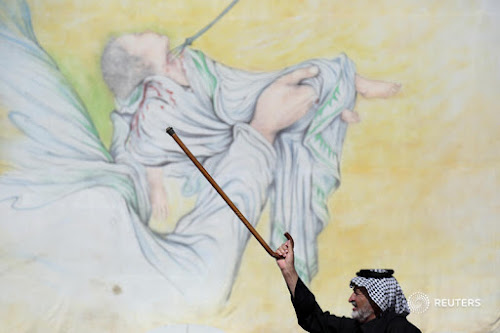
A clever use of a pale background image and a stroke of luck for Teba Sadiq as a man raises his cane to create a cris cross of compositional lines. The full range of tones from white to blacks with only the faintest of colour, pale yellow, set in graphic shapes also helps to make this very pleasing to the eye, that is, until you are jolted with the realisation that the image in the rear is that of a dead child.   

A Shi'ite pilgrim walks next to a drawing on the wall depicting a scene from the 7th century battle of Karbala, ahead of Ashura, the holiest day on the Shi'ite Muslim calendar, amid the spread of the coronavirus disease (COVID-19), in the holy city of Kerbala, Iraq, August 29, 2020. REUTERS/Teba Sadiq

Baz Ratner has taken the time to prepare an image he had in mind to illustrate the impact of flooding at Lake Baringo. A sort of live before and after or a “now you see now you don’t” picture. I think what made it  even more interesting is where the photograph has been cropped off at the top in the print version, is almost at the exact level of water in the live image. Read on here.    

Camp manager, James Owuor, holds a photo showing a structure before it was submerged under rising water due to months of unusually heavy rains, in lake Baringo, Kenya, August 25, 2020. REUTERS/Baz Ratner 

Here are a few highlights from the last two weeks –  I wanted to include these terrific images.

A man throws a stone at a police Inyala (armoured vehicle) during a protest demanding the police account for the death of the teenage boy who was allegedly shot by the police the previous night in Eldorado park, outside Johannesburg, South Africa August 27, 2020. REUTERS/Siphiwe Sibeko 

A resident pours out the waters of the Blue Nile floods within the Al-Ikmayr area of Omdurman in Khartoum, Sudan August 27, 2020. REUTERS/Mohamed Nureldin Abdallahya

Khadjou Sambe, 25, Senegal's first female professional surfer, surfs during a training session off the coast of Ngor, Dakar, Senegal, August 18, 2020. "When I am in the water I feel something extraordinary, something special in my heart," said Sambe. REUTERS/Zohra Bensemra

A flamboyance of flamingos crowds together in Lake Bogoria, in Baringo County, Kenya, August 26, 2020. REUTERS/Baz Ratner 

Colonel Modibo Kone, one of the junta leaders of the National Committee for the Salvation of the People (CNSP) which overthrew Mali's President Ibrahim Boubacar Keita, waves as he attends a mass rally to celebrate the coup at the Independence Square in Bamako, Mali, August 21, 2020. REUTERS/Mamadou Keita 

A body of a militant is seen at the scene of an attack at the Elite Hotel in Lido beach, in Mogadishu, Somalia August 17, 2020. REUTERS/Feisal Omar

People are pictured on the roof of a police station set on fire by protesters during a demonstration against the decision of Ivory Coast President Alassane Ouattara to run for a third term in the next presidential election, in Bonoua, Ivory Coast August 14, 2020. REUTERS/Luc Gnago

Policemen detain a demonstrator during a protest against president Alassane Ouattara's decision to stand for a third term, in Abidjan, Ivory Coast, August 13, 2020. REUTERS/Luc Gnago

Police take cover as they are pelted with stones during a protest against racial and economic inequalities in Kayamandi township near Stellenbosch, South Africa, August 12, 2020. REUTERS/Mike Hutchings

Elephants are seen as they cross lake Kioko in the Amboseli National Park, Kenya, August 11, 2020. REUTERS/Baz Ratner

Supporters of the Imam Mahmoud Dicko and other opposition political parties attend a mass protest demanding the resignation of Mali's President Ibrahim Boubacar Keita in Bamako, Mali August 11, 2020. REUTERS/Rey Byhre

An Israeli soldier beats down smoke with a fire broom in an area that has seen blazes caused by fire balloons launched from the Palestinian enclave of Gaza, near Kibbutz Nir Am on the Israeli side of the border between Israel and the Gaza Strip August 17, 2020. Picture taken August 17, 2020. REUTERS/Amir Cohen

Smoke and flare are seen in the sky, as pictured from Houla village near the Lebanese-Israeli border, in southern Lebanon, August 25, 2020. REUTERS/Aziz Taher 

An aerial view shows beach-goers standing on salt formations in the Dead Sea near Ein Bokeq, Israel August 25, 2020. Picture taken with a drone. REUTERS/Ammar Awad

A Palestinian man uses his mobile phone as he sits at the doorsteps of his home on a hot day during a power cut after Gaza's lone power plant shut down amid tension with Israel, in Jabalia refugee camp, in the northern Gaza Strip August 23, 2020. Picture taken August 23, 2020. REUTERS/Mohammed Salem

The Iron Dome anti-missile system fires interception missiles as rockets are launched from Gaza towards Israel, as seen from the city of Ashkelon, Israel, August 21, 2020. REUTERS/Amir Cohen

Rita Faraj Oghlo, 31, looks at her phone in her mother’s house after her family were forced to live there because their home was damaged in the Beirut port blast in Beirut, Lebanon, August 13, 2020. REUTERS/Hannah McKay 

A boy jumps in the Nile River during hot weather on the outskirts of Cairo, following the outbreak of the coronavirus disease (COVID-19), Egypt August 18, 2020. REUTERS/Mohamed Abd El Ghany

Cranes stand around the remains of site, that was damaged by an explosion at the Beirut port, stands in Beirut, Lebanon, August 12, 2020. REUTERS/Alkis Konstantinidis. REUTERS/Alkis Konstantinidis


Sunday, 22 September 2019

A Week in Pictures, Middle East and Africa, September 20, 2019


Afolabi Sotunde’s image of a traditional healer is far removed from preconceived notions of what such a scene would look like, but the light and colour in the frame are quite astounding. Once you read the caption you quickly look past the beauty of the light and colour and descend into the story. Read on here
Agbetuyi Samuel, a traditional header with his friend, also a healer, prepare a traditional medicine that contains the head of a pangolin in his house in Akure, Nigeria, August 28, 2019.   REUTERS/Afolabi Sotunde

A sliver of catchlight highlights the profile of lips and nose of a riot police officer in this well-observed picture by Philimon Bulawayo. The face, although quite stern, still warms and softens the cool hard edges of the blue helmets and the grey uniforms. Cover the highlight with your finger and look again at the image: the feeling of menace trebles.  
Riot police stand before striking healthcare workers protesting over the disappearance of Peter Magombeyi, the leader of their union outside a hospital in Harare, Zimbabwe, September 18, 2019.   REUTERS/Philimon Bulawayo

A complex combination of the symmetrical shapes of the doors and windows, with people moving in and out, gives the viewer a slightly uncomfortable feeling in Alphonso Toweh’s picture. You struggle to see what is going on in the distance as you peer through the entrances at the bright light and colours of the clothing. Only once out are drawn back into the blackened building do you notice the man looking at the scene where so many children died.       
A man looks into the burned building after a fire swept through a school killing children in Monrovia, Liberia September 18, 2019.    REUTERS/Alphonso Toweh


The pressure is on when you know you are on the top global story, the attack on the Aramco oil field. Hamad Mohammed keep his cool told the story visually when on the face of it all you have to photograph is shapeless lumps of metal, the story was rocket fragments being displayed to the media by the Saudi military. A clever use of a silhouette of a camera being held in profile leads you to the unmistakable shape of fins of a rocket in the background. Of course, you need to the see the objects too and you can do so here. 
Remains of the missiles which the Saudi government says were used to attack an Aramco oil facility are displayed during a news conference in Riyadh, Saudi Arabia, September 18, 2019.   REUTERS/Hamad I Mohammad.


After Xenophobic attacks in both Nigeria and South Africa, people have fled home. Temilade Adelaja has captured exhausted children flopping all over mum and dad as they are carried through the airport. You can almost feel of the weight of these sleeping children. But what I love most about this picture is the tiny detail of the passport being held bottom left.   
Nigerians, who were evacuated from South Africa after xenophobic attacks on foreign nationals, arrive at the airport in Lagos, Nigeria, September 18, 2019.    REUTERS/Temilade Adelaja


No doubt Corinna Kern could not believe her luck as Benny Gantz, the leader of the Blue and White party, lifted his had to gesture into blue and white light. The contrast between the warm tones on his face and the cold light on his hand is set against a perfectly black background. Maybe it was not luck, and Corinna spotted the light and just had to wait for the perfect shape to capture the right moment. 
Blue and White party leader Benny Gantz speaks at the party’s headquarters following the announcement of the exit polls during Israel’s parliamentary election in Tel Aviv, Israel September 18, 2019.   REUTERS/Corinna Kern

A perfect moment of light and shape captured by Zoubeir Souissi is wonderfully pleasing to the eye, but why? I think it’s the tip of the finger’s shadow just a fraction away from the face. A moment before or after and the visual tension between the shapes would be lost. The temptation would be to crop to just the shadows and the hand, but then you would lose the right and downward pressure of the figure on the left that counters the upwards and left flow of the shadows.
Election workers count votes as the country awaits the official results of the presidential election in Tunis, Tunisia September 17, 2019.   REUTERS/Zoubeir Souissi

A wonderful daily life picture by Mohammed Salem draws you in layer by layer using focus, compositional structure and a little tilt to offset and break up the vertical and horizontal lines of the walls and buildings. Each time you look you find more and more. The boy in the green shorts on the left, not so distracting as he is not in focus; the girl in the foreground looks through the gap in the fence to lead us to the perfectly timed skipping girl in midair. Finally, you notice the boy in the background on the left looking across at the play. And this is all set in the warm tones of rusting metal.
A Palestinian girl plays with a skipping rope outside her family house at Al-Shati refugee camp in Gaza City September 16, 2019.   REUTERS/Mohammed Salem

Thousands have marched globally in support of action on climate change, but it’s the simplicity of Afolabi Sotunde’s picture that caught my eye. The baking sun with an optical ring and a protest banner being lifted up towards it, the image grey and bleached of all colour, giving it a sense of foreboding. You can see the rest of the pictures here.  

A protester raises a placard during a demonstration for climate protection in Abuja, Nigeria, September 20, 2019.   REUTERS/Afolabi Sotunde


Friday, 29 June 2018

A Week in Pictures Middle East & Africa, June 29, 2018

When I got my first full-time job as a photographer with a small news agency, I was told by my boss: “If you shoot a ‘thumbs-up’ picture or a ‘points at something picture’ I will fire you on the spot. We are better than that.” Sound advice but rules are for breaking, so with these words of wisdom ringing in my ears I select Hamad I Mohammed’s wonderfully happy picture of a beaming woman giving a thumbs-up as she drives her car off the forecourt just after midnight on the first day that women were allowed to drive in Saudi Arabia. You can see more picture here


A Saudi woman celebrates as she drives her car in her neighborhood in Al Khobar, Saudi Arabia, June 24, 2018.    REUTERS/Hamad I Mohammed 

A simple gesture from the woman who sits behind a sleeping child has an overwhelming sense of futility. The child sleeps on, resting on what we assume is all that remains of her possessions. Khaled Abdullah created this sense of hopelessness by leaving an over-exposed and empty space that fills over half the frame. It says: “What future for these people? Who knows?” The answer is in the picture itself. Follow the story here


A woman displaced by the fighting in the Red Sea port city of Hodeidah reacts as she waits to be registered at an IDP registration centre in Sanaa, Yemen June 27, 2018.  REUTERS/Khaled Abdullah

A simple gesture from the woman who sits behind a sleeping child has an overwhelming sense of futility. The child sleeps on, resting on what we assume is all that remains of her possessions. Khaled Abdullah created this sense of hopelessness by leaving an over-exposed and empty space that fills over half the frame. It says: “What future for these people? Who knows?” The answer is in the picture itself.  


Cranes are seen at the Red Sea port of Hodeidah, Yemen June 24, 2018. REUTERS/Abduljabbar Zeyad

Again creeping off my turf and onto Russian soil, I could not help but include Jason Caimduff’s emotional picture of dejected soccer star Mohamed Saleh. It never ceases to amaze me how much passion and energy these sportsmen display right up until the final whistle, believing until that moment they can still win no matter what the score. When the whistle blows the losers are are crushed. To judge from Mohamed’s disappointed face, highlighted against the clean green background, he just can’t believe it, he doesn’t know what to do. So he grabs his shorts and pulls them up as far as they will go. Now, like all great athletes, he will no doubt get back to training, get his head (and his shorts) straight, focusing on the next match, ready to enrich millions of  (Egyptian) fans’ lives with his skills. See the highlight pictures from the game here.


Egypt’s Mohamed Saleh looks dejected after their Group A World Cup match against Saudi Arabia in the Volgograd stadium, Volgograd, Russia June 25, 2018.  REUTERS/Jason Caimduff

There is something gentle and calm in the visual frenzy of Zohra Bensemra’s picture of the Old Town of Jeddah. Maybe it’s the way your eye is slowly drawn from the chaos of the red bunting, the yellow road barriers, the ramshackle balconies and the whirring aircon units to the beautifully crisp white robes of the man on the phone. Whatever it is that gives this image its calm, I love this eye-of-the-storm composition.


A Saudi man walks through the old town of Jeddah Saudi Arabia June 22, 2018. REUTERS/Zohra Bensemra

National leaders dancing and smiling during peace talks provide a warm image shot by Mohamed Nureldin Abdallah. I suspect that Mohamed was happy to capture all three main parties in one image, especially managing to keep the pointing fingers and hands in the top of the frame What I also like about this are the dashes of red and purple in the leaders ties and the flag set against white with a bright yellow background. All very cheerful. 


Sudan’s President Omar Al-Bashir joins South Sudan’s President Salva kiir and South Sudan rebel leader Riek Machar in a dance during a peace meeting as part of talks to negotiate an end to a civil war that broke out in 2013, in Khartoum, Sudan June 25, 2018.   REUTERS/Mohamed Nureldin Abdallah


Virtually all colour is drained from Thomas Mukoya’s back-lit picture that looks like a scene from the apocalypse, the four horsemen dismounted. We are sucked into the centre of the breathless picture by a clever series of compositional U’s that lead us from the top of the frame into the centre just above the police helmets. The centre is marked with a small red part of the policeman’s weapon to finally catch the eye.


Riot police stand at the smoldering scene of the fire that gutted a timber dealership in Gikomba market and nearly homes in central Nairobi, Kenya.   REUTERS/Thomas Mukoya

One can only begin to imagine what is going through the mind of the girl in Omar Sanadiki’s picture. Her blank stare seems to pass right through the viewer as she maybe thinks of an uncertain and distant future. What I really like about this picture is how Omar has not only exposed for the shadow detail of the girl, leaving the soldiers in the background to bleach out, but used a shallow depth of field, adding to the feeling that maybe this journey is fading into the past in the girls mind. 


A Syrian refugee girl who left Lebanon looks through a window as she arrives in Qalamoun, Syria June 28, 2018.   REUTERS/Omar Sanadiki 

On the other side of the Lebanese Syrian border, Mohamed Azakir photographed the chaos of families try to leave. People crammed into overloaded vehicles with all they own, children and grandparents squeezed onto the truck almost as an afterthought. At first, I thought it was a shame that the top of the mattresses were cropped off but then I decided that this crop, which might have been unintentional, actually adds to the cramped feeling of the picture. Maybe it needs an even tighter crop? You can read the developing story  here 


Syrian refugees prepare to return to Syria from the Lebanese border town of Arsal, Lebanon, June 28, 2018.    REUTERS/Mohamed Azakir

I can’t hide my disappointment that Senegal are out of the World Cup and I can’t explain to myself why I really hoped they'd do well. Maybe it was the effort the fans would put into getting a glimpse of the game, a passion highlighted by Mikal McAlister’s picture. All they had to do was draw but sadly, for me, they lost 1-0. See highlight pictures from the match here


People climb into a tree in Dakar Senegal to watch the Senegal v Colombia Group H World Cup match June 28, 2018.   REUTERS/Mikal McAllister


Friday, 15 December 2017

A Week in Pictures Middle East & Africa December 15 2017

Okay okay it’s from last week, but it’s good enough for a mention this week as I bend the rules to include Ronen Zvulun’s picture. Wham! You are drawn in to the white shirt and face on the pavement make up a tiny fraction of the picture. As your eye draws out from the centre, the more intrigued and maybe confused you are. Shadows of people push you back in, where you are met with a surreal combination of hooves, boots, shoes and stirrups that I think Salvador Dali would have admired.  


A Palestinian man lays on the ground beneath police horses as he is detained by Israeli police during scuffles at Damascus Gate after Friday prayers in Jerusalem’s Old City, as Palestinians call for a ‘Day of Rage’ in response to U.S President Donald Trump’s decision to recognize Jerusalem as the capital of Israel December 8, 2017.   REUTERS/Ronen Zvulun

A crisscross composition of blacks, reds, whites and the silhouette of an outstretched hand that demands you look at the weeping woman makes for a powerful picture of grief. Everything leads to the open mouth and closed eyes of the woman who sobs for her dead relative. The sadness of this picture is burned into my mind forever.   


A relative of a Palestinian man, who was shot dead during clashes with Israeli troops on Friday, mourns during his funeral in Khan Younis in the southern Gaza strip December 9, 2017.   REUTERS/Suhaib Salem

To say that Thaier Al-Sudani’s picture is a little messy is an understatement - a blue gash right to left across the centre of the picture, ugly lines in the buildings in the background, a power cable top right, not to mention two balloons, one red, one pink, in the bottom left. So why did this catch my eye? The answer is in the detail: this is a moment of sheer joy. A man is dancing and waving a flag, and in fact he is so happy he has thrown his crutches aside and is dancing on the roof of a kiosk on his one good leg.  


A man holds an Iraqi flag as he celebrates the final victory over Islamic State at Tahrir Square in Baghdad, Iraq, December 10, 2017.  REUTERS/Thaier Al-Sudani 

Sometimes a picture raises many questions. Satish Kumar’s picture of a camel hanging upside down is one such image – what is going on? At first glance I thought of food, game hanging from the ceiling or even a giant turkey, maybe because it was near lunchtime and I was hungry. Who are the people on the right? They are actually vets and this is the Dubai Camel Hospital, a warm picture that will certainly bring a smile to most – click here to know more. 


A camel is seen hanging upside down as he is brought in for foot surgery at the Dubai Camel hospital in Dubai, UAE December 11, 2017.  REUTERS/Satish Kumar

I bet Baz Ratner could not believe his luck when a tiny figure dressed all in black stopped at the exact point on a wall where the sunlight ended and the shadows began, climbed onto a railing and leaned over to try to catch a glimpse of the burial of Rabbi Shteinman. This gives a focal point to what would otherwise have been a very busy picture with a strong diagonal composition and no focus. 


An Ultra-Orthodox Jewish man tries to see the burial of prominent spiritual leader Rabbi Aharon Yehuda Leib Shteinman, who died at the age of 104, during his funeral ceremony in Bnei Brak near Tel Aviv, Israel, December 12, 2017.   REUTERS/Baz Ratner

On Wednesday I was interviewed by Monocle about Reuters’ pictures of the year and was asked what makes a picture of the year. The answer is easy: a powerful, beautifully composed image that captures a key moment in a top news story. Mohamad Torokman’s picture of an undercover policeman making an arrest is made extraordinary when the policeman points his pistol at Torokman, delivering a very clear message – keep back. Torokman’s presence of mind has to be admired. In one minute everyone around him is shouting anti-Israel slogans, and in the next, as the undercover security reveal their identity, protesters are grabbed and detained. To continue to take pictures when a gun is being pointed at you at close range in a riot situation is for me truly remarkable. Could you remain calm enough to grasp what had happened, react, keep safe and get the picture sharp? The full back-story can be read here


Undercover Israeli security personnel detain a Palestinian demonstrator during clashes at a protest against U.S President Donald Trump’s decision to recognize Jerusalem as the capital of Israel, near the Jewish settlement of Beit El, near the West Bank city of Ramallah December 13, 2107.   REUTERS/Mohamad Torokman

I think it’s worth showing a few more pictures shot by Mohamad Torokman this week to demonstrate that his fantastic picture of the undercover policeman was not a one-off but part of a very strong body of work. It’s also worth mentioning that he works as part of a team, but this week the luck was with him.


A Palestinian lawyer hurls stones towards Israeli troops during clashes toprotest against U.S President Donald Trump’s decision to recognize Jerusalem as the capital of Israel, near the Jewish settlement of Beit El, near the West Bank city of Ramallah December 13, 2017.   REUTERS/Mohamad Torokman


An Israeli border policeman reacts as he fires towards Palestinian protesters during clashes as Palestinians call for a ‘Day of Rage’ in response to U.S President Donald Trump’s decision to recognize Jerusalem as the capital of Israel, near the Jewish settlement of Beit El, near the West Bank city of Ramallah December 8, 2017.   REUTERS/Mohamad Torokman


A Palestinian demonstrator hurls stones towards Israeli troops during clashes to protest against U.S President Donald Trump’s decision to recognize Jerusalem as the capital of Israel, near the Jewish settlement of Beit El, near the West Bank city of Ramallah December 11, 2017.   REUTERS/Mohamad Torokman


A Palestinian kicks a burning tire during clashes with Israeli troops at a protest against U.S President Donald Trump’s decision to recognize Jerusalem as the capital of Israel, near the Jewish settlement of Beit El, near the West Bank city of Ramallah December 12, 2017.   REUTERS/Mohamad Torokman

The slowly turning wheels of the political story in Zimbabwe have overtaken the frenzied elation in the streets in Harare of last month. It’s much harder to photograph politics than street demonstrations, but it’s equally important and when it’s done well, it’s very rewarding. I think that Philimon Bulawayo’s quiet photograph of a picture being hung, half out of the spotlight, prior to a political meeting speaks volumes. To me this picture asks the question will President Mnangagwa bring  Zimbabwe out of the shadows and back into the international community? Only time will tell, but either way, it’s a great picture.


An official puts up a portrait of Zimbabwe’s President Emmerson Mnangagwa ahead of a meeting of the ZANU-PF central committee in downtown Harare, Zimbabwe, December 14, 2017.   REUTERS/Philimon Bulawayo

Sometimes when events unfold and there is a great single picture there is also the sequence around that single image. A question often asked is can video be replacement for a series of stills? Personally, and especially in this case, I don't think so as each picture can be carefully studied frame by brutal frame as the event unfolds. Video would have been more about the motion but you just would not be able to see the detail a high resolution picture provides. Have a look at Goran Tomaesvic's picture and then the combo we produced and decide for yourself. You can read the full story here too.


Israel border police stand away after shooting a Palestinian man with a knife and what looks like an explosive belt near the Jewish settlement of Beit El, near the West Bank city of Ramallah, December 15, 2107.   REUTERS/Goran Tomasevic