Pages

Showing posts with label Nigeria. Show all posts

Friday, 31 July 2020

A Week in Pictures, Middle East and Africa, July 31, 2020

If someone has 160 suits, 200 pairs of shoes and 300 hats more is more. Thomas Mukoya asked his subject to dress up in different suits and photographed him with the same backdrop, these then presented as a combination picture. The more we can see the better – enjoy the story here.

A combination picture shows Kenyan fashionista James Maina Mwangi posing as he displays his attire comprising at least 160 suits with matching accessories including a mask to prevent the coronavirus disease (COVID-19) infection at his residence in Nairobi, Kenya July 30, 2020. REUTERS/Thomas Mukoya

What you mainly get a sense from in Mohamed al-Sayaghi’s picture is the weight of the sheep being carried away. It’s probably wriggling about quite a bit, making it even harder to carry. The image has been shot quite wide so you get a real feeling of the bustle of the ancient business of goat-selling, with straw, and mud all mingled in with the modern trappings of cars, a modern building with reflective glass and advertising hoardings as people prepare for the festival. 

A man carries a sheep at a livestock market ahead of the Eid al-Adha festival amid the coronavirus disease (COVID-19) pandemic in Sanaa, Yemen July 28, 2020. REUTERS/Mohamed al-Sayaghi

In Ronen Zvulun’s picture your attention is immediately grabbed by the graphic shape of the hand contrasting with the the red and the Israeli flag. It takes more than a little while before you can visually get around this bold and loud shape to see the water cannon spray thundering into the crouching protesters, who protect themselves with small shields. Read on here.
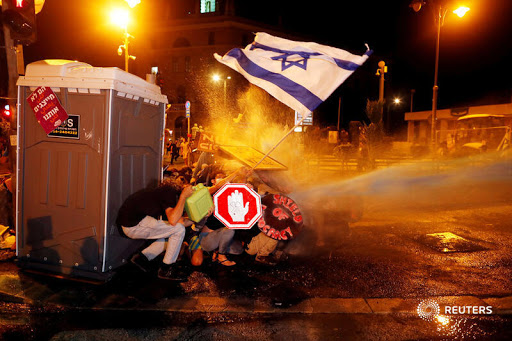

Police use water cannon during a protest against Israeli Prime Minister Benjamin Netanyahu's alleged corruption and his government's handling of the coronavirus disease (COVID-19) crisis, near his residence in Jerusalem July 26, 2020. REUTERS/Ronen Zvulun

Makeshift roofing, rubbish in the street and drying clothing hanging over rough brick walls crisscross through Khaled Abdullah’s picture and dwarf the two figures. This feeling of enormity echoes the seemingly insurmountable problem of poverty and poor housing. Everything crushes down heavily in the heat and squalor: the old tyres, the large bricks, the makeshift weights to keep the flimsy roofs from blowing away.

Boys play at a slum area for the Muhamasheen (marginalized) community in Sanaa, Yemen July 26, 2020. REUTERS/Khaled Abdullah

Although this is a straightforward before and after image using Ahmed Jadallah’s file picture dated 2016,  the power of comparison to demonstrate the impact of  COVID-19 and social distancing is striking. Read on here.

A combination picture shows Muslim pilgrims circling the Kaaba at the Grand mosque during the annual Haj pilgrimage September 8, 2016, and after the coronavirus disease (COVID-19) outbreak July 29, 2020, in Mecca, Saudi Arabia. Pictures taken September 8, 2016 and July 29, 2020. REUTERS/Ahmed Jadallah (top)/ Saudi Ministry of Media/Handout via REUTERS

What a wonderful feature picture by Zohra Bensemra who teases us with “photography pure” elements of the moment caught, tones, shape and colour. Take the time to get past the almost abstract shapes and tones of solid blacks that fill the foreground. We are given just enough highlight detail of the boy’s face in the centre, but nothing is given away in the figure on the left or the dark space on the ground, we just have to figure it out ourselves. To counter these shadows we are treated to the full orange colour in bright sunlight of the boy playing, legs at full stride, head held high, a moment caught. I even like the roof of the building that just kisses the edge of the frame against the blue sky.  

Children are seen at the fishermen port ahead of the Muslim festival of sacrifice Eid al-Adha, amid the coronavirus disease (COVID-19) outbreak, in Dakar, Senegal July 30,2020. REUTERS/Zohra Bensemra

The dawn light bursts over a herd of goats being sold off for slaughter in Thomas Mukoya’s picture. The image is well composed so the animals’ bodies fan out from the centre highlight of the sun, like rays of warmth reaching out to the chill in the foreground. Dotted amongst them are herders and customers alike drawing us deeper into the picture as the goods are inspected and haggled over.    

Muslim faithful buy goats at a livestock market during celebrations marking the Muslim holiday of Eid al-Adha amid the spread of the coronavirus disease (COVID-19) in Nairobi, Kenya July 31, 2020. REUTERS/Thomas Mukoya

I can’t hide my pleasure over a great detail picture that focuses on a small element of a scene that tells a bigger story, and this enjoyment is doubled when it’s an element from a hard to illustrate economic story. Afolabi Sotunde has captured a money dealer flicking through naira notes that are as tired and worn as the trader’s fingers. The story is that the economy is struggling as businesses struggle to find U.S. dollars to buy the materials they need to continue trading. The oil price, Nigeria’s main export to secure dollars, is depressed by the impact of COVID-19.  Read on here.

A man carries Nigerian naira banknotes at a livestock market in Abuja, Nigeria July 29, 2020. REUTERS/Afolabi Sotunde


Friday, 22 May 2020

A Week in Pictures, Middle East and Africa, May 22, 2020


There is no way you can look at Mohamed Torokman’s picture without a smile appearing on your face. It’s reminiscent of images of Olympic breaststroke swimmers coming up for air when, for a split second, a film of water covers their faces, distorting their features. What is special about this image is that not only can you see the boy just under water cooling himself but you get a sense of the place with other swimmers in the background.  

A Palestinian boy dips in a natural spring to cool off during a heat wave, amid concerns about the spread of the coronavirus disease (COVID-19), near Jericho in the Israeli-occupied West Bank May 17, 2020. REUTERS/Mohamad Torokman

Maybe it’s the extra grip the rubber gloves that allows the hairdresser to pull the hair a little tighter, but the slight grimace in Mohamed Abd El Ghany’s picture lets us know that for sure it hurts a little. I love the muted colours in this picture, the white set against the solid black of the background, and the tiny, but all so important, fringe of hair that is about to be clipped off.      


A boy gets his hair cut by hairdresser Youssif Hamada at his home in Cairo, amidst the global outbreak of the coronavirus disease (COVID-19), Egypt, May 18, 2020. REUTERS/Mohamed Abd El Ghany

One of many from a terrific sequence of images by Abubaker Lubowa of an arrest. What gives this one is the edge for me is the fate of the fallen glasses that Stella is looking down at. They are beyond rescue. What I would not give to have the arm of the glasses extended to match the other side perfectly, but life is imperfect, so I will settle for what is here. Read on here

Ugandan academic Stella Nyanzi looks at her glasses as police officers detain her for protesting against the way that government distributes relief food and the lockdown situation to control the spread of the coronavirus disease (COVID-19) outbreak in Kampala, Uganda May 18, 2020. REUTERS/Abubaker Lubowa

Siphiwe Sibeko has given me a dilemma, which I hand to you. I can’t choose which picture I like best. Do you prefer the strong diagonals of vast queues of people that create compositional lines that stretch to the horizons, cutting across the powerful orange and blue colours in this first image? We are immediately grabbed by the shape and colour and left in no doubt as to how many are in need of food handouts. Read on here

People stand in a queue to receive food aid amid the spread of the coronavirus disease (COVID-19), at the Itireleng informal settlement, near Laudium suburb in Pretoria, South Africa, May 20, 2020. REUTERS/Siphiwe Sibeko

Or do you prefer this second image? The dynamic compositional relationship of the orange and blues bisected by lines is not as strong, but that is countered by the powerful horizonal shapes made by the queues of people. Secondly, we don’t quite get the same sense of just how many people are queuing, as the queues are less defined in the background. But what we do get is a greater understanding of the individuals waiting in line. Just look at that woman in pink in the foreground, hands on hips as she takes a long stride and moves slowly forward.

People stand in a queue to receive food aid amid the spread of the coronavirus disease (COVID-19), at the Itireleng informal settlement, near Laudium suburb in Pretoria, South Africa, May 20, 2020. REUTERS/Siphiwe Sibeko

There is no other way to put it, Temilade Adelaja makes you work hard to look at her picture. The centrally placed square-shaped highlight is quite abstract. We really don’t know what it is, but the eye is continually drawn to it and it dominates the image. We then get to see the figure lying in the gloom, on the floor and barely lit. Finally, we see the corrugated iron roofing and we get the sense of poverty. But this picture is about light and not poverty and we’ve been drawn into the story so read on here.

A beneficiary of a Salpha Energy solar panel home installation, Recent Kodjo, lies on a wrapper in her room illuminated by a solar-powered bulb, in Sagbo-Kodji community, amid concerns over the spread of coronavirus disease (COVID-19) in Lagos, Nigeria April 25, 2020. REUTERS/Temilade Adelaja

Just look at the faces in Clovis Guy Siboniyo’s picture. Every single one of these young men is  looking at the elder woman casting her vote. And just look at her expression too, determined, dignified and strong. Great too that the highlight of her profile is captured between the shadows on the man’s red shirt and the shadow cast by the security lock of the ballot box or it could so easily be lost in the busy and harshly lit picture.

A voter casts her ballot at a polling station during the presidential, legislative and communal council elections, under the simmering political violence and the growing threat of the coronavirus disease (COVID-19), in Ngozi, Burundi May 20, 2020. REUTERS/Clovis Guy Siboniyo

I can’t help feeling that this girl got a little more than she bargained for when she no doubt pleaded to have the bucket of water thrown on her in Ali Hashisho’s affectionate picture. Arms spread out, feet firmly placed and then splash, the force of the water pushing her head, and her hair, to one side. The slow shutter speed accentuates the speed and volume of the water. From my own experience of parenthood, if mum was watching I am sure a telling-off would quickly be issued – but what a wonderful memory of childhood Ali has captured.  

A man throws water on a girl playing in a pool, during a hot weather, amid concerns over the spread of coronavirus disease (COVID-19), in Sidon, southern Lebanon May 21, 2020. REUTERS/Ali Hashisho

It’s an old visual trick, replacing a person’s head with a shape, object or ball. Sometimes it works better than at other times and on this occasion, I think Khaled Abdullah’s fun picture works well. Enjoy the smile from Yemen.

A man carries his son who holds a balloon outside a shopping mall ahead of Eid al-Fitr holiday, amid concerns of the spread of the coronavirus disease (COVID-19), in Sanaa, Yemen May 17, 2020.  REUTERS/Khaled Abdullah 

Hard to socially distance when you are visually impaired and touch is so important. Temilade Adelaja has shot a clever set of pictures to illustrate this personal struggle. The image is exposed for the highlights of a harsh sliver of light, and we are only able to see a fraction of what is there. Look very hard and you see a second person, hand held for guidance. Read on here.  

Shobowale Kehinde, 28, an entertainer who is visually impaired, walks through the corridor at his church with assistance from his friend amid the coronavirus disease (COVID-19) outbreak in Lagos, Nigeria May 5, 2020. REUTERS/Temilade Adelaja


Friday, 27 March 2020

A week in Pictures, Middle East and Africa, March 27, 2020

A twisted swirl of neon-lit roads is devoid of traffic except a single motorcycle in Satish Kumar’s eerie picture from Dubai. The dark bridge that cuts across the image but apart from that, to me, the yellow roads take on an undersea organic appearance.

An aerial view of the Sheikh Zayad Road following the outbreak of coronavirus disease (COVID-19) in Dubai, United Arab Emirates, March 26, 2020.    REUTERS/Satish Kumar

The bright reds and blues in Tiksa Negri’s picture of of humble worship are flattened in the soft light and the haze of incense. The way the woman is bowing gives such a gentle sense of reverence. The picture is held together by powerful compositional shapes and lines made up of classic vertical thirds of the figures in red and white and a diagonal emphasised by the bowing woman. 


An Ethiopian Orthodox Priest blesses the faithful with incense, which they believe will keep the coronavirus disease (COVID-19) away in Addis Ababa, Ethiopia, March 26, 2020.   REUTERS/Tiksa Nigeri

As the coronavirus sweeps across the globe one thing that has struck me is how in some countries there is a full lockdown of movement and people are protecting themselves with masks, gloves and suits; while in others life goes on as normal. Baz Ratner’s images of two tourists in shorts strolling past a man sanitising an airport seems to sum this up.  


A health worker sprays disinfectant to help prevent the spread of an outbreak of the coronavirus disease (COVID-19) at the Jomo Kenyatta International airport in Nairobi, Kenya March 24, 2020.  REUTERS/Baz Ratner

Olivia Acland’s image of traders waiting at a crossing point is a wonderfully composed portrait of a group of people. It looks as if it was constructed by a Renaissance painter. The gentle lop-sided U-shaped curve that leads your eye left to right to the figure standing in the doorway. Each limb leading you back along the line of people in a zigzag journey through the cool blues and tones. Olivia was careful not to crop out fingers, toes and clothing and kept them all in frame ; and then you see it, the smiling cartoon cow with a pink nose and thumbs up – nothing high Renaissance about that. Read on here.


Traders sit near a deserted crossing point between the Democratic Republic of Congo and Rwanda amid concerns about the spread of coronavirus disease (COVID-19), at the Petite Barriere in Goma, Democratic Republic of Congo (DRC) March 23, 2020. REUTERS/Olivia Acland


A myriad of busy colour and chaos is the first impression of Zohra Bensemra’s wide-angle picture as your eye zooms in from all sides to the X-shape of the figure in a white suit. Once you visually step back to survey the mess you are left thinking about the size of this worker’s task. You are overwhelmed with a sense of pointlessness – what chances of controlling the virus in such a mess? Read on here.

A member of a local hygiene service wears a protective suit and face mask as he disinfects the street and market to try to stop the spread of coronavirus disease (COVID-19) in Dakar, Senegal March 22, 2020.    REUTERS/Zohra Bensemra

What wonderful colours in Afolabi Sotunde’s affectionate picture as cyan fights with yellows and ochre for your attention on a battle field of black and grey. And there to break up the fight is the “doorman”, standing tall, gloves and disinfectant at the ready. In reality, he’s a member of the church congregation making sure that people who enter to worship have their hands sanitized. The lines of door behind him and the mat on floor welcome you into the church. Read on here.

A man stands with a sanitiser in his hands at the entrance of a Living Faith Church following the outbreak of the coronavirus disease (COVID-19) in Abuja, Nigeria, March 22, 2020.   REUTERS/Afolabi Sotunde

Siphiwe Sibeko’s picture is a beautifully seen image of people going to church and being protected by using hand sanitiser. Take your time to look around, the coordinated women’s dress which is the uniform of the church, right down to their white shoes, thankfully kept in frame. The perfect moment of the hands outstretched waiting for the spray, and the relaxed, easy seated, legs stretched out manner of the woman applying the spray. Look further, the blue notice board matching the uniform colour, the cold metal of the brass instruments waiting to be blown and the visual joke of the heater trying to pretend it’s an instrument too. And finally, the picture of Jesus on the wall. Read on here

A member of the faithful applies hand sanitiser to a woman as she arrives to attend church service at the Apostolic Christian Church in Kagiso, near Johannesburg, South Africa, March 22, 2020.   REUTERS/Siphiwe Sibeko

No escape and trapped in a cage a bear gnaws at the bars while a lion watches, on the face of it an easy image to capture. But not so, take closer look at Alaa al-Marjani’s picture, a combination of good luck, good light and perfect timing. Good luck as the bear is close to the bars, its enormous claws reaching out, good luck too as the lion is resting on this side of the cage and not the other. Good light so we can see both the foreground and into the shadows of the cage; and good timing as the bear’s mouth is wide open, teeth on show and the line of the bar divides the centre of the lion’s head so we can see both eyes on both animals. Remove any one of these elements and the picture would be so much weaker.  

A bear and a lion are seen in a closed zoo, as the zoo staff were advised to not come to work due to a curfew to prevent the spread of coronavirus disease (COVID-19) in the holy city of Najaf, Iraq, March 25, 2020.   REUTERS/Alaa Marjani 

A clever and thoughtful picture by Thomas Mukoya as people try to leave cities and escape to the countryside. The shapes and lines of the image drive us to the centre of the image so we are left in no doubt what we need to look at. It’s minimalist in its detail but we have just enough information from the shadows to let us know this is passenger carrying her child and baggage between two buses. Read on here.

A passenger carries he child before boarding a disinfected public transport bus as residents leave for the villages amid concerns over the spread of the coronavirus disease (COVID-19) in downtown Nairobi, Kenya, March 25, 2020.   REUTERS/Thomas Mukoya 


Sunday, 8 March 2020

A Week in Pictures, Middle East and Africa, March 6, 2020

Khalil Ashawi’s image is very open to interpretation if you let your imagination wander. Is the impression given that the IDP camp is being hidden away, by the cloth, like the feeling among those at the camp that they are getting no help from the global community and are unseen? Is the woman trying to retain normality of life washing and drying her favorite item as if she were still at home, the beautiful cloth a reminder of a life gone by? Or she is just doing the washing? I leave it to you to ponder. 

An internally displaced Syrian woman hangs a piece of cloth out to dry in Atmeh IDP camp, located near the border with Turkey, Syria March 4, 2020.   REUTERS/Khalil Ashawi

Afolabi Sotunde’s picture can best be described as warm and affectionate as the world braces itself to face the spread of the coronavirus outbreak. I think if the background were not so clean and the colour so warm this image would not do as well as it does to raise a gentle smile during these worrying times.     

A boy wearing two face masks records with his phone during a friendly football match for International Women’s day in Abuja, Nigeria March 5, 2020. REUTERS/Afolabi Sotunde

Mike Hutchings’ picture is as expansive as it is full of emotion. Even though the image is shot wide to keep the outstretched arms in frame you are drawn into the woman’s face that is fraught with emotion, via the bold 12 on her shirt. The police in the background make for a dark and somewhat static backdrop for the action in foreground. The tilt to the frame, although subtle, is an important compositional element that adds to the drama.

A woman wails as law enforcement officers move in to disperse a group of immigrants who had occupied a historic church and a square demanding to be moved to another country as they claimed not to feel safe because of xenophobic attacks, in Cape Town, South Africa March 1, 2020.   REUTERS/Mike Hutchings 

What a wonderful detail picture by Amir Cohen - which works so well as the eye is drawn to the single image of Netanyahu in a mass of ballot papers. His face is clear and bold even though it’s quite small in the frame. I also like that the  the colours in the picture are similar to those of the  Israeli national flag.

Israeli Prime Minister Benjamin Netanyahu’s Likud party election ballots are seen on the floor following Netanyahu’s address to supporters at the party headquarters in Tel Aviv, israel, march 3, 2020.   REUTERS/Amir Cohen 

Ari Jalal’s picture makes you feel like you are the person who is being checked for a high temperature, a symptom of possible coronavirus infection. The claustrophobic feel is created by a dark frame and the masked medical worker leaning into the image. Would I have cropped the yellow out on the left? Probably yes, but then maybe you would lose the sense that this was shot from inside a car, which is also very much part of its strength.     

A member of a medical team checks the temperature of an old man in a car at a checkpoint on the outskirts of Duhok, Iraq following an outbreak of coronavirus, March 2, 2020.   REUTERS/Ari Jalal


Hidden in a swirl of bright colours and patterns it comes as quite a shock as your eye finally settles on the child patient stricken with cancer in Essam al-Sudani’s moving picture. With the boy’s hand held to the forehead you can almost feel the pain. Your  eye moves along his long thin arm to the drip and  the cold grey wall on the left offers little comfort. This image makes me feel sad, and so it should. Read on here, a story that has taken weeks to compile. 

Cancer patient Mostafa Abdullah, 14, lies on a bed after receiving treatment at the children’s cancer hospital in Basra, Iraq September 25, 2019.   REUTERS/Essam al-Sudani

I make no excuses for showing this brutal image as I feel its important to document what happens in conflict. It is always a difficult balancing act between what is gratuitous and intrusive while showing the ugliness of injury and death and Umit Bektas has succeeded in his picture. We can see the man is injured but being cared for as he is in a hospital setting, the scene quite dark with the single light source bearing down on his injured body. It takes a while for us to see the amount of his blood on the floor. Read on here.     

Surgeon Mohammad Abrash waits to start surgery on an injured man in a hospital in Idlib, Syria February 28, 2020.   REUTERS/Umit Bektas

The best way to illustrate the impact that fears of coronavirus are having on public spaces is to show a simple before and after. Not a perfect match as access was somewhat restricted to get to exactly the same place to shoot the “after” picture, but Ganoo Essa’s combination does the trick.

A combination picture shows Muslim pilgrims wearing protective face masks, following an outbreak of coronavirus, as they pray at Kaaba in the Grand Mosque in the holy city of Mecca, Saudi Arabia march 3, 2020 (top) and a general view of Kaaba at the Grand Mosque which is almost empty of worshipers, after Saudi authorities suspended Umrah (Islamic pilgrimage to Mecca) amid the concerns of the outbreak, at the Muslim holy city of Mecca, Saudi Arabia March 6, 2020.    REUTERS/Ganoo Essa 


Monday, 24 February 2020

A Week in Pictures, Middle East and Africa, February 21, 2020

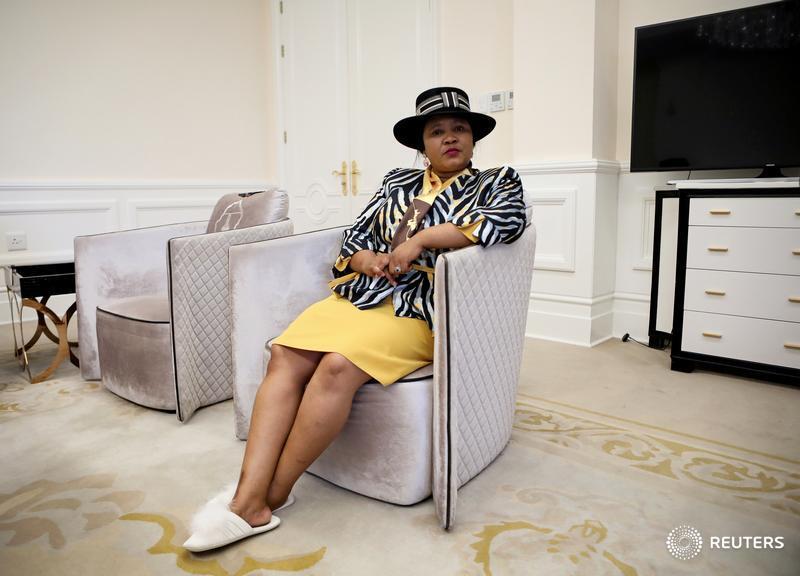
A powerful full-length portrait bSumaya Hisham of Maesaiah, wife of Lesotho’s prime minster, a short while after returning from court after being accused of murder. Her outfit matching the black decorative stripes in the furniture and the yellows in the carpet gives the image a cohesive and well-composed feel. But I think what I like most about this portrait is the fact she has comfortable slippers on. That says to me she’s at home relaxed, but she still has her hat on so she’s not been home long.  Read on here 

Maesaiah Thabane, wife of Lesotho’s Prime Minister Thomas Thabane poses for a photograph at the State House in Maseru, Lesotho, February 18, 2020.  REUTERS/Sumaya Hisham

Harsh light and a harsh out-of-focus diagonal of a rifle barrel that cuts across the regular pattern of the seated troops in Andreea Campeanu’s picture gives it a feeling of unease. In your mind’e eye, remove the rifle barrel and the tension in Andreea’s clever image is removed too.  Read on here 


People’s Defence Forces (SSPDF), South Sudan Opposition Alliance (SSOA), and the People’s Liberation Movement in Opposition (SPLM-IO) soldiers gather at the training site for the joint force to protect VIPs in Gorom outside Juba, South Sudan February 17, 2020.   REUTERS/Andreea Campeanu

Temilade Adelaja’s sombre picture of a tuk-tuk driver illustrates the ban on the vehicles that has hit the city’s transport system and the drivers who make a living from the trade. I can’t shake the feeling of a sense of a nod to Pop artist Roy Lichtenstein as if all that is missing from this image is a thoughts bubble coming from the driver’s head. Maybe it’s the striking yellow and blue in the image – what do you think? 

A corporate tricycle (tuk-tuk) driver cleans his tricycle in Lagos, Nigeria February 13, 2020.   REUTERS/Temilade Adelaja

Khalil Ashawi’s image has me emotionally confused and I can’t help feeling guilty when I look at it. I examined why. On one hand it’s an image of girls posing for a portrait, brightly coloured clothes, newly applied makeup, a gentle smile with relaxed and friendly eye contact, a picture of hope when much must feel bleak in this IDP camp. But look closer. The girl in the centre has a muddy mark on her face, make-up applied without washing her face. I assume water, let alone warm water for washing, is scarce. The girl on the right looks cold, cuffs pulled down over hands clasped together for warmth. The background is mud. I feel the warmth in the fact they still find joy in their friendship and their game of applying make-up. On the other hand, I feel guilty as I fear the situation for these children seems so hopeless. Thankfully Khalil is there to show this plight through his photography and maybe more people, and not just me, feel this angst.   Read on here 


Internally displaced girls pose for a picture at a makeshift camp in Azaz, Syria February 19, 2020.   REUTERS/Khalil Ashawi

I have added this second image from Khalil Ashawi so you get a sense of where these girls are living. 


An internally displaced woman walks at a makeshift camp in Azaz, Syria February 18, 2020.   REUTERS/Khalil Ashawi

Mohamed Salem’s picture is just beautifully lit. Even though it’s quite small in the frame your eye is drawn immediately to the face of the boy, the catch-light touching his eye. Slowly you are drawn away from him, keeping warm under blankets, and notice the holes in the corrugated iron walls and the rough hewn wood until at last you see the three other children in the foreground.   


A Palestinian boy lies on a blanket placed on the floor at his family house on a rainy day in the northern Gaza strip February 19, 2020.   REUTERS/Mohammed Salem

A slightly bizarre image by Essam al-Sudani of tonal contrast and visual confusion. One person is dressed in white, fully covered head to toe, and is touching another person who is fully covered from head to toe in black, except for her face. It takes a little while to work out what is going on. At first the metal cylinder looks like part of the frame structure she is walking under until you realize it is pots she is carrying on her head. It’s only then you look carefully at her face and realise what an affectionate picture of a strong and stoic woman this is. Not only is she having to carry all these heavy supplies, she also has to wait in line to have her temperature taken to check that she is not sick. 


An Iraqi medical staff member checks a passenger’s temperature, amid the coronavirus, upon her arrival to Shalamcha border crossing between Iraq and Iran, February 29, 2020.   REUTERS/Essam al-Sudani