Pages

Friday, 8 February 2019

A Week in Pictures Middle East and Africa February 8, 2019

There is no mistaking the classic beauty of Eissa Alragehi’s picture. It depicts the kind of calm that the pre-Raphaelites strove to achieve in their paintings of imagined rural bliss. But this is Yemen, a far from perfect world, so maybe this is why the top of the tree is cropped off, a slight distraction in this otherwise wonderful picture.  

Students displaced from different cities in Yemen’s northwestern province attend an outdoor class under a tree near Abs, Yemen January 28, 2019.   REUTERS/Eissa Alragehi

Also from Yemen, this brutal image by Fawaz Salman of the execution of two men convicted in court of child rape raises many ethical dilemmas. Should this picture be taken? Should this picture be published? If it’s not taken or published are we self-censoring what is happening in Yemen? If it is taken and published are we normalizing brutality? Is this execution, although legal in Yemen, brutal or just?  These decisions are not taken lightly and keep me awake at night. The men are not dead and this is not the moment of death. My view is that this an important picture to take and publish because this is what is happening in Yemen now. Professional photographers facing this decision will use their own moral compass to decide how to shoot this image. It is also worth noticing the dozens of people using phones to film and photograph the scene. Will they face the same ethical dilemmas when they decide whether to share on social media – thus raising another unanswerable question? 

A police officer prepares for the execution of Wadah Refat, 28 and Mohamed Khaled, 31, who were convicted of raping a twelve-year-old boy, in Aden Yemen February 7, 2018.    REUTERS/Fawaz Salman

And while we are considering ethical dilemmas, Khaled Abdullah had some difficult choices when illustrating the story of conjoined children born in Sanaa Yemen. It is a tragic story that needs to be highlighted, but many would shy away from publishing brutal images of babies suffering in this way. A solution is a clever picture of medical staff looking at x-rays. Even though the reality of the conjoined children can be clearly seen, the image offers hope as the doctors study the x-ray and we allow ourselves the belief there just might be a chance of a normal life. The full story, with other images, can be seen here

Doctors check the x-ray film of newly born conjoined twins at the child intensive care unit of al-Thawra hospital in Sanaa, Yemen February 6, 2019.   REUTERS/Khaled Abdullah

It’s nice when shapes and light all come together to lift an ordinary scene into an image that is a little more special, and this is where Philimon Bulawayo’s picture succeeds. The great shapes of the hat and shoulders are set against the colour of the background, enhanced by the flicker of light from the flame on the face. Delightful. It lifts my spirits.

Zimbabwean Bishop Regina Katsande lights a candle during a national prayer meeting in Harare, Zimbabwe, February 7, 2019.   REUTERS/Philimon Bulawayo

Mohamed, Torokman’s picture has the same structural feel as Philimon’s image above. A single gesture by Alexander Van de Bellen, who looks across to his Palestinian counterpart, lifts an ordinary scene into a picture that is a little more special. The direction of the look by the two men keeps your eye from speeding beyond the edge of the frame as you follow the line of the flags. I like the 16 X 9 format of this image too. It’s easy on the eye as you race back and forth from side to side and back again. 

Palestinian President Mahmoud Abbas and Austrian President Alexander Van der Bellen attend a joint news conference in Ramallah, in the occupied Israeli-occupied West Bank February 5, 2019.   REUTERS/Mohamad Torokman 

The Pope visits United Arab Emirates. There’s a lot of excitement and security is tight. Ahmed Jadallah, as well as producing many classic ‘Pope makes a visit’ pictures, had the  courage to turn 180 degrees from the action to look in the opposite direction to the crowds to produce this very calm security picture. The soldier, although tiny, still jumps out in the frame to grab your eye as the blacks of his uniform stand out against the soft pastels of the blue sky and eggshell white of the minarets.

A member of the security forces guards during the arrival of Pope Francis at the Sheikh Zayad Grand Mosque in Abu Dhabi, United Arab Emirates February 4, 2019.   REUTERS/Ahmed Jadallah

It’s not often that direct eye contact adds to a news picture. In fact it will often destroy it, but Feisal Omar’s image bucks that trend. The reason is that the eye contact takes you directly into the centre of the image, past the red jacket and the cut-off hand that extends annoyingly out of the frame on the right, and the yellow and orange on the rescue worker’s clothing on the left. Once we are through this visual noise, we get to see the injured man on the stretcher and the intense look of the men wheeling him to safety.

Security forces and emergency services evacuate an injured man from the scene where a car bomb exploded at a shopping mall in Mogadishu, Somalia, February 4, 2019.  REUTERS/Feisal Omar

It’s difficult to ignore a sea of red with a beaming smile in the middle. It’s especially difficult when there are two people wearing blue shirts on either side of the picture, maybe they didn’t get the email? I like to think that Siphiwe Sibeko spotted these blue shirts when he shot and cropped the picture. I suspect so, as there were thousands attending the rally. If not, he can add luck to his list of skills. 

Supporters of South Africa’s radical left-wing party, the Economic Freedom Fighters (EFF), hold placards during the launch of the party’s election manifesto in Soshanguve, near Pretoria, South Africa February 2, 2019.    REUTERS/Siphiwe Sibeko 


Friday, 1 February 2019

A week in Pictures Middle East and Africa February 1, 2019


After months of deliberation the Lebanese have formed a unity government. Not an easy assignment for Mohamed Azakir other than the standard headshot of a politician at a podium especially when outside the weather is a light drizzle. But unbeknown to Mohamed he’s not only made one but in my mind several nice pictures. On the original crop that moved to the wire I quite like the blue at the top of the frame, expecting it to be a political phrase; but it’s not, it’s the name of the company who created a hoarding, so my view is to crop it out. The orange bag is also a distraction so maybe nice to crop that out too leaving us with the graphic shape of the umbrella between the face and hand. But if you do that you loose the stride of the figure and the position of his feet, which are key to the original image, so maybe a vertical crop. Below are all possible crops, you chose. I think I prefer the third version with no blue banner and no legs.

A man holding an umbrella walks past a banner of Lebanese Prime Minister Saad al-Hariri in Beirut, Lebanon, February 1, 2019. Mohamed Azakir


I actually like chaos and the opportunity it brings to make pictures and for things to happen. Afolabi Sotunde took full advantage of the chaotic scenes of protesters of opposing sides demonstrating in Abuja and an unlucky policeman trying to keep them apart. The hands and feet all jumping about give this image quite a friendly and almost celebratory feeling. But we all know that at any minute things can take a turn for the worse, so there is an underlying feeling of tension.       

A Nigerian police officer tries to disperse protesters, both supporting and opposing the suspension of the Chief Justice of Nigeria Walter Onnoghen, in Abuja, Nigeria, January 28, 2018. REUTERS/Afolabi Sotunde

Some pictures are a ‘slow burn’ before they begin to grab your attention. Ahmed Jadallah’s image of worshippers in UAE is one such picture. A first glance a well-lit picture of people in shadow with minarets in the background, an easy up and down, left to right composition to draw your eye along the image. It’s then that you spot the Christian statue of the Virgin Mary in a shrine in the Muslim setting, which raises the question ‘what’s going on?’ The answer, it’s a preview to Pope Francis’ visit to the UAE. Photographing an event before it starts is never easy, so this gentle picture is a little special.

Expat worshippers prays in front of St Mary’s shrine at the St. Mary Catholic church in Oud Metha, as Catholics wait for the visit by pope Francis to the United Arab Emirates in Dubai, UAE, January 18, 2019.   REUTERS/Ahmed Jadallah

There’s always something a little comic and maybe a little yukky about feet sticking out of the end of the bed, especially when they belong to someone who is over 3000 years old. Mohamed Abd El Ghany didn’t waste a minute playing to our preconceived ideas when he took this wonderful picture, you just can’t stop looking. You can see more here.

The mummy of the boy pharaoh King Tutankhamen is on display in his newly renovated tomb in the Valley of the Kings in Luxor, Egypt January 31, 2019.   REUTERS/ Mohamed Abd El Ghany

There is no mistaking the anguish on the boy’s face in Ibraheem Abu Mustafa’s picture as the child screams, blood streaming from his eye socket. You don’t need to be an optician to know that he is likely to blinded in that eye. If that imagery is not strong enough on its own, the juxtaposition of the man in the shirt that reads ‘Shit happens’ compounds the sense that for sure shit does happen and it’s often sad. Ibraheem followed up on the boy and his recovery, which offers no solace or happy ending and can be seen here

Wounded Palestinian boy Mohammad An-Najjar, 12, is evacuated during a protest at the Israeli-Gaza border fence, in the southern Gaza strip, January 11, 2019.   REUTERS/Ibraheem Abd Musta

I like graphic shapes and lines in a picture, even better if there is vast areas of powerful strong tones or colour that leads your eye to the tiniest detail. Zohra Bensemra’s bridge picture ticks all those visual boxes. Your eye is rushed along the new black road surface by the solid white line, not stopping for a second as you zoom past the past the man to the tiny solitary car on the bridge on the distant horizon. Take a second more and you notice the wonderful detail of the smallest of highlights between road and vehicle. We are left breathless.

A man walks along the newly inaugurated Sene-Gambia bridge that links Gambia’s south and north banks in Farafenni-Soma, Gambia January 25, 2019.   REUTERS/Zohra Bensemra


As an antidote to this breathtaking speed I have added the calm ripples of a gentle current that bends the lines of refection in a second image from Zohra from the same bridge. Now breathe out.

A general view of the newly inaugurated Sene-Gambia bridge that links Gambia’s south and north banks in Farafenni-Soma, Gambia January 25, 2019.   REUTERS/Zohra Bensemra


I can’t stop my eye from darting all over Afolabi Sotunde’s picture as the more I look the more I see. The warmth and richness of the colour vying for attention, circled and checkered cloth, faces half obscured with strong shadows from the harsh light or modest glances away from the camera; faded and peeling election posters on a metal corrugated hut, the bright reds of clothing in the mid ground on the left and a second queue of women on the right. And then, finally, to the symmetrical brown roofed building in the distance. I don’t think Afolabi could have crammed any more details into this picture if he tried. Read on here

Women queue for relief at the Teachers’ Village IDP camp in Maiduguri, Nigeria, January 16, 2019.  REUTERS/Afolabi Sotunde 


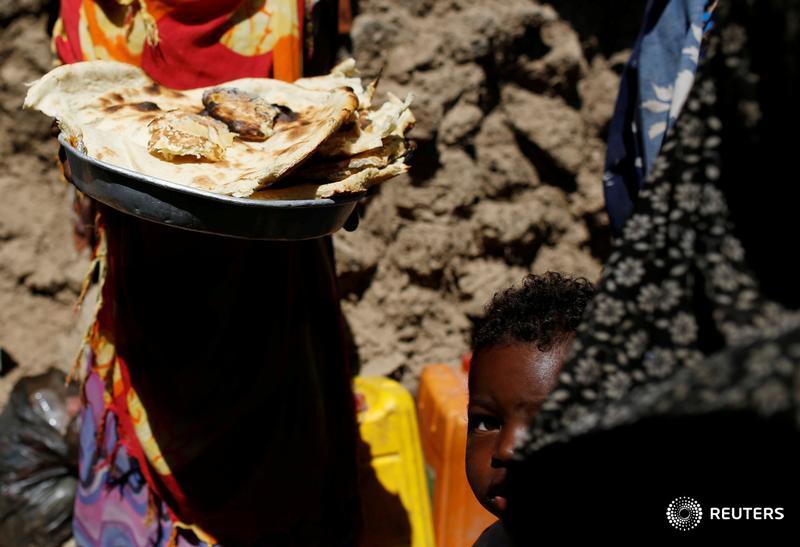
An easy link from Afolabi’s picture above to the complex visual composition of Khaled Abdullah’s picture from Yemen as vibrant colours and harsh light fight for your attention. It takes a little while before you notice the small boy, but once you do see him no matter how hard the colours and light fight for your attention you can’t pull yourself away from the look in this child’s eye.

A boy looks as a woman holds bread she has just made outside her hut at a makeshift camp of internally displaced people near Sanaa, Yemen January 28, 2019.   REUTERS/Khaled Abdullah 


There is a buzz to be heard on the Israeli political landscape as Benny Gantz throws his hat into the ring before the country’s elections. Faced with the challenge of finding an interesting picture to illustrate a good breaking story that is visually arid Amir Cohen has cleverly combined a billboard poster with a street sign. It’s both visually effective and confusing, so to help you fathom it out I’ve added a second picture (that plays with reds and blues) to explain how the first was shot. I feel a little guilty - as if I’m revealing a magician’s secret to their trick.

A part of a campaign billboard of Benny Gantz, a former Israel armed forces chief and the head of a new political party, Israel Resilience, can be seen in Tel Aviv, Israel January 29, 2019.   REUTERS/Amir Cohen 

A campaign billboard of Benny Gantz, a former Israel armed forces chief and the head of a new political party, Israel Resilience, can be seen in Tel Aviv, Israel January 29, 2019.   REUTERS/Amir Cohen


Friday, 25 January 2019

A Week in Pictures Middle East and Africa January 25, 2019

As a late inclusion for pictures of the week I could not ignore Ibraheem Abu Mustafa’s picture from the Gaza-Israeli border, it’s like two images in one. In the bottom left third of the picture is a group of young men, hugging, smiling and taking a selfie. In the rest of the image are scenes of people running during clashes, shrouded in tear gas. The power of this image is that could be used to open so many debates that would polarise opinion.   

Palestinian demonstrators pose for a selfie during a protest at the Israel-Gaza border fence, in the ventral Gaza strip January 25, 2019. REUTERS/Ibraheem Abu Mustafa

There’s no escaping the intrigue in Thaier al-Sudani’s picture of the Bikers of Baghdad. We are squeezed into the image through the backward glance by the black clad rider and the bright Iraqi flag to the bike weaving through the traffic. It’s a feel-good story about  an attempt at unity, so have a look at the rest of the pictures here


A member of Iraq Bikers, first Iraqi biker group, drives with an Iraqi flag on his motorbike in Baghdad, Iraq December 28, 2018.   REUTERS/Thaier Al-Sudani 


Strange shapes and colours in Olivia Acland’s picture combine to intrigue and delight the viewer. The shadow of the young man’s hand doesn’t quite cover his eyes so his face jumps out at you even though it’s quite small in the frame. The catchlight in the out of focus figure in the foreground brings him sharply into focus, if only for a second, but it is time enough for us to notice the loud hailer he’s carrying. Only then are we allowed to drift into the background to notice the other figures milling about expectantly in the heat and dark and then finally to the hand and arm creeping into the frame.  


Supports of Felix Tshisekedi, leader of the Congolese main opposition party, the Union for Democracy and Social progress celebrate along the streets after the judges of the Constitutional Court confirmed Tshisekedi’s victory in the presidential election in Kinshasa, DRC, January 20, 2019.   REUTERS/Olivia Ackland 


At first glance Amir Cohen’s picture looks like a simple graphic weather picture from the Golan heights, a tree set again a blue sky after a fresh snow shower. But it’s not, it’s a clever image of an Iron Dome anti-missile system being installed after another round of attacks. Once the caption is read the tree fades away and the details of the crated weapons system come to the fore of the image.   


A crane lowers Iron Dome anti-missile system’s launch tubes at Mount Hermon in the Israeli-occupied Golan heights near the Israeli-Syria border January 21, 2019.    REUTERS/Amir Cohen

You need to look and look again at Eissa Alragehi picture to make sense of it. It’s like blacksmith Yaarub is part of a machine in a Mad Max type world, stylish in his appearance with his eye wear, strong arms, calm and in control in the chaos of the workshop. There is no mention of his disability in the caption so no clues there. You need to notice the wheels of his wheelchair to begin to understand. It’s a perfect picture to draw you into a story so you can discover more, so click here  


Yaarub Eissa works at a blacksmith workshop in Abs in the northern province of Hajiah, Yemen January 19, 2019.   REUTERS/Eissa Alragehi

Siphiwe Sibeko’s image is one of those pictures that works as it draws you in to awkward space. It shouldn’t really work but it does and you’re not quite sure why. The basic visual story is a man appearing in court who has a famous father. The temptation would be to just show the two of them interacting, as Siphiwe has done. I include that image to demonstrate this. What I enjoy most about Siphiwe’s picture is the space between the figures and how the body language bounces us around. Your eye is drawn straight to the central figure. He’s laughing, relaxed and his eye line draws you to the person on the right, who’s cropped half out of the frame but looking back in, sending your eye off to the third figure on the left. He in turn is looking left to right, sending you back to the central figure. The circle is complete.

 Duduzane Zuma, stands next to his father, former South African President Jacob Zuma, as he waits for the start of his appearance at the Specialist Commercial Crimes Court in Johannesburg, South Africa, January 24, 2019.   REUTERS/Siphiwe Sibeko


Duduzane Zuma, laughs with his father, former South African President Jacob Zuma, as he waits for the start of his appearance at the Specialist Commercial Crimes Court in Johannesburg, South Africa, January 24, 2109.   REUTERS/Siphiwe Sibeko

As an exercise in demonstrating just how a small crop by an editor can make a lot of difference, I want to share an image shot by Philimon Bulawayo in Zimbabwe. The first has  no crop and the second with a slight crop. I don’t want to take away from the difficulty that Philimon is working under as a photographer so this is to highlight just how important these small changes can be in the editing process.


Motorists queue for petrol in Harare, Zimbabwe, January 22, 2019.   REUTERS/Philimon Bulawayo


Motorists queue for petrol in Harare, Zimbabwe, January 22, 2019.   REUTERS/Philimon Bulawayo


Monday, 21 January 2019

A Week in Pictures Middle East and Africa January 18, 2019

We responded quickly to the attack in Nairobi and the team had pictures on the wire within minutes, filling the international news websites with powerful images. I have selected two images from the story. The first by Thomas Mukoya, perfect in its composition, creates an atmosphere of extreme but silent tension. This tension derives from the visual flow of the movement from left to right, the position of arms, feet, hands and eyes as the soldier carefully checks that it’s safe to move. The whole scene unfolds against a backdrop of alternate light and dark tones. More on the story here


A member of the security forces keeps guard as people are evacuated at the scene where explosions and gunshots were heard at the DusitD2 hotel compound in Nairobi, Kenya, January 15, 2019.   REUTERS/Thomas Mukoya

Baz Ratner’s picture is basically a similar moment, a soldier leading people to safety, but has such a different feel. Unlike Thomas’s picture, where you see people led to safety in fearful silence, in Baz’s picture they are crushed into a small space, all lines leading to the woman grimacing in fear. It feels noisy to me as the soldier looks up out of the frame. I like it that you only get the smallest glimpse of his eye. Any more of his face and the image would have a different focal point: the soldier. Any less and he would appear as a green shape obstructing the visual action in the rear.   


People are evacuated by member of the security forces at the scene where explosions and gunshots were heard at the DusitD2 hotel compound in Nairobi, Kenya, January 15, 2019.   REUTERS/Baz Ratner 

What is most striking in Philimon Bulawayo’s second pick this week is that it’s very rare to see such striking flames and running demonstrators in the driving rain. Heavy rainfall often dampens both, so what we are seeing may be a good indicator of the anger felt by those protesting in this compelling picture. More on the Zimbabwe story here


People run at a protest as barricades burn during rainfall in Harare, Zimbabwe January 14, 2019.   REUTERS/Philimon Bulawayo

Even though the prisoner in Philimon Bulawayo’s picture is surrounded by police he looks lonely and defenceless. The position of the police, helmets on, face shields down, batons ready, keeps your eye focused on the prisoner as he occupies the central empty space. You then see the hand that also directs you to the central figure. Another prisoner is being directed to this open space. Some company for our lonely prisoner. No doubt there will be many more.

People arrested during protests wait to appear in the Magistrates court in Harare, Zimbabwe January 16, 2019.   REUTERS/Philimon Bulawayo

A simple but eye-catching picture from Mohamed Abd El Ghany is an easy pick this week. A sandstorm sweeps into Cairo, obliterating the skyline to create this eerie, sepia-toned image. What makes this picture work well is the wrapped-up figure, bold in shape, with the palm trees in the background bowing against the wind.   


A man covers his face during a sandstorm near the River Nile in Cairo, Egypt January 16, 2019.   REUTERS/Mohamed Abd El Ghany

A lucky accident of timing, a well-handled crop and a bit of fun from Suhaib Salem as the ball bounces to create the illusion that Muhsen al-Ghassani’s head is actually a football. The reason this works so well is that the background is clean, the ball’s position is perfect and the colour is nice, allowing us a gentle smile.  


Ela Oman’s Muhsen al-Ghassani jumps for the ball against Japan’s Yuto Nagatomo during their AFC Asian Cup Group F match in Abu Dhabi, United Arab Emirates, January 13, 2019.   REUTERS/Suhaib Salem

Zohra Bensemra’s picture is a gentle look at football spectators in Senegal. You can almost feel the warmth of the sunshine off the wall and the gentle breeze blowing through the gaps as two relaxed figures enjoy the peace of the moment. I’m not sure if the wall is being constructed or in a state of disrepair, but it doesn’t matter. What does matter is the clever use of shape and line.      


Supporters watch a training session of their football team in Medina neighbourhood in Dakar, Senegal, January 14, 2019.   REUTERS/Zohra Bensemra 

Francis Kokoroko’s picture reminded me of a series of landscapes titled ‘Shot at Dawn’ by Chloe Dewe Mathews. The main difference is that the echo of silence felt in Chloe’s pictures, which have no people in them, is broken in Francis’ image by the quiet phone conversation being held by a man standing alone in a wide nondescript setting. We are not sure the killing actually took place in this spot, but the mood, like the cool tones of the blue wall, is very sombre. 


A man talks on the phone in a street believed to be where Ahmed Hussein-Suale, an investigative journalist, was shot dead in Madina, Accra, Ghana January 17, 2019.   REUTERS/Francis Kokoroko

I love the fan-like rhythm in Maheder Haileselaisse’s picture, with perspective lines that would have made medieval painter Paolo Uccello sing with joy. I love, too, the equally spaced dots of colour and highlights in the scarves of the women that break up the lines of the production tables. It also makes me reflect on the effort involved in producing coffee in some parts of the world. Even though it was shot in November, the full story was only published this week. That gives you an indication of how long some stories take to produce.  See the story here


Workers dry washed coffee beans at the Holiso cooperative of Shebedino district in Sidama, Ethiopia November 30, 2018.   REUTERS/ Maheder Haileselaisse 

There is no mistaking the power and energy in Thierry Gouegnon’s picture. What I like too about this, again using a painting theme, is the sense of cubism in the design. Hands, arms, elbows and faces all come in from different directions, some elements visible to make sense, other elements obscured and truncated only to be completed visually in a different part of the picture.   


Supporters of former Ivory Coast president Laurent Gbagbo celebrate along a street in Abidjan, Ivory Coast, January 15, 2019.   REUTERS/Thierry Gouegnon


Monday, 14 January 2019

A Week in Pictures Middle East and Africa January 11, 2019


A belated happy New Year to all. It might have gone unnoticed that in UAE Hamad I Mohammed photographed what appears to be an alien landing. Well, that is what it looks like to me or maybe it’s a sneak preview of Blade Runner 3. A beam of light shimmers from the Burj Khalifa as if the occupants of an alien craft are searching for something or someone in the grey-brown tower blocks. You can see the best of Reuters 2018 here 

The Buri Khalifa us lit up during new Year celebrations in Dubai, United Arab Emirates, January 1, 2019.   REUTERS/Hamad I Mohammed

The composition of Mohamed Nureldin Abdallah’s picture is ‘in your face’ very much as his lens was in the face of the security guard to produce this striking picture. The blue of the sky creates a clean backdrop for the strong shapes and lines to cut across. Am I worried the face is not perfectly cut in half or that the cane extends beyond the edge of the frame? Not at all, as this makes the image bleed wider than its borders, giving it a ‘big screen’ feel.   

Sudan’s President Omar al-Bashir waves to his supporters during a rally at the Green Square in Khartoum, Sudan January 9, 2019.    REUTERS/Mohamed Nureldin Abdullah

Perfect timing as the ashes leave the shovel in front of the rising sun gives a powerful left-to-right compositional flow to Feisal Omars’s picture. The figures on the left in the background help to echo the wider V shape that makes up the dark foreground. The bare branches of the tree cut through the haze of rising smoke and the handle of the shovel adds to this compositional echo.     

A trader uses a shovel as he attempts to recover his merchandise within the smoldering remains of clothing stalls after an overnight fire at the Bakara market in Mogadishu, Somalia January 11, 2019.    REUTERS/Fesial Omar

A strange moment captured by Olivia Acland as people react to election news in DRC. Your eye goes immediately to the blue cross and then quickly to the figure on the right, hand on head, mouth open and eyes closed with tears, his colleagues closing in to console him as they look at a picture of their leader. But look deeper into the picture. A woman is smiling and posing as she seems to be shooting a selfie of herself in front of election banners.  

Supporters of Felix Tshisekedi, leader of the Congolese main opposition the Union for Democracy and Social Progress (UDPS) react at the party HQ in Kinshasa, Democratic Republic of Congo January 10, 2019. REUTERS/Olivia Acland

I’ve broken my own rule and added a picture with no watermark (so no stealing please), the reason being that it completely destroys the key focal point of Philimon Bulawayo’s picture - the upward look of the man. Confusing action of what appears to be people jumping up and down is exaggerated by the left-hand-down tilt of the picture and countered by the upwards look of the salesman.   

A man looks up at old Zimbabwean currency notes for sale in Harare, Zimbabwe January 10, 2019.   REUTERS/Philimon Bulawayo

A giant wave of people swirls around Fayulu in Baz Ratner’s picture. It’s as if the arms of his supporters are spinning the shape and flow of the image around and around so you are drawn into the picture like a whirlpool. What I admire too is that I know exactly how much energy and hard work it would have taken for Baz to get into this position through the crowds of supporters. More on the election here 

Martin Fayulu, runner up in Democratic Republic of Congo’s presidential election waves to his supporters as he arrives to a political rally in Kinshasa, Democratic Republic of Congo, January 11, 2019.   REUTERS/.Baz Ratner

‘Shit Happens’ it most certainly does and I am drawn uncomfortably to Ibraheem Abu Mustafa’s powerful picture. On one hand I cannot help but admire the perfect visual combination of the wording on the man’s shirt and the injured boy. But I am also aware that the boy is suffering greatly and his injury will probably blind him in one eye. I would much rather that this image did not exist and the boy had his sight. But he was injured, we report the news as it happens, and ‘shit happens’. we are following up to see what has happened to this boy.

A wounded Palestinian boy is evacuated during a protest at the Israel-Gaza border fence, in the southern Gaza strip January 11, 2019.   REUTERS/Ibraheem Abu Mustafa