Pages

Showing posts with label bikers. Show all posts

Friday, 25 January 2019

A Week in Pictures Middle East and Africa January 25, 2019

As a late inclusion for pictures of the week I could not ignore Ibraheem Abu Mustafa’s picture from the Gaza-Israeli border, it’s like two images in one. In the bottom left third of the picture is a group of young men, hugging, smiling and taking a selfie. In the rest of the image are scenes of people running during clashes, shrouded in tear gas. The power of this image is that could be used to open so many debates that would polarise opinion.   

Palestinian demonstrators pose for a selfie during a protest at the Israel-Gaza border fence, in the ventral Gaza strip January 25, 2019. REUTERS/Ibraheem Abu Mustafa

There’s no escaping the intrigue in Thaier al-Sudani’s picture of the Bikers of Baghdad. We are squeezed into the image through the backward glance by the black clad rider and the bright Iraqi flag to the bike weaving through the traffic. It’s a feel-good story about  an attempt at unity, so have a look at the rest of the pictures here


A member of Iraq Bikers, first Iraqi biker group, drives with an Iraqi flag on his motorbike in Baghdad, Iraq December 28, 2018.   REUTERS/Thaier Al-Sudani 


Strange shapes and colours in Olivia Acland’s picture combine to intrigue and delight the viewer. The shadow of the young man’s hand doesn’t quite cover his eyes so his face jumps out at you even though it’s quite small in the frame. The catchlight in the out of focus figure in the foreground brings him sharply into focus, if only for a second, but it is time enough for us to notice the loud hailer he’s carrying. Only then are we allowed to drift into the background to notice the other figures milling about expectantly in the heat and dark and then finally to the hand and arm creeping into the frame.  


Supports of Felix Tshisekedi, leader of the Congolese main opposition party, the Union for Democracy and Social progress celebrate along the streets after the judges of the Constitutional Court confirmed Tshisekedi’s victory in the presidential election in Kinshasa, DRC, January 20, 2019.   REUTERS/Olivia Ackland 


At first glance Amir Cohen’s picture looks like a simple graphic weather picture from the Golan heights, a tree set again a blue sky after a fresh snow shower. But it’s not, it’s a clever image of an Iron Dome anti-missile system being installed after another round of attacks. Once the caption is read the tree fades away and the details of the crated weapons system come to the fore of the image.   


A crane lowers Iron Dome anti-missile system’s launch tubes at Mount Hermon in the Israeli-occupied Golan heights near the Israeli-Syria border January 21, 2019.    REUTERS/Amir Cohen

You need to look and look again at Eissa Alragehi picture to make sense of it. It’s like blacksmith Yaarub is part of a machine in a Mad Max type world, stylish in his appearance with his eye wear, strong arms, calm and in control in the chaos of the workshop. There is no mention of his disability in the caption so no clues there. You need to notice the wheels of his wheelchair to begin to understand. It’s a perfect picture to draw you into a story so you can discover more, so click here  


Yaarub Eissa works at a blacksmith workshop in Abs in the northern province of Hajiah, Yemen January 19, 2019.   REUTERS/Eissa Alragehi

Siphiwe Sibeko’s image is one of those pictures that works as it draws you in to awkward space. It shouldn’t really work but it does and you’re not quite sure why. The basic visual story is a man appearing in court who has a famous father. The temptation would be to just show the two of them interacting, as Siphiwe has done. I include that image to demonstrate this. What I enjoy most about Siphiwe’s picture is the space between the figures and how the body language bounces us around. Your eye is drawn straight to the central figure. He’s laughing, relaxed and his eye line draws you to the person on the right, who’s cropped half out of the frame but looking back in, sending your eye off to the third figure on the left. He in turn is looking left to right, sending you back to the central figure. The circle is complete.

 Duduzane Zuma, stands next to his father, former South African President Jacob Zuma, as he waits for the start of his appearance at the Specialist Commercial Crimes Court in Johannesburg, South Africa, January 24, 2019.   REUTERS/Siphiwe Sibeko


Duduzane Zuma, laughs with his father, former South African President Jacob Zuma, as he waits for the start of his appearance at the Specialist Commercial Crimes Court in Johannesburg, South Africa, January 24, 2109.   REUTERS/Siphiwe Sibeko

As an exercise in demonstrating just how a small crop by an editor can make a lot of difference, I want to share an image shot by Philimon Bulawayo in Zimbabwe. The first has  no crop and the second with a slight crop. I don’t want to take away from the difficulty that Philimon is working under as a photographer so this is to highlight just how important these small changes can be in the editing process.


Motorists queue for petrol in Harare, Zimbabwe, January 22, 2019.   REUTERS/Philimon Bulawayo


Motorists queue for petrol in Harare, Zimbabwe, January 22, 2019.   REUTERS/Philimon Bulawayo


Saturday, 25 November 2017

A Week in Pictures, Middle East & Africa November 24, 2017


Relatively late in the day on Friday Siphiwe Sebeko filed this picture of a supporter at the inauguration of Zimbabwe's new president. that I wanted to include it as an update. At first look it's a wide picture of a supporter in a crowd holding a banner that says 'Thank you Zimbabwe'. I could not resist cropping this to bring out what I really like in this picture, the sea of faces in the banner that almost matches the sea of faces in the crowd. As a foot note to my thinking; had I left it as a tighter cropped horizontal (as I wanted to) I felt the red shirt of the man on the right would have been too much of a distraction. Agree? 


Locals celebrate after the swearing in of Zimbabwe's new president Emmerson Mnangagwa in Harare, Zimbabwe, November 24, 2017.   REUTERS/Siphiwe Sibeko 

Good pictures of people waiting for something to happen are hard to shoot. People are not doing anything, just waiting. But that in itself presents an opportunity, translating a long period of quiet and calm into something visual can produce powerful pictures that ooze tension, apprehension, anticipation, hope, longing and boredom. Both Ibraheem Abu Mustafa and Suhaib Salem, in my opinion, have achieved just that.


Palestinians wait for relatives to cross into Gaza, after Rafah border crossing was opened under the control of the western-backed Palestinian Authority for the first time since 2007 in Rafah in the southern Gaza strip November 19, 2017.   REUTERS/Ibraheem Abu Mustafa


Palestinians wait for travel permits to cross into Egypt after Rafah border crossing was opened under the control of the western-backed Palestinian Authority for the first time since 2007 in Rafah in the southern Gaza strip November 19, 2017.   REUTERS/Suhaib Salem

Again a disturbing image of an injured child needs to be seen, as the story of the besieged town of Douma in Syria unfolds. It’s not the injured arm that disturbs me in Bassam Khabeih’s picture, but the sheer terror in the child’s face. That fear is accentuated by the light reflected in his eye, while his tense and open mouth fight for your immediate attention with the blood on the white table. The strong diagonals of the line of the wall and the markings on the floor draw you back in, not allowing you to look away.


A wounded child is seen lying in Douma hospital after heavy shelling in the rebel-held besieged town of Douma, eastern Ghouta in Damascus, Syria November 19, 2017.    REUTERS/Bassam Khabieh

You can almost taste the tension in Philimon Bulawayo’s picture as Robert Mugabe fails to announce his expected resignation in a live television broadcast. You don’t need a caption to tell you what the men are talking about as your eye dances around the greens, reds and blues of the bar’s lighting that create negative and positive shapes formed by the men’s profiles and their incredulous lips.


People talk as they watch television in a bar in Harare Zimbabwe as Zimbabwean President Robert Mugabe addresses the nation November 19, 2017.    REUTERS/Philimon Bulawayo

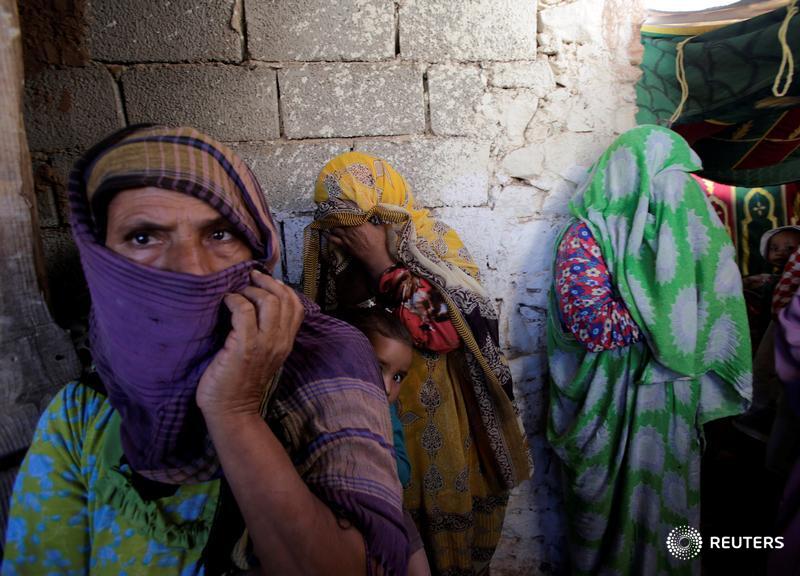
Not many know there was a stampede of people in Morocco when food aid was being distributed. Fifteen people were killed. Youssef Boudlal’s picture of grieving relatives is a haunting reminder of this easily ignored tragedy. As a viewer, I am not sure if the women are hiding from the camera or grieving, I suspect both. For me, the strength of this picture is the small boy who peering around from the back of the woman who is staring into space. His presence, like the news of the deaths at the stampede, is easily missed.


Relatives mourn the death of Lakbira Essabiry, one of the people who were killed when a stampeded broke out in the south western Moroccan town of Sidi Boulaalam as food aid was being distributed in a market, in Sidi Boulaalam, Morocco November 20, 2017.   REUTERS/Youssef Boudlal

 A bible-holding supporter of President Kenyatta screams into the air with joy, as people celebrate the news that a court had upheld his re-election. The relief on the faces of these people in Baz Ratner’s picture is so powerful that the visual noise of the yellow line, white pillars and railings don’t destroy the image. A close look reveals that the bible is open at Kings 2, Chapter 12, ‘Joash repairs the Temple’. I hope that rebuilding is the theme of the presidency after all the clashes.


Jubilee party supporters cheers after Kenya’s Supreme Court upheld the re-election of President Uhuru Kenyatta in last month’s repeat presidential vote in Nairobi, Kenya, November 20, 2017.   REUTERS/Baz Ratner

I have little secret, I love good pictures that illustrate business stories especially when they are about commodities. Mining, oil pictures from drilling to the global impact of price changes, and agriculture are particular favourites. So how could I resist Khalid al-Mousily’s symmetrical picture of a small mountain of sugar in Iraq, a man in black striding purposefully towards it. A picture with great shape that jumps out at you and can be used well on any platform, from a small screen on a mobile device or as a double-page spread in a magazine, or on an advertising hoarding in the street.  


An employee checks raw sugar at a sugar refinery in the city of Hilla, Iraq, November 21, 2017.   REUTERS/Khalid al-Mousily

Amid the euphoria of Zimbabwe it would be easy to forget the crisis in Yemen, if only for a day. But there is no respite as Khaled Abdullah’s picture brings our minds quickly back to what is going on. It’s hard to tell the age of the person with thin and fragile legs until you realise that this helpless child is so tiny that he is on a set of scales designed for weighing babies. For me, the fact that you do not see the face of this malnourished boy gives a sense of the wider issue of hunger created by conflict in Yemen, and not just one person’s story.  


A boy lies on a weighing scale at a malnutrition treatment centre in Sanaa, Yemen, November 22, 2017.   REUTERS/Khaled Abdullah 

Almost a week of rising tension in Zimbabwe ended in an explosion of joy, relief, all night parties and smiling faces after fears that the transition of power from Mugabe would be bloody proved unfounded. Hard to chose one picture from Mike Hutchings but I think the frame full of smiling faces is a winner for me. I wish I was there. Have a look at more pictures here to lift your spirits.


Zimbabweans celebrate after President Robert Mugabe resigns in Harare, Zimbabwe November 21, 2017.  REUTERS/Mike Hutchings

One might not immediately think of Libya in terms of sun, sea, sand and … motorbikes.  So it’s therefore impossible to not include Ahmed Jadallah’s simple but affectionate picture of bikers, some of whom belong to the ‘Monsters’ group, on a Libyan beach. Although the picture was taken a while ago I’ve included in this week’s round-up as it was only published this week. You can read on here.


Members of the Tripoli bikers group ride their motorbikes at the beach in Tripoli, Libya November 4, 2017.  REUTERS/Ahmed Jadallah