Pages

Showing posts with label Iron Dome. Show all posts

Friday, 25 January 2019

A Week in Pictures Middle East and Africa January 25, 2019

As a late inclusion for pictures of the week I could not ignore Ibraheem Abu Mustafa’s picture from the Gaza-Israeli border, it’s like two images in one. In the bottom left third of the picture is a group of young men, hugging, smiling and taking a selfie. In the rest of the image are scenes of people running during clashes, shrouded in tear gas. The power of this image is that could be used to open so many debates that would polarise opinion.   

Palestinian demonstrators pose for a selfie during a protest at the Israel-Gaza border fence, in the ventral Gaza strip January 25, 2019. REUTERS/Ibraheem Abu Mustafa

There’s no escaping the intrigue in Thaier al-Sudani’s picture of the Bikers of Baghdad. We are squeezed into the image through the backward glance by the black clad rider and the bright Iraqi flag to the bike weaving through the traffic. It’s a feel-good story about  an attempt at unity, so have a look at the rest of the pictures here


A member of Iraq Bikers, first Iraqi biker group, drives with an Iraqi flag on his motorbike in Baghdad, Iraq December 28, 2018.   REUTERS/Thaier Al-Sudani 


Strange shapes and colours in Olivia Acland’s picture combine to intrigue and delight the viewer. The shadow of the young man’s hand doesn’t quite cover his eyes so his face jumps out at you even though it’s quite small in the frame. The catchlight in the out of focus figure in the foreground brings him sharply into focus, if only for a second, but it is time enough for us to notice the loud hailer he’s carrying. Only then are we allowed to drift into the background to notice the other figures milling about expectantly in the heat and dark and then finally to the hand and arm creeping into the frame.  


Supports of Felix Tshisekedi, leader of the Congolese main opposition party, the Union for Democracy and Social progress celebrate along the streets after the judges of the Constitutional Court confirmed Tshisekedi’s victory in the presidential election in Kinshasa, DRC, January 20, 2019.   REUTERS/Olivia Ackland 


At first glance Amir Cohen’s picture looks like a simple graphic weather picture from the Golan heights, a tree set again a blue sky after a fresh snow shower. But it’s not, it’s a clever image of an Iron Dome anti-missile system being installed after another round of attacks. Once the caption is read the tree fades away and the details of the crated weapons system come to the fore of the image.   


A crane lowers Iron Dome anti-missile system’s launch tubes at Mount Hermon in the Israeli-occupied Golan heights near the Israeli-Syria border January 21, 2019.    REUTERS/Amir Cohen

You need to look and look again at Eissa Alragehi picture to make sense of it. It’s like blacksmith Yaarub is part of a machine in a Mad Max type world, stylish in his appearance with his eye wear, strong arms, calm and in control in the chaos of the workshop. There is no mention of his disability in the caption so no clues there. You need to notice the wheels of his wheelchair to begin to understand. It’s a perfect picture to draw you into a story so you can discover more, so click here  


Yaarub Eissa works at a blacksmith workshop in Abs in the northern province of Hajiah, Yemen January 19, 2019.   REUTERS/Eissa Alragehi

Siphiwe Sibeko’s image is one of those pictures that works as it draws you in to awkward space. It shouldn’t really work but it does and you’re not quite sure why. The basic visual story is a man appearing in court who has a famous father. The temptation would be to just show the two of them interacting, as Siphiwe has done. I include that image to demonstrate this. What I enjoy most about Siphiwe’s picture is the space between the figures and how the body language bounces us around. Your eye is drawn straight to the central figure. He’s laughing, relaxed and his eye line draws you to the person on the right, who’s cropped half out of the frame but looking back in, sending your eye off to the third figure on the left. He in turn is looking left to right, sending you back to the central figure. The circle is complete.

 Duduzane Zuma, stands next to his father, former South African President Jacob Zuma, as he waits for the start of his appearance at the Specialist Commercial Crimes Court in Johannesburg, South Africa, January 24, 2019.   REUTERS/Siphiwe Sibeko


Duduzane Zuma, laughs with his father, former South African President Jacob Zuma, as he waits for the start of his appearance at the Specialist Commercial Crimes Court in Johannesburg, South Africa, January 24, 2109.   REUTERS/Siphiwe Sibeko

As an exercise in demonstrating just how a small crop by an editor can make a lot of difference, I want to share an image shot by Philimon Bulawayo in Zimbabwe. The first has  no crop and the second with a slight crop. I don’t want to take away from the difficulty that Philimon is working under as a photographer so this is to highlight just how important these small changes can be in the editing process.


Motorists queue for petrol in Harare, Zimbabwe, January 22, 2019.   REUTERS/Philimon Bulawayo


Motorists queue for petrol in Harare, Zimbabwe, January 22, 2019.   REUTERS/Philimon Bulawayo


Saturday, 11 August 2018

A Week in Pictures Middle East and Africa August 10, 2018

Some time on vacation but I am drawn as ever to look at the pictures. Here are the images that struck me most during this week from the region.


Iron Dome anti-missile system fires an interceptor missile as rockets are launched from Gaza towards Israel near the southern city of Sderot, Israel August 9, 2018. REUTERS/Amir Cohen 


A missile lands as an Israeli aircraft bombs a building in Gaza City August 9, 2018. REUTERS/Mohammed Salem

More picture from the Israeli-Palestinian clashes here.


A vendor carries a sold sheep to the customer's car, ahead of the Muslim festival of sacrifice Eid al-Adha in Giza, on the outskirts of Cairo, Egypt August 9, 2018. REUTERS/Mohamed Abd El Ghany


Ivory Coast's former first lady Simone Gbagbo smiles as she is welcomed by supporters after being released from detention in Abidjan, Ivory Coast August 8, 2018. REUTERS/Thierry Gouegnon


Ruqqayah Abubakar lies on a bed after being treated at an obstetric fistula repair centre in Maiduguri, Nigeria August 1, 2018. Picture taken August 1, 2018. REUTERS/Afolabi Sotunde


A Palestinian boy looks out of his family's house that was damaged in an Israeli air strike, in Al-Mughraqa on the outskirts of Gaza City August 9, 2018. REUTERS/Mohammed Salem


A boy stands on woven mats in Idlib province, Syria July 29, 2018. REUTERS/ Khalil Ashawi


Women from Berber Kabylie region walk up to visit the Azrou N'Thor (Zenith Rock) mausoleum on the top of the Djurdjura Mountain in Tizi Ouzou province, Algeria August 3, 2018. REUTERS/Zohra Bensemra


Boys inspect graves prepared for victims of Thursday's air strike in Saada province, Yemen August 10, 2018. REUTERS/Naif Rahma


A former child soldier holds a gun as they participate in a child soldiers' release ceremony, outside Yambio, South Sudan, August 7, 2018. REUTERS/Andreea Campeanu. More picture here


Flowers are laid under a wall displaying the names of people killed in the 1998 U.S. Embassy bombing at the August 7th memorial park in Nairobi, Kenya, August 5, 2018. Picture taken August 5, 2018. REUTERS/Baz Ratner


Ethiopian Federal Police officers detain a woman suspected to be carrying explosives during the welcoming ceremony of Jawar Mohammed, U.S.-based Oromo activist and leader of the Oromo Protests, in Addis Ababa, Ethiopia August 5, 2018. REUTERS/Tiksa Negeri


South Sudanese civilians celebrate the signing of a cease fire and power sharing agreement between President Salva Kiir and rebel leader Riek Machar, in Khartoum; along the streets of Juba, South Sudan August 5, 2018. REUTERS/Samir Bol

Although it's from the week when i was travelling before I just had to include this from Siphiwe Sibeko. You can see images from Zimbabwe here.


A supporter of the opposition Movement for Democratic Change party (MDC) of Nelson Chamisa wears a cone as they block a street in Harare, Zimbabwe, August 1, 2018. REUTERS/Siphiwe Sibeko

Friday, 20 July 2018

A Week in Pictures Middle East & Africa July 20, 2018


I can’t decide if Amir Cohen is lucky or unlucky to be close enough to an Iron Dome missile system to capture its launch during a mortar attack, but either way it’s a striking picture. What adds to the strength of this image is that the photographer was quick enough to not only capture the missile’s launch but keep in the frame an equally lucky/unlucky person to give it scale and drama.  


An Israeli man looks on as Iron Dome launcher fires an interceptor rocket in the southern Israeli city of Ashkelon July 14, 2018.   REUTERS/Amir Cohen

No less striking a moment is captured by Ibraheem Abu Mustafa’s picture of an airstrike in Gaza on the same day as the Iron Dome launch. The ball of fire and great plumes of smoke are see in the terrifying context of city buildings all around. Stepping away from the actual news story that this was the worse exchange of fire between Israel and Gaza since 2014, and looking at this in pure visual terms, like the dark shapes in the foreground, it gives it scale and places it in a city. I did have a look at a tighter crop of the ball of fire as a focal point of the picture but think at the end of the day the wider image tells the story better. What do you think?   


An explosion is seen following an Israeli airstrike on a building in Gaza City July 14, 2018.   REUTERS/Ibraheem Abu Mustafa

An editor’s crop has transformed Philimon Bulawayo’s picture from vertical to  horizontal but also removed wasted white space at the top, drawing your eye to Chamisa’s face and the outstretched hands. What you do lose is the sense of the enormous crowds and the people who have climbed the pylon in the background. For my money I like the tighter crop. You may differ. 


Zimbabwe’s opposition party leader Nelson Chamisa is greeted by supporters at a rally at Sakubva stadium in Mutare, Zimbabwe, July 14, 2018.   REUTERS/Philimon Bulawayo

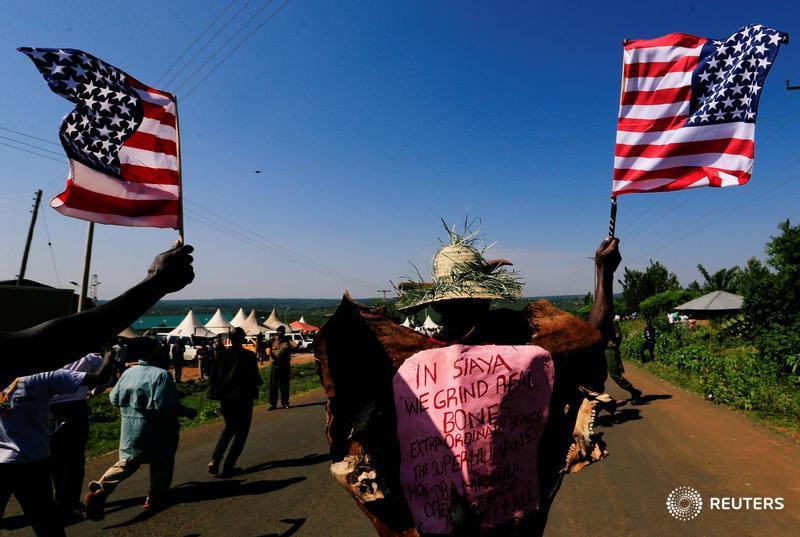
Sometimes you look and look at a picture and think something is a little out of place but can’t quite put your finger on what. Thomas Mukoya’s picture is one such image. The harsh light creates a complex set of shapes and colours, the hat, silhouetted figures, the pink shirt with writing on it you can’t make out and the tents, all make it hard for the eye to settle. Then slowly it dawns: the US flags have been attached to their poles back to front.  


Residents wave the U.S. national flag as the chant slogans as they walk along the road prior to the visit by former U.S. president Barack Obama to his ancestral home, Nyangoma Kogelo village, in Siaya county, western Kenya, July 16, 2018.   REUTERS/Thomas Mukoya

Siphiwe Sibeko’s picture breaks all the rules. You have a flat line that cuts the image in half, top to bottom; large empty black spaces; faces looking out of the frame so close to the edge of the picture you sense they are going to bump their heads. And yet it works wonderfully. 


Former U.S. President Barack Obama delivers the 16th Nelson Mandela annual lecture, marking the centenary of the anti-apartheid leader’s birth in Johannesburg, South Africa, July 17, 2018.   REUTERS/Siphiwe Sibeko

 We encourage photographers when they are shooting a story to make sure to include a detail picture. In my mind a detail picture is an image of something small that might easily go unseen but is quite revealing. It doesn’t have to be a closeup but often it is. Ari Jalal’s picture is quite abstract when you look at it in its entirety and turns the notion of detail on its head. You see a wide picture, horizonal line cutting the image in half with two slabs of toned colour, a ‘button’ casting a shadow in the top centre and small patches of colour. You have to look closely to see the patches of colour are hand prints and signatures of patients. Now you take the time to look at each of the hand prints and try to read the writing of each individual’s story.  


A mural of painted hands and messages from wounded people, who have recovered and have been discharged from the Medecins Sans Frontieres hospital in Mosul, Iraq, July 10, 2018.   REUTERS/Ari Jalal

One can only imagine the feelings you must have as a father hugging your daughters after being separated for 18 years, but Tiksa Negeri captures this moment forever. A very quiet image that needs a caption to explain it but you immediately get a sense of the powerful and tight embrace, as his daughters are held close and tight, their faces pressed to his chest. When you look into the shadows of the image, its real beauty comes alive, the sisters looking into each other’s tear-stained eyes, one with her hand on her father’s chest, just inside his jacket, where she can feel his heart beat. The lines on his face speak to me of years of worry and separation. You can see more heart-warming pictures from Asmara here


Adisalem Abu, reacts as he embraces his daughters, after meeting them for the first time in eighteen years at the Asmara International Airport after Ethiopian Airlines flight ET314 arrived in Asmara, Eritrea July 18, 2018.   REUTERS/Tiksa Negeri

The woman in the blue head scarf in Khalil Ashawi’s picture looks like she is frozen in time. Her mind and eyes are a thousand miles away, her sleeping baby is held close. Even though the picture is busy with the swirl of activity around her, your eye is drawn to the central point of her face. You are not distracted by the boy in the blue shirt, the white highlight to the left or the purple head scarf, you just keep coming back to that face.   


People are evacuated from the villages of al-Foua and Kefraya, Syria, July 19, 2018.   REUTERS/Khail Ashawi