Pages

Showing posts with label Bethlehem. Show all posts

Friday, 3 May 2019

A Week in Pictures Middle East and Africa May 3, 2019


Mohammed Salem’s affectionate picture of skaters poses the questions: What is shadow? What is painting? And what is silhouette? Your eye bounces around the images as if you are a skater yourself. The downward curves of the painted arcs of colour and the upward black line lead you to the inverted solid black figure. The shadows of the spectators leaning in from bottom right lead to the centre, where a Matisse-like series of cut outs layer on top of each other. Read on here

Members of the Gaza Skating Team cast shadows as they practice their rollerblading and skating skills at the seaport of Gaza City March 8, 2019.   REUTERS/Mohammed Salem 

Hands that look almost as old as the wall itself wait to dig fingers deep into the cross in the wall in Raneen Sawafta’s wonderful detail picture of religious fervor. The colour and texture of the hands begin to merge into the warm tones and lines of the wall, a sense of melting that is stopped only by the dashes of red on the pink nails and the strong dark lines of wrinkles in the knuckle joints.   

A worshipper places her fingers inside the holes in a column that form the shape of a cross before the arrival of the Holy Fire, at the Church of the Nativity in Bethlehem, in the Israeli-occupied West bank April 27, 2019.  REUTERS/Raneen Sawafta

There’s no mistaking the powerful draw of the fire in Corinna Kern’s image. Even today the impact is quite striking, so I can’t help imagining what life-changing effect this might have had on people who witnessed this scene in centuries past. The figures are dwarfed by the buildings glowing with the warm light of the fire.    
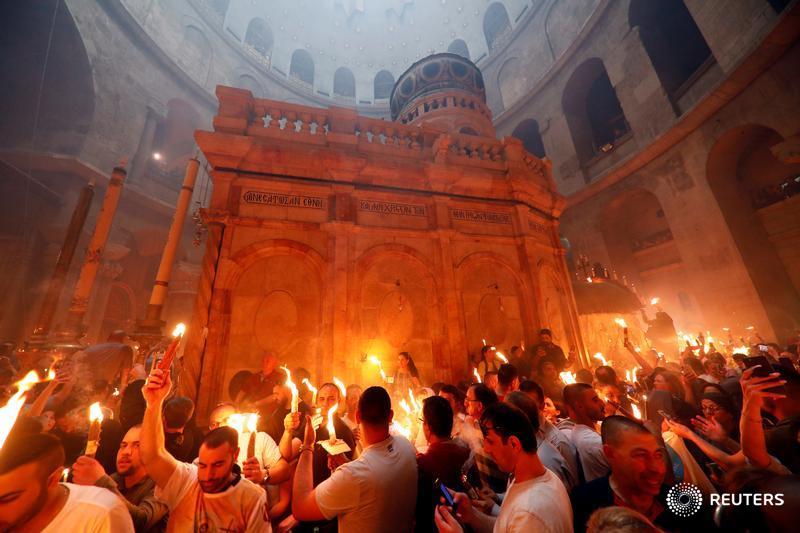
Worshippers take part in the Christian Orthodox Holy Fire ceremony at the Church of the Holy Sepulchre in Jerusalem’s Old City April 27, 2019.    REUTERS/Corinna Kern

A cyclone has hit Mozambique for the second time in a month.  What I have come to realise is that to tell the story visually you have to show both show the enormity of the devastation and the impact it has on individuals. Mike Hutching’s picture does just that. A lone figure is striding through water, firewood gathered and carried on the head. In the background, destroyed crops that disappear into the distance lean to the right, countering the leftward motion of the figure, showing the storm’s powerful mark on the flooded landscape. Read on here

A villager carries wood through maize fields flooded in the aftermath of Cyclone Kenneth, along the Mieze river near Pemba Mozambique, April 30, 2019.   REUTERS/Mike Hutchings 

There is an eerie calm around Umit Bektas’ picture. A small crowd gathers in front of what looks like a skeletal building, the focus of their attention a camel at rest, being cared for by the man in a yellow shirt, his hand resting affectionately on the animal’s back. Why is this happening? What are they expecting? Closer inspection shows that the camel’s legs are tied; the caption reveals it’s due for slaughter, the crowd waiting for meat.  

Sudanese protesters wait for a camel to be slaughtered to share its meat in-front of the defence ministry in Khartoum, Sudan, May 1, 2019.  REUTERS/Umit Bektas

A frenzied picture by Suhaib Salem of honey harvesting in Gaza. It’s been said that if your pictures are not good enough, get closer. Suhaib gets in as close as he can,  with a bee filling a large part of the frame top right and a swarm of bees filling the air as the workers try to calm them with smoke. This picture is, as they say, as busy as a bee. 

Palestinian beekeepers collect honey at a farm in Gaza City, April 29, 2019.   REUTERS Suhaib Salem

Sumaya Hisham has created a layered and surreal image that looks like a combination of a trompe l’oeil and a Windows background image. It’s an image that intrigues and makes you want to click to know more. What is happening? Why is the building unfinished? Why are there no people seen? Find out here

A view through the window of an incomplete house at Baken park housing project near Bethlehem, South Africa, April 16, 2019.   REUTERS/Sumaya Hisham


Saturday, 4 November 2017

A Week in Pictures Middle East & Africa November 3, 2017


Palestinian militants killed by Israeli security forces security while digging tunnels from Gaza are taken to the mortuary where their bodies are viewed by grieving family and supporters. On this occasion, not one or two but three dead faces are pulled out for inspection.   Mohammed Salem photographed the scene from on high so that we look down on the dead and the chaotic scene, the light from the TV cameras drawing us down, down into the picture.


People gather around the bodies of Palestinians killed in a tunnel near he border between Israel and central Gaza strip October 30, 2017.    REUTERS/Mohammed Salem

How can you possibly go wrong photographing a re-enactment of the ‘Battle of Beersheba’, a WW1 battle that involves costumed military history enthusiasts, horses, a low sun and dust from the desert. Amir Cohen managed to produce something extra special as the horses rode past. The light filtered through the dust, silhouetting the horsemen and creating an effect that I am sure Spielberg would spends hours recreating.


Descendants of soldiers from the Australian and New Zealand Army Corps (ANZAC) take part in a dress rehearsal of a re-enactment of the famous World war One cavalry charge known as the ‘Battle of Beersheba’, when ANZAC soldiers conquered Turkish forces and helped the British capture the Holy Land in 1917, in Beersheba, Israel October 30, 2017.   REUTERS/Amir Cohen

The sheer joy and release of tension seen in the screwed up faces and hands of the hugging families makes Omar Sanadiki’s picture of people who has escaped Islamic State in Syria one of passion and beauty. The faces, to me, tell the viewer their thoughts ‘I never thought I’d see you again, but here you are in my arms’. Could it have cropped tighter? Maybe, but then then you’d lose the sense of place: this is happening in the street, in public, for all to share in.


Relatives hug one of the hostages held by Islamic State militants who escaped from his captors in Qaryatayn town in Homs Province, Syria October 29, 2017.    REUTERS/Omar Sanadiki

Photographs of graffiti artists and their pictures are on the whole easy to shoot. But clandestine acts of graffiti on the Israeli barrier in Bethlehem are a different story. In this picture, artist @lushSux paints a kiss between leaders Donald Trump and Benjamin Netanyahu. What attracts me most to Ammar Awad’s picture is that the artist himself is like the censor’s pen, hiding the actual kiss. I think if we could see it all the artist’s message would be less clear. Read on here.


Australian graffiti artist works on his mural depicting U.S. President Donald Trump and Israeli Prime Minister Benjamin Netanyahu on the controversial barrier in the West Bank city of Bethlehem October 28, 2017.    REUTERS/Ammar Awad

A simply composed picture by Baz Ratner seems to me to sum up the whole political election struggle in Kenya, as we all wait to see what happens next. There is just enough light on the figure to see details but Baz has ensured he has dropped low so the figure against the sky is strong and dark. A powerful picture, to me giving the sense of tension and pending violence.


A member of the Luo ethic group is seen as he holds a machete near the town of Muhoroni in Kisumu County, Kenya, October 29, 2017.     REUTERS/Baz Ratner

Very much in the same compositional vein as Baz’s picture, I am a sucker for simplicity of design. Afolabi Sotunde’s affectionate image of a woman walking down the fairway during a golf tour raises the question, what is she doing? But actually, who cares, it’s a great picture of warm tones and soft green colours, but your eye races to her white hat. The sort of picture you shoot to enjoy just because it’s there. For some a bit like playing golf I suppose?  


A guest walks on the course during the West Africa golf tour in Abuja, Nigeria October 28, 2017.    REUTERS/Afolabi Sotunde


Ismail Zitouny’s picture is one that takes a little time to understand. At first glance it’s a queue of young men at a table – so what? The first two elements I noticed is that the men queuing are ordered into height and this picture is all about feet. Those queuing are wearing no shoes but they have matching tops – a team? The man on the left foot and the table legs on the yellow line guide you from left to right to look along the line of bare feet, your eye driven to the right of picture only to be pushed back into the frame by the figure in the orange top with the help of the man’s arm extended out to pull you back in. Quickly along the line of heads to the central figure in the red shirt his eye line looking at the shoes on the table. It’s then you finally notice the man pointing to the first in the queue and the man on the left holding the soccer boots. You almost hear them asking ‘what size son? Get your boots on and then onto the pitch”. I love this picture as I think it’s about hope, charity, self-help, determination and teamwork. Maybe I am seeing too much here, but read the caption and decide for yourself.


Migrants receive boots before playing a soccer match at a detention centre in Tripoli, Libya, October 30, 2017.    REUTERS/Ismail Zitouny

Just because I enjoy mildly bizarre pictures that make me smile Muhammad Hamed’s picture is included this week as it fits the bill. Brightly coloured robotic jockeys are firmly attached to their camel mounts that are seen from the rear prior to a race in Wadi Rum. The combination of the bright colours of the ‘silks’ numbered with just legible figures of 4 and 11, the arms of the robots leading down to their crops gives the viewer with a sense of miniature jockeys on giant beats ready for the off. See the whole race slideshow here.


Robot jockeys are seen on camels prior to a race in Wadi Rum in Jordan, November 2, 2017. REUTERS/Muhammad Hamed