Pages

Showing posts with label Libya. Show all posts

Friday, 2 August 2019

A Week in Pictures, Middle East and Africa, August 2, 2019

It’s very hard to single out one image from this terrific story on how slaves travelled through Ghana by Siphiwe Sibeko and Francis Kokoroko that marks the 400th anniversary of the slave trade to the United States, so I won’t. Very clever composition by Siphiwe, who makes the focal point of his picture the waters of the river. This is achieved by exposing for the highlight bouncing off the river and squeezing the figures into the bottom right of the frame. It takes quite a while for your eyes to adjust to the bright light before you notice the solemn group standing in prayer in the waters. Read on here.

Tourists gather at the Assin Manso river, Ghana, July 23, 2019. Near their journey’s end in Ghana, the captives were given a last, ritual bath in the river before being sold. Today the Assin Manso site is a sacred place of remembrance.   REUTERS/Siphiwe Sibeko 

Francis Kokoroko’s portrait is a powerful, proud image created by lighting the figure with a single light source so he appears to be emerging into the light from dark shadows. The light catches every detail of the proud lines on his face. Your eye is only momentarily distracted from his face by the red decorations on his hand and the richness of the cloth before returning to that wonderful face.

Nana Assenso, 68, chief of Adidwan, a village in Ghana’s interior, looks on before visiting the grave of his uncle, Kwame Badu, in Adidwan, Ashanti Region, Ghana. His uncle’s name Kwame Badu, has been passed down through the family in remembrance of his ancestor with that same name who was captured and sold into slavery.  REUTERS/Francis Kokoroko

A missile strike on a parade that killed more than 30 people created a devastating and horrific scene. Fawaz Salman, confronted by this horror, photographed everything. Many pictures were far too distressing to publish but this image, taken seconds after the blast, captures the chaos and violence. The dead and the injured litter the ground, and people choke on acrid smoke as others try to help. To show mutilated bodies and bleeding wounds would not give you any more information than you can gather from this image. Fawaz has shown enough of the horror of the attack without offending the reader with gratuitous and intrusive imagery of people’s suffering. This was hard to do if you imagine his ears were still ringing from the blast that could have easily killed him too.  Read on here.  

Soldiers lie on the ground after a missile attack on a military parade during a graduation ceremony for newly recruited troops in Aden, Yemen, August 1, 2019.   REUTERS/Fawaz Salman

What appears to be a peaceful domestic scene of a woman ironing while watching TV is not all it seems. Philimon Bulawayo’s thoughtful image illustrates the 18-hour power cuts that Zimbabwe is currently facing. The cold blue light of the TV and the single overhead lamp don’t look quite right in this warm domestic scene. On reading the caption you realise why. There is only power in the middle of the night. Read on here.

Cynthia Chabwinn irons clothes late at night after electricity was restored as the country faces 18-hour daily power cuts in Harare, Zimbabwe July 30, 2019.   REUTERS/Philimon Bulawayo

There is no escaping the strong shapes that create a rhythm that drums out a beat in Khalid al-Mousily’s picture. Lucky too for Khalid (one wonders how long he waited for that to happen?) that a boy is diving off the structure, frozen in a perfect wide reversed V, adding the extra detail needed to make this image work.    

An Iraqi youth dives into the Euphrates river near Norias (water-wheels) or as called in Iraq ‘al-Nawaeer’ in Hit Iraq, July 23, 2019.   REUTERS/Khalid al-Mousily 

This is just a fun, uplifting picture that makes me smile. Upturned faces and applauding hands lead you into the picture. Then the bobbing orange balloons take you up and then back down to the sea of smiling faces. If Njeri Mwangi had taken this image an instant later, cropping even the tiniest sliver off the top balloon, the moment would have been destroyed.  

Workers at the DusitD2 Hotel celebrate during its reopening ceremony since its closure following an attack by Al Shabaab-affiliated militant group that killed at least 21 people in Nairobi Kenya, July 31, 2019.   REUTERS/Njeri Mwangi

Stunned migrants seem to stumble as they come ashore after being rescued from a boat that had overturned, killing dozens. It took me a while to understand why this image works so well. Then it hit me. Ismail Zitouny has used a low camera angle and a slight tilt to the horizon to create his effect. A sad and desperate scene that is out of step with the beauty of the blue skies and the clear warm seas. 

Migrants are seen after being rescued by the Libyan coast guard off the coast of Tripoli, Libya July 26, 2019.   REUTERS/Ismail Zitouny

This, in terms of composition, is a very noisy and messy picture. Your eye is grabbed by the green in the background and the letters LET’S REP on the black t-shirt in the foreground. Your mind is desperately trying to work out what it means. Half the word is missing, the woman in the middle distance is looking into the camera and there is a  truncated hand with bitten nails and old nail varnish on the left. It’s then the noise turns to silence and you see the woman saluting, her hand and face strong and still, held in silent respect.      

A woman salutes during the funeral of Tunisian President Beji Caid Essebsi in Tunis, Tunisia July 27, 2019.   REUTERS/Zoubeir Souissi 


Saturday, 27 April 2019

A Week in Pictures Middle East and Africa April 26, 2019


I’ve been away this week but thought that I’d still share my choice of the best from the region without the commentary, enjoy.


A Sudanese demonstrator carries a noose and gestures during a mass anti-government protest outside the Defence Ministry in Khartoum, Sudan, April 21, 2019.   REUTERS/Mohamed Nureldin Abdallah 

Ink bottles are seen in a polling station during the second day of the referendum on draft constitutional amendments, in Cairo, Egypt, April 21, 2019.   REUTERS/Amr Abdallah Dalsh

Worshippers gather in the church of the Holy Sepulchre in Jerusalem’s Old City during the traditional Washing of the Feet ceremony in Jerusalem’s Old City, April 25, 2019.   REUTERS/Ammar Awad

Murals painted by Palestinian artist Alo Al-Jabail are seen on the remains of a building destroyed in former Israel airstrikes, in Gaza City April 15, 2019.  REUTERS/Ibraheem Abu Mustafa

A Libyan man is seen through a burning poster of French President Emmanuel Macron during a demonstration to demand an end to the Khalifa Haftar’s led offensive against Tripoli, at Martyrs’ Square in central Tripoli April 26, 2019.   REUTERS/Ahmed Jadallah 

Orthodox Christian worshippers take part in the Good Friday services in the Church of the Holy Sepulchre in Jerusalem’s Old City April 26, 2019.    REUTERS/Corinna Kern

People queue to buy bread in Aleppo’s Kalasa district, Syria 12, 2019.   REUTERS/Omar Sanadiki

An Iraqi Marsh Arab woman paddles her boat at the Chebayesh marsh in Dhi Qar province, Iraq April 13, 2019.   REUTERS/Thaier Al-Sudani

A presidential protection guard from South Sudan’s People Defence Force (SSPDF) walks in the rain after a parade at their training camp in Rejaf West, outside Juba, South Sudan April 26, 2019.    REUTERS/Andreea Campeanu

A Sudanese girl with a painted face watches as protesters demonstrate outside the defence ministry compound in Khartoum, Sudan, April 25, 2019.   REUTERS/Umit Bektas


Saturday, 25 November 2017

A Week in Pictures, Middle East & Africa November 24, 2017


Relatively late in the day on Friday Siphiwe Sebeko filed this picture of a supporter at the inauguration of Zimbabwe's new president. that I wanted to include it as an update. At first look it's a wide picture of a supporter in a crowd holding a banner that says 'Thank you Zimbabwe'. I could not resist cropping this to bring out what I really like in this picture, the sea of faces in the banner that almost matches the sea of faces in the crowd. As a foot note to my thinking; had I left it as a tighter cropped horizontal (as I wanted to) I felt the red shirt of the man on the right would have been too much of a distraction. Agree? 


Locals celebrate after the swearing in of Zimbabwe's new president Emmerson Mnangagwa in Harare, Zimbabwe, November 24, 2017.   REUTERS/Siphiwe Sibeko 

Good pictures of people waiting for something to happen are hard to shoot. People are not doing anything, just waiting. But that in itself presents an opportunity, translating a long period of quiet and calm into something visual can produce powerful pictures that ooze tension, apprehension, anticipation, hope, longing and boredom. Both Ibraheem Abu Mustafa and Suhaib Salem, in my opinion, have achieved just that.


Palestinians wait for relatives to cross into Gaza, after Rafah border crossing was opened under the control of the western-backed Palestinian Authority for the first time since 2007 in Rafah in the southern Gaza strip November 19, 2017.   REUTERS/Ibraheem Abu Mustafa


Palestinians wait for travel permits to cross into Egypt after Rafah border crossing was opened under the control of the western-backed Palestinian Authority for the first time since 2007 in Rafah in the southern Gaza strip November 19, 2017.   REUTERS/Suhaib Salem

Again a disturbing image of an injured child needs to be seen, as the story of the besieged town of Douma in Syria unfolds. It’s not the injured arm that disturbs me in Bassam Khabeih’s picture, but the sheer terror in the child’s face. That fear is accentuated by the light reflected in his eye, while his tense and open mouth fight for your immediate attention with the blood on the white table. The strong diagonals of the line of the wall and the markings on the floor draw you back in, not allowing you to look away.


A wounded child is seen lying in Douma hospital after heavy shelling in the rebel-held besieged town of Douma, eastern Ghouta in Damascus, Syria November 19, 2017.    REUTERS/Bassam Khabieh

You can almost taste the tension in Philimon Bulawayo’s picture as Robert Mugabe fails to announce his expected resignation in a live television broadcast. You don’t need a caption to tell you what the men are talking about as your eye dances around the greens, reds and blues of the bar’s lighting that create negative and positive shapes formed by the men’s profiles and their incredulous lips.


People talk as they watch television in a bar in Harare Zimbabwe as Zimbabwean President Robert Mugabe addresses the nation November 19, 2017.    REUTERS/Philimon Bulawayo

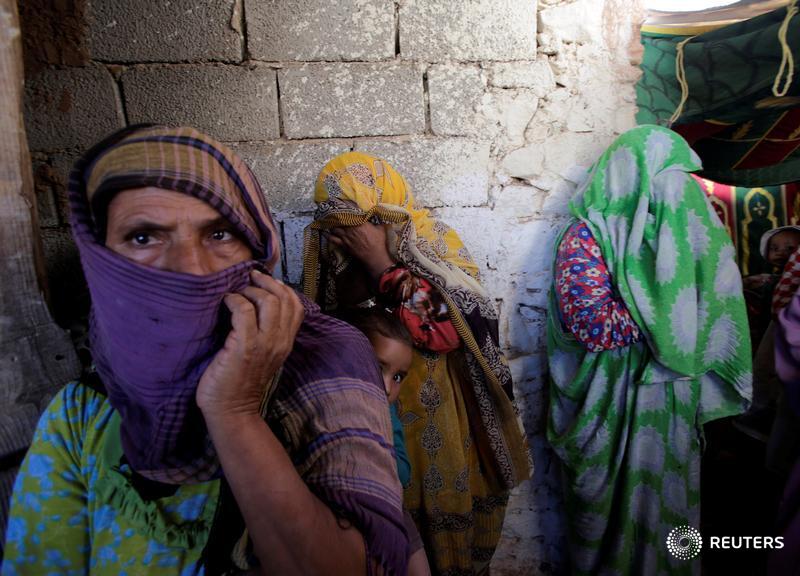
Not many know there was a stampede of people in Morocco when food aid was being distributed. Fifteen people were killed. Youssef Boudlal’s picture of grieving relatives is a haunting reminder of this easily ignored tragedy. As a viewer, I am not sure if the women are hiding from the camera or grieving, I suspect both. For me, the strength of this picture is the small boy who peering around from the back of the woman who is staring into space. His presence, like the news of the deaths at the stampede, is easily missed.


Relatives mourn the death of Lakbira Essabiry, one of the people who were killed when a stampeded broke out in the south western Moroccan town of Sidi Boulaalam as food aid was being distributed in a market, in Sidi Boulaalam, Morocco November 20, 2017.   REUTERS/Youssef Boudlal

 A bible-holding supporter of President Kenyatta screams into the air with joy, as people celebrate the news that a court had upheld his re-election. The relief on the faces of these people in Baz Ratner’s picture is so powerful that the visual noise of the yellow line, white pillars and railings don’t destroy the image. A close look reveals that the bible is open at Kings 2, Chapter 12, ‘Joash repairs the Temple’. I hope that rebuilding is the theme of the presidency after all the clashes.


Jubilee party supporters cheers after Kenya’s Supreme Court upheld the re-election of President Uhuru Kenyatta in last month’s repeat presidential vote in Nairobi, Kenya, November 20, 2017.   REUTERS/Baz Ratner

I have little secret, I love good pictures that illustrate business stories especially when they are about commodities. Mining, oil pictures from drilling to the global impact of price changes, and agriculture are particular favourites. So how could I resist Khalid al-Mousily’s symmetrical picture of a small mountain of sugar in Iraq, a man in black striding purposefully towards it. A picture with great shape that jumps out at you and can be used well on any platform, from a small screen on a mobile device or as a double-page spread in a magazine, or on an advertising hoarding in the street.  


An employee checks raw sugar at a sugar refinery in the city of Hilla, Iraq, November 21, 2017.   REUTERS/Khalid al-Mousily

Amid the euphoria of Zimbabwe it would be easy to forget the crisis in Yemen, if only for a day. But there is no respite as Khaled Abdullah’s picture brings our minds quickly back to what is going on. It’s hard to tell the age of the person with thin and fragile legs until you realise that this helpless child is so tiny that he is on a set of scales designed for weighing babies. For me, the fact that you do not see the face of this malnourished boy gives a sense of the wider issue of hunger created by conflict in Yemen, and not just one person’s story.  


A boy lies on a weighing scale at a malnutrition treatment centre in Sanaa, Yemen, November 22, 2017.   REUTERS/Khaled Abdullah 

Almost a week of rising tension in Zimbabwe ended in an explosion of joy, relief, all night parties and smiling faces after fears that the transition of power from Mugabe would be bloody proved unfounded. Hard to chose one picture from Mike Hutchings but I think the frame full of smiling faces is a winner for me. I wish I was there. Have a look at more pictures here to lift your spirits.


Zimbabweans celebrate after President Robert Mugabe resigns in Harare, Zimbabwe November 21, 2017.  REUTERS/Mike Hutchings

One might not immediately think of Libya in terms of sun, sea, sand and … motorbikes.  So it’s therefore impossible to not include Ahmed Jadallah’s simple but affectionate picture of bikers, some of whom belong to the ‘Monsters’ group, on a Libyan beach. Although the picture was taken a while ago I’ve included in this week’s round-up as it was only published this week. You can read on here.


Members of the Tripoli bikers group ride their motorbikes at the beach in Tripoli, Libya November 4, 2017.  REUTERS/Ahmed Jadallah

Friday, 10 November 2017

A Week in Pictures Middle East and Africa November 10, 2017

Looking directly into the camera with the confidence and beauty of a model, a migrant in Libya demands our immediate attention in Ahmed Jadallah’s striking image. I asked myself, does the red line in the background detract from the picture? For me, no. As soon as I try to look away the red line draws me back into these piercing eyes that seem to hold so many questions.


A migrant arrives at a naval base in Tripoli after he was rescued by Libyan coastal guards off the coast of Libya, November 6, 2017.   REUTERS/Ahmed Jadallah

A combination of strong, simple shapes, primary colours and the visual surprise of a man’s head popping up from a sea of red make this picture irresistible. Immediately, we want to know what is going on in Khaled Abdullah’s eye-catching picture. Is this man being swallowed by a giant pillow? Why does he have a rifle? And why does he have a picture on a stick poking out of the barrel of his gun? It’s only the caption that saves us from a lifetime of frustration.


A Houthi follower emerges from a gap in a flag as he attends a rally organised to show support for the Palestinians in Sanaa, Yemen, November 6, 2017.   REUTERS/Khaled Abdullah

I love pictures that immediately raise questions in our minds. We just want to know what is being said to President Mugabe by his wife Grace in Philimon Bulawayo’s wonderful picture, and at the same time we want to know what he’s thinking. The temptation might be to crop this even tighter to just the lips and eyes but then we’d lose the bright yellows of their matching berets, which would be a shame. There is temptation also to use this picture in a speech and thought bubble caption competition, but that would only cheapen this great image. 


President Robert Mugabe listens to his wife Grace at a rally of his ruling ZANU-PF party in Harare, Zimbabwe, November 8, 2017.   REUTERS/Philimon Bulawayo

 A tightly shot detail picture can often be one of the most revealing images in a sequence of  images in a visually led story. James Akena’s picture of a father holding a treasured but tiny black and white image of his murdered son is one such case. The young man’s face on this slightly damaged photograph is held up against a clean blue and green background. We look at him and wonder about his short life. It takes a while for us to notice the missing nail on the middle finger of his grieving father: more pain.


South Sudanese refugee Simon Wani holds up a picture of his son who he claims was killed by rebels in South Sudan when he returned in search of food from Palorinya settlement in Moyo district, northern Uganda October 25, 2017.               REUTERS/James Akena

The conflict in Libya is far from the front pages but the struggle for power by different political and militant factions rages on. Esam Omran Al-Fetori’s front line pictures as the Libyan national army battles Islamic Militants are very powerful so I can’t select just one. I will say no more as they speak for themselves. To see more click here.


A military vehicle belonging to the Libyan national Army fires towards the positions of Islamic militants during clashes in Khreibish district in Benghazi, Libya November 9, 2017.   REUTERS/Esam Omran Al-Fetori 


Members of the Libyan national Army take position during clashes with Islamic militants in Khreibish district in Benghazi, Libya November 9, 2017.   REUTERS/Esam Omran Al-Fetori


A member of the Libyan national Army runs during clashes with Islamic militants in Khreibish district in Benghazi, Libya November 9, 2017.   REUTERS/Esam Omran Al-Fetori

On occasion a spectacle itself is enough to make great pictures. Crowds of worshipers descending to worship at a shrine is one such example. Abdullah Dhiaa al-Deen photographed the commemoration of Arbaeen and went a step further to make one of the most eye-catching pictures of the week. Looking through an archway of red tiles and light, we are drawn into a seemingly endless crowd, for me, with a complete sense of awe. The celebrations are estimated to be twice the size of the Hajj pilgrimage, with 22 million people expected to converge on the holy city of Kerbala.  


Shi’ite pilgrims pray at the Imam al-Abbas shrine during the commemoration of Arbaeen in Kerbala, Iraq, November 9, 2017.  REUTERS/Abdullah Dhiaa al-Deen

 Just published now is Abdullah Dhiaa Al-Deen story on the culmination of hundreds of thousands of Shi’ite Muslims gathering in Kerbala and I just had to add this image. It the exception of the printed picture in the background this could have been from hundreds of years ago, amazing. See the whole story here


 Muslim men beat themselves with their hands September 24, 2017 in mourning for Imam Hussein, a grandson of the Prophet Mohammed who was killed in a 7th century battle in Kerbala, Iraq.   REUTERS/Abdullah Dhiaa Al-Deen

Saturday, 4 November 2017

A Week in Pictures Middle East & Africa November 3, 2017


Palestinian militants killed by Israeli security forces security while digging tunnels from Gaza are taken to the mortuary where their bodies are viewed by grieving family and supporters. On this occasion, not one or two but three dead faces are pulled out for inspection.   Mohammed Salem photographed the scene from on high so that we look down on the dead and the chaotic scene, the light from the TV cameras drawing us down, down into the picture.


People gather around the bodies of Palestinians killed in a tunnel near he border between Israel and central Gaza strip October 30, 2017.    REUTERS/Mohammed Salem

How can you possibly go wrong photographing a re-enactment of the ‘Battle of Beersheba’, a WW1 battle that involves costumed military history enthusiasts, horses, a low sun and dust from the desert. Amir Cohen managed to produce something extra special as the horses rode past. The light filtered through the dust, silhouetting the horsemen and creating an effect that I am sure Spielberg would spends hours recreating.


Descendants of soldiers from the Australian and New Zealand Army Corps (ANZAC) take part in a dress rehearsal of a re-enactment of the famous World war One cavalry charge known as the ‘Battle of Beersheba’, when ANZAC soldiers conquered Turkish forces and helped the British capture the Holy Land in 1917, in Beersheba, Israel October 30, 2017.   REUTERS/Amir Cohen

The sheer joy and release of tension seen in the screwed up faces and hands of the hugging families makes Omar Sanadiki’s picture of people who has escaped Islamic State in Syria one of passion and beauty. The faces, to me, tell the viewer their thoughts ‘I never thought I’d see you again, but here you are in my arms’. Could it have cropped tighter? Maybe, but then then you’d lose the sense of place: this is happening in the street, in public, for all to share in.


Relatives hug one of the hostages held by Islamic State militants who escaped from his captors in Qaryatayn town in Homs Province, Syria October 29, 2017.    REUTERS/Omar Sanadiki

Photographs of graffiti artists and their pictures are on the whole easy to shoot. But clandestine acts of graffiti on the Israeli barrier in Bethlehem are a different story. In this picture, artist @lushSux paints a kiss between leaders Donald Trump and Benjamin Netanyahu. What attracts me most to Ammar Awad’s picture is that the artist himself is like the censor’s pen, hiding the actual kiss. I think if we could see it all the artist’s message would be less clear. Read on here.


Australian graffiti artist works on his mural depicting U.S. President Donald Trump and Israeli Prime Minister Benjamin Netanyahu on the controversial barrier in the West Bank city of Bethlehem October 28, 2017.    REUTERS/Ammar Awad

A simply composed picture by Baz Ratner seems to me to sum up the whole political election struggle in Kenya, as we all wait to see what happens next. There is just enough light on the figure to see details but Baz has ensured he has dropped low so the figure against the sky is strong and dark. A powerful picture, to me giving the sense of tension and pending violence.


A member of the Luo ethic group is seen as he holds a machete near the town of Muhoroni in Kisumu County, Kenya, October 29, 2017.     REUTERS/Baz Ratner

Very much in the same compositional vein as Baz’s picture, I am a sucker for simplicity of design. Afolabi Sotunde’s affectionate image of a woman walking down the fairway during a golf tour raises the question, what is she doing? But actually, who cares, it’s a great picture of warm tones and soft green colours, but your eye races to her white hat. The sort of picture you shoot to enjoy just because it’s there. For some a bit like playing golf I suppose?  


A guest walks on the course during the West Africa golf tour in Abuja, Nigeria October 28, 2017.    REUTERS/Afolabi Sotunde


Ismail Zitouny’s picture is one that takes a little time to understand. At first glance it’s a queue of young men at a table – so what? The first two elements I noticed is that the men queuing are ordered into height and this picture is all about feet. Those queuing are wearing no shoes but they have matching tops – a team? The man on the left foot and the table legs on the yellow line guide you from left to right to look along the line of bare feet, your eye driven to the right of picture only to be pushed back into the frame by the figure in the orange top with the help of the man’s arm extended out to pull you back in. Quickly along the line of heads to the central figure in the red shirt his eye line looking at the shoes on the table. It’s then you finally notice the man pointing to the first in the queue and the man on the left holding the soccer boots. You almost hear them asking ‘what size son? Get your boots on and then onto the pitch”. I love this picture as I think it’s about hope, charity, self-help, determination and teamwork. Maybe I am seeing too much here, but read the caption and decide for yourself.


Migrants receive boots before playing a soccer match at a detention centre in Tripoli, Libya, October 30, 2017.    REUTERS/Ismail Zitouny

Just because I enjoy mildly bizarre pictures that make me smile Muhammad Hamed’s picture is included this week as it fits the bill. Brightly coloured robotic jockeys are firmly attached to their camel mounts that are seen from the rear prior to a race in Wadi Rum. The combination of the bright colours of the ‘silks’ numbered with just legible figures of 4 and 11, the arms of the robots leading down to their crops gives the viewer with a sense of miniature jockeys on giant beats ready for the off. See the whole race slideshow here.


Robot jockeys are seen on camels prior to a race in Wadi Rum in Jordan, November 2, 2017. REUTERS/Muhammad Hamed