Pages

Showing posts with label Khartoum. Show all posts

Friday, 23 August 2019

A Week in Pictures, Middle East and Africa, August 23, 2019.

This month sees the 400th anniversary of the first slaves transported to North America from Africa. I have chosen four images from one story as the whole series is quite striking. You can see the full story here.

Strong, flat shapes bear down on the solitary figure looking out to sea in Afolabi Sotunde’s beautifully composed image. The oppressive black tones seem to muffle and squeeze all the sound and air from the picture and we are left wondering what this man is thinking. Slowly we can breathe again as we look back to the blue window on the right and then beyond the figure to the far horizon.   

A man looks out from a sea viewing commemorative building that is known locally as ‘the Tunnel’ that is sited near the ‘Point of No Return’ where slaves were shipped from the slave port of Badagry, Nigeria June 21, 2019.  REUTERS/Afolabi Sotunde

You get a full understanding of the adage ‘still waters run deep’ in Luc Gnago’s eerie and slightly unnerving image of people gathered by the water’s edge. Although the almost perfect reflection is beautiful, you sense something not good has happened here. The trees, bushes and dark waters dwarf the gathered group, clouds have moved across the sun, which casts a shadow of flat light that gives the image a cold chill. 

Villagers take part in a bathing ritual at the Bodo river in the Kanga Nianze village in Tiassale, July 21, 2019, that was built on a former slave route where men and women captured and sold into slavery took their final bath before their sea journey to America.   REUTERS/Luc Gnago

That eye contact in Zohra Bensemra’s picture will not let you look away. Your glance might flick up to the highlight in the background along the gloomy, damp passageway but quickly you are drawn back. It’s then you notice the USA inscription, but only for a minute, and then back to those eyes. 

A Senegalese boy walks from the ‘Door of No return’ as he visits the ‘Maison des Esclaves’ slaves house, a gathering point from where slaves were shipped west in the 1700s and 1800s, at Goree Island off the coast of Dakar, Senegal July 7, 2019.   REUTERS/Zohra Bensemra

Bold bright colours and composition, and spot on timing, make Siphiwe Sibeko’s picture a great eye-catcher. One of its strengths is that it can be used very small on the page and it will still work. The words, even though a letter is obscured, still makes sense, the mind’s eye adding the ‘a’ in about. If the figure was a little to the right or the left the words will be broken up and will lose context.      

A girl walks past a flag of Ghana outside the Cape Coast castle in Ghana, July 28, 2019.  Cape Coast Castle was used as a slaving post from where slaves were bought and sold and then shipped off to the U.S. and other countries.  REUTERS/Siphiwe Sibeko

There is no getting away from it, but in terms of beauty Mohamed Nureldin Abdallah’s pictute has no redeeming features. But this image is not about beauty it’s about the stark brutal reality that was gathered in the seconds allocated to take pictures and its harshness is gripping. A former leader, dressed in white, stands upright as he’s held in a black cage like an exhibit, with people sitting around waiting for court proceedings to start. The slightly awkward tilt, the hard light and the bright blue uniforms of the police tangle visually with the white, red and orange of the foreground, which all make fir uneasy viewing of an uncertain future. 

Sudan’s former president Omar Hassan al-Bashir stands guarded inside a cage at the courthouse where he is facing corruption charges in Khartoum, Sudan August 19, 2019.   REUTERS/ Mohamed Nureldin Abdallah

Two days earlier Mohamed Nureldin Abdallah waited for the perfect shape as a train laden with celebrating people slowly approached him. Once you have finished enjoying the sweep of the national flags at the front of the train, you are led back, back and further back along the arc of the train’s carriages, all brimming with hundreds of people. A great feel-good picture. 

Sudanese civilians from other provinces ride on a train to join the celebrations of the signing of Sudan’s power sharing deal, that paves the way for a transitional government, and eventually elections following the overthrow of the long time leader Omar al-Bashir in Khartoum, Sudan August 17, 2019.   REUTERS/ Mohamed Nureldin Abdallah

A classic or a cliché? Either way there is no escaping the immediacy of Mohamed al-Sayaghi’s picture that consists almost entirely of eyes staring directly at you, the message on her head very bold. 

A follower of the Shi’ite Houthi group is seen with a headband as she celebrates Eid al-Ghadir, which marks a day Shi’ites believe Prophet Muhammad nominated his cousin, Imam Ali, to be his successor, in Sanaa, Yemen August 19, 2019,  REUTERS/ Mohamed al-Sayaghi
  
An emotional picture from Mohammed Salem as a mourner weeps and appears to stare into infinity as he is both comforted by and comforts a fellow mourner. The grey and blue colours give the image a cold feeling despite the warmth of the close hug. The figure drifting into the image from the left looks almost abstract as it appears like a shadow on the softly lit wall to the foreground moments before it will obscure the view of the mourners.  

A relative of a Palestinian gunman who was killed by Israeli forces as he tried to cross the Gaza border, is hugged at a hospital in the northern Gaza strip August 18, 2019.   REUTERS/Mohammed Salem

Shooting pictures to match stories about the Egyptian economy, inflation, credit ratings, GDP etc is never easy but Hayam Adel’s picture caught my eye. It is simple and effective. It has every element needed to illustrate most aspects of the economy: a product, a transaction, money, a vendor and a consumer. The fact that Hayam has managed to get all these elements into one well-composed (I love that diagonal), well timed and softly lit image that is rich in colour makes it well worth drawing highlighting this week. Take the time to enjoy it.  

An Egyptian vendor holds his money at the fish market in Cairo, Egypt August 20, 2019.  REUTERS/Hayam Adel 

I can’t help but be attracted to Ronen Zvulun’s picture from the world of cyber security. He got lucky in so much as the subject in the picture is hiding his identity with a red hoodie and the office space is daubed with terrific graffiti, mostly blue. To surround the figure in black by shooting through a doorway is a clever move that builds on the luck he was handed by the situation and gives us the sense that we are intruding, a perfect sense for a picture on cyber security. Read on here.    

A man takes part in a training session at Cybergym, a cyber-warfare training facility backed by the Israel Electric Corporation, at their training centre in Hadera, Israel July 8, 2019.   REUTERS/Ronen Zvulun 


Friday, 3 May 2019

A Week in Pictures Middle East and Africa May 3, 2019


Mohammed Salem’s affectionate picture of skaters poses the questions: What is shadow? What is painting? And what is silhouette? Your eye bounces around the images as if you are a skater yourself. The downward curves of the painted arcs of colour and the upward black line lead you to the inverted solid black figure. The shadows of the spectators leaning in from bottom right lead to the centre, where a Matisse-like series of cut outs layer on top of each other. Read on here

Members of the Gaza Skating Team cast shadows as they practice their rollerblading and skating skills at the seaport of Gaza City March 8, 2019.   REUTERS/Mohammed Salem 

Hands that look almost as old as the wall itself wait to dig fingers deep into the cross in the wall in Raneen Sawafta’s wonderful detail picture of religious fervor. The colour and texture of the hands begin to merge into the warm tones and lines of the wall, a sense of melting that is stopped only by the dashes of red on the pink nails and the strong dark lines of wrinkles in the knuckle joints.   

A worshipper places her fingers inside the holes in a column that form the shape of a cross before the arrival of the Holy Fire, at the Church of the Nativity in Bethlehem, in the Israeli-occupied West bank April 27, 2019.  REUTERS/Raneen Sawafta

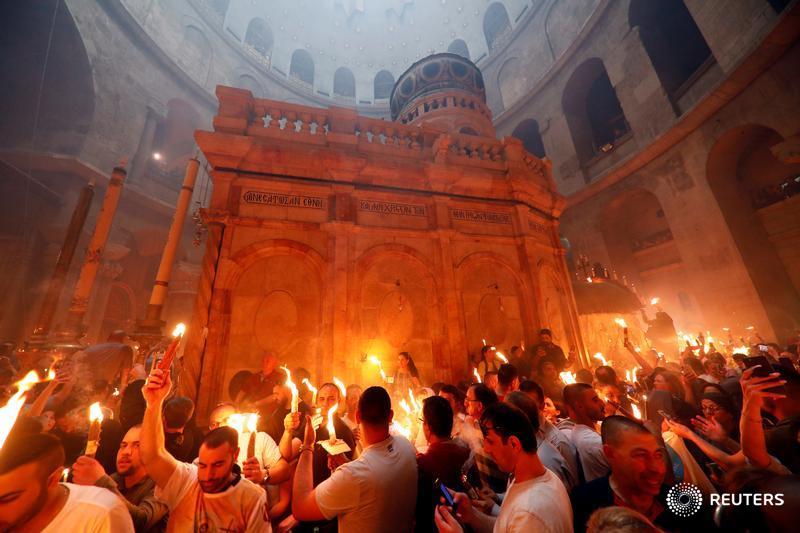
There’s no mistaking the powerful draw of the fire in Corinna Kern’s image. Even today the impact is quite striking, so I can’t help imagining what life-changing effect this might have had on people who witnessed this scene in centuries past. The figures are dwarfed by the buildings glowing with the warm light of the fire.    

Worshippers take part in the Christian Orthodox Holy Fire ceremony at the Church of the Holy Sepulchre in Jerusalem’s Old City April 27, 2019.    REUTERS/Corinna Kern

A cyclone has hit Mozambique for the second time in a month.  What I have come to realise is that to tell the story visually you have to show both show the enormity of the devastation and the impact it has on individuals. Mike Hutching’s picture does just that. A lone figure is striding through water, firewood gathered and carried on the head. In the background, destroyed crops that disappear into the distance lean to the right, countering the leftward motion of the figure, showing the storm’s powerful mark on the flooded landscape. Read on here

A villager carries wood through maize fields flooded in the aftermath of Cyclone Kenneth, along the Mieze river near Pemba Mozambique, April 30, 2019.   REUTERS/Mike Hutchings 

There is an eerie calm around Umit Bektas’ picture. A small crowd gathers in front of what looks like a skeletal building, the focus of their attention a camel at rest, being cared for by the man in a yellow shirt, his hand resting affectionately on the animal’s back. Why is this happening? What are they expecting? Closer inspection shows that the camel’s legs are tied; the caption reveals it’s due for slaughter, the crowd waiting for meat.  

Sudanese protesters wait for a camel to be slaughtered to share its meat in-front of the defence ministry in Khartoum, Sudan, May 1, 2019.  REUTERS/Umit Bektas

A frenzied picture by Suhaib Salem of honey harvesting in Gaza. It’s been said that if your pictures are not good enough, get closer. Suhaib gets in as close as he can,  with a bee filling a large part of the frame top right and a swarm of bees filling the air as the workers try to calm them with smoke. This picture is, as they say, as busy as a bee. 

Palestinian beekeepers collect honey at a farm in Gaza City, April 29, 2019.   REUTERS Suhaib Salem

Sumaya Hisham has created a layered and surreal image that looks like a combination of a trompe l’oeil and a Windows background image. It’s an image that intrigues and makes you want to click to know more. What is happening? Why is the building unfinished? Why are there no people seen? Find out here

A view through the window of an incomplete house at Baken park housing project near Bethlehem, South Africa, April 16, 2019.   REUTERS/Sumaya Hisham


Saturday, 27 April 2019

A Week in Pictures Middle East and Africa April 26, 2019


I’ve been away this week but thought that I’d still share my choice of the best from the region without the commentary, enjoy.


A Sudanese demonstrator carries a noose and gestures during a mass anti-government protest outside the Defence Ministry in Khartoum, Sudan, April 21, 2019.   REUTERS/Mohamed Nureldin Abdallah 

Ink bottles are seen in a polling station during the second day of the referendum on draft constitutional amendments, in Cairo, Egypt, April 21, 2019.   REUTERS/Amr Abdallah Dalsh

Worshippers gather in the church of the Holy Sepulchre in Jerusalem’s Old City during the traditional Washing of the Feet ceremony in Jerusalem’s Old City, April 25, 2019.   REUTERS/Ammar Awad

Murals painted by Palestinian artist Alo Al-Jabail are seen on the remains of a building destroyed in former Israel airstrikes, in Gaza City April 15, 2019.  REUTERS/Ibraheem Abu Mustafa

A Libyan man is seen through a burning poster of French President Emmanuel Macron during a demonstration to demand an end to the Khalifa Haftar’s led offensive against Tripoli, at Martyrs’ Square in central Tripoli April 26, 2019.   REUTERS/Ahmed Jadallah 

Orthodox Christian worshippers take part in the Good Friday services in the Church of the Holy Sepulchre in Jerusalem’s Old City April 26, 2019.    REUTERS/Corinna Kern

People queue to buy bread in Aleppo’s Kalasa district, Syria 12, 2019.   REUTERS/Omar Sanadiki

An Iraqi Marsh Arab woman paddles her boat at the Chebayesh marsh in Dhi Qar province, Iraq April 13, 2019.   REUTERS/Thaier Al-Sudani

A presidential protection guard from South Sudan’s People Defence Force (SSPDF) walks in the rain after a parade at their training camp in Rejaf West, outside Juba, South Sudan April 26, 2019.    REUTERS/Andreea Campeanu

A Sudanese girl with a painted face watches as protesters demonstrate outside the defence ministry compound in Khartoum, Sudan, April 25, 2019.   REUTERS/Umit Bektas


Thursday, 18 April 2019

A Week in Pictures Middle East and Africa April 19, 2019


Look at me! Listen to my protest! is the message from this picture from Sudan. The flame licking into the half-light of the evening highlights the protester’s glasses and open mouth so that he takes on the momentary appearance of a fire-breathing dragon. Once your eyes get used to the bright light of the flame you can see the thousands of protesters in the background, stretching into the horizon of the evening gloom. 

A Sudanese demonstrator chants slogan as he attends a sit-in protest outside the Defence Ministry in Khartoum, Sudan April 14, 2019.    REUTERS

A big, fun yellow picture, a big smile, curls of hair and hands emerging from a mist of yellow powder. The only other real colour is the red mask guiding us to the laughing eyes of the person on the right. There is no way you can look at this picture without feeling the warmth of a smile.    

A girl is covered in yellow powder during Egypt’s first Colour Run in Giza Egypt April 13, 2019.    REUTERS/Mohamed Abd El Ghany 

Ali Hashisho’s picture has a feeling of a post-apocalyptic scene as three unidentified figures stand framed in a ruined building, looking across a cityscape at storm clouds in the distance. Are they gathering or clearing? The dash of warm sunlight on the broken concrete pillar to the left gives us some hope.   

Children stand together inside a damaged house in Kobani, Syria April 3, 2019.   REUTERS/Ali Hashisho 

Omar Sanadiki’s pictures need a little text to help explain them. On the face of it, we see ruined buildings with vegetation. So what? Now understand that this peaceful verdant scene was recently the scene of fierce fighting in Aleppo, Syria. I include two images from Omar, because the pictures need some explanation. The most colourful image, with reds and yellows, just does not have enough buildings to illustrate the context of the story. So much for the adage ‘a picture paints a thousand words’. Read on here.  

Blossomed vegetation is seen over damaged buildings and the ancient citadel during a warm day of spring in the old city of Aleppo, Syria April 9, 2019.   REUTERS/Omar Sanadiki

Poppies are seen in full bloom during spring in Aleppo governorate, Syria April 14, 2019.   REUTERS/Omar Sanadiki

What a wonderful picture by Umit Bektas as he plays with scale and space. Almost a silhouette, but thankfully not. Your eye is drawn quickly to the figures in the trees, a flag extended as it is waved back and forth. These men look far too big to be safely in the tree, and maybe this sense is created by the open space above them or the line of figures beneath them. See more from Sudan here

Sudanese demonstrators wave a flag after climbing a tree outside the Defence Ministry in Khartoum, Sudan April 16, 2019.   REUTERS/Umit Bektas 

It’s just a lot of fun, people hugging, laughing and enjoying a moment perfectly captured by Luc Gnago as Ivanka Trumps visits Ivory Coast amid a myriad of dancing shapes, colours, stripes, patterns and smiles. Normally these visits are very stiff and formal but this breaks the mould. 

White House advisor Ivanka Trump dances as she meets women entrepreneurs, at the demonstration cocoa farm in Adzope, Ivory Coast, April 17, 2019.   REUTERS/Luc Gnago

Baz Ratner’s image is a little unsettling. I think the obvious reason is the figure wearing full bio protective gear walking behind the woman and the child seemingly unnoticed. What can be going on that this this gear is needed but there is a child unprotected? This then brings you to the full-on eye contact from both the woman and the child. You are drawn into the picture and it’s then you begin to notice that the only natural elements in this image are the uncovered faces. Plastic gloves, plastic clothing, plastic mask, plastic background and plastic fencing in the foreground. It all feels very unnatural and in this environment you are captivated by the eye contact, and that is unsettling. Why aren’t these people protected too?  Read on here to discover the story of those who survived Ebola caring for children with the killer disease.      


Mwamini Kahindo, an Ebola survivor working as a carer to babies who are confirmed Ebola cases, holds a child outside the red zone of the Ebola treatment centre in Butembo, Democratic Republic of Congo, March 25, 2019.    REUTERS/Baz Ratner   

To describe Mohamed Abd Al Ghany’s picture of an old book as lush - very rich and providing great sensory pleasure - might be a step too far but it’s the word I kept coming back to when looking at this detail picture. The warm tones of the aged pages, wrinkled with time, make us want to touch the book. The clever crop, so you can’t see all the book, ensures we spend time looking at the ancient text, which is quite exquisite. You can see more artefacts and the restoration project here.   


‘Codex Syriacus’, an ancient copy of the Gospels in Syriac, is seen on display in St. Catherine’s Monastery in South Sinai, Egypt, March 7, 2019.  REUTERS/Mohamed Abd El Ghany 

Hard to ignore the wonderful beam of light in Ammar Awad’s picture of clergy during Holy Week in Jerusalem. Equally hard to ignore is the candle-lit procession of worshippers in the Holy City. These pictures really speak for themselves so I will let them do just that.       

Members of the clergy take part in the Catholic Washing of the Feet ceremony on Easter Holy Week in the church of the Holy Sepulchre in Jerusalem’s Old City, April 18, 2019.   REUTERS/Ammar Awad

Worshippers take part in a procession during the Catholic Washing of the Feet ceremony on Easter Holy Week in the church of the Holy Sepulchre in Jerusalem’s Old City, April 18, 2019.   REUTERS/Ammar Awad


Friday, 5 January 2018

A Week in Pictures, Middle East & Africa, January 5, 2018

A happy New Year to you. I will continue to share my thoughts in 2018 on some pictures from the Middle East and Africa that have caught my eye. They may not be from the top news stories in the region but they would have caught my eye for some reason or another. You may agree or disagree with what I see in these images and the reasons I chose to highlight them but these thoughts are my personal view. At the very least I hope you enjoy the pictures that may have been missed in tsunami of images from a very busy news region.


I could not let the week go by without highlighting Maheder Haileselassie’s beautifully composed and balanced picture taken on the 5th January but moved now. I just love the zigzag of the tops of the building against the blue skies and the way shadows cast on the warm toned walls of the building take your eye to the robed monk striding from the church. And, although it’s a bit late, I’ve added two additional images from Lalibela taken by Tiksa Negeri for you to enjoy too.


A monk walks out of Bete Giyorgis Church ( St. George’s Church) that is considered to be one of the eleven rock-hewn churches in Lalibela, Ethiopia January 5, 2018.  REUTERS/Maheder Haileselassie 


Ethiopian Orthodox pilgrims walk within a monolithic Orthodox church ahead of Ethiopian Christmas in Lalibela, Ethiopia January 5, 2018.  REUTERS/Tiksa Negeri


Ethiopian Orthodox pilgrims attend a prayer session at the monolithic Orthodox church ahead of Ethiopian Christmas in Lalibela, Ethiopia January 6, 2018.  REUTERS/Tiksa Negeri

A simple backdrop for a portrait series by Afolabi Sotunde makes for a gentle and affectionate visual journey. It is beautiful in its rough and ready feel, and I get a real sense of the personalities of the people we meet, who barter goods in their refugee camp. I don’t think we’d get this feeling of closeness if the backdrop and lighting were uniform. Maybe you disagree, but look here on the Wider Image for the whole story and make up your own mind.


Aisha Umaru Gaye holds up a pumpkin at the Bakasi IDP, Maiduguri, Nigeria November 22, 2017.   REUTERS/Afolabi Sotunde

All the compositional lines in this image direct you towards the face of dead protester Mosab al-Tamimi in Mohamad Torokman’s funeral picture. The bird’s-eye view creates a feeling of falling into the image, your eyes crash into the youthful face and the yellow flower placed by his cheek. The mourners fan out from the body as it is carried from the arched building. Slowly your eyes come back to the portrait that rests on a Palestinian flag, a face circled by a pink and orange wreath. I cannot escape a feeling of sadness at this loss of a young life.


Mourners carry the body of Palestinian Mosab al-Tamimi during his funeral near the West bank city of Ramallah, January 4, 2018.   REUTERS/Mohamad Torokman

A clean black background, a bright red, white and blue flag, great human shapes and a strong back light all come together in a special moment for Thierry Gouegnon during election celebrations in Liberia. The curve of the flag, frozen before it envelopes the figure reaching up in celebration, brings the viewer’s eye from the rear of the picture forward to the sweat-covered man celebrating in the heat of the night. 


Supporters of George Weah, former soccer player and presidential candidate for the Coalition for Democratic Change (CDC), celebrate after the announcement of the presidential election results in Monrovia, Liberia, December 28, 2017.  REUTERS/Thierry Gouegnon

In very much the same vein as Thierry’s image above, I love the bright colours against a black night sky in Mohamed Nureldin Abdallah’s Independence Day celebration picture. The focal point of the picture, the blue robes of President Al Bashir, is squeezed into the frame by the reds in the foreground, demanding that you look at him. If you give yourself time while you look at the back of the picture, you will be rewarded by the playful sight of dancers and musicians entertaining the guests. Such a busy and bright picture.


Sudan’s President Omar Al Bashir arrives to address the nation during the 62nd anniversary Independence Day at the Palace in Khartoum, Sudan December 31, 2017.    REUTERS/Mohamed Nureldin Abdullah

 A fleeting moment of strong light and action is captured in perfect combination by Ammar Awad as children play in the evening light. The only horizontals in a composition of strong diagonals are the outstretched arms of the boys, who seem to be in a race against the visual left-to-right sweep of the sunlit wall and the clouds in the sky. The dark foreground echoes the lines of the track and the wall, adding emphasis to the diagonals. 


Children roll tyres as they run alongside the Israeli barrier in East Jerusalem refugee camp of Shuafat, January 3, 2018.   REUTERS/Ammar Awad

Drained of virtually all colour, Bassam Khabieh’s picture of destruction in Misraba stands out in monochromatic starkness. Your eye goes quickly to the small figure walking on the rubble, the only real recognisable shape until you are slowly drawn out to see the remains of a crushed vehicle.  


A boy walks on rubble of damaged buildings after an airstrike on the Eastern Ghouta town of Misraba, Syria, January 4, 2018.   REUTERS/Bassam Khabieh