Pages

Showing posts with label Kerbala. Show all posts

Saturday, 10 October 2020

A Week in Pictures, Middle East and Africa, October 9, 2020

A striking picture of wild fires in Lebanon from Mohamed Azakir, the silhouetted trees giving a sense of scale against the raging fires and night skies. 

Wildfires burn a forest in Chbaniyeh village, Lebanon October 9, 2020.  REUTERS/Mohamed Azakir 

Thomas Mukoya captures the moment Liban Abdullah Omar reacts to his acquittal of involvement in the Westgate attack. As the tear is wiped away he looks across the picture frame into the space left by the empty seat. This space creates a sense of momentary calm and quiet. I love the way his other hand is delicately holding another tissue. What I would like to make disappear is the white square to the left but crop it out and the image loses its shape. Read on here.  
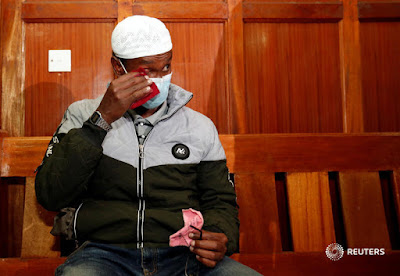
Liban Abdullah Omar reacts after he was acquitted at the Milimani Law Courts in Nairobi, Kenya October 7, 2020. REUTERS/Thomas Mukoya

We are left in no doubt by Mike Hutching’s picture that this is about – anti-corruption. The black bold letters scream out against the reds of the banners, adding to the noise of the shouting likely coming from the open mouth. In fact this picture is so noisy we hardly notice the quite acute angle of the tilt as Mike composes his frame.    

Members of the Congress of South African Trade Unions (COSATU) carry placards as the take part in a nationwide strike over issues including corruption and job losses in Cape Town, South Africa, October 7, 2020. REUTERS/Mike Hutchings 

Zohra builds her picture up by using the framing of the black gates, the centrally placed minaret and a low angle to let the figures play into the stage she has composed. This feeling of stage may also be enhanced by the bright reds, greens and yellows worn by the “actors” as they move into the setting.    

A faithful stands with hand sanitiser at the entrance of the Great Mosque as hundreds of thousands of Senegalese Mouride Brotherhood pilgrims gather for the annual Grand Magal festival, as the global spread of the coronavirus disease (COVID-19) continues, in the holy city of Touba, Senegal October 5, 2020. REUTERS/Zohra Bensemra

You have to work hard to look into the shadows of Essam al-Sudani’s picture through the glare of the flames to see what is going on. Once you do, you are a little too visually exhausted to be met with the sad vision of three boys playing in the fumed-filled air among the rubbish on the ground.  

Children play with flames rising from oil refinery pipes in the background in Basra, Iraq July 23, 2020.  REUTERS/Essam al-Sudani 

As far as the eye can see bricks and more bricks make up a smoky, desolate landscape captured by Abdullah Dhiaa Al-Deen. The sun beats down to bleach all colour from the picture as we are drawn to the single focal point of the figure labouring away, with that set between the two other secondary features in the picture, the chimneys spewing smoke.  

An Iraqi labourer works as a brick factory's chimney belches out smoke in Najaf, Iraq September 22, 2020. Picture taken September 22, 2020. REUTERS/Abdullah Dhiaa Al-Deen

Abdullah Dhiaa Al-Deen captures the momentarily upturned face of the boy whose mouth takes the shape of the Melpomene, the muse of tragedy mask, but the image is buried in the mass of swirling mass of arms, faces, reds and blacks. Once you spot him it’s hard to look away: even as the eye is distracted by the beauty of the lights in the background, you are drawn back to his face again.  

Shi'ite Muslim pilgrims take part in a mourning ceremony, ahead of the holy Shi'ite ritual of Arbaeen, amid the outbreak of the coronavirus disease (COVID-19), in Kerbala, Iraq, October 7, 2020. REUTERS/Abdullah Dhiaa Al-Deen

Two things strike me immediately about Muhammad Hamed’s wonderful picture; the stoic nature of what looks like lonely work and the greyness of the classroom devoid of students. But this initial impression of loneliness and grey quickly disappears when we look at her face, the energy of her teaching of what looks like trigonometry. You can then imagine the children all at home watching online. And on the subject of angles and shapes, we are drawn by the  arc of the projector cable from one side of the picture through her arm to the pen poised on the white board. 

A private-school teacher gives an online lesson to students receiving distance education, amid fears of a rising number of coronavirus disease (COVID-19) cases in Amman, Jordan October 7, 2020. REUTERS/Muhammad Hamed 

Who can resist an image that has bright orange and yellow flames reflected in a black pool of water with the additional focal point of a cloaked figure poised mid-step? Not me. A visual treat from Afolabi Sotunde that delights us with moment, colour and composition. The story behind this powerful image is not so delightful as we learn of energy waste and pollution. Read on here

A reflection of two gas flaring furnaces and a woman walking on sand barriers is seen in the pool of oil-smeared water at a flow station in Ughelli, Delta State, Nigeria September 17, 2020. REUTERS/Afolabi Sotunde

Bolts and padlocks add a literal sense to coronavirus (COVID-19) lockdown in Mohammed Salem’s thoughtfully shot picture of food being delivered. Timing is all important to get the figure at the centre of the smallest of gaps and it’s not an easy one to expose for either.   

A worker is seen through an opening in a school door as he carries a sack of flour distributed by UNRWA to be delivered to a Palestinian family amid the coronavirus disease (COVID-19) outbreak, in Gaza City October 7, 2020. REUTERS/Mohammed Salem


Friday, 10 November 2017

A Week in Pictures Middle East and Africa November 10, 2017

Looking directly into the camera with the confidence and beauty of a model, a migrant in Libya demands our immediate attention in Ahmed Jadallah’s striking image. I asked myself, does the red line in the background detract from the picture? For me, no. As soon as I try to look away the red line draws me back into these piercing eyes that seem to hold so many questions.


A migrant arrives at a naval base in Tripoli after he was rescued by Libyan coastal guards off the coast of Libya, November 6, 2017.   REUTERS/Ahmed Jadallah

A combination of strong, simple shapes, primary colours and the visual surprise of a man’s head popping up from a sea of red make this picture irresistible. Immediately, we want to know what is going on in Khaled Abdullah’s eye-catching picture. Is this man being swallowed by a giant pillow? Why does he have a rifle? And why does he have a picture on a stick poking out of the barrel of his gun? It’s only the caption that saves us from a lifetime of frustration.


A Houthi follower emerges from a gap in a flag as he attends a rally organised to show support for the Palestinians in Sanaa, Yemen, November 6, 2017.   REUTERS/Khaled Abdullah

I love pictures that immediately raise questions in our minds. We just want to know what is being said to President Mugabe by his wife Grace in Philimon Bulawayo’s wonderful picture, and at the same time we want to know what he’s thinking. The temptation might be to crop this even tighter to just the lips and eyes but then we’d lose the bright yellows of their matching berets, which would be a shame. There is temptation also to use this picture in a speech and thought bubble caption competition, but that would only cheapen this great image. 


President Robert Mugabe listens to his wife Grace at a rally of his ruling ZANU-PF party in Harare, Zimbabwe, November 8, 2017.   REUTERS/Philimon Bulawayo

 A tightly shot detail picture can often be one of the most revealing images in a sequence of  images in a visually led story. James Akena’s picture of a father holding a treasured but tiny black and white image of his murdered son is one such case. The young man’s face on this slightly damaged photograph is held up against a clean blue and green background. We look at him and wonder about his short life. It takes a while for us to notice the missing nail on the middle finger of his grieving father: more pain.


South Sudanese refugee Simon Wani holds up a picture of his son who he claims was killed by rebels in South Sudan when he returned in search of food from Palorinya settlement in Moyo district, northern Uganda October 25, 2017.               REUTERS/James Akena

The conflict in Libya is far from the front pages but the struggle for power by different political and militant factions rages on. Esam Omran Al-Fetori’s front line pictures as the Libyan national army battles Islamic Militants are very powerful so I can’t select just one. I will say no more as they speak for themselves. To see more click here.


A military vehicle belonging to the Libyan national Army fires towards the positions of Islamic militants during clashes in Khreibish district in Benghazi, Libya November 9, 2017.   REUTERS/Esam Omran Al-Fetori 


Members of the Libyan national Army take position during clashes with Islamic militants in Khreibish district in Benghazi, Libya November 9, 2017.   REUTERS/Esam Omran Al-Fetori


A member of the Libyan national Army runs during clashes with Islamic militants in Khreibish district in Benghazi, Libya November 9, 2017.   REUTERS/Esam Omran Al-Fetori

On occasion a spectacle itself is enough to make great pictures. Crowds of worshipers descending to worship at a shrine is one such example. Abdullah Dhiaa al-Deen photographed the commemoration of Arbaeen and went a step further to make one of the most eye-catching pictures of the week. Looking through an archway of red tiles and light, we are drawn into a seemingly endless crowd, for me, with a complete sense of awe. The celebrations are estimated to be twice the size of the Hajj pilgrimage, with 22 million people expected to converge on the holy city of Kerbala.  


Shi’ite pilgrims pray at the Imam al-Abbas shrine during the commemoration of Arbaeen in Kerbala, Iraq, November 9, 2017.  REUTERS/Abdullah Dhiaa al-Deen

 Just published now is Abdullah Dhiaa Al-Deen story on the culmination of hundreds of thousands of Shi’ite Muslims gathering in Kerbala and I just had to add this image. It the exception of the printed picture in the background this could have been from hundreds of years ago, amazing. See the whole story here


 Muslim men beat themselves with their hands September 24, 2017 in mourning for Imam Hussein, a grandson of the Prophet Mohammed who was killed in a 7th century battle in Kerbala, Iraq.   REUTERS/Abdullah Dhiaa Al-Deen