Pages

Showing posts with label cancer. Show all posts

Sunday, 8 March 2020

A Week in Pictures, Middle East and Africa, March 6, 2020

Khalil Ashawi’s image is very open to interpretation if you let your imagination wander. Is the impression given that the IDP camp is being hidden away, by the cloth, like the feeling among those at the camp that they are getting no help from the global community and are unseen? Is the woman trying to retain normality of life washing and drying her favorite item as if she were still at home, the beautiful cloth a reminder of a life gone by? Or she is just doing the washing? I leave it to you to ponder. 

An internally displaced Syrian woman hangs a piece of cloth out to dry in Atmeh IDP camp, located near the border with Turkey, Syria March 4, 2020.   REUTERS/Khalil Ashawi

Afolabi Sotunde’s picture can best be described as warm and affectionate as the world braces itself to face the spread of the coronavirus outbreak. I think if the background were not so clean and the colour so warm this image would not do as well as it does to raise a gentle smile during these worrying times.     

A boy wearing two face masks records with his phone during a friendly football match for International Women’s day in Abuja, Nigeria March 5, 2020. REUTERS/Afolabi Sotunde

Mike Hutchings’ picture is as expansive as it is full of emotion. Even though the image is shot wide to keep the outstretched arms in frame you are drawn into the woman’s face that is fraught with emotion, via the bold 12 on her shirt. The police in the background make for a dark and somewhat static backdrop for the action in foreground. The tilt to the frame, although subtle, is an important compositional element that adds to the drama.

A woman wails as law enforcement officers move in to disperse a group of immigrants who had occupied a historic church and a square demanding to be moved to another country as they claimed not to feel safe because of xenophobic attacks, in Cape Town, South Africa March 1, 2020.   REUTERS/Mike Hutchings 

What a wonderful detail picture by Amir Cohen - which works so well as the eye is drawn to the single image of Netanyahu in a mass of ballot papers. His face is clear and bold even though it’s quite small in the frame. I also like that the  the colours in the picture are similar to those of the  Israeli national flag.

Israeli Prime Minister Benjamin Netanyahu’s Likud party election ballots are seen on the floor following Netanyahu’s address to supporters at the party headquarters in Tel Aviv, israel, march 3, 2020.   REUTERS/Amir Cohen 

Ari Jalal’s picture makes you feel like you are the person who is being checked for a high temperature, a symptom of possible coronavirus infection. The claustrophobic feel is created by a dark frame and the masked medical worker leaning into the image. Would I have cropped the yellow out on the left? Probably yes, but then maybe you would lose the sense that this was shot from inside a car, which is also very much part of its strength.     

A member of a medical team checks the temperature of an old man in a car at a checkpoint on the outskirts of Duhok, Iraq following an outbreak of coronavirus, March 2, 2020.   REUTERS/Ari Jalal


Hidden in a swirl of bright colours and patterns it comes as quite a shock as your eye finally settles on the child patient stricken with cancer in Essam al-Sudani’s moving picture. With the boy’s hand held to the forehead you can almost feel the pain. Your  eye moves along his long thin arm to the drip and  the cold grey wall on the left offers little comfort. This image makes me feel sad, and so it should. Read on here, a story that has taken weeks to compile. 

Cancer patient Mostafa Abdullah, 14, lies on a bed after receiving treatment at the children’s cancer hospital in Basra, Iraq September 25, 2019.   REUTERS/Essam al-Sudani

I make no excuses for showing this brutal image as I feel its important to document what happens in conflict. It is always a difficult balancing act between what is gratuitous and intrusive while showing the ugliness of injury and death and Umit Bektas has succeeded in his picture. We can see the man is injured but being cared for as he is in a hospital setting, the scene quite dark with the single light source bearing down on his injured body. It takes a while for us to see the amount of his blood on the floor. Read on here.     

Surgeon Mohammad Abrash waits to start surgery on an injured man in a hospital in Idlib, Syria February 28, 2020.   REUTERS/Umit Bektas

The best way to illustrate the impact that fears of coronavirus are having on public spaces is to show a simple before and after. Not a perfect match as access was somewhat restricted to get to exactly the same place to shoot the “after” picture, but Ganoo Essa’s combination does the trick.

A combination picture shows Muslim pilgrims wearing protective face masks, following an outbreak of coronavirus, as they pray at Kaaba in the Grand Mosque in the holy city of Mecca, Saudi Arabia march 3, 2020 (top) and a general view of Kaaba at the Grand Mosque which is almost empty of worshipers, after Saudi authorities suspended Umrah (Islamic pilgrimage to Mecca) amid the concerns of the outbreak, at the Muslim holy city of Mecca, Saudi Arabia March 6, 2020.    REUTERS/Ganoo Essa 


Friday, 24 August 2018

A Week in Pictures, Middle East and Africa, August 24, 2018

A last minute update for my weekly round up to include Zohra Bensemra's details picture from the haj. The hands reaching across the crowds to touch against the black Kaaba that glints in the light tell the story of adoration and prayer. You can see more of Zohra's pictures here and read her account of the haj.


Muslim pilgrims kiss and touch the wall of the Kaaba as they perform Tawaf al- Ifada during the annual haj pilgrimage at the grand Mosque in the holy city of Mecca, Saudi Arabia August 23, 2018. REUTERS/Zohra Bensemra

Andreea Campeanu’s picture of a girl in profile standing shoulder deep in swamp waters has such a dreamlike feeling it’s hard to not make up stories as to what she is thinking about as you look at her. Her head is in perfect profile as she watches the ripples in the still water that break up the reflection of the plants in the background and her head as she moves her arm gently back and forth. The ripples serve to break up the dream as we learn from the story that she is waiting for a food drop from an NGO. 


An internally displaced girl plays in the Sudd Swamp near the town of Nyal, in South Sudan august 19, 2018.   REUTERS/Andreea Campeanu 

Standing under black and red drapes, beautifully robed mourners seem to whisper in the cool of the courtyard in Francis Kokoroko’s picture. Even though there is a small triangle of bright light and heat creeping through the drapes, the picture has an overall sense of cool. It takes a while to spot the figure on the right through the complex compositional web of crosses and diagonals but when you do see him he brings an even greater sense of calm and respect to the image as a whole.


Mourners gather at the family home of the late Kofi Annan, former United Nations Secretary-General and Nobel Peace Prize laureate, in Bompata town in Kumasi, Ghana, August 19, 2018.   REUTERS/Francis Kokoroko

There is no escaping the sheer glee in Khaled Abdulla’s picture on the faces of the boys as they carry their goats away from market prior to the Eid celebration and feasting. The action bursts out of the frame as the boy on the right is only just contained in the image. The composition spreads out in a scalene triangular shape, its peak being the red tent in the rear of the picture. Take even more time to study the faces and small details and you will eventually notice the boys’ feet, some bare, some with sandals and some with Wellington boots. But the boys all have hopeful smiles, a rare treat in Yemen.  


Boys carry goats at a livestock market where people buy sacrificial animals ahead of the Eid al-Adha celebrations in Sanaa, Yemen August 18, 2018.   REUTERS/Khaled Abdullah

We are often faced with tough decisions of using images of children in areas of conflict who are suffering, wounded or even dead. Equally challenging is the edit when we cover stories about children who are sick. We are challenged with showing what is really happening while being respectful and preserving the dignity of those involved. Khaled Abdullah gained access to a cancer hospital in Yemen that is struggling to maintain care as the ongoing war drains access to resources and medicines. Khaled’s picture of a child who is sick with cancer is both powerful and empathetic. You can see the full story here


A girl with cancer lies on the lap of her mother at the national Oncology Centre in Sanaa Yemen, August 6, 2018.   REUTERS/Khaled Abdullah

 I am very drawn to Amir Cohen’s picture of the couple posing for a picture for many reasons. First, I love the shape created by the women taking pictures as they lead you into the centre of the picture. Secondly, the almost classical pose the couple are assuming to have their image recorded and the way the side light falls gently on their faces, lifting the tones and drawing you to the calm and natural expression on faces. And lastly, a sense of timelessness as much of the colour is drained from the image by the evening light, leaving the picture with an almost monochromatic feel.    


People enjoy themselves along the shore of the Mediterranean Sea during the Muslim holiday of Eid al-Adha at a beach in Tel Aviv, Israel August 23, 2018.   REUTERS/Amir Cohen

Maybe you agree, maybe not, but Tiksa Negeri’s picture of husband of wife at the IPD camp in Ethiopia put me immediately in mind of the painting American Gothic by Grant Wood, which you can see here. Maybe it’s the gaunt lines in Biratu’s face, or the slight tilt to the head of his wife or maybe it’s just the sense I get of pride and dignity in the face of hardship. An extra bonus to me is that Tiksa has kept the feet well in the frame too – pictures that cut the feet off are a pet hate of mine. You can see the story here.


Biratu Ejersa, 73, stands in front of his shelter with his wife, Adanech Biftu, 35, and their daughter, Mazaynesh 7, in a camp for the internally displaced people in Chelelektu, town of Southern Nations, Nationalities and peoples’ region in Ethiopia August 15, 2018.   REUTERS/Tiksa Negeri

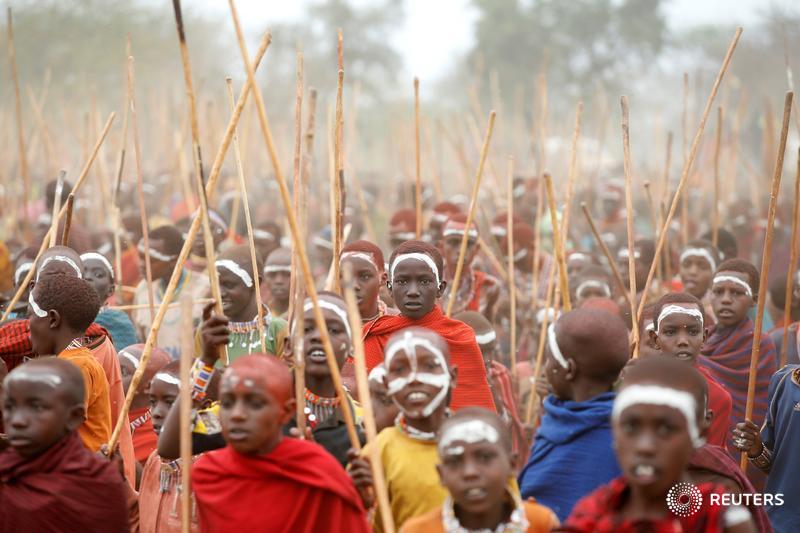
It’s the eyes of the boy in the centre of this chaotic picture by Baz Ratner that seem to look to distant horizons, or in a flight of fancy, to the future, that really make this picture stand out. Even though the pounding feet of thousands has drummed up quite a dust cloud, their vibrant coloured robes of reds, yellows, blues, greens and orange and the bright white arcs of face paint dance and cut through the murky and excited atmosphere. You can see the full story here


Maasai children hold sticks as they gather for an initiation into an age group ceremony near the town of Bisil, Kajiado county, Kenya, August 23, 2018.   REUTERS/Baz Ratner


Friday, 9 February 2018

A Week in Pictures Middle East and Africa February 9, 2018

I can’t stop looking at Khaled Abdullah’s stark and very sad picture. The children’s tiny, frightened faces peer out from a busy, colourful image. To me, the sadness in their eyes fills the frame, so all you can do is feel for their suffering. How much worse can it get? You live in war zone, you are only a child, and you and your sibling both have cancer. 


A boy and his sister who both suffer from cancer lie on a bed at a cancer treatment centre in Sanaa, Yemen, February 4, 2018.    REUTERS/Khaled Abdullah

How could I resist highlighting the bizarre scene of a masked gunman scrolling through his phone, sitting on a red sofa in a grey, rubble-strewn street in al-Bab, Syria? I think Khalid Ashawi’s centrally composed picture is as striking as it is bizarre, so no resistance from me, it’s here.


A Turkish-backed Free Syrian Army fighter is seen in the eastern suburbs of al-Bab, Syria, February 4, 2018.   REUTERS/Khalil Ashawi

To me, the strength of Ismail Zitouny’s almost abstract combination of texture, tone, wood, metal and cloth is that it takes quite a while to understand that you are looking at the wrapped figure of a woman. Her invisibility mirrors the plight of the displaced people who cannot return to their homes in the ghost town of Tawergha. More pictures here.


A Libyan woman displaced from the town of Tawergha stands at a camp in Tripoli, Libya, February 5, 2018.   REUTERS/Ismail Zitouny

The ghost-like figures that appear from the smoke and dust of the aftermath of an air strike in Bassam Khablieh’s picture haunt me far more than his other images of blood-stained pavements taken at the same time. Why? The people seem to be drowning in the streets as they run from the devastation, putting me in mind of the first line of Stevie Smith’s poem ‘Not Waving but Drowning’: ‘Nobody heard him, the dead man.’


Civil defence members and civilians are seen running after an air raid in the besieged town of Douma in eastern Ghouta in Damascus, Syria, February 6, 2018.   REUTERS/Bassam Khabieh

It’s not clear what everyone is looking at, but what is clear is the desperation in the faces of those gathered behind the wide-eyed, open-mouthed security officers in red berets in Ibraheem Abu Mustafa’s picture. I feel as if every pair of eyes has a sad story to tell. The man in the rear of the image pushes his passport forwards, giving us a clue as to what this picture is about. Story here.


Members of Palestinian Hamas security forces stand guard as people ask for travel permits to cross into Egypt through the Rafah border crossing after it was opened by Egyptian authorities for humanitarian cases, in the southern Gaza strip, February 7, 2018.   REUTERS/Ibraheem Abu Mustafa

Wild swings in the stock market provide great opportunities for making and losing lots of money but they also provide photographers with an opportunity to shoot thoughtful and clever pictures. Not easy when you consider the only ‘action’ is people sitting at screens. I love the circular composition of Faisal Al Nasser’s picture, where the top line of the screens curves round to visually link with the curve of the balcony in the rear of the picture. This shape is echoed by the trader’s agal holding his keffiyeh in place. And in Satish Kumar’s wonderfully graphic image below that, I love it that investor has momentarily taken his eyes of the screen to look directly into the lens. At this moment, did he lose money or make it?


A Saudi trader observes the stock market on monitors at Falcom stock exchange in Riyadh, Saudi Arabia February 7, 2018.   REUTERS/Faisal Al Nasser


An investor looks up from the screen at the Dubai International Financial market in Dubai, United Arab Emirates, February 7, 2018.  REUTERS/Satish Kumar

In what initially looks like a curious mixture of street theatre and a Zombie run, Amir Cohen has captured a picture that draws you in as your interest is piqued. What is actually going on? Some faces painted white in a reverse Al Jolson style, others half painted white. Once you move beyond the right to left gaze of the focal point of the image you are zigzagged uncomfortably to the rear of the picture to see dark eyes and pale death-like faces. Two words stand out: Israel and deport. Story here.


African migrants protest against the Israeli government’s plan to deport part of their community, in front of the Rwandan embassy in Herzliya, Israel, February 7, 2018.   REUTERS/Amir Cohen

It’s not often I feel I can share a sports picture from the Middle East and Africa region, but Mike Hutchings’ eye-watering picture of an awkward delivery during the one-day international between South Africa and India seemed to select itself today.


South Africa’s Aiden Markham gets hit by a delivery from Hardik Pandya during the Third One-Day International against India in Newlands Stadium in Cape Town, South Africa, February 8, 2018.   REUTERS/Mike Hutchings

Omar Sanadiki’s pictures from rare trip to Aleppo reveals slow signs of the city coming back to life. Once you look beyond the massive hole in the foreground and the destruction of the city to the horizon, you begin to pick out tiny details: cars moving, people walking about and sitting at a table. A small hardware store has opened for business and what looks like a food stall on the left has three customers. You do have to look hard, but it’s there. So I think there is a little hope here.    


People and cars are seen in the streets of old town Aleppo, Syria, February 8, 2018.   REUTERS/Omar Sanadiki

Khalil’s Ashawi’s picture is full of tension and action. What really makes this picture work for me is that in addition to the strong light coming through the pillars as the gunman runs for cover, the barrel and aiming sight of the rifle are silhouetted against the light on the wall. If you use your thumb to take away the end of the rifle, the image is much harder to define and you lose the immediate sense of ‘gunman’.  Read the latest from this conflict here.  


A Turkey-backed Free Syrian fighter is seen in the eastern suburbs of al-Bab, Syria February 8, 2018.   REUTERS/Khalil Ashawi


2018