Pages

Showing posts with label Reuters. Show all posts

Friday, 23 February 2018

A Week in Pictures Middle East & Africa February 23, 2018

In the confusion of claims that Boko Haram had kidnapped over 100 teenage school girls and counter claims that the military had rescued them Photographer Afolabi Sotunde was assigned to find out what had actually happened. The scene he was met with was scared people coming back in from the bush who has escaped the attack, empty class rooms, weeping relatives and for me most poignantly a single lost pair of slippers (flip flops) left in the sand. Catch up with the ongoing story here.


Abandoned slippers in left in the sand of the school compound in Dapchi in the northeastern state of Yobe, Nigeria, February 23, 2018 where dozens of girls went missing after an attack on the village suspected to have been carried out by Boko Haram.  REUTERS/Afolabi Sotunde 

After spending weeks shooting the looming drought in Cape Town, Mike Hutching’s in-depth story has finally been published. It was hard to choose a single image, but for me a lone figure, carrying a water container and squeezed between the shadows seems to sum up the situation, or maybe a lucky escape. Day Zero, when the taps in Cape Town will be turned off, has been put back from mid April to mid July. Maybe if the rains come and the reservoirs are replenished,   the city will have a lucky escape too. I fear that in the long term there is no escape from water shortage. His whole picture story, with some amazing drone footage, can be seen here.  
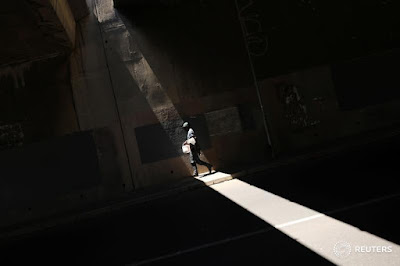

  
A man carries a bucket used to collect water from a small roadside spring in Cape Town, South Africa, February 4, 2018. REUTERS/Mike Hutchings 

Helping hands reach up as the body of dead Palestinian teenager Abdullah Abu Shekhah is lowered into his grave in Ibraheem Abu Mustafa’s frantic and distressing picture. It looks like Death himself is taking another soul as mourners gather to take a last look at their relative or friend. The gentle touch of a hand on the young man’s face is a calm moment in the eye of a storm in this powerful picture.  


Mourners bury the body of Palestinian teenager Abdullah Abu Shekhah during his funeral in Rafah in the southern Gaza Strip, February 18, 2018. REUTERS/Ibraheem Abu Mustafa

With uncomfortable similarities to Ibraheem’s image above, there is no mistaking the desperation in a storm of violence in Bassam Khabieh’s picture from Ghouta. But this time, instead of the helping hands lowering a dead man into his last resting place, a living but unconscious woman is lifted up from a shelter that looks like a concrete grave to what we hope is relative safety. More pictures here


Civil defence help an unconscious woman from a shelter in the besieged town of Douma in eastern Ghouta in Damascus, Syria, February 22, 2018. REUTERS/Bassam Khabieh 

Recent changes in Zimbabwe’s politics have been, to say the least, rapid. Photographer Philimon Bulawayo’s carefully positioned and composed picture of Nelson Chamisa seems to have the full political weight of Morgan Tsvangirai bearing down at him, even at his funeral. The small sliver of black background by the side of Chamisa’s face is so important to make this image work. 


Nelson Chamisa, the new leader for Movement For Democratic Change (MDC), looks on during the funeral parade of Morgan Tsvangirai in Harare, Zimbabwe February 19, 2018. REUTERS/Philimon Bulawayo

James Akena’s picture has a somewhat clumsy composition. The boy on the left is walking out of the frame, the bush on the right should either be completely in the frame or cropped out, and the child in yellow is a little distracting. But I really like this picture for two reasons: the children being held so tightly by the adults to ensure they are not lost, and the objects being carried by the equally spaced figures. Bucket for water, child and, probably, all the worldly goods the family could flee the conflict with. 


Congolese family, who migrated from Democratic Republic of Congo by fleeing on a boat across Lake Albert, arrives in Ntoroko, Uganda February 17, 2018. REUTERS/James Akena 

I can’t help thinking about two things when I look at Khalil Ashawi’s picture of resting troops. First, just how well the camouflage actually works. It takes a while to see all five exhausted soldiers. And then, bizarrely, I am put mind of the trolls turned to stone in JRR Tolkien’s book The Hobbit. Maybe it’s the grey rock behind the resting figures and the light coming in from the back of the picture through the trees. 


Turkish-backed Free Syrian Army fighters rest near the city of Afrin, Syria February 19, 2018. REUTERS/Khalil Ashawi

Taking full advantage of the warm evening light, long shadows and classic thirds with his ‘environmental portrait’ of two spacemen, Ronen Zvulun manages to make us believe, if only momentarily, that we are on the surface of an alien  planet. I can’t quite my head around the notion that dressing up in a space suit and walking around in the desert constitute simulating a mission to Mars, but who am I judge. Judge for yourself here


Israeli scientists participate in an experiment simulating a mission to Mars, at the D-MARS Desert Mars Analog Ramon Station project of Israel's Space Agency, Ministry of Science, near Mitzpe Ramon, Israel, February 18, 2018. REUTERS/Ronen Zvulun

There was no way that James Akena would fail to shoot great pictures at a hydroelectric construction project in Uganda and he didn’t disappoint. A lone figure in a cavernous underground tunnel is dwarfed by waves of light that shift from darkest blacks to golden yellow in shapes that emulate the water that will rush through this shaft. It makes for an irresistible image. 


A contractor walks in a tunnel at the construction site at Karuma 600 megawatts hydroelectric power project under construction on River Nile, Uganda February 20, 2018.   REUTERS/James Akena

It’s not often you get to see an elephant suspended upside down by its feet, but Thomas Mukoya’s picture delights us with just that. Ears flopping like Disney’s Dumbo, and a ranger holding the elephant’s tail, are watched by a small crowd that has gathered. The clouds in the sky complete the scene as if they had been drawn to order by a Disney animator. The whole story here.


Kenya Wildlife Service (KWS) rangers load a tranquillised elephant onto a truck during a translocation exercise to Ithumba Camp in Tsavo East National Park, in Solio Ranch in Nyeri County, Kenya, February 21, 2018. REUTERS/Thomas Mukoya

The worn climbing holds in Zohra Bensemra's picture take a little time to see. The eye is first drawn to the strong blacks of the window and the doorway, then to the child dangling from the window. What is going on? Only the caption can explain. This is a great example of how a mysterious picture draws us into a sequence of images because we just have to know more. All is revealed here
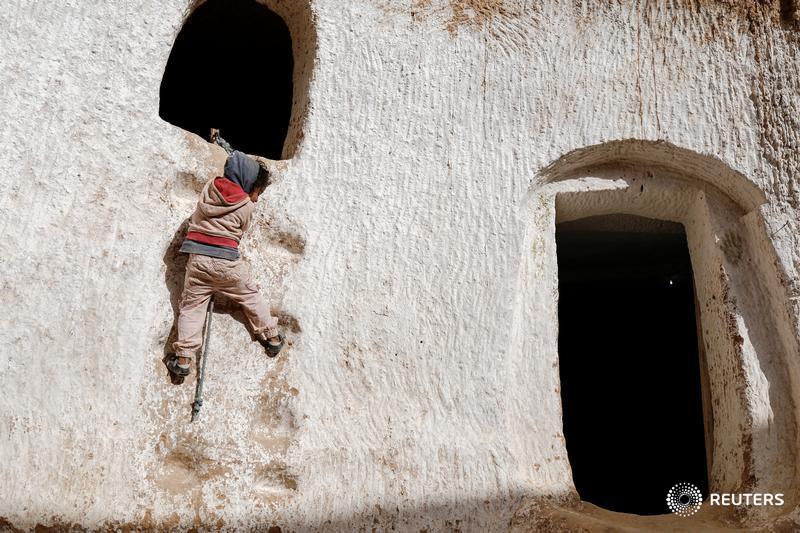

Ahlem, four, climbs up a wall to reach her rabbit's hideaway at her troglodyte house on the outskirts of Matmata, Tunisia, February 5, 2018. REUTERS/Zohra Bensemra


Monday, 7 July 2014

On the Sidelines of the Brazil 2014 World Cup

As national soccer teams and the photographers who have been covering them start to trickle home from the Brazil World Cup, it’s time to revisit the “On the Sidelines” project.
This Reuters Pictures project was billed as a chance for photographers to share “their own quirky and creative view of the World Cup”. I thought that I’d examine what has been achieved


As a way of introducing the project, let me use a comparison. I’m intrigued by the notion that an animal that has been caged, but is well fed and well treated, will not exchange freedom from its pen for the uncertainty that this freedom might bring.

Likewise, working as a photographer at the World Cup comes with a kind of cage of security. You know what you are going to do, what time you are going to do it, and what is expected of you. You need to capture pictures of great sporting action, goals, celebrations, red cards and, of course, every important incident, be it Suarez’s teeth marks or the collision that led to Neymar’s broken vertebra.


For editors too, life can fall into a regular pattern. First, arrive at the office two hours before the start of the game and make sure all the technology works, and that tests have been received from the photographers.

Then, with three other colleagues, look at between 12,000 and 20,000 frames per game, select the right pictures and make sure the captions and image quality are good (all while trying to block out the sound of drilling from builders in the next room… See video below).


As the game finishes and the last end-of-match celebration and dejection pictures are being picked through, the photographers from the next game are already starting to send in tests for their match.

Eleven hours after arriving in the office, the World Cup editing team here in Miami leaves and tries to find something (healthy, of course…) to eat. And hopefully there is no polite but disgruntled call from a photographer claiming you missed their best picture…

Here is my screen after the Netherlands v. Costa Rica quarterfinal match.


It’s not at all easy to cover the World Cup. Photographers face all sorts of struggles: travelling for hours to get to the ground, avoiding being robbed, dealing with technical issues, setting up and shooting in the rain, not to mention getting the best picture. All of this can make you feel like you are trapped in a cage when it comes to being creative with your photography.

The “On the Sidelines” project was intended as an outlet from this hard work – an opportunity to enjoy the freedom to shoot additional creative and unexpected photographs, just for fun’s sake.


The guidelines for the project were simple. You could photograph anything that you liked, with any camera or even phone that you liked, and use any caption you wanted as long as it had the correct date and location and didn’t offend.

The photographers were not to use filters (who needs amateur filters when you can compose and expose professionally anyway?) and, of course, they had to follow all of our professional ethical guidelines.

We added the following sentence to the caption of each picture so that some of the stranger shots would be put into context: “In a project called “On The Sidelines” Reuters photographers share pictures showing their own quirky and creative view of the 2014 World Cup in Brazil”.


And which photographers took part? Every one of them.

What amazed me most was the energy and sense of fun that came through in the hundreds of pictures produced by photographers who were tired, hungry, and sometimes wet and grumpy, but never bored.

After a hard day in the cage, it was time for some freedom.

Having edited thousands of pictures from the matches, I also enjoyed looking at and processing “On the Sidelines” images when they were filed. They can all been seen here.

As we prepare for the final four matches of the World Cup, we are sending our mainstream clients an edited picture package, showing a selection of some of the hundreds of images produced as part of “On the Sidelines”.

We hope that our media clients and their readers will enjoy this second package of new material as much as they enjoyed a previous set of Sidelines pictures that we sent out.

So, what has been achieved by the “On the Sidelines” project?  Our professional photographers have had a lot of fun producing yet another set of amazing pictures, all of which are in the archive to show “their own quirky and creative view of the 2014 World Cup in Brazil.”

It’s a great record for them to look back on, in addition to the thrills and spills of the soccer action.

Now, bring on the final.


Saturday, 3 May 2014

Instagram - A Platform For Professionals?

Two amazing pictures showed up on my screen over the past few days. The first was from Myanmar, where a Rohingya Muslim woman was pictured holding her malnourished twins. The second captured a deadly explosion in Iraq. 

Both were sent out to our clients on our newswire, and I decided to share them on social media. First I posted them to Twitter, with links to Reuters.com slideshows and our Wider Image website. The people who follow us on Twitter know what to expect – breaking news pictures from around the globe including some images that are quite brutal. 

Then I went to Instagram. I paused. Over the last few months, Reuters Instagram account has increased its following to almost 50,000. Each picture gets an average of over 1,000 likes and the numbers are growing. 

We don’t force crop our pictures into squares and we never use the filters – what you see is an image just as it was moved to the wire, un-manipulated. 


Displaced Rohingya woman Norbagoun carries her severely malnourished 25-day-old twins in her lap in their house at the Dar Paing camp for internally displaced people in Sittwe, Rakhine state, April 24, 2014. Restrictions on international aid have exacerbated a growing health crisis among stateless Muslim Rohingya in west Myanmar. In February, Myanmar's government expelled the main aid group providing health to more than half a million Rohingya, Medecins Sans Frontieres-Holland (MSF-H), after the organisation said it had treated people believed to have been victims of violence in southern Maungdaw township in January. The United Nations says at least 40 Rohingya were killed there by Buddhist Rakhine villagers. The government denies any killings occurred. An attack in March on NGO and U.N. offices by a Rakhine mob led to the withdrawal of other groups providing healthcare and other essential aid to another 140,000 Rohingya living in camps.  REUTERS/Minzayar

We are continually told that Instagram is the platform of the future for picture-sharing and news photography. It’s a space Reuters need to be in.  

So why my hesitancy? Who would want to “like” a picture of malnourished children? No one, I assume. Yet purely in terms of beauty of photography, emotion and content it’s a very powerful news picture. 

But is Instagram a platform for this? The second picture is an exclusive image of a deadly blast, captured with full force. It shows the very moment that several people were killed and many injured. Again, what to “like”? 


An explosion is seen during a car bomb attack at a Shi'ite political organisation's rally in Baghdad, April 25, 2014. A series of explosions killed 18 people at a Shi'ite political organisation's rally in Iraq on Friday, police and medical sources said. The militant group, Asaib Ahl Haq (League of the Righteous), introduced its candidates for elections on April 30 at the rally in eastern Baghdad. Three bombs exploded in succession as people were leaving, Reuters reporters at the scene said. REUTERS/Thaier al-Sudani 

Followers can comment right under the picture. Would there be an outcry and accusations of insensitivity at posting a picture of suffering children? Or would groups, who blame the Myanmar authorities for the health crisis among Rohingya Muslims – which the state denies – say the image was meant to advocate their cause? 

Would supporters of militants who exploded the bombs at the Shi’ite political rally write comments applauding the image and enraging those who suffered from the attack, who would be appalled that the image had even been posted? 

Every good news picture evokes debate and opinion. The more followers an Instagram account gets, the more diverse the commentary normally becomes. Nothing goes unchallenged or fails to raise the hackles of one group or another. 


One might think a picture from Ireland of a sheep that had been dyed pink to support a cycle race would be fun and harmless enough (it got 1046 “likes”). The comments ranged from clapping hands, smilies and “Mood for a pink outfit anyone?” to “People who do this to animals should be SHOT. Most dyes are not safe for them”.


The only pictures that don’t seem to upset people are silhouettes. So maybe we should just ignore everyone and post whatever represents the best of the file? But the point is to gain followers not lose them. Would someone interested in world news like to see cute pandas; or would our “panda followers” be horrified by pictures of children with malnutrition or bomb blasts in Iraq? 

I have to admit I enjoy posting Reuters pictures to Instagram; I get the buzz of instant gratification from “likes” and positive comments. Also, I tip my hat the very small group of photographers who have carved out a niche for themselves using Instagram to promote their work (I believe these photographers are so good that they could make great pix using a pin-hole camera). The platform has given joy to millions of amateurs using their phones to post pictures.   

But we are paid professionals and I am beginning to struggle with the question: “what is the actual value of Instagram for professional news photographers?” Likes cannot not, as yet, be converted into dollars so how will they fund the business now or in the future? 

So another question: is the platform best left to the amateurs, to enjoy filter-enhanced sunsets, rainbows, street scenes, lovers, pets and families or is this really the new, professional platform of the future? 

Last question “Would you ‘like’ a picture of malnourished babies in Myanmar?” 


If don’t give a damn about “likes” and just want to read the story and see the pictures, click here

Saturday, 5 April 2014

News photography – going wider and updated

Sometimes apparently unconnected events turn out to be related in some abstract way, and they get me thinking.


My friend Jennifer O’Neill, the guitarist with a young band named “Bleech” posted a picture on Facebook recently. It read: “a musician is someone who puts £5,000 worth of gear into a car worth £500 to drive 100 miles to earn £50.” It’s a sentiment many young photographers can also relate to in the changing landscape of professional news photography.

A catch-up drink with some of my (now retired) mentors, colleagues and competitors from the AP and UK national newspapers revealed stories of gloom and decline. A respected photographer was selling his gear to pursue a career in baking since news pictures could no longer provide a viable livelihood. We heard a tale of young photographers waiting to be assigned jobs, knowing that if their pictures did not get published they would not get paid, even if they had invested time and money to produce the images. And of course we heard predictions that media companies would soon start to drop some of their newswire services to cut costs.

All this discussion took place against the backdrop of a debate as to why professional photographers hand out their pictures for free on social media platforms: “How can professional photographers expect to sell a picture that has already been seen for free?”

The conclusion of the assembled group was that young photographers must misguidedly believe that by giving their work away for free now, they will get the big-paying jobs later on. Yet the group agreed that, in reality, if you give your pictures away now, no one will pay for them in the future – why would they?

It seemed like another echo of the music industry, where bands now find themselves needing to give their music away for nothing and then make money by selling T-shirts. There was much shaking of heads and another round of drinks was quickly ordered to wash away these dire thoughts.

It was all food for thought, and more than enough to get you down. But I’m not down because I have hope to offer. Here’s why.

At Reuters we are presently carrying out workshops with our photographers in the United States and South America about The Wider Image, the name for Reuters’ branded, long-form, storytelling photojournalism. We have already done the same thing in the Middle East and Africa, Europe and Asia.

Our goal is to explain how to balance the need for quality, breaking-news pictures with an increasing demand for more in-depth photography that will provide something “different”.  The results very quick and very rewarding - here is an example from this week, Jorge's Silva's look at the issues behind the conflict in Caracas, "Venezuela's skyscraper slum".


The message to the photographers is simple. We will continue to do what we always do – produce fast, accurate, unbiased breaking-news pictures covering all the top stories around the globe. But in addition we will explain visually and in-depth why that news is happening, producing stories that cannot be sourced for free from social media. Simple to say, harder to put into practice.

But here are some more recent examples to highlight the success of the strategy.

On March 17, the United Nations Human Rights Council in Geneva heard a report on human rights abuses in North Korea. The news picture of the day was the address by Michael Kirby, who led the inquiry, officially presenting the report. It also could have been images from Pyongyang (unlikely) or perhaps anti-North Korea demonstrations in Seoul. High-quality pictures of this sort are all on the wires, readily available, and are sometimes even available for free on social media – even if they are not of such high or trusted quality.


But to offer something different, Seoul-based photographer Kim Hong-ji spent time beforehand making contact with people who had been separated from their families during the Korean War, and who had recently seen their long-lost relatives again at a rare, inter-Korean family reunion that took place just north of the border.

Hong-ji asked them what their most precious memento was from their time in North Korea and produced a very moving series of portraits. The International New York Times dedicated just about all of page 2 to his images.


A second example is the Wider Image coverage of a regular annual event – International Women’s Day. Every year, the wires are alive with great pictures that celebrate women and highlight the struggles many of them face. Our competitors will of course also have good pictures to match ours.

This year, weeks before the event we planned and shot a series of portraits showing women with their daughters in countries around the world. We also asked them questions about their personal aspirations for their daughters’ futures.

The published results were nothing short of spectacular, and you can see the series here.


The last example, a personal favorite of mine, is from our photographers Feisal Omar and Omar Faruk in Mogadishu.

It not only demonstrates how our photographers in developing countries are now producing new and valuable pictures; it also goes a long way to demonstrating how we are reshaping and differentiating the file, preparing for an uncertain future.

The idea was developed after members of Somali militant group al-Shabaab attacked the Westgate shopping mall in Nairobi. Photographer Goran Tomasevic was quickly on the scene, and followed security forces into the building to produce a dramatic and awarding-winning set of breaking-news pictures.

Thinking ahead, we asked Feisal and Omar to shoot a picture story to show what the Somali capital Mogadishu was like for ordinary people living there.

The results were different from the normal news pictures of Mogadishu, showing bomb-blast aftermaths and shootings, where the only colors are provided by either flames or blood and the subjects are often ignored by the world’s media.


Here is the Wider Image look at Mogadishu, a series of pictures that published globally.

The biggest surprise for me was seeing the iconic symbol of all things USA – Mickey Mouse – at a child-care centre. The sequence of pictures revealed an equally unexpected splash of colour and normality from a part of the world that many think of as grey and shaped only by disaster, violence and bloodshed.


Working for a large and complex organisation, it is sometimes easy to forget a golden rule in business – if your competitors produce the same product as you but faster and cheaper, you will eventually lose custom. The end result of this shortsightedness is no revenue, no business and no paid professional photographers.

But I am confident that this won’t happen because I am inspired by the creativity and hard work of the likes of Hong-ji, Fiesal and Omar and the global team who produced the International Women’s Day project.

This confidence is further underlined by the impact these stories have on global publications, and the firm knowledge that the same photographers who produced them will compete daily to win breaking-news stories. They are true photojournalists who are looking forward and not lamenting the past.

At the end of the day, what will always sell is quality and integrity. If you combine that with creative storytelling that genuinely interests people, you will have a secure future.

We are living in an increasingly visual world full of opportunity for photographers with new ideas. The situation is not the same as it is for the music industry. As it stands now, professional photographers don’t sell T-shirts, they sell pictures.

If you work for Reuters, The Wider Image team would like to hear your ideas. If we think the stories are relevant to Reuters top news, visually rich and exclusive, we will pay you to shoot them. Good luck.