Pages

Showing posts with label Nelson Chamisa. Show all posts

Friday, 20 July 2018

A Week in Pictures Middle East & Africa July 20, 2018


I can’t decide if Amir Cohen is lucky or unlucky to be close enough to an Iron Dome missile system to capture its launch during a mortar attack, but either way it’s a striking picture. What adds to the strength of this image is that the photographer was quick enough to not only capture the missile’s launch but keep in the frame an equally lucky/unlucky person to give it scale and drama.  


An Israeli man looks on as Iron Dome launcher fires an interceptor rocket in the southern Israeli city of Ashkelon July 14, 2018.   REUTERS/Amir Cohen

No less striking a moment is captured by Ibraheem Abu Mustafa’s picture of an airstrike in Gaza on the same day as the Iron Dome launch. The ball of fire and great plumes of smoke are see in the terrifying context of city buildings all around. Stepping away from the actual news story that this was the worse exchange of fire between Israel and Gaza since 2014, and looking at this in pure visual terms, like the dark shapes in the foreground, it gives it scale and places it in a city. I did have a look at a tighter crop of the ball of fire as a focal point of the picture but think at the end of the day the wider image tells the story better. What do you think?   


An explosion is seen following an Israeli airstrike on a building in Gaza City July 14, 2018.   REUTERS/Ibraheem Abu Mustafa

An editor’s crop has transformed Philimon Bulawayo’s picture from vertical to  horizontal but also removed wasted white space at the top, drawing your eye to Chamisa’s face and the outstretched hands. What you do lose is the sense of the enormous crowds and the people who have climbed the pylon in the background. For my money I like the tighter crop. You may differ. 


Zimbabwe’s opposition party leader Nelson Chamisa is greeted by supporters at a rally at Sakubva stadium in Mutare, Zimbabwe, July 14, 2018.   REUTERS/Philimon Bulawayo

Sometimes you look and look at a picture and think something is a little out of place but can’t quite put your finger on what. Thomas Mukoya’s picture is one such image. The harsh light creates a complex set of shapes and colours, the hat, silhouetted figures, the pink shirt with writing on it you can’t make out and the tents, all make it hard for the eye to settle. Then slowly it dawns: the US flags have been attached to their poles back to front.  
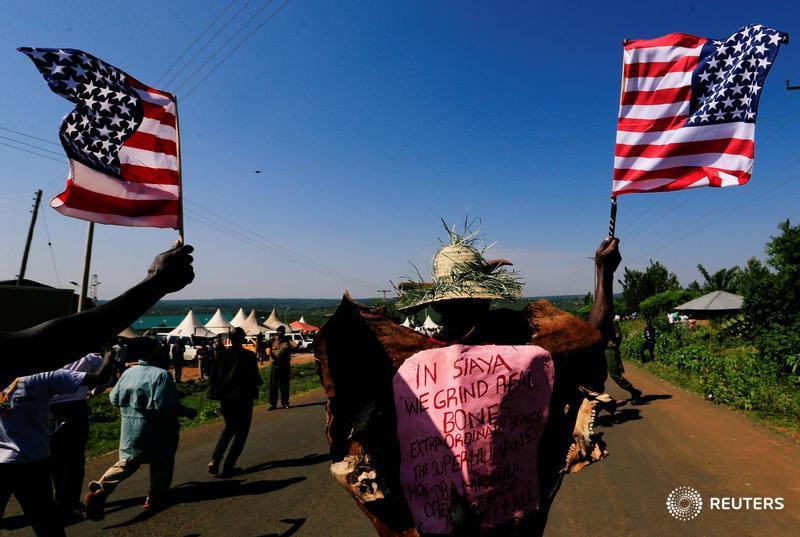

Residents wave the U.S. national flag as the chant slogans as they walk along the road prior to the visit by former U.S. president Barack Obama to his ancestral home, Nyangoma Kogelo village, in Siaya county, western Kenya, July 16, 2018.   REUTERS/Thomas Mukoya

Siphiwe Sibeko’s picture breaks all the rules. You have a flat line that cuts the image in half, top to bottom; large empty black spaces; faces looking out of the frame so close to the edge of the picture you sense they are going to bump their heads. And yet it works wonderfully. 


Former U.S. President Barack Obama delivers the 16th Nelson Mandela annual lecture, marking the centenary of the anti-apartheid leader’s birth in Johannesburg, South Africa, July 17, 2018.   REUTERS/Siphiwe Sibeko

 We encourage photographers when they are shooting a story to make sure to include a detail picture. In my mind a detail picture is an image of something small that might easily go unseen but is quite revealing. It doesn’t have to be a closeup but often it is. Ari Jalal’s picture is quite abstract when you look at it in its entirety and turns the notion of detail on its head. You see a wide picture, horizonal line cutting the image in half with two slabs of toned colour, a ‘button’ casting a shadow in the top centre and small patches of colour. You have to look closely to see the patches of colour are hand prints and signatures of patients. Now you take the time to look at each of the hand prints and try to read the writing of each individual’s story.  


A mural of painted hands and messages from wounded people, who have recovered and have been discharged from the Medecins Sans Frontieres hospital in Mosul, Iraq, July 10, 2018.   REUTERS/Ari Jalal

One can only imagine the feelings you must have as a father hugging your daughters after being separated for 18 years, but Tiksa Negeri captures this moment forever. A very quiet image that needs a caption to explain it but you immediately get a sense of the powerful and tight embrace, as his daughters are held close and tight, their faces pressed to his chest. When you look into the shadows of the image, its real beauty comes alive, the sisters looking into each other’s tear-stained eyes, one with her hand on her father’s chest, just inside his jacket, where she can feel his heart beat. The lines on his face speak to me of years of worry and separation. You can see more heart-warming pictures from Asmara here


Adisalem Abu, reacts as he embraces his daughters, after meeting them for the first time in eighteen years at the Asmara International Airport after Ethiopian Airlines flight ET314 arrived in Asmara, Eritrea July 18, 2018.   REUTERS/Tiksa Negeri

The woman in the blue head scarf in Khalil Ashawi’s picture looks like she is frozen in time. Her mind and eyes are a thousand miles away, her sleeping baby is held close. Even though the picture is busy with the swirl of activity around her, your eye is drawn to the central point of her face. You are not distracted by the boy in the blue shirt, the white highlight to the left or the purple head scarf, you just keep coming back to that face.   


People are evacuated from the villages of al-Foua and Kefraya, Syria, July 19, 2018.   REUTERS/Khail Ashawi


Friday, 23 February 2018

A Week in Pictures Middle East & Africa February 23, 2018

In the confusion of claims that Boko Haram had kidnapped over 100 teenage school girls and counter claims that the military had rescued them Photographer Afolabi Sotunde was assigned to find out what had actually happened. The scene he was met with was scared people coming back in from the bush who has escaped the attack, empty class rooms, weeping relatives and for me most poignantly a single lost pair of slippers (flip flops) left in the sand. Catch up with the ongoing story here.


Abandoned slippers in left in the sand of the school compound in Dapchi in the northeastern state of Yobe, Nigeria, February 23, 2018 where dozens of girls went missing after an attack on the village suspected to have been carried out by Boko Haram.  REUTERS/Afolabi Sotunde 

After spending weeks shooting the looming drought in Cape Town, Mike Hutching’s in-depth story has finally been published. It was hard to choose a single image, but for me a lone figure, carrying a water container and squeezed between the shadows seems to sum up the situation, or maybe a lucky escape. Day Zero, when the taps in Cape Town will be turned off, has been put back from mid April to mid July. Maybe if the rains come and the reservoirs are replenished,   the city will have a lucky escape too. I fear that in the long term there is no escape from water shortage. His whole picture story, with some amazing drone footage, can be seen here.  


A man carries a bucket used to collect water from a small roadside spring in Cape Town, South Africa, February 4, 2018. REUTERS/Mike Hutchings 

Helping hands reach up as the body of dead Palestinian teenager Abdullah Abu Shekhah is lowered into his grave in Ibraheem Abu Mustafa’s frantic and distressing picture. It looks like Death himself is taking another soul as mourners gather to take a last look at their relative or friend. The gentle touch of a hand on the young man’s face is a calm moment in the eye of a storm in this powerful picture.  


Mourners bury the body of Palestinian teenager Abdullah Abu Shekhah during his funeral in Rafah in the southern Gaza Strip, February 18, 2018. REUTERS/Ibraheem Abu Mustafa

With uncomfortable similarities to Ibraheem’s image above, there is no mistaking the desperation in a storm of violence in Bassam Khabieh’s picture from Ghouta. But this time, instead of the helping hands lowering a dead man into his last resting place, a living but unconscious woman is lifted up from a shelter that looks like a concrete grave to what we hope is relative safety. More pictures here


Civil defence help an unconscious woman from a shelter in the besieged town of Douma in eastern Ghouta in Damascus, Syria, February 22, 2018. REUTERS/Bassam Khabieh 

Recent changes in Zimbabwe’s politics have been, to say the least, rapid. Photographer Philimon Bulawayo’s carefully positioned and composed picture of Nelson Chamisa seems to have the full political weight of Morgan Tsvangirai bearing down at him, even at his funeral. The small sliver of black background by the side of Chamisa’s face is so important to make this image work. 


Nelson Chamisa, the new leader for Movement For Democratic Change (MDC), looks on during the funeral parade of Morgan Tsvangirai in Harare, Zimbabwe February 19, 2018. REUTERS/Philimon Bulawayo

James Akena’s picture has a somewhat clumsy composition. The boy on the left is walking out of the frame, the bush on the right should either be completely in the frame or cropped out, and the child in yellow is a little distracting. But I really like this picture for two reasons: the children being held so tightly by the adults to ensure they are not lost, and the objects being carried by the equally spaced figures. Bucket for water, child and, probably, all the worldly goods the family could flee the conflict with. 


Congolese family, who migrated from Democratic Republic of Congo by fleeing on a boat across Lake Albert, arrives in Ntoroko, Uganda February 17, 2018. REUTERS/James Akena 

I can’t help thinking about two things when I look at Khalil Ashawi’s picture of resting troops. First, just how well the camouflage actually works. It takes a while to see all five exhausted soldiers. And then, bizarrely, I am put mind of the trolls turned to stone in JRR Tolkien’s book The Hobbit. Maybe it’s the grey rock behind the resting figures and the light coming in from the back of the picture through the trees. 


Turkish-backed Free Syrian Army fighters rest near the city of Afrin, Syria February 19, 2018. REUTERS/Khalil Ashawi

Taking full advantage of the warm evening light, long shadows and classic thirds with his ‘environmental portrait’ of two spacemen, Ronen Zvulun manages to make us believe, if only momentarily, that we are on the surface of an alien  planet. I can’t quite my head around the notion that dressing up in a space suit and walking around in the desert constitute simulating a mission to Mars, but who am I judge. Judge for yourself here


Israeli scientists participate in an experiment simulating a mission to Mars, at the D-MARS Desert Mars Analog Ramon Station project of Israel's Space Agency, Ministry of Science, near Mitzpe Ramon, Israel, February 18, 2018. REUTERS/Ronen Zvulun

There was no way that James Akena would fail to shoot great pictures at a hydroelectric construction project in Uganda and he didn’t disappoint. A lone figure in a cavernous underground tunnel is dwarfed by waves of light that shift from darkest blacks to golden yellow in shapes that emulate the water that will rush through this shaft. It makes for an irresistible image. 


A contractor walks in a tunnel at the construction site at Karuma 600 megawatts hydroelectric power project under construction on River Nile, Uganda February 20, 2018.   REUTERS/James Akena

It’s not often you get to see an elephant suspended upside down by its feet, but Thomas Mukoya’s picture delights us with just that. Ears flopping like Disney’s Dumbo, and a ranger holding the elephant’s tail, are watched by a small crowd that has gathered. The clouds in the sky complete the scene as if they had been drawn to order by a Disney animator. The whole story here.


Kenya Wildlife Service (KWS) rangers load a tranquillised elephant onto a truck during a translocation exercise to Ithumba Camp in Tsavo East National Park, in Solio Ranch in Nyeri County, Kenya, February 21, 2018. REUTERS/Thomas Mukoya

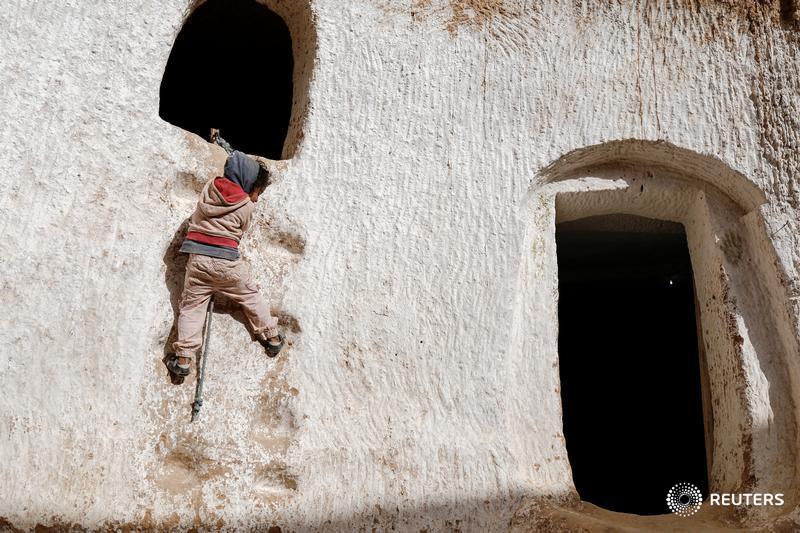
The worn climbing holds in Zohra Bensemra's picture take a little time to see. The eye is first drawn to the strong blacks of the window and the doorway, then to the child dangling from the window. What is going on? Only the caption can explain. This is a great example of how a mysterious picture draws us into a sequence of images because we just have to know more. All is revealed here


Ahlem, four, climbs up a wall to reach her rabbit's hideaway at her troglodyte house on the outskirts of Matmata, Tunisia, February 5, 2018. REUTERS/Zohra Bensemra