Pages

Showing posts with label Holocaust. Show all posts

Friday, 31 January 2020

A Week in Pictures, Middle East and Africa, January, 31 2020

A very gentle and poignant moment captured by Nir Elias as Jona Laks, a survivor from the Holocaust, is hugged in Auschwitz. The tones and colours are muted and we are aware, by the low position in the frame of the people hugging that the background is equally important, your eye slowly drifting away from the emotion of their gesture to the number 10. Once we read the caption we know why. Read on here for Jona Laks story. 

Jona laks, survivor of Dr. Josef Mengele’s twins experiments and her grand-daughter Lee Aldar hug in front of the block number 10 which served as Mengele’s laboratory, as they visit the Auschwitz death camp in Oswiecim, Poland January 26, 2020.   REUTERS/Nir Elias


A detail picture within a detail picture very cleverly observed and shot by Aziz Taher. At first you are drawn to the reds and whites of the well-groomed and aged hand set against the cold green and blacks background of the solder. And at first glance it looks like a gentle moment of restraint. But look closely at the motif on the ring – defiance. 

A protester holds the hand of a Lebanese soldier during a protest against the political elite in Beirut, Lebanon, January 27, 2020.   REUTERS/Aziz Taher

Crowds leaning in to see a worker unearth a mass grave may seem somewhat ghoulish.  It makes for a way of illustrating the story without showing the horror. But readers are on the whole no different from those peering into the earth trying to get a glimpse of a corpse. Evrard Ngendakumana provided images that satisfy those who want to look and those who don’t. For those who do want to see, he photographed an unearthed skull being carefully tended by a worker wearing gloves, which I think softens the harshness of the image. Read on here  

Burundian workers from the Truth and Reconciliation Commission dig to extract bodies from a mass grave in Bukirasazi Hill in Karusi Province, Burundi, January 27, 2020.  REUTERS/ Evrard Ngendakumana 

A Burundian worker from the Truth and Reconciliation Commission extracts a skull from a mass grave in Bukirasazi Hill in Karusi Province, Burundi, January 27, 2020.  REUTERS/Evrard Ngendakumana 


Amr Abdallah Dalsh has succeeded in giving us the feeling that you are in the middle of the claustrophobic heat and noise of an Egyptian football match with his slow motion image. It’s not so slow that everyone blurs to abstraction or so fast that it’s frozen and static. 

Fans sing and chat prior to the Africa Champions League match between Al Ahly and Etoile du Sahel in Cairo, Egypt, January 26, 2020.   REUTERS/Amr Abdallah Dalsh 


I can’t help but be attracted to the action in Abdullah Dhiaa al-Deen’s picture from clashes in Iraq. I love the backlight casting confused shadows on the road from the near silhouetted figure and I am not distracted by the lamp post and cables in the background, which I be would on most occasions, as they provide a sharp cold edge alongside the buildings. Would I have cropped the half figure on the left out of the frame? For sure, but I do like the vividness of the tear gas-filled space the protester is running into.

Demonstrators run from tear gas thrown at them during ongoing anti-government protests in Baghdad, Iraq January 28, 2020.   REUTERS/ Abdullah Dhiaa al-Deen


If you like red, you’ll love this. What you should also like in Zohra Bensemra’s picture is the compositional rush from left to right and the perfect timing where the leaders’ heads and chests remain in the light, their suits falling into shadow. And this all perfectly balanced against the guardsman in the foreground. Does he get in the way? Not really, as he’s in shadow and the highlight takes your eyes straight to the leaders’ faces a second before they too are plunged into shadow and the moment, captured by Zohra, is lost forever.

Senegal’s President Macky Sall welcomes his Turkish counterpart Tayyip Erdogan at the Presidential palace in Dakar, Senegal January 28, 2020.   REUTERS/Zohra Bensemra  

Raneen Sawafta’s picture is messy. The background is busy, the atmosphere is full of dust giving it a murky feel, the figure in the centre of the picture is not central to the action and therefore your eye jumps about in the chaos of the scene. But suddenly you see the man on the left’s finger and his eye line. You follow that line to the soldier on the right and see the open mouth and then the gun, pointing back at the man. The circle is complete and you no longer see the chaos and the dust or hear the shouting: you are just fixated on the interplay of these two people. Your imagination runs wild with dialogue. Read on here  

A Palestinian demonstrator argues with Israeli forces during a protest against U.S. President Donald Trump’s Middle East peace plan, in the Jordan valley in the Israeli-occupied west bank January 29, 2020.   REUTERS/Raneen Sawafta 

The exhaustion really comes across to me in Yamam al Shaar’s picture from Syria. Even though it’s another victory for Assad’s forces as they take control of a destroyed town, the body language in the soldier walking away within a devastated cityscape makes me sad. Not quite sure why this feeling is so powerful to me, maybe it’s the sight tilt of the head, the limp food bag or just the overall sense that this scene could be ordinary - someone walking with their lunch – but isn’t because it is set in a cityscape of destruction. Read on here

A Syrian army soldier carries food as he walks through the streets of Maraat al-Numan, Syria January 30, 2020.    REUTERS/Yamam al Shaar


Repetition of shape and line in Mohammed Salem’s image makes for a very graphic composition. Add to that the strong side light, the shaven heads and the open mouths shouting slogans and we are left in no doubt this is military training.

Palestinian police recruits loyal to Hamas shout slogans as they demonstrate their skills during a training session at a police academy in Gaza City January 30, 2020.   REUTERS/Mohammed Salem 


Friday, 19 October 2018

A week in Pictures Middle East & Africa October 19, 2018

The chaos of a bomb blast can best be appreciated alongside a scene of ordinary daily life, especially when it’s the same exact spot, a year earlier. Feisal Omar’s powerful before and after pictures take the viewer from the devastation of Somalia’s blasts to a street scene you can quite easily imagine walking or driving along. It makes you think, ‘that could have been me’. See the whole series here. 


A combination picture of a file photo (top) showing Somali Armed Forces evacuating an injured colleague from the scene of an explosion in KM4 street in the Hodan district of Mogadishu, Somalia October 14, 2018 and traffic flowing in the same place along KM4 street almost a year later, October 10, 2018.   REUTERS/Feisal Omar

I include two pictures from Suhaib Salem to demonstrate the importance of employing different styles to give the overall file pace and depth. The first image is ‘in your face’, fraught with passion and action. The whole visual focus sends you immediately to the woman’s screaming face. The eye line and the faces of the people in the background, hands reaching in. and the two inward looking faces of the women left and right keep you looking and looking, no escape from her distress. 


A relative of Palestinian gunman Naji al-Zaneen, who was killed in an Israeli airstrike, reacts during his funeral in the northern Gaza strip October 17, 2018.   REUTERS/Suhaib Salem

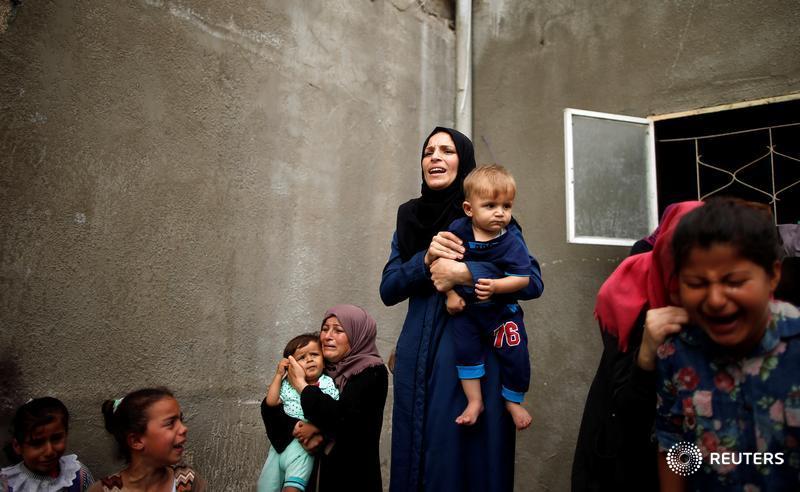
The second image from Suhaib takes longer to ‘see’ but is no less powerful. It has a strong compositional flow, driven by the eye line of the weeping child on the bottom left and moving like a wave that reaches its crest with the woman in blue and then falls away to the crying child on the right. As you take the time to look from face to face, the sadness grows like a wave gathering its height. The immediate impact of the first picture and the slow build of the second are powerful storytelling combination.   


Relatives of Palestinian gunman Naji al-Zaneen, who was killed in an Israeli airstrike, mourn during his funeral in the northern Gaza strip October 17, 2018.   REUTERS/Suhaib Salem

What is not clear from Newton Nambwaya’s picture is if this coffin is being carried by a villager who has lost a family member or a rescue worker. I suppose that doesn’t really matter as the task at hand is just as precarious. I feel real apprehension for this person carrying the awkward load of the empty coffin across a makeshift bridge. What I am also struggling to understand is why the others are just watching and not helping?


A man crosses the Sume river carrying an empty coffin on his head after a landslide rolled down the slopes of Mt. Elgon through their village of Wanjenwa in Bududa district, Uganda, October 13, 2018.  REUTERS/Newton Nambwaya


If you have read my post before you will know just how much pleasure I get when an editor’s crop changes a good picture into a great picture. A perfect example of this is Mohamed Torokman’s picture from the West Bank cropped by Suhaib Salem. Both pictures were moved to the wire, the wider version giving the action context, but the tight crop, wham! What emotion! This picture leads Reuters global ‘picture of the week’ that you can see here. 


A Palestinian man argues with an Israeli soldier during clashes over an Israeli order to shut down a Palestinian school near Nablus in the occupied west bank October 15, 2018.   REUTERS/Mohamad Torokman


I am very attracted to Omar Sanadiki’s picture from the Syria-Jordan border, not only because of the symmetry of the converging lines of perspective that race to the vanishing point in the distance but also because of the splash of a filled-in shell crater in front of the car. The pothole is a reminder of the fighting that took place in this area only weeks ago. 


A civilian car from Jordan passes into Syria at the Nasib border crossing with Jordan in Deraa, Syria October 15, 21018.   REUTERS/Omar Sanadiki

Corinna Kern’s simple detail picture raises so many questions when you first see it. First, it’s beautifully lit, you can see details of the aging skin and veins on well-manicured hands, the nails perfectly painted a deep red. The jewelry, except for the bracelet on the right hand, looks a little out of place as it’s quite heavy and dark on the delicate hands. Maybe its worn for a memory attached to it?  The watch looks expensive (but I am no expert) and maybe not worn every day as it doesn’t look like a practical timepiece. Some of the questions are answered by the caption, but then the information sets off other trains of thought. Maybe some more answers here.


A Holocaust survivor waits for the beginning of the annual Holocaust survivor’s beauty pageant in Haifa, Israel October 14, 2018.   REUTERS/Corinna Kern


Friday, 13 April 2018

A Week in Pictures Middle East and Africa April 13, 2018

A provocative image by Ibraheem Abu Mustafa works well in the visual simplicity of its composition, leaving no-one in any doubt as to these protesters’ feelings about U.S President Trump. In my mind this crop has been well paced: too tight and you lose the sense of the weight of many people, too loose and you lose the details of the tears and folds in the face. 


Palestinian demonstrators step on a representation of an Israeli flag and a poster of U.S President Donald Trump during a protest demanding the right to return to their homeland, at the Israel-Gaza border in the southern Gaza strip April 13, 2018.   REUTERS/Ibraheem Abu Mustafa

At first look Ammar Awad’s picture is that of an idyllic scene, a perfect blue-green sea  stretches to clear blue sky, white crested waves gently roll onto a golden beach, a single person enjoys the warmth of the sunshine on what appears to be an exclusive beach. It’s only when you read the caption that the scream of a siren marking the death of millions in the Holocaust can be heard. The picture, to my mind, changes from that of peace to mourning, underlying the power of pictures with words and words with pictures. A slide show of images from the two-minute remembrance can be seen here.


A beachgoer stands still as a two-minute siren marking the annual Israeli Holocaust Remembrance Day is heard in Tel Aviv, Israel, April 12, 2018.   REUTERS/Ammar Awad 

The message is very simple in Siphiwe Sibeko’s striking portrait ‘Rest in Peace mother Winnie’. In complete contrast to the image above, no caption is needed as everything is there: the strength and beauty of the face framed with the nation’s colours, the eyes looking directly at you and the bold message on her face. The nation mourns for Winnie Mandela, considered by many to be ‘the mother’ of modern South Africa. More pictures from the memorial service can be seen here.


An ANC supporter arrives at a memorial service for Winnie Madikizela-Mandela at Orlando Stadium in Johannesburg’s Soweto Township, South Africa, April 11, 2018.  REUTERS/Siphiwe Sibeko

A sea of hands and faces crush closer to try to touch a symbolic casket in Khaild Al-Mousily’s picture. I get a strange sense of heat and energy as the casket seems to hover above the pilgrims in a surreal manner, like an out of scale and out of context object that has been cut out and dropped into a picture of hundreds of people. All lines of the hands and arms focus our attention on the centre, visually emphasizing the importance of the act of mourning. 


Shi’ite pilgrims carry a symbolic casket outside Imam Moussa al-Kadhim’s shrine to mark his death anniversary in Baghdad, Iraq, April 12, 2018.   REUTERS/Khalid Al-Mousily

A very gentle image by Reem Baeshen that has just been published on the Wider Image, the story, about a woman photographed by a woman, took a long time to pull together and can be seen in full here. What to me is special about this particular picture from the story is that I get the abstract sense that the woman on the right is freeing birds that seem to fly away from her and then circle back, as if encouraging the woman on the left to join her. I think the light bleeding in from the left to the right of the picture adds to the circular ‘compositional flow’ of the picture. Or maybe it’s just the peaceful feel that draws me in and sets off my imagination, I can’t quite decide. The whole story here


Amirah al-Turkistani, a graphic design lecturer at Jeddah University takes a selfie in Jeddah, Saudi Arabia, January 15, 2018.    REUTERS/Reem Baeshen 

First, all I see in Suhaib Salem’s picture is the tranquil face of dead Yasser Murtaja, the touch of his colleague’s hand on his body and then the mourner’s face, wet with tears and contorted with grief. As I’ve said before I always look at the faces of the dead at these funerals; I want to remember. I then notice the word PRESS on the flak vest laid out on his body and it’s only then I made the connection to the second image below. I can’t shake the look in Yassers’s eye in Ibraheem Abu Mustafa’s picture as he stares straight at me out of his shadow, dying after being shot while taking pictures at the clashes, wearing his PRESS vest. It seems that I now look at the faces of dying as well as the dead.  


Colleagues of Palestinian journalist Yasser Murtaja, 31, who died of his wounds during clashes at the Israeli-Gaza border, carry his body during his funeral in Gaza City April 7, 2018.  REUTERS/Suhaib Salem


Mortally wounded Palestinian journalist Yasser Murtaja is evacuated during clashes with Israeli troops at the Israeli-Gaza border, in the southern Gaza Strip Aril 6, 2018. REUTERS/Ibraheem Abu Mustafa

In a perfect world I would like to see the figure in Afolabi Sotunde’s just slightly to the right so the man’s shoulder is just clear of the bridge in the background. But our world is far from perfect so I am very happy with the strong zigzag composition that zooms you to the furthest horizon on the top right of the picture, and the slow movement of the workers with buckets of sand on their heads that brings you back to the foreground, bottom left. The standing figure in the centre is the fulcrum around which the whole picture balances.   


Workers carry sand on the banks of the Benue River in Benue, Nigeria, April 11, 2018.   REUTERS/Afolabi Sotunde

Feisal Omar’s picture is a brutal image of death, but I find myself asking why it’s not as disturbing as many of the images I look at. I am not shocked, saddened or disturbed, despite the fact that half the image is of a dead body – very ugly. This picture doesn’t read like that - why? Is it the fact that there are no pools of blood and gore? Or maybe because the face of the dead man cannot be seen so he has become anonymous. This is a dead attacker in military uniform, not a face that can be identified as a son, father or brother. Also, could it be because other people in the picture are casually sweeping up the debris in the street as if sweeping the steps to a function hall, seemingly oblivious of the corpse?  


Civilians walk past the dead body of a suspected unidentified attacker at the scene of an explosion at a security checkpoint in the Hodan district of Mogadishu, Somalia April 6, 2018.    REUTERS/Feisal Omar

Adding this for no other reason than Mohammed Salem's picture is just a great picture of a captured moment.


A girl hurls a stone during clashes with Israeli troops at a protest where Palestinians demand the right to return to their homeland at the Israeli-Gaza border, east of Gaza City April 13, 2018.   REUTERS/Mohammed Salem