Pages

Showing posts with label bomb. Show all posts

Friday, 29 March 2019

A Week in Pictures Middle East and Africa March 29, 2019

Wham! Siphiwe Sibeko’s picture hits you as hard as the downdraft from the helicopter rotor blades. The boys explode past you as if the starting gun has just fired for a 100-metre Olympic sprint. Arms, legs, faces, in the frame, out the frame, in highlight or in shadow all rush past you over the flattened grass. One small point: I’d like to see a little movement in the rotor blades, but then maybe we’d lose sharpness in the running boys. See more of the story here


People run after collecting food aid from a South African National Defence Force (SANDF) helicopter rescue team in the aftermath of Cyclone Idai in Nhamatanda village, near Beira, Mozambique, March 26, 2019.    REUTERS/Siphiwe Sibeko

After the pictures of the huge impact of Cyclone Idai on the landscape and infrastructure and the rescue stories come the sad personal stories of death. Philimon Bulawayo’s picture of a man using his bare hands to dig in the mud to find missing relatives is as powerful as it is haunting with its close-up detail of the tragic task. 


Relatives use bare hands to dig in the mud as they search for their missing loved ones in the debris and rubble left in the aftermath of Cyclone Idai in Chianimani, Zimbabwe, March 23, 2019.   REUTERS/Philimon Bulawayo

Equally powerful are images of “calm after the storm” as a survivor tries to get on with daily life with ruin all around.  Blue skies appear through storm clouds and the trees in Mike Hutchings’ picture seem to bow to embrace the boy as he walks through the flood waters. The twisted corrugated iron half submerged in water, aided by shadow from the trees, pick out the small, solitary figure making his way through the devastated landscape. More from Mozambique here


A child walks past debris as flood waters begin to recede in the aftermath of Cyclone Idai, in Buzi, near Beira, Mozambique, March 24, 2019.   REUTERS/Mike Hutchings

After the devastating plane crash story from Ethiopia it’s great to see such an affectionate and warm image by Tiksa Negeri, on the return of a historic relic from Britain. The pride in the ex-soldier’s stance and face and the sense of joy in the dancers is overwhelming. It takes a while to notice the stark background of the room as you are led visually from the proud former soldier to the dancer on the left and then through to dancer in shorts and sandals to the musician in the background. Its only then you notice the sheen and glare in the varnished wood surfaces 

An Ethiopian army veteran dances during the welcoming ceremony of the two locks of hair of Emperor Tewodros II as it is repatriated from Britain’s national Army museum in Addis Ababa, Ethiopia March 23, 2019.   REUTERS/Tiksa Negeri

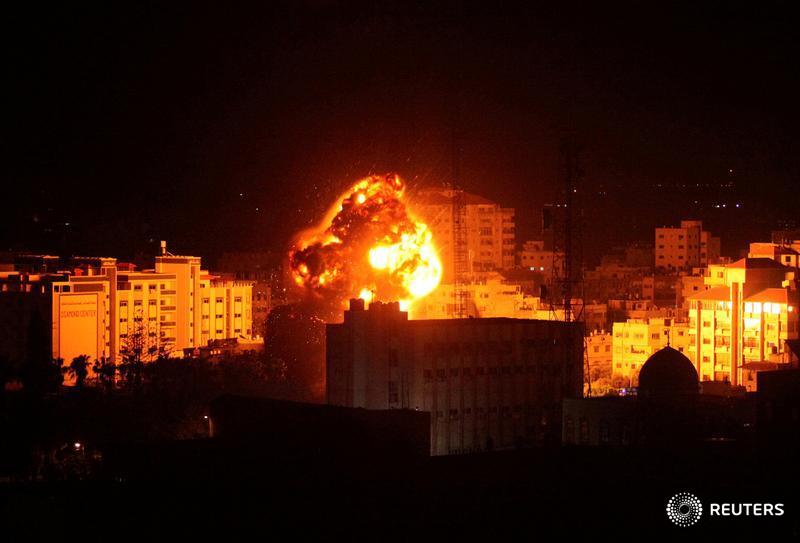
I am very uncomfortable remarking on the beauty of this image as it’s an act of violence, but there is no escaping the visual strength of the symmetrical composition, perfect timing and richness of colour in Mohammed Ajour’s picture of an explosion. The ball of fire reaching its crescendo, illuminating the buildings next to it, giving us the sense of scale of the blast all set against a black night sky. You have to respect the nerves of steel it takes waiting on the roof of a building for explosions just to take a picture.  


Flames and smoke are seen during an Israeli air strike in Gaza City March 25, 2019.   REUTERS/Mohammed Ajour

Mohammed Salem has captured a simple moment of gentle human kindness: a girl wiping her brother’s face. The powerful image of a sweet act is amplified 1,000-fold as they are standing in the rubble of their destroyed house after a missile attack. It’s not only her gentle action but her leopard skin print top and the red shoes, that seem completely out of context in the ruins. More pictures here


A Palestinian girl cleans the face of her brother outside their destroyed house after an Israeli missile targeted a nearby Hamas site, in Gaza City March 26, 2019.  REUTERS/Mohammed Salem

Broken glass in delicate shoes is an image that sets the mind on edge immediately, it’s just not right and that is why Ammar Awad’s detail picture is so powerful. The image perfectly opens the door to the story: you just need to know more. Why are these delicately coloured shoes with a pretty yellow bow covered in shattered glass? Whose shoes are they, and what happened to the owner? Why are they covered in glass? 


Shattered glass covers shoes left on the seat of a car that was damaged after a rocket hit a house north of Tel Aviv, Israel, March 25, 2019.   REUTERS/Ammar Awad

The passion and desire our photographers to make pictures never ceases to amaze me. Even though Ammar Awad was on assignment covering the scene of the rocket attack where he shot the picture above he spotted and took this beautiful, peaceful rural scene. It’s the pursuit of beauty of image that I most admire, be it missile attack or cow in a field. I suspect what caught Ammar’s eye is the graphic pattern of the three similar shapes in a landscape: bush, cow and trees. 


Cows are seen in a field in the Israeli-occupied Golan Heights March 25, 2019.   REUTERS/Ammar Awad

Just try looking away from those eyes, in Abduljabber Zeyad’s picture. When you do finally escape that gaze, you see the child in the background, dirty face, distressed, hand on head and enormous bump on his forehead. It’s only then that you notice what should be a distraction, the yellow and black shirt. You are then drawn back into those eyes again. A thought for you: if the father’s fingers were all kept in the frame would it be another distraction? I think so, so good they were cropped out.


Hanaa Ahmad Ali Bahr, a malnourished girl, sits on her father’s lap in a shanty town in Hodeidah, Yemen, March 25, 2019.   REUTERS/Abduljabber Zeyad


It’s hard to fathom what is going on in Amir Cohen’s picture as you look for a focal point -  all you get is a sense of cold grey steel weighing down on a mud base. As your eye jumps around trying to make sense of it, you may pick up the white inverted V or maybe the white 4 on the right. Finally you spot the figure in the foreground, dwarfed by this crush of intimidating metal.  

An Israeli soldier stands atop and tank near the border with Gaza, in Southern Israel March 27, 2019.   REUTERS/Amir Cohen 

In complete contrast to Amir’s picture above, there is no confusion about the focal point as you are drawn immediately into the roaring flames of Mohamad Torokman’s image. As you study the flames they seem to come alive, drawing you into the angry hot fire and then forcing you out to the choking smoke on the right and back across to the background. Only then do you notice the three figures on the left, seemingly playing a bit part in the picture while stoking the flames.   


A Palestinian protester moves a burning tyre during clashes with Israeli troops near the Jewish settlement of Beit El, in Israeli-occupied West Bank March 27, 2019.   REUTERS/Mohamed Torokman

Dylan Martinez has shot a terrific story titled “capturing 24 hours in Gaza, one hour at a time”. Each picture in the series requires time, their strength is in their subtlety. I have chosen one image and I could have chosen many different ones. The image is shot wide so you can take in the scene, bare wasteland, the soil a putrid colour. In the background, pock-marked bare concrete walls, with burn marks and old plaster. Smoke hangs in the air. The overall sense is that of poverty. You then focus on the boy in the background, mouth open, shouting, taunting. In response to his taunts another boy prepares to throw something across the wasteland, or is it no-man’s land? They seem to be in trenches. This picture needs words to explain to us what we already sense about the image. Boys are re-enacting the ongoing conflict, but as play. See the whole picture story here


Children play a game of ‘Arabs and Jews’ outside a school in Gaza City February 20, 2019. Dylan says ‘These kids were burning some cardboard, they had trenches, they were throwing sand balls so they weren’t hurting each other. And I said, Oh, what are you guys doing?’ and they said ‘Oh we are playing Jews and Arabs.’ The image he said, ‘will probably stay with me forever’.   REUTERS/Dylan Martinez

Friday, 19 October 2018

A week in Pictures Middle East & Africa October 19, 2018

The chaos of a bomb blast can best be appreciated alongside a scene of ordinary daily life, especially when it’s the same exact spot, a year earlier. Feisal Omar’s powerful before and after pictures take the viewer from the devastation of Somalia’s blasts to a street scene you can quite easily imagine walking or driving along. It makes you think, ‘that could have been me’. See the whole series here. 


A combination picture of a file photo (top) showing Somali Armed Forces evacuating an injured colleague from the scene of an explosion in KM4 street in the Hodan district of Mogadishu, Somalia October 14, 2018 and traffic flowing in the same place along KM4 street almost a year later, October 10, 2018.   REUTERS/Feisal Omar

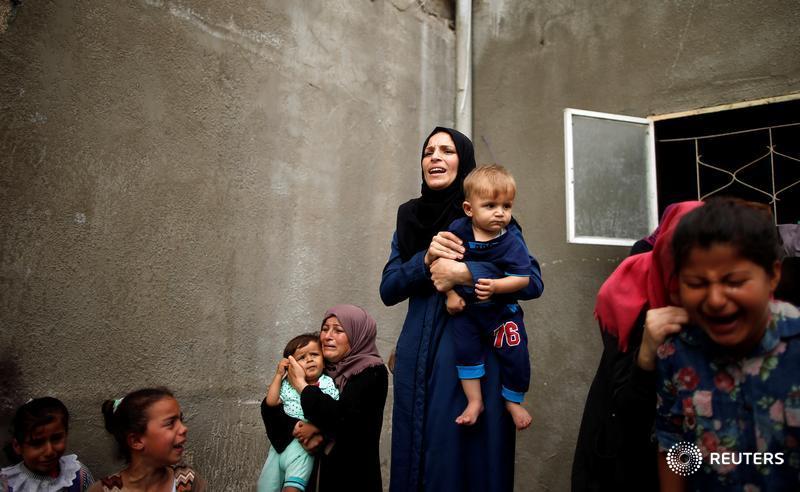
I include two pictures from Suhaib Salem to demonstrate the importance of employing different styles to give the overall file pace and depth. The first image is ‘in your face’, fraught with passion and action. The whole visual focus sends you immediately to the woman’s screaming face. The eye line and the faces of the people in the background, hands reaching in. and the two inward looking faces of the women left and right keep you looking and looking, no escape from her distress. 


A relative of Palestinian gunman Naji al-Zaneen, who was killed in an Israeli airstrike, reacts during his funeral in the northern Gaza strip October 17, 2018.   REUTERS/Suhaib Salem

The second image from Suhaib takes longer to ‘see’ but is no less powerful. It has a strong compositional flow, driven by the eye line of the weeping child on the bottom left and moving like a wave that reaches its crest with the woman in blue and then falls away to the crying child on the right. As you take the time to look from face to face, the sadness grows like a wave gathering its height. The immediate impact of the first picture and the slow build of the second are powerful storytelling combination.   


Relatives of Palestinian gunman Naji al-Zaneen, who was killed in an Israeli airstrike, mourn during his funeral in the northern Gaza strip October 17, 2018.   REUTERS/Suhaib Salem

What is not clear from Newton Nambwaya’s picture is if this coffin is being carried by a villager who has lost a family member or a rescue worker. I suppose that doesn’t really matter as the task at hand is just as precarious. I feel real apprehension for this person carrying the awkward load of the empty coffin across a makeshift bridge. What I am also struggling to understand is why the others are just watching and not helping?


A man crosses the Sume river carrying an empty coffin on his head after a landslide rolled down the slopes of Mt. Elgon through their village of Wanjenwa in Bududa district, Uganda, October 13, 2018.  REUTERS/Newton Nambwaya


If you have read my post before you will know just how much pleasure I get when an editor’s crop changes a good picture into a great picture. A perfect example of this is Mohamed Torokman’s picture from the West Bank cropped by Suhaib Salem. Both pictures were moved to the wire, the wider version giving the action context, but the tight crop, wham! What emotion! This picture leads Reuters global ‘picture of the week’ that you can see here. 


A Palestinian man argues with an Israeli soldier during clashes over an Israeli order to shut down a Palestinian school near Nablus in the occupied west bank October 15, 2018.   REUTERS/Mohamad Torokman


I am very attracted to Omar Sanadiki’s picture from the Syria-Jordan border, not only because of the symmetry of the converging lines of perspective that race to the vanishing point in the distance but also because of the splash of a filled-in shell crater in front of the car. The pothole is a reminder of the fighting that took place in this area only weeks ago. 


A civilian car from Jordan passes into Syria at the Nasib border crossing with Jordan in Deraa, Syria October 15, 21018.   REUTERS/Omar Sanadiki

Corinna Kern’s simple detail picture raises so many questions when you first see it. First, it’s beautifully lit, you can see details of the aging skin and veins on well-manicured hands, the nails perfectly painted a deep red. The jewelry, except for the bracelet on the right hand, looks a little out of place as it’s quite heavy and dark on the delicate hands. Maybe its worn for a memory attached to it?  The watch looks expensive (but I am no expert) and maybe not worn every day as it doesn’t look like a practical timepiece. Some of the questions are answered by the caption, but then the information sets off other trains of thought. Maybe some more answers here.


A Holocaust survivor waits for the beginning of the annual Holocaust survivor’s beauty pageant in Haifa, Israel October 14, 2018.   REUTERS/Corinna Kern


Friday, 27 July 2018

A Week in Pictures Middle East and Africa July 27, 2018

I just needed to add Mohamed Abd El Ghany’s star spangled picture of the 'Blood Moon'. What I like so much about this is that Mohamed has approached this differently know that there would be many images of the moon in its red state through out the region. By using a long exposure and tripod he has put the lunar eclipse in the context of the cosmos and man. I feel this drives home just how small we look with our little electric light and digital technology. See more lunar eclipse pictures here


A Man takes pictures during the ‘Blood Moon’ lunar eclipse in the desert of Al Fayoum Governorate, south west of Cairo, Egypt July 27, 2018.   REUTERS/Mohamed Abd El Ghany

Baz Ratner’s picture of people watching as slum homes are destroyed to make way for a road has a slightly uncomfortable yet familiar feel to it. How often have you peered through fencing to watch construction work, or those of you who have toddlers would have more than likely entertained them with a trip to look at the ‘diggers’ and ‘workmen’. Although a very busy and complex image we are drawn into it from the strong dark tones in the foreground, through to the centrally placed figures wearing red in the middle ground up to the hazy distance of a mechanical digger tearing at the makeshift buildings in the dust. What is slightly uncomfortable is that this is the destruction of the homes of some of the poorest in the city. Read on here.


Onlookers watch as bulldozers demolish houses to make way for a new road in the Kibera slum in Nairobi, July 23, 2018.   REUTERS/Baz Ratner

The only way to describe Luc Gnago’s picture from the bus station in Mali is an explosion of light and colour. I am excited and exhausted as my eye races around this busy scene. Any colour you like is there. I so want to be there in the hustle and bustle, and I am not even worried by his shadow cast on the back of the green minibus or is that the shadow of the woman with the sack on her head? 


People hurry as they move to and from mini buses at the bus station in the evening light in Bamako, Mali, July 24, 2018.    REUTERS/Luc Gnago

I can’t help but think of the sun-dried bones of a prehistoric dinosaur when looking at the building in Tiksa Negri’s picture from Eritrea. I like the beauty and magnificence of the building destroyed by conflict and baked for years by the sun. It’s the same heat that the person carrying a table is sheltering from.  


A man carries a table as he walks past the ruins of a building in the port city of Massawa, Eritrea July 22. 2018.   REUTERS/Tiksa Negri

What is exciting is that we are now getting pictures out of Eritrea after years of no access. I love the pool of light which draws the viewer straight to the figures crossing the road silhouetted by the single car heading towards us. I sense that Tiksa Negri’s night street scene picture is really quite illustrative of the issues confronting the country and the capital, Asmara. The fact that the streets are hardly lit demonstrates the extent of the poverty the country is facing. 


An Eritrean couple walk along a street at night in Asmara, Eritrea July 21, 2018.   REUTERS/Tiksa Negri

In very much the same vein as the picture above, a small detail in a wide, even-toned space will catch your eye and you will look closely into it. With Ammar Awad’s powerful picture of a warplane in an attack dive you need to study it even more closely. Only then will you spot the two bombs released from the aircraft - destruction and possible death only seconds away.  


A warplane carries out a bombing run above Syria near the Israeli-Syrian border as seen from the Israeli-occupied Golan heights Israel, July 24, 2018. REUTERS/Ammar Awad


The strong light and the shallow depth of field in Suhaib Salem’s picture create an almost abstract swirl of body shapes, faces and hands that finally draws you to the face of the grieving woman. Once your eye settles on her, you look deeper into the grief. Her arms are tightly wrapped around the man, squeezing hard. It’s then you notice the hand from the almost invisible woman standing passively on the left, fingers digging into her brow, we assume, trying to rub her grief away.   


Relatives of Palestinian militant Abu Dakah, 31, who was killed in an Israeli strike, mourn during his funeral in Khan Younis in the Southern Gaza strip July 21, 2018.   REUTERS/Suhaib Salem

One normally associates the rainbow colours with LGBT and gay rights demonstrations, but not so in Corinna Kern’s haunting picture. Most colour has been taken out of the image as Corinna shoots through a transparent banner that has Netanyahu’s face printed on it. The image has the look of video frozen in transition as you fade from one sequence to the next. 


Israeli national flags can be seen through a banner with a picture of Israeli Prime Minister Benjamin Netanyahu, during a LGBT community members protest against the discriminatory surrogate bill in Tel Aviv, Israel July 22, 2018.   REUTERS/Corinna Kern

Strong colours, strong lines of design and a flow and counter flow all balance in Siphiwe Sibeko’s picture to make you feel like you are on a powerful tide of people moving from left to right and back again. Everyone is looking from right to left in this picture, their arms all leading in the same direction, a seething mass of people. But the main figure looks in the opposite direction, her face held motionless in the strong light. She seems to be beckoning to the army of people from Zimbabwe: Onwards, onwards!    


Supporters of Zimbabwe’s opposition party attend a rally in Chitungwiza, outside the capital Harare, Zimbabwe, July 26, 2018.   REUTERS/Siphiwe Sibeko

The inclusion of a second picture from the same story by the same photographer is rare in my weekly round-up, but I cannot resist the grace and beauty of the hands, fingers, eyes and colours in Luc Gnago’s wonderful picture of supporters at a political rally. You are immediately smitten with the beauty of the woman in profile with the red head scarf. You then feel as if you are in a complex and delicate dance that involves half glances of eyes through veils that finger and hand movements momentarily reveal. Count the number of eyes you can see but where you can’t see the full face; include in that count the posters too and you will maybe understand how I got this impression. Read on here.


Supporters of candidate Aliou Diallo, leader of the Democratic Alliance for Peace (Alliance Democratique pour la paix, or ADP-MALIBA) Party, attend an election rally in Bamako, Mali, July 26, 2018.   REUTERS/Luc Gnago

Amr Abdullah Dalsh uses the simple technique of back focusing that draws you immediately to the point of the picture, a portrait of a son. The ugly top stark lighting in the room not only highlights the picture in the black frame against a white wall but also darkens the eyes of the parents as they recount their story of their arrested son. The mood is very somber. Shawkan, their son, faces the death penalty. Read on here.


A photograph of jailed Egyptian photojournalist Mahmoud Abu Zeid, also known as ‘Shawkan’ is seen behind his parents at their home in Cairo, Egypt July 19, 2018.   REUTERS/Amr Abdallah Dalsh


Friday, 2 March 2018

A Week in Pictures Middle East & Africa March 2, 2018


In my mind it's often a detail picture that can really tell a story, this I think never truer than in Afolabi Sotunde's picture of the upturned meal from the girl's school in Dapchi. To me the wasted meal in a place where little goes to waste screams of panic, fear and ultimately loss. Afolabi has been working on and following up on the story about the missing 110 girls that can be seen here in full


Last meal served to students before an attack by suspected Boko Haram insurgents, lies on the ground at the Government Girls Science and Technical College in Dapchi, the northeastern state of Yobe, Nigeria, February 28, 2018.   REUTERS/Afolabi Sotunde

Looking at Mohamed Torokman’s picture I feel like I am waking on eggshells. I almost dare not look as the bright coloured and back-lit balloons seem dangerously squeezed between the grey wall and the razor wire, a single touch will burst them.


Demonstrators hold balloons during a protest marking the 13th anniversary of a campaign against the Israeli barrier, in the village of Bilin, in the occupied West Bank march 2, 2018.  REUTERS/Mohamad Torokman

Hand on hips in a landscape of devastation, a hotel security officer seems to me to be dwarfed and overwhelmed by the destruction around him in Feisal Omar’s picture. The low angle of the camera takes us into the scene where nothing has been left untouched by the explosion. Even the building in the background seems to have a tilt to it.


A security officer from Doorbin Hotel assesses the debris after a suicide car explosion in front of the hotel in Mogadishu, Somalia, February 24, 2018.   REUTERS/Feisal Omar


A striking mix of strong light, dark clothing, large beards and paneled wooden doors all come together to draw us into Amir Cohen’s graphic picture that is built up of dark shapes and highlighted detail. To me the figures look like they are a stone relief that has suddenly come to life while retaining a feeling of two dimensions as if the transition is only half complete; the strong shapes of the hats, the dark shadow under the eyes and noses, the chiseled grey beard of the man in profile and behind them the glimpsed faces seen over shoulders combine for dramatic effect.


Greek Orthodox Patriarch of Jerusalem, Theophilos III stands with other church leaders after a news conference in front of the closed doors of the Church of the Holy Sepulchre in Jerusalem’s Old City, February 25, 2018.   REUTERS/Amir Cohen

At first glance the beautiful minaret seen against blue skies with white clouds drifting across Bassam Khabieh’s picture lulls you into a momentary belief this is a simple cityscape. Your eye is then suddenly snapped into focus with an unpleasant surprise as you spot the smoke drifting through the back of the image and you notice that every building in the foreground is damaged. This is a rare look at Ghouta’s skyline  -- normally we see it from ground level or underground, where terrified children huddle in a bomb shelter. More of Bassam's images here 


Smoke rises on the horizon of the besieged eastern Ghouta in Damascus February 27, 2018.   REUTERS/Bassam Khabieh


Children are seen in a shelter in the besieged eastern Ghouta in Damascus February 27, 2018.   REUTERS/Bassam Khabieh


Up go the shouts and voices of successful protesters as they carry a cross through the narrow streets of the Jerusalem’s Old City in Ammar Awad’s picture as Israel reverses a tax plan decision that would have hit the Church. To me the mass of people seems to swirl down the narrow passage like a rush of dark floodwaters barely contained in grey banks, the cross bobbing about like a ships mast in a storm, the ‘sailor’ in the crow’s nest holding on for dear life.


Worshippers shout slogans during a protest near to the closed entrance to the Church of the Holy Sepulchre in Jerusalem's old City February 27, 2018.    REUTERS/Ammar Awad


The phrase expect the unexpected is in my head most days and this visual readiness was affirmed when Amir Cohen’s picture of a boy dressed as a clown in a library dropped onto the wire. It’s not so much the costume, as this traditional during Purim, it’s the black and gold coloured background, the serious, somber downward look of the boy that contrasts with the bright colour and gaiety of his dress. The cross of the bookshelves brings your eye to the boy’s eye. From this point you look outwards, finally settling on the blue hat.  


An Ultra-Orthodox Jewish boy dressed in a costume takes part in the reading from the Book of Esther, a ceremony performed on the Jewish holiday of Purim, in a synagogue in Ashdod, Israel, February 28, 2018. REUTERS/Amir Cohen