Pages

Showing posts with label tear gas. Show all posts

Friday, 31 January 2020

A Week in Pictures, Middle East and Africa, January, 31 2020

A very gentle and poignant moment captured by Nir Elias as Jona Laks, a survivor from the Holocaust, is hugged in Auschwitz. The tones and colours are muted and we are aware, by the low position in the frame of the people hugging that the background is equally important, your eye slowly drifting away from the emotion of their gesture to the number 10. Once we read the caption we know why. Read on here for Jona Laks story. 

Jona laks, survivor of Dr. Josef Mengele’s twins experiments and her grand-daughter Lee Aldar hug in front of the block number 10 which served as Mengele’s laboratory, as they visit the Auschwitz death camp in Oswiecim, Poland January 26, 2020.   REUTERS/Nir Elias


A detail picture within a detail picture very cleverly observed and shot by Aziz Taher. At first you are drawn to the reds and whites of the well-groomed and aged hand set against the cold green and blacks background of the solder. And at first glance it looks like a gentle moment of restraint. But look closely at the motif on the ring – defiance. 

A protester holds the hand of a Lebanese soldier during a protest against the political elite in Beirut, Lebanon, January 27, 2020.   REUTERS/Aziz Taher

Crowds leaning in to see a worker unearth a mass grave may seem somewhat ghoulish.  It makes for a way of illustrating the story without showing the horror. But readers are on the whole no different from those peering into the earth trying to get a glimpse of a corpse. Evrard Ngendakumana provided images that satisfy those who want to look and those who don’t. For those who do want to see, he photographed an unearthed skull being carefully tended by a worker wearing gloves, which I think softens the harshness of the image. Read on here  

Burundian workers from the Truth and Reconciliation Commission dig to extract bodies from a mass grave in Bukirasazi Hill in Karusi Province, Burundi, January 27, 2020.  REUTERS/ Evrard Ngendakumana 

A Burundian worker from the Truth and Reconciliation Commission extracts a skull from a mass grave in Bukirasazi Hill in Karusi Province, Burundi, January 27, 2020.  REUTERS/Evrard Ngendakumana 


Amr Abdallah Dalsh has succeeded in giving us the feeling that you are in the middle of the claustrophobic heat and noise of an Egyptian football match with his slow motion image. It’s not so slow that everyone blurs to abstraction or so fast that it’s frozen and static. 

Fans sing and chat prior to the Africa Champions League match between Al Ahly and Etoile du Sahel in Cairo, Egypt, January 26, 2020.   REUTERS/Amr Abdallah Dalsh 


I can’t help but be attracted to the action in Abdullah Dhiaa al-Deen’s picture from clashes in Iraq. I love the backlight casting confused shadows on the road from the near silhouetted figure and I am not distracted by the lamp post and cables in the background, which I be would on most occasions, as they provide a sharp cold edge alongside the buildings. Would I have cropped the half figure on the left out of the frame? For sure, but I do like the vividness of the tear gas-filled space the protester is running into.

Demonstrators run from tear gas thrown at them during ongoing anti-government protests in Baghdad, Iraq January 28, 2020.   REUTERS/ Abdullah Dhiaa al-Deen


If you like red, you’ll love this. What you should also like in Zohra Bensemra’s picture is the compositional rush from left to right and the perfect timing where the leaders’ heads and chests remain in the light, their suits falling into shadow. And this all perfectly balanced against the guardsman in the foreground. Does he get in the way? Not really, as he’s in shadow and the highlight takes your eyes straight to the leaders’ faces a second before they too are plunged into shadow and the moment, captured by Zohra, is lost forever.

Senegal’s President Macky Sall welcomes his Turkish counterpart Tayyip Erdogan at the Presidential palace in Dakar, Senegal January 28, 2020.   REUTERS/Zohra Bensemra  

Raneen Sawafta’s picture is messy. The background is busy, the atmosphere is full of dust giving it a murky feel, the figure in the centre of the picture is not central to the action and therefore your eye jumps about in the chaos of the scene. But suddenly you see the man on the left’s finger and his eye line. You follow that line to the soldier on the right and see the open mouth and then the gun, pointing back at the man. The circle is complete and you no longer see the chaos and the dust or hear the shouting: you are just fixated on the interplay of these two people. Your imagination runs wild with dialogue. Read on here  

A Palestinian demonstrator argues with Israeli forces during a protest against U.S. President Donald Trump’s Middle East peace plan, in the Jordan valley in the Israeli-occupied west bank January 29, 2020.   REUTERS/Raneen Sawafta 

The exhaustion really comes across to me in Yamam al Shaar’s picture from Syria. Even though it’s another victory for Assad’s forces as they take control of a destroyed town, the body language in the soldier walking away within a devastated cityscape makes me sad. Not quite sure why this feeling is so powerful to me, maybe it’s the sight tilt of the head, the limp food bag or just the overall sense that this scene could be ordinary - someone walking with their lunch – but isn’t because it is set in a cityscape of destruction. Read on here

A Syrian army soldier carries food as he walks through the streets of Maraat al-Numan, Syria January 30, 2020.    REUTERS/Yamam al Shaar


Repetition of shape and line in Mohammed Salem’s image makes for a very graphic composition. Add to that the strong side light, the shaven heads and the open mouths shouting slogans and we are left in no doubt this is military training.

Palestinian police recruits loyal to Hamas shout slogans as they demonstrate their skills during a training session at a police academy in Gaza City January 30, 2020.   REUTERS/Mohammed Salem 


Friday, 8 June 2018

A Week in Pictures Middle East & Africa, June 8, 2018


Being hit with a tear gas canister is terrifying but being hit with a tear gas canister that embeds itself in your face must be truly awful. Ibraheem’s Abu Mustafa’s picture of a man with tear gas still pouring from the canister in his face is quite disturbing but something I just can’t stop looking at as I have never seen the like before. Ibraheem followed up with him and you can see the story here 


A wounded Palestinian demonstrator is hit in the face with a tear gas canister fired by Israeli troops during a protest marking al-Quds day (Jerusalem Day), at the Israeli-Gaza border in the southern Gaza strip June 8, 2018.   REUTERS/Ibraheem Abu Mustafa

Next week the world’s attention will be on Russia and the World Cup. As a preview to the football tournament, Wider Image have pulled together a global project on unusual places the game is played. Contributions from Africa were very strong but in choosing one I have to settle on Siphiwe Sibeko’s offering as my favourite. The light is beautiful and I just love those yellow trousers in the low sun at full stretch and the red ball. See the set of pictures from around the world here


A combination picture shows boys playing soccer and details of a football, a pitch and shoes, at a makeshift pitch in Soweto, South Africa, May 14, 2018.   REUTERS/Siphiwe Sibeko

I can’t help but smile when looking at Ammar Awad’s picture of a vendor grabbing a fish from the tank. Do you also think that the two fish slightly on the right are gasping, opened mouthed ‘phew lucky this time, not me!’ What I also love about this picture is the colour and tone. The warm orange/yellow colours of the arm in the water against the cool blue colours of the fish


A vendor holds a fish at a market in Amman, Jordan June 6, 2018.   REUTERS/Ammar Awad

There is no mistaking for even a second what the pull is for Mohamed Torokman’s picture: it’s the perfect shadow, the great lines in the picture and the shape of the man’s body climbing the rickety ladder. The shadow of the barbed wire snaking down from the top of the frame is an added bonus.


A Palestinian uses a ladder to climb over a section of the controversial Israeli barrier as he tries to make his way to attend Friday prayer of the Holy fasting month of Ramadan in Jerusalem’s Al-Aqsa mosque, near Ramallah in the occupied west bank June 8, 2018.  REUTERS/Mohamad Torokman

Wissam al-Okili’s picture is one that makes me want to scratch my head and wonder why the people in the picture are doing what they are doing. I just keep on looking and wondering, unable to pull myself away from this image. Eighteen people killed and over 90 injured in the blast and these young men are sitting on this half-buried car as if it’s garden furniture. Maybe it’s the contrast between the landscape of sheer devastation and the nonchalant relaxed manner of the men that gives this image its strength as you wonder ‘Wow! What happened here?’ If you want to know read on here


People gather at the site of an explosion in Baghdad’s Sadr City district, Iraq, June 7, 2018.    REUTERS/Wissam al-Okili

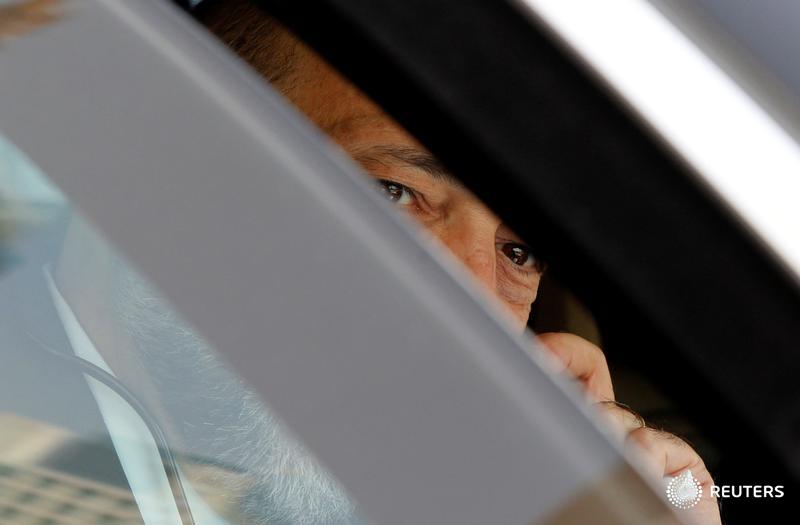
Jordan’s new Prime Minister Razzaz is being squeezed between the demands of the IMF trying to put the Jordan economy back on track with austerity measures and the demands of the people protesting on the streets because they can’t make ends meet. Muhammad Hamed’s picture seems to sum up all his problems in a single frame. 


Jordan’s designated new Prime Minister Omar al-Razzaz speaks on the phone after leaving parliament building in Amman, Jordan June 7, 2018.  REUTERS/Muhammad Hamed

 The newly repaired road cuts through the hills dotted with destroyed buildings from which a stream of vehicles seem to flow downhill. What catches my eye first in Omar Sanadiki’s picture is that it’s such a great shape. It also took me a while to realise what is a little strange: the traffic is moving in the same direction, towards the viewer on both sides of the road.  


Vehicles travel on the road between Homs and Hama after it was re-opened in Rastan, Syria June 6, 2018.   REUTERS/Omar Sanadiki


Friday, 18 May 2018

A Week in Pictures Middle East & Africa May 18, 2018

It was not easy to pick a single image from the clashes on the Israel-Gaza border but Ibraheem Abu Mustafa’s image is breathtakingly powerful. Figures running from the black smoke, flames, live fire and incoming tear gas canisters combine all the elements of the day. The only real colour in a black and dark picture is that of the Palestinian flag. You can see Ibraheem’s personal account of how he took his picture here


Palestinian demonstrators run for cover from Israeli fire and tear gas during a protest against U.S embassy move to Jerusalem and ahead of the 70th anniversary of Nakba, at the Israel-Gaza border in the southern Gaza strip May 14, 2018.   REUTERS/Ibraheem Abu Mustafa 

Surrounded in black shadows, the face of a dead child is gently touched by a relative at her funeral. The light seems to be borrowed from a high renaissance painting. Mohammed Salem’s image is as powerful as it is sad. To me the silence around the scene is deafening. A complete contrast from the smoke, fire, noise, anger and bloodshed that filled images from the previous day. I am saddened by this but the debate surrounding this death will rage on. 


A relative mourns as she carries the body of eight-month-old Palestinian infant Laila al-Ghandour, who his family claim died after inhaling tear gas during a protest against U.S embassy move to Jerusalem at the Israel-Gaza border during her funeral in Gaza May 15, 2018.   REUTERS/Mohammed Salem

Thaier Al-Sudani’s colourful picture of a woman displaying her ink-stained finger after voting is a wonderful mix of bold colour, shape and line. What is most attractive about this image is that even though it has all the colours of the rainbow, your eye is drawn straight to the woman’s face and hand, framed in the solid blacks. Once you have looked at her face and inky finger, your eye can move on to enjoy the colours.


An Iraqi woman shows her ink stained finger after casting her vote at a polling station during the parliamentary election in the Sadr city district of Baghdad, Iraq May 12, 2018.   REUTERS/Thaier Al-Sudani 

I can’t help smiling at the reaction of the fans in this picture by Zoubeir Souissi as the riot police officer charges at them. The man on left seems to be saying, “not me, honest,”  the man in the middle is running away -  “I’m out of here” - while the man on the right is just sitting there – “innocent me”. Let’s hope none of them got whacked by the policeman’s baton. 


Riot Police chase Club African fans during clashes at the Tunisian Cup final against Etoile Sportive du Sahel in Tunis, Tunisia, May 13, 2018.   REUTERS/Zoubeir Souissi

What is most appealing in Ammar Awad’s picture is the optical illusion that the man being photographed appears to be floating in the air. This illusion is created by the shadow cast on the ground in the lower part of the image. At first glance, you might think it is being cast by the man being photographed, but it is not. If you look carefully you can see that his shadow is cast behind him and the shadow in the foreground is that of the boy taking pictures.   


People take pictures of the U.S and Israeli national flags that are projected on part of the wall surrounding Jerusalem’s Old City May 14, 2018.   REUTERS/Ammar Awad

It’s hard to ignore this bold and colourful picture by Zoubeir Souissi as it jumps out at you from the page. This is a classic case of an image that can read as easily in tiny form published on a mobile device as it can if it were printed the size of a billboard.  The big red triangle directs the eye to the lone demonstrating figure.    


The shadow of a protester holding a Palestinian flag is seen during protests against the U.S. embassy move to Jerusalem, in Tunis, Tunisia, May 15, 2018.   REUTERS/Zoubeir Souissi

Portraits are some of the hardest pictures to shoot well, especially when you only have a short time to capture your subject in the street. Akintunde Akinleye’s affectionate portrait of a rat poison seller is a well-composed image of understated and muted tones and colours. A wry smile creeps across my face when I see ‘doctor’ written on his hat and the words rat, rat, and kill come into focus from the eye line of the man who’s just creeping into the edge of the frame. A lucky break too for Akintunde as the man on the edge has a most wonderful outfit of striped blue and white. Any more into the frame, he’d be a distraction from the ‘doctor’ and any less he would not be there.


A man selling rat poison sits on a stool as he waits for customers at Oiodu district in Nigeria’s commercial capital Lagos, May 3, 2018.  REUTERS/Akintunde Akinleye

Although a Week in Pictures is not so much about the top news stories but more about the pictures that have caught my eye, this week it is dominated by the clashes on the Gaza-Israeli border. This story has thrown up so many great images it’s hard not to include them. You almost choke on the fumes in Ibraheem Abu Mustafa’s picture, as tiny figures dwarfed and engulfed by the raging flames and black smoke, run in different directions in the chaos.  


Palestinian demonstrators run during a protest marking the 70th anniversary of Nekba, at the Israel-Gaza border in the southern Gaza strip, May 15, 2018.    REUTERS/Ibraheem Abu Mustafa

The curved compositional shape created by the coffins and the people standing on the edge of the mass grave make me think of a giant mouth that is going to consume the bodies of those killed in the flood. The different-sized coffins in the dark hole add to this impression, as they look like broken teeth in blackened gums. The sadness is quite overwhelming when you notice that the many are the coffins are small, holding the bodies of drowned children who will soon be swallowed by the earth.  


Coffins are seen arranged inside a mass grave during the burial of people killed when a dam burst it walls, the water flooding onto nearby homes, in Solai town near Nakuru, Kenya May 16, 2018.   REUTERS/Thomas Mukoya

To illustrate the start of Ramadan in the region, Amr Abdullah Dalsh shot this calm picture of reflection and prayer. This mood is created by wide space around the lone figure, his white robes highlighted against the black symmetrical background of the arched doorways and graceful sweep of the drapes. The high contrast of black against white is held in by the pastel colours of the brickwork and marble flooring


A member of the Bohra community prays inside the Al-Hakim bi-Amr Allah Mosque on the first day of the Muslim holy fasting month of Ramadan in Cairo, Egypt, May 17, 2018.    REUTERS/Amr Abdullah Dalsh


Friday, 17 November 2017

A week in Pictures Middle East and Africa November 17, 2017


Some gestures seem more futile than others at demonstrations. Khaled Abdullah’s picture of a man holding up a dagger seems to shout out anger and frustration, which gives the picture its strength. There is no mistaking the knife’s shape, the silver metal glinting in the sun with violent intent. The hand holding the knife is central in the frame, thrusting up to pierce the perfect blue sky, while the scene around the blade seems to lean into it. The picture says to me there will be more bloody violence. 


A supporter of the Houthi movement waves a dagger during a demonstration in Sanaa, Yemen against the closure of Yemen’s ports by the Saudi led coalition November 13, 2017.    REUTERS/Khaled Abdullah 

Following the theme of blue skies being pieced, how could I ignore Satish Kumar’s affectionate and gentle picture of a broken heart? What I like about this picture is the imperfection of the heart’s shape as the fumes melt away, taking the edge off the blue sky and the irregular red headscarves. After all, the pursuit of matters of the heart is rarely perfect. See Editors Choice here.


Visitors take pictures as Al Fursan aerobatic team of the United Arab Emirates Air Force perform during the Dubai Airshow, in UAE, November 13, 2017.   REUTERS/Satish Kumar

I am always a sucker for a graphic shape. Here, colour is drained from the scene to leave a cold, monochromatic stage for a figure in isolation. Mike Hutchings’ classically composed picture gets my vote this week. I love the overall shape that is aided by a tilt that is not so overdone that you feel you are slipping off the picture. In a perfect world I might have wanted the figure to be taking a more pronounced step, but we don’t live in a perfect world.


A Student walks up the steps in-front of the University of Cape Town’s Jameson Hall in Cape Town, South Africa November 13, 2017.   REUTERS/Mike Hutchings 

Suhaib Salem’s picture from the commemoration of Arafat’s death is a very sophisticated composition that slowly works its way into your mind. It is a busy, back-focused and harshly lit image that invites you into the complex web of vertical and horizontal lines of scaffolding punctuated with yellow flags. Slowly you are drawn out to the man at the bottom right. His face is partly hidden by the shadow from his hand as he shields his eyes from the harsh light, looking a little like a character from superhero comic book. 


Palestinian Fatah supporters take art in a rally marking the death of late Palestinian leader Yasser Arafat in Gaza City, November 11, 2017. 

There is no ignoring the upheaval in Zimbabwe this week. As you can imagine it is a difficult story for a photographer to cover. But two pictures by Philimon Bulawayo  caught my eye, both images conveying a feeling of tension and unease. The first shows a woman carrying a child as she passes a military vehicle, her eyes darting across the picture as quickly as she darts through the nearly empty streets. The second is also a captured momentary glance, as a saluting officer looks across from Mugabe at a graduation ceremony. What I also like is the contrast between the different shapes of the hats they are wearing: the soft curve of the officer’s cap compared with to the sharp angles of the mortar board worn by Mugabe. See more pictures from Zimbabwe here.


A woman hurries past an armoured vehicle outside the parliament building in Harare, Zimbabwe, November 16, 2017.   REUTERS/Philimon Bulawayo


Zimbabwe President Robert Mugabe attends a university graduation ceremony in Harare, Zimbabwe November 17, 2017.   REUTERS/Philimon Bulawayo

Violent clashes have again broken out in Kenya, with stone-throwing protesters up against riot police, who fired tear gas. Nothing illustrates the confusion and chaos better than Thomas Mukoya’s image of people being hit by vehicles speeding away from the tear gas. Something else that strikes me in chaotic scenes is how ordinary objects seem to take on greater importance, or how ‘quiet’ pictures can sometimes be the strongest. The colours in Baz Ratner’s image initially lead you away from the fact this man is injured. First you see the yellow shirt, then his arm leads your eye to the water bottle. (Why is he still holding onto something so unimportant? Maybe as an antidote to the effects of the tear gas?). Then you see the reds of the shoes. The grey of the open space on the left then  makes you look back at the blood-covered face. Although the man looks in a bad way, Baz confirms that he was not killed. See more pictures from the clashes here.


Kathiani Member of Parliament Robert Mbui (beneath the darker vehicle number plate) is hit by another car as riot police disperse the convoy of Kenyan opposition leader Raila Odinga, upon Odinga’s return to Nairobi, Kenya November 17, 2017.    REUTERS/Thomas Mukoya


An injured supporter of Kenyan opposition leader Raila Odinga lies on the ground in Nairobi, November 17, 2017.    REUTERS/Baz Ratner