Pages

Showing posts with label editor. Show all posts

Friday, 16 November 2018

A Week in Pictures Middle East and Africa November 16, 2018


Again the thorny ethical issue of using pictures of dead children has come to the fore. Mohamed al-Sayaghi was present at the hospital when tiny Hajar died of malnutrition in Yemen, a story that must be told while respecting the feelings of the parents. Permission was granted to take photographs. Mohamed had stark images of the doctor carrying away the child’s limp, dead body but editors decided these were just too brutal to move to the network. Aware of this potential concern when photographing, Mohamed carefully shifted focus from the body to the child’s mother in the background, so we are spared the sight of a dead child but starkly aware of the sadness of this death. I have also included the tender image of Hajar’s father gently holding her tiny and emaciated hand, an image that makes sadness well up in me. You can see the whole story here but please be aware it’s distressing.   

The mother of four-month-old Hajar Saleh Hassan al-Faqeh, who died at the malnutrition ward of al-Sabeen hospital, walks by as a nurse holds her daughter’s body in Sanaa, Yemen November 15, 2018.   REUTERS/Mohamed al-Sayaghi

Saleh Hassan al-Faqeh, holds the hand of his four-month-old daughter Hajar Saleh Hassan al-Faqeh, who died at the malnutrition ward of al-Sabeen hospital in Sanaa, Yemen November 15, 2018.   REUTERS/Mohamed al-Sayaghi

Amir Cohen’s picture of lightning has a visual feel of a painting created by the slow shutter speed combined with the slow movement of the waves. Adding to this sense of a painting are the complementary colours of the purple and yellow: the Impressionists often closely juxtaposed these colours. Throw in the jagged hard lines of the strike and you have the enjoyable contrast of the soft movements of shape and colour contrasted with the hard lines. Wonderful.  

Lightning strikes over the Mediterranean Sea during a rain storm near the city of Ashkelon, Israel, November 14, 2018.    REUTERS/Amir Cohen 

What catches my eye in Faisal Al Nasser’s picture is the warm colour of the woman’s face set against the cool tones and monochromatic backdrop of the poster of the Saudi Crown Prince and the circular swirl of its design. I love the compositional curve in the picture that takes you around from the eyes and the line of the Crown Prince’s beard through the line of the arm and hand holding the mobile phone into the face of the woman posing for the picture. 

Participants take photos next to a picture of saudi Crown prince Mohammed bi Salmon during the Misk Global Forum in Riyadh, Saudi Arabia, November 14, 2018.   REUTERS/Faisal al Nasser

A very clever use of scale by Muhammad Hamed turns a security picture into something a little more special. Do we need to keep the top of the helmet of the security officer in the foreground in the frame? I think not. The careful crop keeps your eye contained and squeezed into the frame to look at the tiny figure set against a clean background. His raised arms provide enough visual interest to keep the viewer busy with this open spaced and bold image. 

Jordanian security personnel stand guard during the trial of those accused of staging an attack on December 2016 on a Crusader castle in Karak, at the State security court in Amman, Jordan November 13, 2018.   REUTERS/Muhammad Hamad

Harsh light, strong shadows creating flat shapes and abstract lines all make for a powerful picture by Ronen Zvulun of the pock holes of shrapnel after a missile attack. The flat ‘cut out’ figures give us a sense of scale. Would I have cropped off the blue sky and greenery on the top of the frame? Yes I would, to ensure the image is completely devoid of any colour, reminding me of the importance of subtle cropping. But now I am nit-picking a picture that already works very well. 

A man is silhouetted as he stands near a house damaged by a rocket fired from the Gaza strip, in the Israeli city of Ashkelon, November 13, 2018.    REUTERS/Ronen Zvulun

When a politician makes a bold move there is often no stronger image than a direct eye contact portrait and this is never truer than in Ammar Awad's powerful press conference portrait. It never ceases to amaze me how you are drawn to the eyes in such pictures. So why not recrop and make that the key element of the image? Everything else is superfluous. 


Israel’s Defence minister Avigdor Lieberman delivers a statement to the media following his party, Yisrael Beitenu, faction meeting at the Knesset, Israel’s parliament, in Jerusalem November 14, 2018.   REUTERS/Ammar Awad

Although Thomas Mukoya’s picture was shot in February 2016 it was only moved this week and therefore qualifies for week in pictures. I can never resist pictures of objects that are seen out of context such as boats on hills or cars in swimming pools so to see a pile of military hardware stacked up and rusting away is a sure pick. Simple in its composition, no distraction of figures or bright colours: your eye just wanders over the tangled mess. 

Piles of rusted soviet-era tanks and military equipment are seen at the ‘tank graveyard’ in Asmara, Eritrea February 21, 2016.   REUTERS/Thomas Mukoya

A powerful explosion as Hamas TV station is destroyed was captured by Ahmed Zakot in this terrific image. Not only can you see the scale of the blast by looking at the size of the windows lit up by the flames but it’s worth considering the circumstances around taking this picture. Imagine waiting on a rooftop of a building in Gaza in total darkness listening to warplanes and exchange of missiles flying overhead, waiting for an explosion and ensuring that you get timing, framing and exposure all correct. Even though targeted building were warned beforehand you would also be hoping that it’s not your building that is targeted, or a building so close that, even though you are taking all possible precautions, you are peppered with shrapnel. Read on here 


An explosion is seen during an Israeli air strike on Hamas’s television station in Gaza City November 12, 2018.    REUTERS/Ahmed Zakot 


Friday, 22 June 2018

A Week in Pictures Middle East & Africa, June 22, 2018

I love the strong diagonal composition of Thaier al-Sudani’s picture, which seems to pivot around the light-coloured headdress of the man in the centre. As your eye moves to the top of the frame you are rewarded with a break in the strong line, al-Hakim leading the prayer. It’s not often I would like to see video from a scene that has been well photographed but I would love to see the left to right movement of the line of worshippers. Maybe it’s the wide-screen 16 x 9 proportions of the crop that puts this in my mind. 


Ammar al-Hakim, leader of the Hikma Current, leads prayers for the Muslim festival of Eid al-Fitr at his headquarters, in Baghdad, Iraq, June 16, 2018.    REUTERS/Thaier al-Sudani

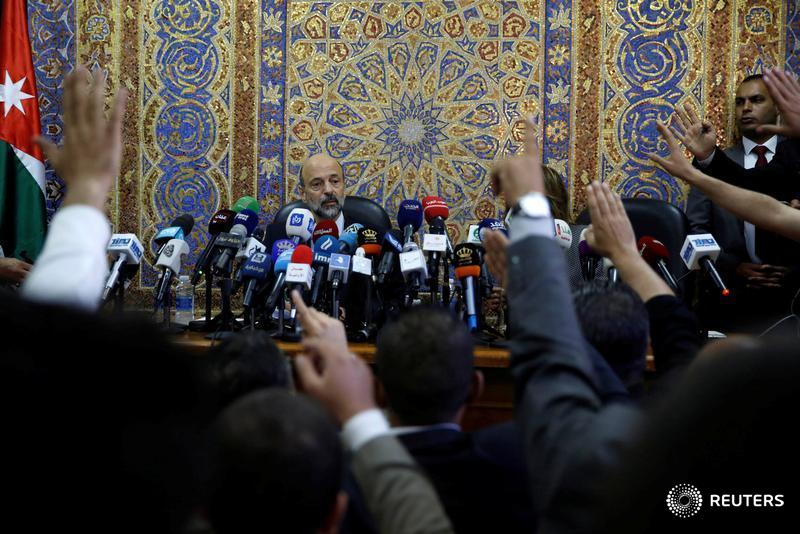
Muhammad Hamad’s picture almost makes me feel breathless as it’s so busy. I love it that I feel I have to fight my way through a visual crowd of arms, hands, microphones and even the background wallpaper to finally get to the speaking PM al-Razzaz . Once there I feel that I am trapped in a small, almost claustrophobic space, immersed in a sea of wonderful colour and warmth.      


Journalists try to ask Jordan’s Prime Minister Omar al-Razzaz questions during his news conference in Amman, Jordan June 19, 2018.   REUTERS/Muhammad Hamed

There is a dream-like quality to Amir Cohen’s Eid al-Fitr holiday picture, thanks to a complex combination of elements that would normally send a picture to the spike. But the flare, over-exposure and back focus all work together with Amir’s great composition of figures. 


People enjoy themselves along the shore of the Mediterranean Sea during the Muslim holiday of Eid al-Fitr at a beach in Tel Aviv, Israel, June 17, 2018.   REUTERS/Amir Cohen

Ahmed Jadallah was given exclusive access to the Aramco driving school for women in Saudi Arabia, where hundreds of women are preparing for the historic day on June 24, when they will be allowed to drive in Saudi Arabia. It’s not an easy story to photograph. Ahmed’s simple picture of pupil and teacher discussing mirror position is essentially a detail picture; hands, eyes and profile of the women’s faces that for me tells the whole story. You can see the rest of the story here


Trainee driver Maria al-Farai (L) adjusts the mirror during a driving lesson with instructor Ahlam al-Somali at the Saudi Aramco Driving Centre in Dhahran, Saudi Arabia, June 6, 2018.   REUTERS/Ahmed Jadallah

The half-open door and the plastic sheeting seems to wrap around the scene of grief like a cold embrace as boys huddle together looking for warm comfort in Mohammed Salem’s powerful and distressing image. Their hands and arms seems to claw through the picture, the open mouths and faces wet with tears leave us in no doubt about the extent of their grief. I hear the cries and screams ringing in my ears. A very sad picture. 


Relatives of a Palestinian, who was killed at the Israel-Gaza border, react at a hospital in Gaza City June 18, 2018.   REUTERS/Mohammed Salem

I am encroaching on another patch but can’t resist including Christian Hartmann’s fun picture of Senegal fans at their game against Poland at the World Cup in Russia . These guys have taken a lot of time to coordinate not only what they look like but where they stand. Their efforts were rewarded with a 2-1 win. 


Senegal fans cheers during their World Cup match against Poland in Spartak Stadium, Moscow, Russia June 19, 2018.   REUTERS/Christian Hartmann  


Friday, 2 March 2018

A Week in Pictures Middle East & Africa March 2, 2018


In my mind it's often a detail picture that can really tell a story, this I think never truer than in Afolabi Sotunde's picture of the upturned meal from the girl's school in Dapchi. To me the wasted meal in a place where little goes to waste screams of panic, fear and ultimately loss. Afolabi has been working on and following up on the story about the missing 110 girls that can be seen here in full


Last meal served to students before an attack by suspected Boko Haram insurgents, lies on the ground at the Government Girls Science and Technical College in Dapchi, the northeastern state of Yobe, Nigeria, February 28, 2018.   REUTERS/Afolabi Sotunde

Looking at Mohamed Torokman’s picture I feel like I am waking on eggshells. I almost dare not look as the bright coloured and back-lit balloons seem dangerously squeezed between the grey wall and the razor wire, a single touch will burst them.


Demonstrators hold balloons during a protest marking the 13th anniversary of a campaign against the Israeli barrier, in the village of Bilin, in the occupied West Bank march 2, 2018.  REUTERS/Mohamad Torokman

Hand on hips in a landscape of devastation, a hotel security officer seems to me to be dwarfed and overwhelmed by the destruction around him in Feisal Omar’s picture. The low angle of the camera takes us into the scene where nothing has been left untouched by the explosion. Even the building in the background seems to have a tilt to it.


A security officer from Doorbin Hotel assesses the debris after a suicide car explosion in front of the hotel in Mogadishu, Somalia, February 24, 2018.   REUTERS/Feisal Omar


A striking mix of strong light, dark clothing, large beards and paneled wooden doors all come together to draw us into Amir Cohen’s graphic picture that is built up of dark shapes and highlighted detail. To me the figures look like they are a stone relief that has suddenly come to life while retaining a feeling of two dimensions as if the transition is only half complete; the strong shapes of the hats, the dark shadow under the eyes and noses, the chiseled grey beard of the man in profile and behind them the glimpsed faces seen over shoulders combine for dramatic effect.


Greek Orthodox Patriarch of Jerusalem, Theophilos III stands with other church leaders after a news conference in front of the closed doors of the Church of the Holy Sepulchre in Jerusalem’s Old City, February 25, 2018.   REUTERS/Amir Cohen

At first glance the beautiful minaret seen against blue skies with white clouds drifting across Bassam Khabieh’s picture lulls you into a momentary belief this is a simple cityscape. Your eye is then suddenly snapped into focus with an unpleasant surprise as you spot the smoke drifting through the back of the image and you notice that every building in the foreground is damaged. This is a rare look at Ghouta’s skyline  -- normally we see it from ground level or underground, where terrified children huddle in a bomb shelter. More of Bassam's images here 


Smoke rises on the horizon of the besieged eastern Ghouta in Damascus February 27, 2018.   REUTERS/Bassam Khabieh


Children are seen in a shelter in the besieged eastern Ghouta in Damascus February 27, 2018.   REUTERS/Bassam Khabieh


Up go the shouts and voices of successful protesters as they carry a cross through the narrow streets of the Jerusalem’s Old City in Ammar Awad’s picture as Israel reverses a tax plan decision that would have hit the Church. To me the mass of people seems to swirl down the narrow passage like a rush of dark floodwaters barely contained in grey banks, the cross bobbing about like a ships mast in a storm, the ‘sailor’ in the crow’s nest holding on for dear life.


Worshippers shout slogans during a protest near to the closed entrance to the Church of the Holy Sepulchre in Jerusalem's old City February 27, 2018.    REUTERS/Ammar Awad


The phrase expect the unexpected is in my head most days and this visual readiness was affirmed when Amir Cohen’s picture of a boy dressed as a clown in a library dropped onto the wire. It’s not so much the costume, as this traditional during Purim, it’s the black and gold coloured background, the serious, somber downward look of the boy that contrasts with the bright colour and gaiety of his dress. The cross of the bookshelves brings your eye to the boy’s eye. From this point you look outwards, finally settling on the blue hat.  


An Ultra-Orthodox Jewish boy dressed in a costume takes part in the reading from the Book of Esther, a ceremony performed on the Jewish holiday of Purim, in a synagogue in Ashdod, Israel, February 28, 2018. REUTERS/Amir Cohen