Pages

Showing posts with label Jordan. Show all posts

Friday, 16 August 2019

A Week in Pictures, Middle East and Africa, August 16, 2019

Strong colours and graphic shapes grab your attention immediately in Benoit Tessier’s
picture, with the open arms of the man being searched filling the clean background of the
cloudless blue sky. It also has a slightly bizarre feeling that highlights the tension of the
pat-down. What can you possibly find in such wide-open spaces that stretch to the far
horizon? I am sure there is sound reasoning behind this. Read on here.

A French soldier of the 2nd Foreign Engineer Regiment searches a man during an area control operation in the Gourma region during Operation Barkhane in Ndaki, Mali, July 27, 2019.   REUTERS/Benoit Tessier 

Baz Ratner’s image is completely abstract and we can only guess at what is depicted in
the eye-catching swirl of hot red, orange and blacks. No figures, no real shape and no
sense of scale but you can’t help but continue to look to make sense of it, being drawn in
deeper and deeper. Once you read the caption you find out what is going on.

Lava is seen glowing inside the crater of the Nyiragongo volcano inside the Virunga national park near Goma in the Democratic republic of Congo August 9, 2019.   REUTERS/Baz Ratner 

Continuing with the theme of abstraction and moving slowly to the figurative, Feisal
Omar’s image of sheep being led to market is a pleasing graphic image with a gentle
curved composition and a strong right to left sweep to it.

Sheep are seen at a livestock market ahead of the Eid-al-Adha festival in Mogadishu, Somalia august 10, 2019.    REUTERS/Feisal Omar 

All good things come in threes so I had to complete the abstraction set with Muhammad
Hamed’s star-lit sky. The figure on the rock outcrop using a light gives us a single focal
point that both the previous images didn’t have. What has struck me is just how
comforting this focal point is and how - when it’s lacking from an image - it is missed
even if the image is strong in its overall design

A man watches the stars seen in the skies over Al-Kharza area of Wadi Rum in the south of Amman, Jordan July 27, 2019.   REUTERS/Muhammad Hamed

A powerful and angry picture by Ammar Awad. Two policemen moving through a crowd
of struggling security forces and protesters are momentarily circled by the movement
throughout the image. The dark shapes of the uniformed men are harsh against the
pavement and the drift of tear gas, their weapons a stark focal point of the image. If the
circular composition is not enough to lead your eye to the police in the centre, the hand in
the foreground points the way.

Israel police clash with Palestinian worshippers on the compound known to Muslims as Noble Sanctuary and to Jews as temple Mount as Muslims mark Eid al-Adha in Jerusalem Old City August 11, 2019.    REUTERS/Ammar Awad

Amir Cohen’s picture is one of those images that leads you in layer after layer like a
stage set. You start with the hooded figure on the left and his book, then across to the
man in the peaked cap and his book on the right, then down to sleeping man centrally
placed and next to him another man deep in concentration in his book. All set against a
wonderful backdrop of the ancient and yellowed wall.

Jewish worshipers pray on the Tisha B’Av, a day of fasting and lament, that commemorates the date in the Jewish calendar on which it is believed the First and Second temples were destroyed, near the Western Wall in Jerusalem’s Old City August 11, 2019.   REUTERS/Amir Cohen  

Umit Bektas’ image looks like a bas-relief of white-robed figures on a rocky foreground
against a jet-black sky. The picture is drained of almost all colour and the eye is led to the
back of the image through the ever-decreasing size of the figures, which are dotted about
equally in space from foreground to far distance. This visual impression works only
because almost all the figures are uniformly clad.

Muslim pilgrims gather on Mount Mercy on the plains of Arafat during the annual Haj pilgrimage, outside the holy city of Mecca, Saudi Arabia August 10, 2019.    REUTERS/Umit Bektas

A very brutal image by Philimon Bulawayo from the clashes in Harare that raises many
questions. A woman lies unconscious as a red-booted, baton-holding, policeman looks
down at her as he strolls by. The viewer may leap to many conclusions. Is she dead? I
checked with the photographer and was told no, she is okay. The body language appears
so aggressive and as an image is as powerful as the violence that led up to this scene. 

A policeman walks past a woman injured during clashes after police banned protests over austerity and rising costs called by the opposition Movement for Democratic Change (MDC) party in Harare, Zimbabwe, August 16, 2019.  REUTERS/Philimon Bulawayo 


Thursday, 25 July 2019

A Week in Pictures, Middle East and Africa, July 26, 2019


August this year is the 400th anniversary of the start of the slave trade to North America. To mark this date one of several stories Reuters is working on are artefacts from the slave period. Ancient things in cabinets rarely make for good images but one image that will haunt me, and not because I shot it (a rare thing these days) is the “Brookes” slave ship illustration. Using a narrow depth of field, I have tried to single out an individual packed on the boat with hundreds of others to humanize him. The details in the original drawing are spectacular. It’s as if every figure is a personal portrait and makes us feel as if we know them. If this was shot too wide the figures become unidentifiable, but too tight and you lose the sense of the vast numbers involved. Read on here.

A section of a print of the Brookes Slave Ship diagram dated 1791 forms part of the collection in the Wilberforce House Museum in Hull, Britain, July 5, 2019. According to the museum the print is arguably one of the most recognisable images from the campaign to abolish the Transatlantic Slave Trade in Britain. The publication of this image provided the public with a clear visual representation of conditions on board slave ships for the first time. August 2019 marks 400 years when the slave trade to North America began.   REUTERS/Russell Boyce

Emerging from a hole dug by hand, a miner brings up a shovel of earth that may or may not contain gold. Zohra Bensemra’s picture is as compelling and compassionate as it is claustrophobic. Every element is there, the perfect shovel shape, the miner’s lamp on his head, the black and dangerous chasm, and, most importantly, the glimpse of determination in his eyes. But there is more to this than meets the eye and that is why it’s taken months to get this story out. The gold comes at a price -  Read on  


An Informal gold miner carries a shovel as he climbs out from inside a gold mining pit at the site of the Nsuaem-Top, Ghana November 24, 2018. Zohra Bensemra 

Bloody and brutal with an eerie sense of isolation and silence. This is what strikes me most with Afolabi Sotunde’s image from the clashes in Nigeria. Why is this? Very rarely do you see a dead body in the street in complete isolation; there are usually emergency services, other demonstrators or even just bystanders, all usually part of the chaotic deadly scene.   

A member of the Shi’ite movement lies dead after a Shi’ite movement group set fire to an ambulance and fire engine station at the Federal Secretariat in Abuja, Nigeria July 22, 2019.   REUTERS/Afolabi Sotunde 

Bold and simple, great shape, great colour and ‘mini me’ feel to James Akena’s portrait picture lifts it above the ordinary. If I were to be really picky I’d like Bobi to be a little smaller in the frame so you can see both the eyes fully in the image behind him, but I won’t be picky.    

Ugandan musician turned politician. Robert Kyagulanyi, also known as Bobi Wine, addresses a news conference at his home in Kasangati, Kampala, Uganda July 24, 2019.    REUTERS/James Akena

Just because I am a big fan of the quirky, where objects are in place but out of context -  cars in swimming pools, boats on roofs - I can’t resist armoured vehicles under cool blue water photographed by the Aqaba Special Economic Zone Authority. Find out why they are underwater here. 

Jordanian Armed Forces vehicles lay on the seabed of the red Sea off the coast of southern port city of Aqaba, as part of a new underwater military museum, Jordan in this handout picture obtained July 23, 2019. Aqaba Special Economic Zone Authority/Handout via REUTERS

Ammar Awad’s mysterious image of smoke swirling around a building works as the window is just about the only sharp-edged shape you can see through the soft blur of smoke. This contrast creates a momentary focal point. If the picture had been taken a little earlier, the building would not be fully enveloped by the smoke, a moment later, the window would be obscured and the focal point lost.  

Palestinian building is blown up by Israeli forces in the village of Sur Baher which sits on either side of the Israeli barrier in East Jerusalem and the occupied West Bank July 22, 2019.   REUTERS/Ammar Awad

A great combination sequence picture by Mussa Qawasma from the same scene as Ammar’s picture above tells the same story but in a different way. Each element is perfectly captured. With the still images, every detail can be examined closely. For sure it would be great to see video of this, but then you would not be able to look at every detail closely, see what it looked like before, followed by the blast, the smoke and then the destruction.    

A combination picture shows a Palestinian building as it is blown up by Israeli forces in the village of Sur Baher which sits on either side of the Israeli barrier in East Jerusalem and the occupied West Bank July 22, 2019.   REUTERS/Mussa Qawasma

As far as the eye can see there are football fans surrounding the victory parade bus in Ramzi Boudina’s picture. Are the arms raised in adoration or is it that just about everyone is holding up a mobile phone to take pictures and shoot video. Either way it really doesn’t matter as what it does achieve is to make the bus take on the appearance of a boat slowly sailing away from white cliffs through a sea of waving arms.  

Football fans surround a bus during a victory parade to celebrate Algeria winning the Africa Cup of Nations (Afcon) in Algiers, Algeria July 20, 2019.    REUTERS/Ramzi Boudina  


Monday, 3 December 2018

A Week in Pictures Middle East and Africa November 30, 2018

Baz Ratner’s picture has a stark beauty and symmetrical feel that draws you in. You are immediately grabbed by the bright red against the pale tones and you are slightly troubled that you can’t see the eyes. But the figure is relaxed and you the get an overwhelming sense of peace as you explore the image further. It’s then that you notice the carefully manicured beard that has a hint of henna and you become aware of the pale skin tones of a relaxed contestant  preparing for the Mr & Miss Albinism Kenya Beauty Pageant. You can see the full story here


A participant receives beauty treatment before the Mr & Miss Albinism Kenya Beauty Pageant 2018 in Nairobi, Kenya, November 30, 2018.   REUTERS/Baz Ratner

Images from the Middle East and Africa are often hard news, drained of colour and tough to look at, so a fun picture of people laughing that is stuffed full of colour caught my eye. Compositionally, Sumaya Hisham’s picture is nothing special. The event has been orchestrated and its news value is pretty low. But look at everyone’s face. They are just enjoying the moment and it’s that captured moment - smiles, eyes, teeth and hands - that makes me feel good. 


Youths pose for a photograph with Britain’s Prince Harry, during his visit to Circus Zambia in Lusaka, Zambia, November 27, 2018.    REUTERS/Sumaya Hisham

On the theme of colour, I struggled to choose between two of Zohra Bensema’s pictures so I will share them both. The first is a corridor of clothing, like the wardrobe in C.S Lewis’ The Lion, the Witch and the Wardrobe but much brighter, leading you to the biggest smile of the week, even though it quite small in the frame. The second is composed of blues, yellows, red and purples and the most eclectic set of portraits you can imagine. For the life of me I cannot find a link.  


A woman laughs while she feeds her baby at the corridor of her house in the Newtown neighbourhood of Accra, Ghana November 27, 2018.   REUTERS/Zohra Bensemra

A street vendor sits beside her stall in Jamestown, Accra, Ghana November 28, 2018.   REUTERS/Zohra Bensemra

In Feisal Omar’s picture your eye is troubled by the chaos of what is going on and cannot quite settle. It might be the colour, the two men larking about, the random criss-crossing of the building structure or even the raw meat hanging from the rack.  It takes a while to get to grips with what is actually going on. These men have set up their butcher’s shop a day after it was destroyed by a bomb blast, so no wonder we feel unsettled.  It’s hard to imagine what they are feeling. 

A butcher hangs meat in the ruins of his butchery, destroyed following an explosion in Wadajir district in Mogadishu, Somalia November 27, 2018.   REUTERS/Feisal Omar 

The more closely you look at Mohamed al-Sayaghi’s picture the better it gets. First you get the white sleeved arm sweeping in from the right to meet the bold black shape that stretches into fingers at the focal point of the child’s squished face. The mouth pushed open, highlights catching the boy’s eyes, and then at last you see the tiny droplet of vaccination caught perfectly between dropper and mouth.   


A Boy is administrated vitamin A drops during an anti-polio vaccination campaign in Sanaa, Yemen November 26, 2018.   REUTERS/ Mohamed al-Sayaghi


 There is no escaping the strong diagonal that leads from bottom right to top left in Amr Abdullah Dalsh’s picture. Visually it’s like a hill that is being climbed. I love the bold shapes and the blacks and reds that are not only in the clothing but echoed in the writing on the wall. Maybe it’s my imagination, but it feels like the child is reaching up to achieve something for the future, the mother is busy working hard to achieve something now and the abstract figure looks like some free and futuristic symbol sprinting away. Is the writing on the wall? Enjoy the full story here


A woman, with her daughter, writes messages of support during the first Egyptian Woman’s race to raise awareness about violence against women in Cairo, Egypt, November 30, 2018.   REUTERS/Amr Abdallah Dalsh

An interesting swirling composition in Ronen Zvulun’s picture is enhanced by the yellow neon of the night lights. It gives us an almost abstract bird’s eye view of a demonstration in Jerusalem. It’s only after we have looked at this for a while that the surrounded vehicles give us a clue to scale and a figurative sense.  


Israeli ultra-Orthodox men protest against the detention of a member of their community who refuses to serve in the Israeli army, in Jerusalem November 28, 2018.  REUTERS/Ronen Zvulun

It’s officially colour week and I am always a sucker for complimentary colours, reds and greens especially. Add a strong sense of scale, as Muhammad Hamed has done in his picture, and it’s almost a dead cert for my weekly selection. What saves the visual flow of this picture is that the child is looking directly out of the frame and not out to the right of the picture, as that would have destroyed the flow. 


A Syrian child runs next to a mural at Al-Zaatari refugee camp, which is located near the Jordanian city of Mafraq, close to the border with Syria November 28, 2018.   REUTERS/Mohammad Hamed


Friday, 12 October 2018

A Week in Pictures Middle East and Africa October 12, 2018


Ibraheem Abu Mustafa has crouched down low to create a powerful combination of flames, black smoke and figures in his picture from Gaza. It’s worth looking deeper into the image beyond its immediate impact. At first you notice the two protesters holding their catapults at full tension, aimed at different targets. Beyond them, and to the far distance, dozens of others figures start to emerge from the smoke; some running, some pointing and others just watching, but all risking their lives to protest. Read the latest details here.

Palestinians hurl stones at Israeli troops during a protest calling for lifting the Israeli blockade on Gaza demanding the right to their homeland, at the Israel-Gaza border fence in the southern Gaza strip October 12, 2018.    REUTERS/Ibraheem Abu Mustafa

There are ways to photograph a building and there are great ways to photograph a building and it’s not often I get excited about a picture with no people in it, but Muhammad Hamed’s picture of the Monastery in Petra is just breath-taking. Like a scene from the Lord of the Rings film trilogy, the vision created by the light is spectacular and if this picture doesn’t want to make you visit Petra, nothing will. By way of explanation the September date was when this picture was shot, but it was moved on the wire this week.   


A general view of the Monastery at night in the ancient city of Petra, south of Amman, Jordan September 27, 2018.   REUTERS/Muhammad Hamed

There’s no mistaking the sadness in Ronen Zvulen’s powerful detail picture that has been carefully cropped by picture editor Nir Elias as a hand tenderly reaches out to touch the Star of David, which forms part of the shroud covering the body of Kim Yehezkel. There is no respite from the cold tones of the black cloth and the stonework, even the bare and tattooed arm looks cold to the touch.

A woman touches the cover for the body of Kim Yehezkel during her funeral at the cemetery in Rosh Ha’ain near Tel Aviv, Israel October 7, 2018.   REUTERS/Ronen Zvulun

It takes more than a little while to work out what is going on in Zohra Bensemra’s picture. As you flick from white highlights to black shadows eventually your eye catches hold of the small white piece of paper suspended in the black. Then you spot the woman on the left sitting behind a lamp with her eyes sharply focused on the paper. You then get the sense of it as a ballot paper. The picture snaps into meaning – what a tough task, counting votes in a dark room, lit only with small lamps


Election workers take part in vote counting during the presidential election in Yaounde, Cameroon October 7, 2018.   REUTERS/Zohra Bensemra 


A brave decision by Amr Abdallah Dalsh to use a very wide lens to shoot Melania Trump arriving at the Great Pyramids has paid off. The stark empty landscape is populated with security as far as the eye can see. The slight V of the clouds dipping down to point to the U.S. first lady as she strides through this open space. But what I would give for another inch beneath the security guard’s foot on the right-hand side, the foot is just cut off a tiny bit, a pet hate of mine. 


U.S first lady Melania Trump walks with Egypt’s Antiquities Minister Khaled El-Enany as security personnel stand guard during her visit to the Great Pyramids in Cairo, Egypt, October 6, 2018.   REUTERS/Amt Abdallah Dalsh 


Carefully framed by silhouetted figures in the foreground we are dawn deeper and deeper into Naif Rahma’s picture by the rhythm of the school children queuing at the start of the new term. I am greatly saddened by this picture as I can’t get the notion out of my head that the silhouettes in the foreground represent the children who were killed in the air strike. This picture haunts me. Read on here 


Students perform morning exercises and drill at their school which lost pupils in an August 2018 Saudi-led air strike on a school bus in Saada province, Yemen October 6, 2018.   REUTERS/Naif Rahma


When I first saw Mohamed Abd El Ghany’s picture I am sure I heard an audible ‘click’ of the player’s neck as he stretches! The warm tones of the colours, the deep shadows of the blacks and the dash of red all strongly evoke the high temperatures this athlete is competing in. His closed eyes and this sense of warmth combine to give me a sense that this refugee has relaxed, he feels he is through the worst of his difficult life; let’s hope so. It’s a story of hope, so read on here.  It’s a story of hope that took a while to shoot so read on here. 

 A Sudanese refugee stretches prior to a basketball game in Cairo, Egypt September 24, 2018.  REUTERS/Mohamed Abd El Ghany

Two pictures by Ammar Awad, which were shot for the same story, are poles apart in terms of mood, and yet I can’t help but link them as they are very similar in shape and design. Both have a strong sense of a right to left sweep of movement, both have three main female figures and the dashes of colour that catch your eye are the pinks and pale purples. I fear that seen together the pictures may convey a sense of youthful hopes that are later dashed. You decide, read on here


Palestinian school children take part in a lesson at a school run by UNRWA (United Nations Relief and works Agency) in the Shuafat refugee camp in East Jerusalem October 10, 2018. REUTERS/Ammar Awad


Palestinian women walk on a street in the Shuafat refugee camp in East Jerusalem October 10, 2018. REUTERS/Ammar Awad


Friday, 17 August 2018

Week in Pictures Middle East and Africa, August 17, 2018


Strong compositional lines cut across Azad Lashkari’s picture like a frenzied attack on the visual senses. The horizon line slightly lower than the centre of the picture cuts through the heads of those holding the poles, forcing you to look up at the soldiers precariously balanced, before your eye speeds back to the flag in the distance. The diagonal lines of the safety mats bring your eye back around to the foreground of the image. A wonderful feat of balance and composition.     


Members of the Peshmerga Zirvani commandos demonstrate their skills during their graduation ceremony at the Tiger training camp in Erbil, Iraq August 16, 2018. REUTERS/Azad Lashkari

Luc Gnago’s picture is a wonderful example of what I call a picture that ‘does what it says on the tin’. It’s the vote count of the presidential run-off, we see the candidates’ names on the blackboard, the number of votes marked in white chalk marks and an official holding up a voting form with the candidates’ pictures on them. If I were to nit-pick I would like the man in the background to not be there but I have learned we don’t live in a perfect world so I go away very happy with this picture.   


Election workers start the counting of the ballots during a run-off presidential election in Bamako, Mali August 12, 2018.   REUTERS/Luc Gnago

I just had to include a second picture from Luc Gnago as it’s just brimming with life, colour and energy.  “Don’t touch my vote,” the black on red placard screams, amid a noisy scene of the bus loaded with people and speakers thundering support, and motor cyclists weaving about the road. You can almost taste the heady atmosphere, as the woman with her tongue out seems to suggest.  


Supporters of Soumaila Cisse, leader of the opposition party Union for the Republic and Democracy (URD), carry banners as they protest along a street in Bamako, Mali, August 16, 2018. The banner reads ‘Don’t touch my vote’.   REUTERS/Luc Gnago 

This picture just makes me feel good and I’m not sure why. Maybe it’s because it’s something one would not expect from Rwanda, a cycling race? Maybe it’s a sense I get, that while it may be plagued with doping scandals cycling might have an opportunity for a new start on a new continent. Or maybe it’s the sense of effort, the straining sinews of the cyclist’s leg caught in the sunlight and out of focus hands clapping encouragement that draws me to this image.


Samuel Mugisha of Team Rwanda competes during the Tour de Rwanda 2018 in Kigali, Rwanda August 12, 2018.   REUTERS/Jean Bizimana

Sometimes happy accidents occur when you set out to achieve one thing and your idea changes to another. Amir Cohen set out to cover the meteor shower but the noticed in his time exposures how vehicles illuminated the road like a magical path. Working on longer exposures and hoping for a greater volume of traffic he got lucky and succeeded in shooting this wonderful atmospheric image. Incidentally, he also managed some terrific pictures of meteors streaking across the skies.


The road is illuminated by the headlights of cars being driven through the Ramon Crater near the town of Mitzpe Ramon, southern Israel, August 12, 2018.   REUTERS/Amir Cohen  

Although you can see only dozens of people in Muhammad Hamed's picture, the visual echo of people's heads, getting smaller as you look to the background, in the shapes of vegetation behind makes us feel as though thousands are attending, as far as the eye can see. Maybe it's just my imagination, but it looks to me that dust thrown up by the mourners seems ghost-like as it hovers over the flag-draped body.


Guard of Honour and relatives of sergeant Hisham Agarbeh, of the anti-terrorist unit, who was killed in an attack, carry his body during his funeral in Birayn in the city of Zarqa, Jordan, august 12, 2018.   REUTERS/Muhammad Hamed


Zohra Bensemra’s picture looks like a combination of a Bridget Riley painting, a Matisse cut out and a cityscape still from the 1927 classic film Metropolis. The harsh light has drained all colour, reducing it almost to blacks and white. The flat black shapes of the foreground look like a cut out that has been laid on the image and once we force our way past this heavy blackness we finally get to see hundreds of people making their way from prayer. What a visual and cultural feast.  Read more from the Haj here. 


Muslim pilgrims walk out after the Friday prayer at the Grand Mosque ahead of the annual Haj pilgrimage in the Holy city of Mecca, Saudi Arabia August 17, 2018. REUTERS/Zohra Bensemra 


Friday, 22 June 2018

A Week in Pictures Middle East & Africa, June 22, 2018

I love the strong diagonal composition of Thaier al-Sudani’s picture, which seems to pivot around the light-coloured headdress of the man in the centre. As your eye moves to the top of the frame you are rewarded with a break in the strong line, al-Hakim leading the prayer. It’s not often I would like to see video from a scene that has been well photographed but I would love to see the left to right movement of the line of worshippers. Maybe it’s the wide-screen 16 x 9 proportions of the crop that puts this in my mind. 


Ammar al-Hakim, leader of the Hikma Current, leads prayers for the Muslim festival of Eid al-Fitr at his headquarters, in Baghdad, Iraq, June 16, 2018.    REUTERS/Thaier al-Sudani

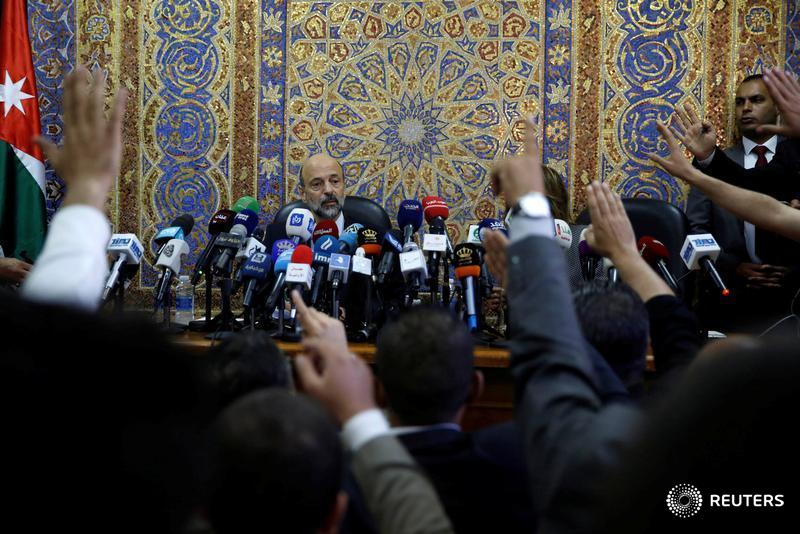
Muhammad Hamad’s picture almost makes me feel breathless as it’s so busy. I love it that I feel I have to fight my way through a visual crowd of arms, hands, microphones and even the background wallpaper to finally get to the speaking PM al-Razzaz . Once there I feel that I am trapped in a small, almost claustrophobic space, immersed in a sea of wonderful colour and warmth.      


Journalists try to ask Jordan’s Prime Minister Omar al-Razzaz questions during his news conference in Amman, Jordan June 19, 2018.   REUTERS/Muhammad Hamed

There is a dream-like quality to Amir Cohen’s Eid al-Fitr holiday picture, thanks to a complex combination of elements that would normally send a picture to the spike. But the flare, over-exposure and back focus all work together with Amir’s great composition of figures. 


People enjoy themselves along the shore of the Mediterranean Sea during the Muslim holiday of Eid al-Fitr at a beach in Tel Aviv, Israel, June 17, 2018.   REUTERS/Amir Cohen

Ahmed Jadallah was given exclusive access to the Aramco driving school for women in Saudi Arabia, where hundreds of women are preparing for the historic day on June 24, when they will be allowed to drive in Saudi Arabia. It’s not an easy story to photograph. Ahmed’s simple picture of pupil and teacher discussing mirror position is essentially a detail picture; hands, eyes and profile of the women’s faces that for me tells the whole story. You can see the rest of the story here


Trainee driver Maria al-Farai (L) adjusts the mirror during a driving lesson with instructor Ahlam al-Somali at the Saudi Aramco Driving Centre in Dhahran, Saudi Arabia, June 6, 2018.   REUTERS/Ahmed Jadallah

The half-open door and the plastic sheeting seems to wrap around the scene of grief like a cold embrace as boys huddle together looking for warm comfort in Mohammed Salem’s powerful and distressing image. Their hands and arms seems to claw through the picture, the open mouths and faces wet with tears leave us in no doubt about the extent of their grief. I hear the cries and screams ringing in my ears. A very sad picture. 


Relatives of a Palestinian, who was killed at the Israel-Gaza border, react at a hospital in Gaza City June 18, 2018.   REUTERS/Mohammed Salem

I am encroaching on another patch but can’t resist including Christian Hartmann’s fun picture of Senegal fans at their game against Poland at the World Cup in Russia . These guys have taken a lot of time to coordinate not only what they look like but where they stand. Their efforts were rewarded with a 2-1 win. 


Senegal fans cheers during their World Cup match against Poland in Spartak Stadium, Moscow, Russia June 19, 2018.   REUTERS/Christian Hartmann  


Friday, 8 June 2018

A Week in Pictures Middle East & Africa, June 8, 2018


Being hit with a tear gas canister is terrifying but being hit with a tear gas canister that embeds itself in your face must be truly awful. Ibraheem’s Abu Mustafa’s picture of a man with tear gas still pouring from the canister in his face is quite disturbing but something I just can’t stop looking at as I have never seen the like before. Ibraheem followed up with him and you can see the story here 


A wounded Palestinian demonstrator is hit in the face with a tear gas canister fired by Israeli troops during a protest marking al-Quds day (Jerusalem Day), at the Israeli-Gaza border in the southern Gaza strip June 8, 2018.   REUTERS/Ibraheem Abu Mustafa

Next week the world’s attention will be on Russia and the World Cup. As a preview to the football tournament, Wider Image have pulled together a global project on unusual places the game is played. Contributions from Africa were very strong but in choosing one I have to settle on Siphiwe Sibeko’s offering as my favourite. The light is beautiful and I just love those yellow trousers in the low sun at full stretch and the red ball. See the set of pictures from around the world here. 


A combination picture shows boys playing soccer and details of a football, a pitch and shoes, at a makeshift pitch in Soweto, South Africa, May 14, 2018.   REUTERS/Siphiwe Sibeko

I can’t help but smile when looking at Ammar Awad’s picture of a vendor grabbing a fish from the tank. Do you also think that the two fish slightly on the right are gasping, opened mouthed ‘phew lucky this time, not me!’ What I also love about this picture is the colour and tone. The warm orange/yellow colours of the arm in the water against the cool blue colours of the fish


A vendor holds a fish at a market in Amman, Jordan June 6, 2018.   REUTERS/Ammar Awad

There is no mistaking for even a second what the pull is for Mohamed Torokman’s picture: it’s the perfect shadow, the great lines in the picture and the shape of the man’s body climbing the rickety ladder. The shadow of the barbed wire snaking down from the top of the frame is an added bonus.


A Palestinian uses a ladder to climb over a section of the controversial Israeli barrier as he tries to make his way to attend Friday prayer of the Holy fasting month of Ramadan in Jerusalem’s Al-Aqsa mosque, near Ramallah in the occupied west bank June 8, 2018.  REUTERS/Mohamad Torokman

Wissam al-Okili’s picture is one that makes me want to scratch my head and wonder why the people in the picture are doing what they are doing. I just keep on looking and wondering, unable to pull myself away from this image. Eighteen people killed and over 90 injured in the blast and these young men are sitting on this half-buried car as if it’s garden furniture. Maybe it’s the contrast between the landscape of sheer devastation and the nonchalant relaxed manner of the men that gives this image its strength as you wonder ‘Wow! What happened here?’ If you want to know read on here


People gather at the site of an explosion in Baghdad’s Sadr City district, Iraq, June 7, 2018.    REUTERS/Wissam al-Okili

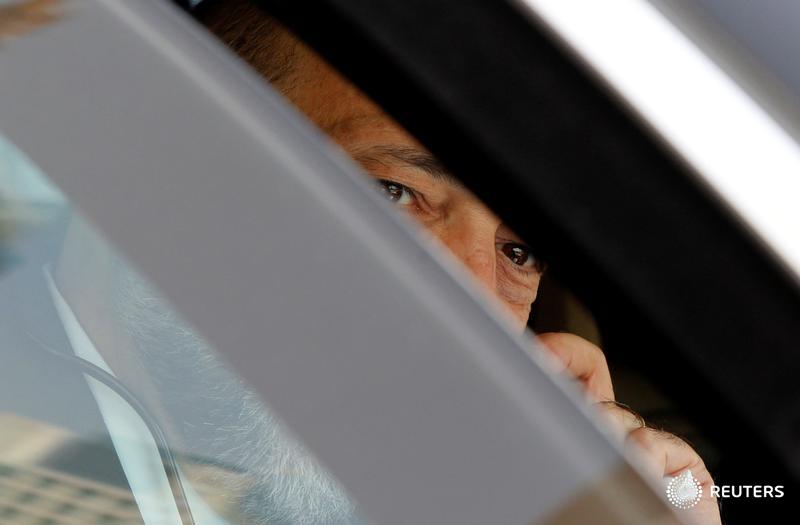
Jordan’s new Prime Minister Razzaz is being squeezed between the demands of the IMF trying to put the Jordan economy back on track with austerity measures and the demands of the people protesting on the streets because they can’t make ends meet. Muhammad Hamed’s picture seems to sum up all his problems in a single frame. 


Jordan’s designated new Prime Minister Omar al-Razzaz speaks on the phone after leaving parliament building in Amman, Jordan June 7, 2018.  REUTERS/Muhammad Hamed

 The newly repaired road cuts through the hills dotted with destroyed buildings from which a stream of vehicles seem to flow downhill. What catches my eye first in Omar Sanadiki’s picture is that it’s such a great shape. It also took me a while to realise what is a little strange: the traffic is moving in the same direction, towards the viewer on both sides of the road.  


Vehicles travel on the road between Homs and Hama after it was re-opened in Rastan, Syria June 6, 2018.   REUTERS/Omar Sanadiki