Wham! Siphiwe Sibeko’s picture hits you as
hard as the downdraft from the helicopter rotor blades. The boys explode past
you as if the starting gun has just fired for a 100-metre Olympic sprint. Arms,
legs, faces, in the frame, out the frame, in highlight or in shadow all rush
past you over the flattened grass. One small point: I’d like to see a little
movement in the rotor blades, but then maybe we’d lose sharpness in the running
boys. See more of the story here
 People run after collecting food aid from a South African National Defence Force (SANDF) helicopter rescue team in the aftermath of Cyclone Idai in Nhamatanda village, near Beira, Mozambique, March 26, 2019. REUTERS/Siphiwe Sibeko
After the pictures of the huge impact of Cyclone Idai on the landscape and infrastructure and the rescue stories come the sad personal stories of death. Philimon Bulawayo’s picture of a man using his bare hands to dig in the mud to find missing relatives is as powerful as it is haunting with its close-up detail of the tragic task.
 Relatives use bare hands to dig in the mud
as they search for their missing loved ones in the debris and rubble left in
the aftermath of Cyclone Idai in Chianimani, Zimbabwe, March 23, 2019. REUTERS/Philimon Bulawayo
 A child walks past
debris as flood waters begin to recede in the aftermath of Cyclone Idai, in
Buzi, near Beira, Mozambique, March 24, 2019.
REUTERS/Mike Hutchings
 An Ethiopian army veteran dances during the
welcoming ceremony of the two locks of hair of Emperor Tewodros II as it is
repatriated from Britain’s national Army museum in Addis Ababa, Ethiopia March
23, 2019. REUTERS/Tiksa Negeri

Mohammed Salem has captured a simple moment of gentle human kindness: a girl wiping her brother’s face. The powerful image of a sweet act is amplified 1,000-fold as they are standing in the rubble of their destroyed house after a missile attack. It’s not only her gentle action but her leopard skin print top and the red shoes, that seem completely out of context in the ruins. More pictures here
 A Palestinian girl cleans the face of her
brother outside their destroyed house after an Israeli missile targeted a
nearby Hamas site, in Gaza City March 26, 2019.
REUTERS/Mohammed Salem
Broken glass in delicate shoes is an image that sets the mind on edge immediately, it’s just not right and that is why Ammar Awad’s detail picture is so powerful. The image perfectly opens the door to the story: you just need to know more. Why are these delicately coloured shoes with a pretty yellow bow covered in shattered glass? Whose shoes are they, and what happened to the owner? Why are they covered in glass?
 Shattered glass covers shoes left on the
seat of a car that was damaged after a rocket hit a house north of Tel Aviv,
Israel, March 25, 2019. REUTERS/Ammar
Awad
 Cows are seen in a field in the Israeli-occupied
Golan Heights March 25, 2019.
REUTERS/Ammar Awad
 Hanaa Ahmad Ali Bahr, a malnourished girl,
sits on her father’s lap in a shanty town in Hodeidah, Yemen, March 25,
2019. REUTERS/Abduljabber Zeyad
 An Israeli soldier stands atop and tank
near the border with Gaza, in Southern Israel March 27, 2019. REUTERS/Amir Cohen
 A Palestinian protester moves a burning
tyre during clashes with Israeli troops near the Jewish settlement of Beit El,
in Israeli-occupied West Bank March 27, 2019.
REUTERS/Mohamed Torokman
Dylan Martinez has shot a terrific story titled “capturing 24 hours in Gaza, one hour at a time”. Each picture in the series requires time, their strength is in their subtlety. I have chosen one image and I could have chosen many different ones. The image is shot wide so you can take in the scene, bare wasteland, the soil a putrid colour. In the background, pock-marked bare concrete walls, with burn marks and old plaster. Smoke hangs in the air. The overall sense is that of poverty. You then focus on the boy in the background, mouth open, shouting, taunting. In response to his taunts another boy prepares to throw something across the wasteland, or is it no-man’s land? They seem to be in trenches. This picture needs words to explain to us what we already sense about the image. Boys are re-enacting the ongoing conflict, but as play. See the whole picture story here
 Children play a game of ‘Arabs and Jews’
outside a school in Gaza City February 20, 2019. Dylan says ‘These kids were
burning some cardboard, they had trenches, they were throwing sand balls so
they weren’t hurting each other. And I said, Oh, what are you guys doing?’ and
they said ‘Oh we are playing Jews and Arabs.’ The image he said, ‘will probably
stay with me forever’. REUTERS/Dylan
Martinez

After the pictures of the huge impact of Cyclone Idai on the landscape and infrastructure and the rescue stories come the sad personal stories of death. Philimon Bulawayo’s picture of a man using his bare hands to dig in the mud to find missing relatives is as powerful as it is haunting with its close-up detail of the tragic task.

Equally powerful are
images of “calm after the storm” as a survivor tries to get on with daily life
with ruin all around. Blue skies appear
through storm clouds and the trees in Mike Hutchings’ picture seem to bow to
embrace the boy as he walks through the flood waters. The twisted corrugated
iron half submerged in water, aided by shadow from the trees, pick out the small,
solitary figure making his way through the devastated landscape. More from Mozambique here

After the devastating plane crash story
from Ethiopia it’s great to see such an affectionate and warm image by Tiksa
Negeri, on the return of a historic relic from Britain. The pride in the ex-soldier’s
stance and face and the sense of joy in the dancers is overwhelming. It takes a
while to notice the stark background of the room as you are led visually from
the proud former soldier to the dancer on the left and then through to dancer
in shorts and sandals to the musician in the background. Its only then you
notice the sheen and glare in the varnished wood surfaces

I am very uncomfortable remarking on the
beauty of this image as it’s an act of violence, but there is no escaping the
visual strength of the symmetrical composition, perfect timing and richness of
colour in Mohammed Ajour’s picture of an explosion. The ball of fire reaching
its crescendo, illuminating the buildings next to it, giving us the sense of
scale of the blast all set against a black night sky. You have to respect the
nerves of steel it takes waiting on the roof of a building for explosions just
to take a picture.
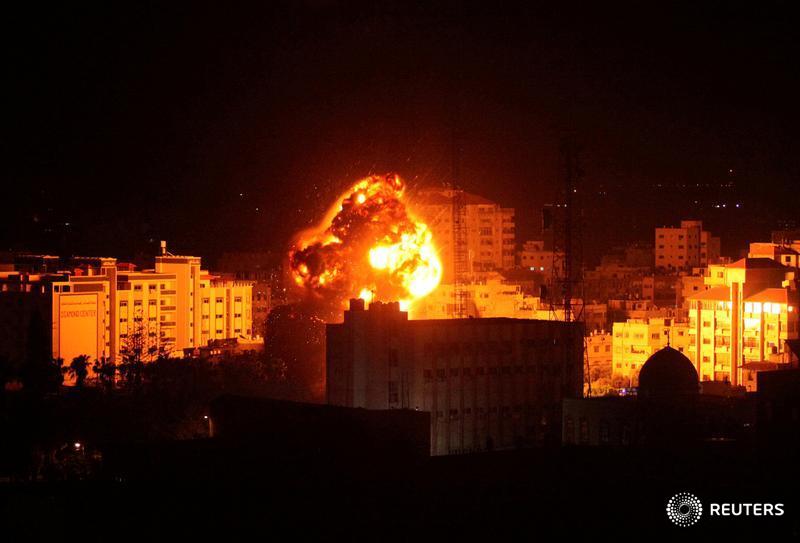
Flames and smoke are seen during an Israeli
air strike in Gaza City March 25, 2019.
REUTERS/Mohammed Ajour
Mohammed Salem has captured a simple moment of gentle human kindness: a girl wiping her brother’s face. The powerful image of a sweet act is amplified 1,000-fold as they are standing in the rubble of their destroyed house after a missile attack. It’s not only her gentle action but her leopard skin print top and the red shoes, that seem completely out of context in the ruins. More pictures here

Broken glass in delicate shoes is an image that sets the mind on edge immediately, it’s just not right and that is why Ammar Awad’s detail picture is so powerful. The image perfectly opens the door to the story: you just need to know more. Why are these delicately coloured shoes with a pretty yellow bow covered in shattered glass? Whose shoes are they, and what happened to the owner? Why are they covered in glass?

The passion and desire our photographers to
make pictures never ceases to amaze me. Even though Ammar Awad was on assignment
covering the scene of the rocket attack where he shot the picture above he
spotted and took this beautiful, peaceful rural scene. It’s the pursuit of
beauty of image that I most admire, be it missile attack or cow in a field. I
suspect what caught Ammar’s eye is the graphic pattern of the three similar
shapes in a landscape: bush, cow and trees.

Just try looking away from those eyes, in
Abduljabber Zeyad’s picture. When you do finally escape that gaze, you see the
child in the background, dirty face, distressed, hand on head and enormous bump
on his forehead. It’s only then that you notice what should be a distraction,
the yellow and black shirt. You are then drawn back into those eyes again. A thought
for you: if the father’s fingers were all kept in the frame would it be another
distraction? I think so, so good they were cropped out.

It’s hard to fathom what is going on in
Amir Cohen’s picture as you look for a focal point - all you get is a sense of cold grey steel
weighing down on a mud base. As your eye jumps around trying to make sense of
it, you may pick up the white inverted V or maybe the white 4 on the right.
Finally you spot the figure in the foreground, dwarfed by this crush of
intimidating metal.

In complete contrast to Amir’s picture
above, there is no confusion about the focal point as you are drawn immediately
into the roaring flames of Mohamad Torokman’s image. As you study the flames
they seem to come alive, drawing you into the angry hot fire and then forcing
you out to the choking smoke on the right and back across to the background.
Only then do you notice the three figures on the left, seemingly playing a bit
part in the picture while stoking the flames.

Dylan Martinez has shot a terrific story titled “capturing 24 hours in Gaza, one hour at a time”. Each picture in the series requires time, their strength is in their subtlety. I have chosen one image and I could have chosen many different ones. The image is shot wide so you can take in the scene, bare wasteland, the soil a putrid colour. In the background, pock-marked bare concrete walls, with burn marks and old plaster. Smoke hangs in the air. The overall sense is that of poverty. You then focus on the boy in the background, mouth open, shouting, taunting. In response to his taunts another boy prepares to throw something across the wasteland, or is it no-man’s land? They seem to be in trenches. This picture needs words to explain to us what we already sense about the image. Boys are re-enacting the ongoing conflict, but as play. See the whole picture story here


