Pages

Showing posts with label flag. Show all posts

Friday, 20 July 2018

A Week in Pictures Middle East & Africa July 20, 2018


I can’t decide if Amir Cohen is lucky or unlucky to be close enough to an Iron Dome missile system to capture its launch during a mortar attack, but either way it’s a striking picture. What adds to the strength of this image is that the photographer was quick enough to not only capture the missile’s launch but keep in the frame an equally lucky/unlucky person to give it scale and drama.  


An Israeli man looks on as Iron Dome launcher fires an interceptor rocket in the southern Israeli city of Ashkelon July 14, 2018.   REUTERS/Amir Cohen

No less striking a moment is captured by Ibraheem Abu Mustafa’s picture of an airstrike in Gaza on the same day as the Iron Dome launch. The ball of fire and great plumes of smoke are see in the terrifying context of city buildings all around. Stepping away from the actual news story that this was the worse exchange of fire between Israel and Gaza since 2014, and looking at this in pure visual terms, like the dark shapes in the foreground, it gives it scale and places it in a city. I did have a look at a tighter crop of the ball of fire as a focal point of the picture but think at the end of the day the wider image tells the story better. What do you think?   


An explosion is seen following an Israeli airstrike on a building in Gaza City July 14, 2018.   REUTERS/Ibraheem Abu Mustafa

An editor’s crop has transformed Philimon Bulawayo’s picture from vertical to  horizontal but also removed wasted white space at the top, drawing your eye to Chamisa’s face and the outstretched hands. What you do lose is the sense of the enormous crowds and the people who have climbed the pylon in the background. For my money I like the tighter crop. You may differ. 


Zimbabwe’s opposition party leader Nelson Chamisa is greeted by supporters at a rally at Sakubva stadium in Mutare, Zimbabwe, July 14, 2018.   REUTERS/Philimon Bulawayo

Sometimes you look and look at a picture and think something is a little out of place but can’t quite put your finger on what. Thomas Mukoya’s picture is one such image. The harsh light creates a complex set of shapes and colours, the hat, silhouetted figures, the pink shirt with writing on it you can’t make out and the tents, all make it hard for the eye to settle. Then slowly it dawns: the US flags have been attached to their poles back to front.  
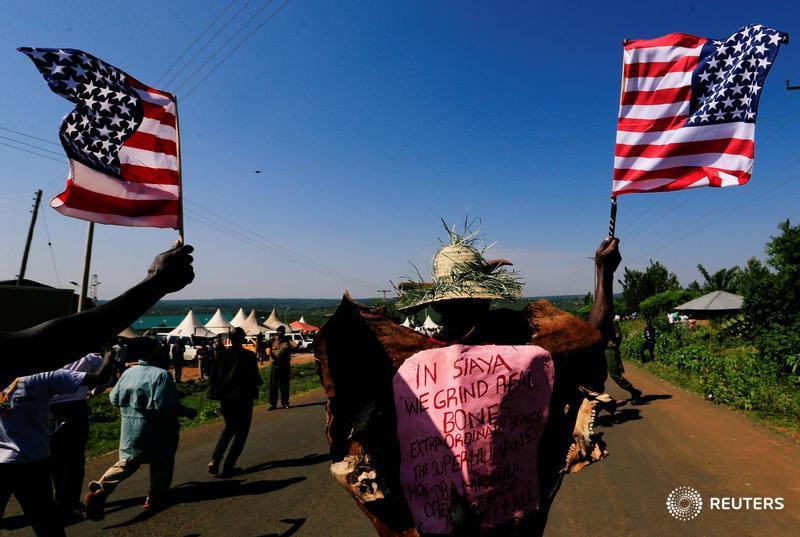

Residents wave the U.S. national flag as the chant slogans as they walk along the road prior to the visit by former U.S. president Barack Obama to his ancestral home, Nyangoma Kogelo village, in Siaya county, western Kenya, July 16, 2018.   REUTERS/Thomas Mukoya

Siphiwe Sibeko’s picture breaks all the rules. You have a flat line that cuts the image in half, top to bottom; large empty black spaces; faces looking out of the frame so close to the edge of the picture you sense they are going to bump their heads. And yet it works wonderfully. 


Former U.S. President Barack Obama delivers the 16th Nelson Mandela annual lecture, marking the centenary of the anti-apartheid leader’s birth in Johannesburg, South Africa, July 17, 2018.   REUTERS/Siphiwe Sibeko

 We encourage photographers when they are shooting a story to make sure to include a detail picture. In my mind a detail picture is an image of something small that might easily go unseen but is quite revealing. It doesn’t have to be a closeup but often it is. Ari Jalal’s picture is quite abstract when you look at it in its entirety and turns the notion of detail on its head. You see a wide picture, horizonal line cutting the image in half with two slabs of toned colour, a ‘button’ casting a shadow in the top centre and small patches of colour. You have to look closely to see the patches of colour are hand prints and signatures of patients. Now you take the time to look at each of the hand prints and try to read the writing of each individual’s story.  


A mural of painted hands and messages from wounded people, who have recovered and have been discharged from the Medecins Sans Frontieres hospital in Mosul, Iraq, July 10, 2018.   REUTERS/Ari Jalal

One can only imagine the feelings you must have as a father hugging your daughters after being separated for 18 years, but Tiksa Negeri captures this moment forever. A very quiet image that needs a caption to explain it but you immediately get a sense of the powerful and tight embrace, as his daughters are held close and tight, their faces pressed to his chest. When you look into the shadows of the image, its real beauty comes alive, the sisters looking into each other’s tear-stained eyes, one with her hand on her father’s chest, just inside his jacket, where she can feel his heart beat. The lines on his face speak to me of years of worry and separation. You can see more heart-warming pictures from Asmara here


Adisalem Abu, reacts as he embraces his daughters, after meeting them for the first time in eighteen years at the Asmara International Airport after Ethiopian Airlines flight ET314 arrived in Asmara, Eritrea July 18, 2018.   REUTERS/Tiksa Negeri

The woman in the blue head scarf in Khalil Ashawi’s picture looks like she is frozen in time. Her mind and eyes are a thousand miles away, her sleeping baby is held close. Even though the picture is busy with the swirl of activity around her, your eye is drawn to the central point of her face. You are not distracted by the boy in the blue shirt, the white highlight to the left or the purple head scarf, you just keep coming back to that face.   


People are evacuated from the villages of al-Foua and Kefraya, Syria, July 19, 2018.   REUTERS/Khail Ashawi


Saturday, 9 December 2017

A week in Pictures Middle East & Africa December 8, 2017


Clashes erupted in the region after US President Donald Trump’s announcement to move the U.S. embassy to Jerusalem. Mohamed Torokman’s picture is as much about the US flag being in tatters as it’s about clashes, for me symbolising the almost global condemnation of this decision. The figure reaching down, their hand creates a moment’s tension between dark shapes and the skies that leads us down into the flames of the picture with what I feel is a growing sense of unease. Click here to see a gallery of images for the clashes. 


A Palestinian protester prepares to burn a U.S flag during clashes with Israeli tropps at a protest against U.S President Donald Trump’s decision to recognise Jerusalem as the capital of Israel, near the Jewish settlement of Beit El, near the West bank city of Ramallah, December 7, 2017.   REUTERS/Mohamad Torokman

It would be quite easy to scroll quickly past images of a funeral from the West Bank, they are, after all, not rare; but I never do. I take time to look at them all. I study the faces of the dead and the faces of those mourning. Sometimes I am captured by a picture’s moment and transported to the funeral. For me Abed Omar Qusini’s picture is one such example. The harsh light picks out the face of the pallbearer, the angst on his face obvious, the hand then points you back to the dead from the shadows. You are led back along the red, white and green of the flag into the shadows of the crowd of mourners, who are slowly shuffling from right to left. Then, caught in the light on the far left, a surprise, a new life. 


Mourners carry the body of Palestinian man Mahmoud Odah during his funeral in the West bank village of Qusrah December 2, 2017.   REUTERS/Abed Omar Qusini

Walking slowly through the dust created by a shelling a boy rubs his face in a picture almost entirely drained of colour. I could have chosen images of the dead being dug out of rubble or the injured being carried but this picture by Bassam Khabieh, for me, portrays a feeling of exhaustion, loneliness and isolation, for me a visual interpretation of the rebel held enclave of Ghouta.


A boy is seen during shelling in the town of Hamoria, eastern Ghouta in Damascus, Syria, December 3, 2017. REUTERS/Bassam Khabieh

A striking portrait of a man accused of being an ISIS bomber is seen through a complex web of vertical and horizontal black lines and shadows created by the cell bars. What for me really makes Muhammad Hamed’s image very intriguing are the dark and shadowy figures that surround the man who stands in strong side light looking directly at you. Is this the face of a member of an organisation that has created so much fear, destruction and terror or is he innocent and wrongly accused? The alleged crime; setting off a car bomb that killed six people and injured many others in a refugee camp on the Jordan Syria border.


Five Syrians, accused of facilitating the Rukban bombings in June 2016, react during their trial at the state Security Court in Amman, Jordan, December 4, 2017.  REUTERS/Muhammad Hamed

In a scene that looks like something created in Hollywood Thaier al-Sudani captures a wonderful business as key members of the Iraqi government meet with Russian oil magnates. All suited and booted they walk as if in carnival parade, their matching white helmets and red lanyards making them appear like soldiers, a troupe of dancers or victorious members of a football team leaving the field of play. A question I have; is the man on the left very tall or is his size an optical illusion? If he is in the foreground why does the man on the right appear smaller than him? If you look at the man on the right his feet he is nearer to the photographer and therefore should appear bigger? I let you think about that.


Iraqi Oil Minister Jaber al-Luaibi and Russian Energy Minister Alexander Dyukov, head of the Russian oil producer Gazprom Neft walk during a tour of the Badra oilfield in Kut province, Iraq December 6, 2017.   REUTERS/Thaier al-Sudani

In Amr Abdallah Dalsh’s football picture I think we all know what is being thought by the sportsmen in the picture; Emilano thinking ‘Please no! Please! Please no! And the referee Malang is thinking ‘No chance son, I’m not interested, move along here’. The picture is perfectly timed, the praying hands, the one eye wide open staring past the hand that lifts the whistle that’s just about to touch the referee’s lips. Wonderful and no doubt a microsecond later the shrill sound of the whistle and the moment, that Amr has frozen in time, broken.


Auckland City’s Emilano Tade appeals a decision by referee Malang Diedhiou durng their Cup World Cup match against Al Jazira in Al Ain City in United Arab Emirates December 6, 2017.   REUTERS/Amr Abdallah Dalsh

 Something that never fails to intrigue me is how a small part of a picture can change the feel of an image as a whole. In Mohammed Al-Sayaghis picture of fighters attending a funeral we first look at a scene of men brandishing their weapons and shouting, what we can assume, are slogans of retribution and oaths of undying revenge for their fallen comrade in front of a mosque, an angry and aggressive picture. What softens the mood is the man on the right doing a selfie. It seems to me that he is not capturing the funeral for prosperity, historical documentary or potential propaganda; he is capturing himself, for himself. 


Houthi fighters attend the funeral of their comrades who were killed during the recent clashes in Sanaa, Yemen December 7, 2017.   REUTERS/Mohammed Al-Sayaghi


Although taken last March but only published this week as part of a special report is would be hard for me not to include Luc Gnago's picture of what appears to be two men on a white cloud looking at darken clouds in the skies. Personally I might have been tempted to crop it to remove the brown earth at the bottom of the frame, but the dark tone does help to balance the composition against the dark skies. Either way a fun and gentle image. Click here to see the rest of Luc's pictures and the special report about Monsanto. 


Farmers work in a cotton market in Soungalodaga village near Bobo-Dioulasso, Burkina Faso March 8, 2017.   REUTERS/Luc Gnago