Pages

Friday, 2 March 2018

A Week in Pictures Middle East & Africa March 2, 2018


In my mind it's often a detail picture that can really tell a story, this I think never truer than in Afolabi Sotunde's picture of the upturned meal from the girl's school in Dapchi. To me the wasted meal in a place where little goes to waste screams of panic, fear and ultimately loss. Afolabi has been working on and following up on the story about the missing 110 girls that can be seen here in full. 


Last meal served to students before an attack by suspected Boko Haram insurgents, lies on the ground at the Government Girls Science and Technical College in Dapchi, the northeastern state of Yobe, Nigeria, February 28, 2018.   REUTERS/Afolabi Sotunde

Looking at Mohamed Torokman’s picture I feel like I am waking on eggshells. I almost dare not look as the bright coloured and back-lit balloons seem dangerously squeezed between the grey wall and the razor wire, a single touch will burst them.


Demonstrators hold balloons during a protest marking the 13th anniversary of a campaign against the Israeli barrier, in the village of Bilin, in the occupied West Bank march 2, 2018.  REUTERS/Mohamad Torokman

Hand on hips in a landscape of devastation, a hotel security officer seems to me to be dwarfed and overwhelmed by the destruction around him in Feisal Omar’s picture. The low angle of the camera takes us into the scene where nothing has been left untouched by the explosion. Even the building in the background seems to have a tilt to it.


A security officer from Doorbin Hotel assesses the debris after a suicide car explosion in front of the hotel in Mogadishu, Somalia, February 24, 2018.   REUTERS/Feisal Omar


A striking mix of strong light, dark clothing, large beards and paneled wooden doors all come together to draw us into Amir Cohen’s graphic picture that is built up of dark shapes and highlighted detail. To me the figures look like they are a stone relief that has suddenly come to life while retaining a feeling of two dimensions as if the transition is only half complete; the strong shapes of the hats, the dark shadow under the eyes and noses, the chiseled grey beard of the man in profile and behind them the glimpsed faces seen over shoulders combine for dramatic effect.


Greek Orthodox Patriarch of Jerusalem, Theophilos III stands with other church leaders after a news conference in front of the closed doors of the Church of the Holy Sepulchre in Jerusalem’s Old City, February 25, 2018.   REUTERS/Amir Cohen

At first glance the beautiful minaret seen against blue skies with white clouds drifting across Bassam Khabieh’s picture lulls you into a momentary belief this is a simple cityscape. Your eye is then suddenly snapped into focus with an unpleasant surprise as you spot the smoke drifting through the back of the image and you notice that every building in the foreground is damaged. This is a rare look at Ghouta’s skyline  -- normally we see it from ground level or underground, where terrified children huddle in a bomb shelter. More of Bassam's images here 


Smoke rises on the horizon of the besieged eastern Ghouta in Damascus February 27, 2018.   REUTERS/Bassam Khabieh


Children are seen in a shelter in the besieged eastern Ghouta in Damascus February 27, 2018.   REUTERS/Bassam Khabieh


Up go the shouts and voices of successful protesters as they carry a cross through the narrow streets of the Jerusalem’s Old City in Ammar Awad’s picture as Israel reverses a tax plan decision that would have hit the Church. To me the mass of people seems to swirl down the narrow passage like a rush of dark floodwaters barely contained in grey banks, the cross bobbing about like a ships mast in a storm, the ‘sailor’ in the crow’s nest holding on for dear life.


Worshippers shout slogans during a protest near to the closed entrance to the Church of the Holy Sepulchre in Jerusalem's old City February 27, 2018.    REUTERS/Ammar Awad


The phrase expect the unexpected is in my head most days and this visual readiness was affirmed when Amir Cohen’s picture of a boy dressed as a clown in a library dropped onto the wire. It’s not so much the costume, as this traditional during Purim, it’s the black and gold coloured background, the serious, somber downward look of the boy that contrasts with the bright colour and gaiety of his dress. The cross of the bookshelves brings your eye to the boy’s eye. From this point you look outwards, finally settling on the blue hat.  


An Ultra-Orthodox Jewish boy dressed in a costume takes part in the reading from the Book of Esther, a ceremony performed on the Jewish holiday of Purim, in a synagogue in Ashdod, Israel, February 28, 2018. REUTERS/Amir Cohen


Friday, 23 February 2018

A Week in Pictures Middle East & Africa February 23, 2018

In the confusion of claims that Boko Haram had kidnapped over 100 teenage school girls and counter claims that the military had rescued them Photographer Afolabi Sotunde was assigned to find out what had actually happened. The scene he was met with was scared people coming back in from the bush who has escaped the attack, empty class rooms, weeping relatives and for me most poignantly a single lost pair of slippers (flip flops) left in the sand. Catch up with the ongoing story here.


Abandoned slippers in left in the sand of the school compound in Dapchi in the northeastern state of Yobe, Nigeria, February 23, 2018 where dozens of girls went missing after an attack on the village suspected to have been carried out by Boko Haram.  REUTERS/Afolabi Sotunde 

After spending weeks shooting the looming drought in Cape Town, Mike Hutching’s in-depth story has finally been published. It was hard to choose a single image, but for me a lone figure, carrying a water container and squeezed between the shadows seems to sum up the situation, or maybe a lucky escape. Day Zero, when the taps in Cape Town will be turned off, has been put back from mid April to mid July. Maybe if the rains come and the reservoirs are replenished,   the city will have a lucky escape too. I fear that in the long term there is no escape from water shortage. His whole picture story, with some amazing drone footage, can be seen here.  


A man carries a bucket used to collect water from a small roadside spring in Cape Town, South Africa, February 4, 2018. REUTERS/Mike Hutchings 

Helping hands reach up as the body of dead Palestinian teenager Abdullah Abu Shekhah is lowered into his grave in Ibraheem Abu Mustafa’s frantic and distressing picture. It looks like Death himself is taking another soul as mourners gather to take a last look at their relative or friend. The gentle touch of a hand on the young man’s face is a calm moment in the eye of a storm in this powerful picture.  


Mourners bury the body of Palestinian teenager Abdullah Abu Shekhah during his funeral in Rafah in the southern Gaza Strip, February 18, 2018. REUTERS/Ibraheem Abu Mustafa

With uncomfortable similarities to Ibraheem’s image above, there is no mistaking the desperation in a storm of violence in Bassam Khabieh’s picture from Ghouta. But this time, instead of the helping hands lowering a dead man into his last resting place, a living but unconscious woman is lifted up from a shelter that looks like a concrete grave to what we hope is relative safety. More pictures here. 


Civil defence help an unconscious woman from a shelter in the besieged town of Douma in eastern Ghouta in Damascus, Syria, February 22, 2018. REUTERS/Bassam Khabieh 

Recent changes in Zimbabwe’s politics have been, to say the least, rapid. Photographer Philimon Bulawayo’s carefully positioned and composed picture of Nelson Chamisa seems to have the full political weight of Morgan Tsvangirai bearing down at him, even at his funeral. The small sliver of black background by the side of Chamisa’s face is so important to make this image work. 


Nelson Chamisa, the new leader for Movement For Democratic Change (MDC), looks on during the funeral parade of Morgan Tsvangirai in Harare, Zimbabwe February 19, 2018. REUTERS/Philimon Bulawayo

James Akena’s picture has a somewhat clumsy composition. The boy on the left is walking out of the frame, the bush on the right should either be completely in the frame or cropped out, and the child in yellow is a little distracting. But I really like this picture for two reasons: the children being held so tightly by the adults to ensure they are not lost, and the objects being carried by the equally spaced figures. Bucket for water, child and, probably, all the worldly goods the family could flee the conflict with. 


Congolese family, who migrated from Democratic Republic of Congo by fleeing on a boat across Lake Albert, arrives in Ntoroko, Uganda February 17, 2018. REUTERS/James Akena 

I can’t help thinking about two things when I look at Khalil Ashawi’s picture of resting troops. First, just how well the camouflage actually works. It takes a while to see all five exhausted soldiers. And then, bizarrely, I am put mind of the trolls turned to stone in JRR Tolkien’s book The Hobbit. Maybe it’s the grey rock behind the resting figures and the light coming in from the back of the picture through the trees. 


Turkish-backed Free Syrian Army fighters rest near the city of Afrin, Syria February 19, 2018. REUTERS/Khalil Ashawi

Taking full advantage of the warm evening light, long shadows and classic thirds with his ‘environmental portrait’ of two spacemen, Ronen Zvulun manages to make us believe, if only momentarily, that we are on the surface of an alien  planet. I can’t quite my head around the notion that dressing up in a space suit and walking around in the desert constitute simulating a mission to Mars, but who am I judge. Judge for yourself here


Israeli scientists participate in an experiment simulating a mission to Mars, at the D-MARS Desert Mars Analog Ramon Station project of Israel's Space Agency, Ministry of Science, near Mitzpe Ramon, Israel, February 18, 2018. REUTERS/Ronen Zvulun

There was no way that James Akena would fail to shoot great pictures at a hydroelectric construction project in Uganda and he didn’t disappoint. A lone figure in a cavernous underground tunnel is dwarfed by waves of light that shift from darkest blacks to golden yellow in shapes that emulate the water that will rush through this shaft. It makes for an irresistible image. 


A contractor walks in a tunnel at the construction site at Karuma 600 megawatts hydroelectric power project under construction on River Nile, Uganda February 20, 2018.   REUTERS/James Akena

It’s not often you get to see an elephant suspended upside down by its feet, but Thomas Mukoya’s picture delights us with just that. Ears flopping like Disney’s Dumbo, and a ranger holding the elephant’s tail, are watched by a small crowd that has gathered. The clouds in the sky complete the scene as if they had been drawn to order by a Disney animator. The whole story here.


Kenya Wildlife Service (KWS) rangers load a tranquillised elephant onto a truck during a translocation exercise to Ithumba Camp in Tsavo East National Park, in Solio Ranch in Nyeri County, Kenya, February 21, 2018. REUTERS/Thomas Mukoya

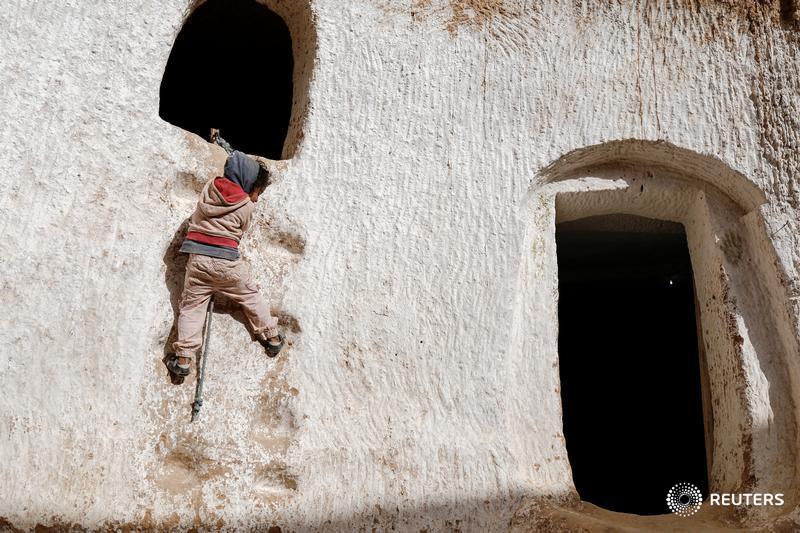
The worn climbing holds in Zohra Bensemra's picture take a little time to see. The eye is first drawn to the strong blacks of the window and the doorway, then to the child dangling from the window. What is going on? Only the caption can explain. This is a great example of how a mysterious picture draws us into a sequence of images because we just have to know more. All is revealed here


Ahlem, four, climbs up a wall to reach her rabbit's hideaway at her troglodyte house on the outskirts of Matmata, Tunisia, February 5, 2018. REUTERS/Zohra Bensemra


Friday, 16 February 2018

A Week in Pictures - Middle East & Africa, February 16, 2018

A last minute update to the week's selection from Middle East and Africa of Luc Gnago's wonderfully composed picture using classic thirds and complementary colours of orange and blue. The picture of the tree against the blue sky on the orange earth would have been nice enough but three girls walking from left to right, all equally spaced in line, one, two, three or A, B C to fill the space perfectly make this image just a little bit special.


Girls carry water on their bicycles at a dispensary in Nedago village near Ouagadougou, Burkina faso, February 16, 2018.   REUTERS/Luc Gnago

A series of air raids by the Israeli Air force and anti-aircraft counter attacks by Syrian forces prompted a quick response by Ammar Awad, who headed to the Golan Heights. The main questions at this time were: ‘Whose move and what happens next?’Ammar’s picture of the signpost, the waiting woman and the cut-out figure of a gunman sum up the moment of watching and waiting. 


A woman sits near a sign at Mount Bental, an observation post in the Israeli-occupied Golan Heights that overlooks the Syrian side of the Quneitra crossing, Israel February 10, 2018. REUTERS/ Ammar Awad

If the cut-out of the gunman in Ammar's picture above is classic in its shape, I think Baz Ratner's running boy is another classic. The boy's legs are almost at full stretch, his arms are clearly defined, and water is splashing up behind. It is an irresistible pick for the week.  


A boy runs across the Turkwel River running through Lodwar, in Turkana County, Kenya February 6, 2018.  REUTERS/Baz Ratner

Satish Kumar’s picture is a wonderful combination of busy line and shape through shadow and structure. There are too many triangles to count as your eye races to the world’s tallest building, the Burj Khalifa, in the middle distance to the tiny shape formed between the hands of the woman taking a picture of her friend.


A visitor takes photos at the 71st floor of the Gevora Hotel, the world's tallest hotel, in Dubai, UAE February 12, 2018. REUTERS/Satish Kumar

The eerie cold blue light from a mobile device highlights the face of the fighter in a room bathed in the warm glow of firelight, creating an almost theatrical scene in Khalil Ashawi’s terrific picture. Shadows flickering in the light on the wall soften the unmistakable shape of his weapon in the background. At the same time the fighter’s covered features are frozen like ice in the harsh blue light.  


Turkey-backed Free Syrian Army fighter holds a cell phone in the town of Tadef in Aleppo Governorate, Syria February 12, 2018. Picture taken February 12, 2018. REUTERS/Khalil Ashawi

Faded glory has got to be the understatement of the week to describe Amr Abdullah Dalsh’s picture. The colours are muted, every poster is torn or faded and the piles of rubbish look as if they have been there for years and will be there for years to come. I can’t imagine for a minute what these men are talking about, but I sense they are in no hurry to finish their conversation. I think this is a wonderful and timeless picture.


An Egyptian man waits in front of Pepsi products shop for customers at the shanty area Zabaleen or "Garbage City", the poorest part of Cairo, where thousands of Copts make a living by recycling everything from plastic bottles, food remains, carton and metal on the Mokattam Hills in eastern Cairo, Egypt February 12, 2018. REUTERS/Amr Abdallah Dalsh

On the day police recommended that Netanyahu should be indicted for bribery, Nir Elias had a lucky break with the light as the prime minister walked into the spotlight. An inch lower and his eyes would be in shadow and the essence of the picture would have been lost. What also makes this picture for me is the fact that the sliver of light ends in black shadow on both sides of the frame, suggesting a momentary glimpse of something going on. 


Israeli Prime Minister Benjamin Netanyahu (R) arrives ahead of a planned address at the Muni World 2018 conference in Tel Aviv, Israel February 14, 2018. REUTERS/Nir Elias

In Bassam Khabieh’s picture, the boy’s arm and his cheek echo the shape of the Red Crescent logo. The circles of the emblem are also echoed in the wheels of the bike and the truck, all combining to make a very complicated composition. There is there is no telling if this boy is holding his head in relief because supplies have reached Douma, or in concern that it’s not enough. But either way, I think the tension in his locked fingers tells a story of concern. 


A boy gestures near a Syrian Arab Red Crescent truck in the besieged town of Douma, eastern Ghouta, in Damascus, Syria February 14, 2018. REUTERS/Bassam Khabieh 

A sea of faces stretching to the furthest horizon, with people’s arms crossed in unison, makes Tiksa Negri’s picture quite striking. The only break in the flow to the rear of the picture is a single flag being waved. I can almost taste the dust being thrown up by these thousands of people.


Supporters of Bekele Gerba, secretary general of the Oromo Federalist Congress (OFC), chant slogans to celebrate Gerba's release from prison, in Adama, Oromia Region, Ethiopia February 14, 2018. REUTERS/Tiksa Negeri

A surprise press conference late in the evening by South African President Zuma gave Siphiwe Sibeko access to a historical moment. On the face of it, a simple assignment -- man speaks at podium to announce his resignation – but it’s much harder to make it something special. Throw in strong light and a long shadow and you have a special moment well captured by Siphiwe. I have added a second picture that was well used and which demonstrates that ‘bread and butter’ pictures are as important as thoughtful, creative images. Think too about the caption as we edit this live. Zuma arrives as president, all smiles, and we don’t know what he is going to say. At the end of his address he announces his resignation and leaves press conference as a former president. 


South Africa's President Jacob Zuma arrives to speak at the Union Buildings in Pretoria, South Africa, February 14, 2018. REUTERS/Siphiwe Sibeko


South Africa's President Jacob Zuma looks down as he speaks at the Union Buildings in Pretoria, South Africa, February 14, 2018. REUTERS/Siphiwe Sibeko 


Friday, 9 February 2018

A Week in Pictures Middle East and Africa February 9, 2018

I can’t stop looking at Khaled Abdullah’s stark and very sad picture. The children’s tiny, frightened faces peer out from a busy, colourful image. To me, the sadness in their eyes fills the frame, so all you can do is feel for their suffering. How much worse can it get? You live in war zone, you are only a child, and you and your sibling both have cancer. 


A boy and his sister who both suffer from cancer lie on a bed at a cancer treatment centre in Sanaa, Yemen, February 4, 2018.    REUTERS/Khaled Abdullah

How could I resist highlighting the bizarre scene of a masked gunman scrolling through his phone, sitting on a red sofa in a grey, rubble-strewn street in al-Bab, Syria? I think Khalid Ashawi’s centrally composed picture is as striking as it is bizarre, so no resistance from me, it’s here.


A Turkish-backed Free Syrian Army fighter is seen in the eastern suburbs of al-Bab, Syria, February 4, 2018.   REUTERS/Khalil Ashawi

To me, the strength of Ismail Zitouny’s almost abstract combination of texture, tone, wood, metal and cloth is that it takes quite a while to understand that you are looking at the wrapped figure of a woman. Her invisibility mirrors the plight of the displaced people who cannot return to their homes in the ghost town of Tawergha. More pictures here.


A Libyan woman displaced from the town of Tawergha stands at a camp in Tripoli, Libya, February 5, 2018.   REUTERS/Ismail Zitouny

The ghost-like figures that appear from the smoke and dust of the aftermath of an air strike in Bassam Khablieh’s picture haunt me far more than his other images of blood-stained pavements taken at the same time. Why? The people seem to be drowning in the streets as they run from the devastation, putting me in mind of the first line of Stevie Smith’s poem ‘Not Waving but Drowning’: ‘Nobody heard him, the dead man.’


Civil defence members and civilians are seen running after an air raid in the besieged town of Douma in eastern Ghouta in Damascus, Syria, February 6, 2018.   REUTERS/Bassam Khabieh

It’s not clear what everyone is looking at, but what is clear is the desperation in the faces of those gathered behind the wide-eyed, open-mouthed security officers in red berets in Ibraheem Abu Mustafa’s picture. I feel as if every pair of eyes has a sad story to tell. The man in the rear of the image pushes his passport forwards, giving us a clue as to what this picture is about. Story here.


Members of Palestinian Hamas security forces stand guard as people ask for travel permits to cross into Egypt through the Rafah border crossing after it was opened by Egyptian authorities for humanitarian cases, in the southern Gaza strip, February 7, 2018.   REUTERS/Ibraheem Abu Mustafa

Wild swings in the stock market provide great opportunities for making and losing lots of money but they also provide photographers with an opportunity to shoot thoughtful and clever pictures. Not easy when you consider the only ‘action’ is people sitting at screens. I love the circular composition of Faisal Al Nasser’s picture, where the top line of the screens curves round to visually link with the curve of the balcony in the rear of the picture. This shape is echoed by the trader’s agal holding his keffiyeh in place. And in Satish Kumar’s wonderfully graphic image below that, I love it that investor has momentarily taken his eyes of the screen to look directly into the lens. At this moment, did he lose money or make it?


A Saudi trader observes the stock market on monitors at Falcom stock exchange in Riyadh, Saudi Arabia February 7, 2018.   REUTERS/Faisal Al Nasser


An investor looks up from the screen at the Dubai International Financial market in Dubai, United Arab Emirates, February 7, 2018.  REUTERS/Satish Kumar

In what initially looks like a curious mixture of street theatre and a Zombie run, Amir Cohen has captured a picture that draws you in as your interest is piqued. What is actually going on? Some faces painted white in a reverse Al Jolson style, others half painted white. Once you move beyond the right to left gaze of the focal point of the image you are zigzagged uncomfortably to the rear of the picture to see dark eyes and pale death-like faces. Two words stand out: Israel and deport. Story here.


African migrants protest against the Israeli government’s plan to deport part of their community, in front of the Rwandan embassy in Herzliya, Israel, February 7, 2018.   REUTERS/Amir Cohen

It’s not often I feel I can share a sports picture from the Middle East and Africa region, but Mike Hutchings’ eye-watering picture of an awkward delivery during the one-day international between South Africa and India seemed to select itself today.


South Africa’s Aiden Markham gets hit by a delivery from Hardik Pandya during the Third One-Day International against India in Newlands Stadium in Cape Town, South Africa, February 8, 2018.   REUTERS/Mike Hutchings

Omar Sanadiki’s pictures from rare trip to Aleppo reveals slow signs of the city coming back to life. Once you look beyond the massive hole in the foreground and the destruction of the city to the horizon, you begin to pick out tiny details: cars moving, people walking about and sitting at a table. A small hardware store has opened for business and what looks like a food stall on the left has three customers. You do have to look hard, but it’s there. So I think there is a little hope here.    


People and cars are seen in the streets of old town Aleppo, Syria, February 8, 2018.   REUTERS/Omar Sanadiki

Khalil’s Ashawi’s picture is full of tension and action. What really makes this picture work for me is that in addition to the strong light coming through the pillars as the gunman runs for cover, the barrel and aiming sight of the rifle are silhouetted against the light on the wall. If you use your thumb to take away the end of the rifle, the image is much harder to define and you lose the immediate sense of ‘gunman’.  Read the latest from this conflict here.  


A Turkey-backed Free Syrian fighter is seen in the eastern suburbs of al-Bab, Syria February 8, 2018.   REUTERS/Khalil Ashawi


2018

Friday, 26 January 2018

A Week in Pictures Middle East & Africa January 26, 2018

A chaotic mess of a picture by Kenny Katombe that keeps on rewarding you the more you look, not unlike a Pieter Bruegel painting from the 16th century.  The policeman walking behind the calm but submissive priest looks like he’s holding his breath. People in the middle distance fall to the ground to take cover, except for the single protester who appears to be glaring defiantly at where the tear gas came from. People behind the tear gas cloud run in panic, while the police to the left of the picture seem unconcerned as they watch the scene unfold. 


Riot police fire tear gas to disperse Catholic Priests and demonstrators during a protest against President Kabila, organised by the Catholic Church in Kinshasa, Democratic Republic of Congo January 21, 2018.   REUTERS/Kenny Katombe

Uniformed men, aggressively chanting and shouting, always slightly disturb me, especially when they are all holding weapons. Rodi Said’s picture gives me an even stronger feeling of unease. In its composition, the picture is very busy and at the same time strangely ordered, with a regular pattern of hands, faces and rifles slowly drawing you to the face of the man shouting, the line of his mouth echoed by his cap. Maybe I feel uneasy because his face is so young and I wonder if he really understands what he could be facing in the coming days on the Syrian-Turkish border once all the chanting is done with.


Fighters from the self-defence forces of the Kurdish-led north hold their weapons during a rally in Hasaka, northeastern Syria January 23, 2018.   REUTERS/Rodi Said 

Cold, damp, miserable and muddy, the mood is set in Khalil Ashawi’s rather ugly-shaped picture as FSA soldiers on the Turkish-Syrian border slowly emerge from a foggy landscape. All colour is drained from this picture, the composition and the focus are on the soldiers in the background, and this accentuates the sense of confusion and uncertainty.


Turkish-backed Free Syrian Army fighters walk together near Mount Barsaya, north of Afrin, Syria January 23, 2018.    REUTERS/Khalil Ashawi

Mohammed Salem’s portrait of a Palestinian protester is one of a series that you can see here on the Wider Image. The reason I have selected this image is rather complex. Even though he is masked, using a sling and standing in a smoke-filled landscape at the scene of clashes, there is no anger coming from the picture. It has a very different mood from the angry images we see from the weekly clashes, and that is probably because it is posed. In this portrait, as in all good portraits, we have time to study and learn about the subject. But its real strength comes when we look at it in the context of the other portraits in the series and read people’s individual reasons for protesting.  The whole is greater than the sum of its parts. I feel that I get a better understanding of their motivation and a very strong sense of the frustration and anger. 


A Palestinian protester holds a sling as he poses for a photograph at the scene of clashes with Israeli troops near the border with Israel, west of Gaza City, January 19, 2018. “What I can do to stop Trump’s decision on Jerusalem is to use this sling to hurl stones at Israeli soldiers with heavy weapons,” he said. “My dream is to see all Arabs and Muslims united in one battle t restore out holy land.” REUTERS/Mohammed Salem 

Ammar Awad’s picture selects itself this week. Who can resist the simple silhouetted shape of a man wearing a hat, carrying a stick and a bag, set in the monochromatic frame of an old city street, especially when the only colour in the picture is a line of yellow lights that guide you straight to the figure.  


A man walks past closed shops as Palestinian political parties call for a general strike protesting the visit of U.S. Vice President Mike Pence in Jerusalem and the U.S recognition as Israel’s capital, in Jerusalem’s old city January 23, 2018.   REUTERS/Ammar Awad

What I like about Amr Abdullah Dalsh’s picture after a news conference is that there are so many expressions of emotion on the various faces. We see sadness, disappointment, anger, frustration, a wry smile and a look of support. Even the posters on the walls get in on the act, along with the consoling hands holding Khaled Ali’s arm.    


Supporters of Egypt’s Presidential candidate Khaled Ali react after a news conference where he announced that he is withdrawing from the presidential race in Cairo, Egypt.   REUTERS/Amr Abdullah Dalsh

The school run is very different in many places but its still a school run. I really like Alaa al-Faqir’s affectionate picture as to me it offers a glimmer of hope. Even through the children are walking past war damage rubble they still getting pleasure from jumping into and over puddles on the way to school. I think a universal pleasure when you are young. I really like the zigzag shapes that draws you into the picture from the child hiding behind their bag to the gaggle of people in the background.


Students run past rubble of damaged buildings in a rebel-held area in the city of Deraa, Syria January 25, 2018.   REUTERS/Alaa al-Faqir


And just for my love of the use of complimentary colours in pictures, captured moments in strong shapes I could not resist adding Satish Kumar’s picture of marathon runners in Dubai pre-dawn. What attracts me most is the strong triangular composition, the light directly behind the leader’s head and the kick of the heels in unison. I think an image that rewarded Satish for their early start.


Athletes compete during the Dubai Marathon in Dubai, UAE, January 26, 2018.   REUTERS/Satish Kumar